

We use cookies to ensure our website works properly and to personalise your experience. Cookies policy
Pharmaceutics,Ashokrao mane institute of pharmacy Ambap.
The primary objective of this study was to formulate, optimize, and evaluate a polyherbal topical hydrogel incorporating ethanolic extracts of Clitoria ternatea flowers and Annona squamosa leaves. Carbopol 934 was utilized as the gelling matrix, with propylene glycol serving as a humectant, methylparaben as a preservative, and triethanolamine as a neutralizing agent. The formulation was subjected to systematic physicochemical characterization, including assessments of organoleptic traits, pH, viscosity, rheological behavior, spreadability, short-term accelerated stability (30 days at 40°C/75% RH), dermal irritancy, and qualitative phytochemical screening. The resulting hydrogel displayed an appealing deep blue hue, smooth non-sticky texture, pseudoplastic rheology, an optimum spreadability of 20.62 g·cm/s, and a skin-compatible pH of 6.0. Preliminary phytochemical screening confirmed the retention of secondary metabolites, including flavonoids, tannins, alkaloids, and phenolics. Dermal patch testing revealed zero irritation, confirming biocompatibility. These findings demonstrate that the developed polyherbal hydrogel possesses favorable physicochemical stability and skin safety, serving as an effective topical formulation base for herbal delivery.
The main reason Clitoria ternatea is used in pharmaceutical formulations is because of its strong anti-inflammatory and antioxidant qualities, which hasten tissue repair and wound healing. It also functions as a natural pH indicator and an efficient antibacterial agent for skin protection. In addition to topical applications, it is It has long been known for its anxiolytic (reducing stress) and nootropic (improving memory) properties.[1]
Because of annona squamosa strong antibacterial and wound-healing qualities, Annona squamosa also known as Custard Apple or "Sitaphal") is highly prized in pharmaceutical research and a great option for topical preparations. Bioactive substances found in its extracts, such as acetogenins, flavonoids, and alkaloids, greatly improve epithelialization, collagen synthesis, and tissue regeneration. It has long been known for its antioxidant, anti-inflammatory & antidiabetic properties in addition to its dermatological uses.[2]
The body uses wound healing, a crucial physiological process, to reconstruct and restore the integrity of damaged tissues. Cells, growth factors, and metabolic pathways interact in this intricate and well-organized system. Maintaining the protective function of the skin and other organs depends on this process, which starts as soon as tissue damage occurs. In addition to preventing excessive blood loss, effective wound healing shields the body from infections and other problems.[3]
Hemostasis, inflammation, proliferation, and remodeling are the four major phases of the healing process that overlap. Blood must be stopped in order to arteries constrict and clots develop during hemostasis. White blood cells then eliminate waste, germs, and injured tissue during the inflammatory phase[4] Collagen production, angiogenesis, and re-epithelialization all contribute to the formation of new tissue during the proliferative phase. Ultimately, the newly created tissue strengthens and matures during the remodeling phase, gradually increasing its shape and function[5].
Age, nutritional status, blood flow, infection, and underlying medical disorders like diabetes can all affect how quickly and well wounds heal. Successful healing also depends on external variables including good hygiene, medical attention, and wound care. In order to properly manage both acute and chronic wounds and lower the risk of complications, it is crucial for healthcare professionals to understand the mechanisms underlying wound healing.[6]
Depending on the severity of the wound, medical treatment frequently entails the use of topical and systemic therapies. Common drugs include painkillers like ibuprofen and antibiotics like amoxicillin or ciprofloxacin that are used to treat or prevent infections. The use of specialty dressings (hydrocolloids, foams, or alginates), negative pressure wound therapy, and occasionally surgical operations like debridement to remove dead tissue are examples of advanced wound care approaches. Treatments like skin grafting or growth factor therapy may be necessary for wounds that are persistent or do not heal.[7]
a well-balanced diet high in protein, vitamins (particularly C and A), and minerals like zinc. Effective healing also depends on managing underlying illnesses like diabetes, keeping oneself clean, and abstaining from smoking. Better recovery results are achieved when issues like infection or delayed healing are promptly treated through routine monitoring and timely medical care.[8]
Hydrogel:
A hydrogel is a system containing at least two solid or semisolid components, with a condensed mass encasing and penetrating a liquid. Despite having more characteristics of a solid than a liquid, hydrogels are made up of little amounts of solids scattered among a comparatively big amount of liquid. A hydrogel's three-dimensional polymeric structure, which gives it solid-like qualities above water, is its distinguishing characteristic.[9]
a] Advantages of Hydrogel [10]
b] Disadvantages of Hydrogel [10]
AIMS AND OBJECTIVES
AIMS:
To Formulate And Evaluate A Polyherbal Hydrogel Incorporating Clitoria ternatea And Annona squamosa.
OBJECTIVES:
PLANT PROFILE
1] plant profile of clitoria ternatea
Clitoria ternatea is a member of the Fabaceae family, which has over 765 genera and over 20,000 species worldwide, making it one of the biggest and most varied families of flowering plants. [12]
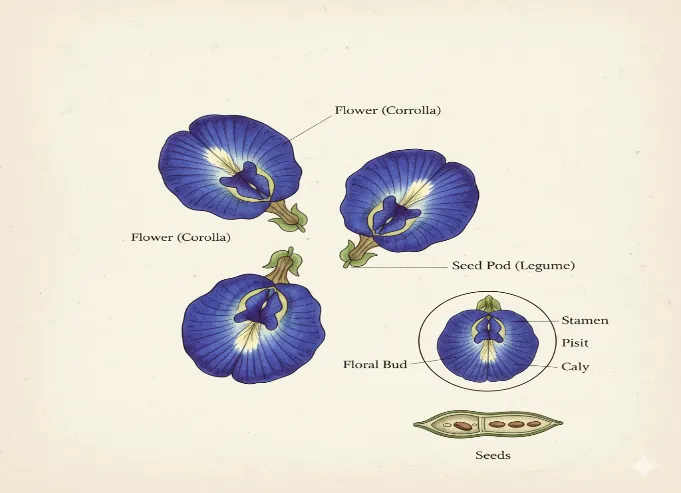
Fig no:1
Botanical classification:
Table no: 1
|
Rank |
Classification |
|
Kingdom |
Plantae |
|
Phylum |
Tracheophyta/magnoliophyta |
|
Class |
Magnoliopsida/equisetopsida |
|
Family |
Fabaceae(leguminasae) |
|
Genus |
Clitoria |
|
Species |
Clitoria ternatea linn [13,14] |
Common names
Table no: 2
|
Language |
Common Names |
|
English |
Blue pea vine, mussel-shell climber, butterfly pea, and pigeon wings |
|
Hindi, Bengali, Oriya |
अपराजिता (Aparajita) |
|
Gujarati |
Koyala, Bismar, and Garani |
|
Kannada |
Billisaiuga, Satugadagida |
|
Telugu |
Dintana, Gilarnika, Neela-ghentana, Sankhupuvvu |
|
Tamil |
Kakkanam, Kakatan, Kavachi, Kuruvilai |
|
Punjabi |
Dhanattar |
|
Rajasthani |
Koyalri, Titlimatar[15] |
Morphological characteristics:
The five-petaled pea blossoms measure roughly 4 cm in length and 3 cm in width. Two wings, two keels, and a bright yellow symbol in the center of the banner. One such is the pea plant. The extremely thin leaves of this climbing legume plant measure 1.5–3.5 cm in length and 2.5–5 cm in width. Each and every width. This plant has fibrous roots and is evergreen. Its enormous nodules may fix nitrogen so that other plants can use it. Bacteria are called rhizobia. The perennial plant Clitoria ternatea reproduces by using black seeds. The vibrant pods are between 7 and 11 cm long. The root and leaves are used in the food business to make herbal and therapeutic drinks. Instructing The most popular peas in the world are butterfly peas [2].
Chemical constituents
Flavonoids: Plant antioxidants called flavonoids aid in lowering inflammation and shielding cells from oxidative damage. Additionally, they enhance wound healing and promote tissue restoration.
Anthocyanins :they are naturally occurring pigments with potent antioxidant properties that give blue and purple hues. They support skin renewal and aid in lowering oxidative stress.
Alkaloids: they are bioactive substances that have analgesic and antibacterial qualities. They may lessen discomfort at the wound site and aid in the prevention of infection.
Tannins:they are polyphenolic substances that have antibacterial and astringent properties. They lessen bleeding, aid with wound contraction, and guard against infections[16].
2] Plant profile of annona squamosa
The Annonaceae family includes the little tropical fruit-bearing tree Annona squamosa. It is extensively grown in India and other warm climates and is also referred to as sitaphal or custard apple. The plant is prized for both its therapeutic qualities and its sweet, creamy fruit. Traditional medicine makes use of the plant's leaves, bark, seeds, and roots, among other elements. Its medicinal properties are attributed to a variety of bioactive substances, including tannins, alkaloids, and flavonoids. The antibacterial, anti-inflammatory, and antioxidant properties of Annona squamosaare well-known. It is extensively researched for its potential in wound healing and other medicinal uses because of these characteristics [17,18 ]
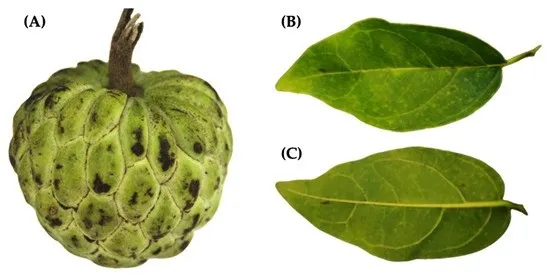
Fig no: 2
Taxonomical classification:
Table no:3
|
Level |
Taxonomic Rank |
Scientific Name |
|
I |
Kingdom |
Plantae |
|
II |
Subkingdom |
Tracheobionta |
|
III |
Superdivision |
Spermatophyta |
|
IV |
Division |
Magnoliophyta |
|
V |
Class |
Magnoliopsida |
|
VI |
Subclass |
Magnoliidae [19] |
Morphological characteristics:
Annona squamosais a tiny, semi-deciduous tree or shrub with an uneven, spreading crown
that can reach heights of 3 to 8 meters. The bark is light brown and the stem is woody. The simple, alternating, thin, oblong-lanceolate leaves have a smooth surface, a distinct smell, and a length of around 5 to 15 cm.
The fragrant, greenish-yellow blooms have three outer and three inner petals and are typically carried individually or in tiny groups. The fruit is a distinctive round or heart-shaped structure with a scaly or segmented outer surface, green in colour when unripe and turning slightly yellowish on ripening. Inside, the pulp is soft, white, and sweet, containing numerous shiny black seeds[20,21].
Chemical Constituents
MATERIALS AND EQUIPMENTS:
Table no: 4
|
Sr. No. |
Ingredient |
Functional Role in Formulation |
|
1 |
Ethanol |
Solvent / Extraction medium |
|
2 |
Carbopol 934 |
Gelling agent (Polymer matrix) |
|
3 |
Propylene glycol |
Humectant / Plasticizer |
|
4 |
Methyl paraben |
Preservative (Antifungal) |
|
5 |
Triethanolamine |
Neutralizer / pH Adjuster |
Table no :5
|
Sr. No. |
Instrument |
|
1 |
Electronic analytical weighing balance |
|
2 |
Electrical water bath |
|
3 |
pH meter |
|
4 |
Brookfield Viscometer (LVDV-60) |
|
5 |
Heating mantle |
EXPERIMENTAL METHODS
High-quality plant materials and pharmaceutical excipients must be gathered in order to manufacture a hydrogel including clitoria ternatea and annona squamosa extract for the treatment of wounds. For the final hydrogel formulation to be effective, safe, and stable, the choice and acquisition of these materials are essential.
Gathering of Plant Materials (annona squamosa leaves and Clitoria ternatea flowers)
To guarantee the maximum concentration of bioactive chemicals, plant materials will be gathered methodically[23].
clitoria ternatea flowers:
Annona squamosa leaves:
PLANTS EXTRACTION:
The Maceration Extraction Process
1. Extract reparation
To maintain the phytochemical integrity of the active chemicals, the harvested clitoria ternatea blooms and annona squamosa leaves were dried in the shade. After drying, a mechanical grinder was used to finely grind the plant materials in order to enhance their surface area and boost extraction efficiency. For extraction, the powdered material was precisely weighed.
2. Solvent Selection
Choosing an appropriate solvent is crucial for efficient extraction of bioactive compounds. Ethanol (70%) was used as they effectively extract flavonoids, alkaloids, terpenoids, and phenolic compounds—essential for wound healing treatment. A solvent-to-sample ratio of 10:1 (v/w) was maintained to ensure optimal extraction.
3. Maceration Process
The powdered plant materials were soaked in the selected solvent inside a closed glass container or maceration vessel. The mixture was agitated occasionally to improve solvent penetration and diffusion of bioactive compounds. The maceration process was carried out at room temperature for 48-72 hours to ensure maximum extraction of phytochemicals.
4. Filtration and Solvent Recuperation
To get rid of solid residues, the extract was filtered using Whitman filter paper or a Buchner funnel following maceration. A concentrated extract was produced by utilizing a rotary evaporator to evaporate the solvent at low pressure.
5. Drying and Storage of Extracts
The obtained extracts were air-dried or freeze-dried to form a semi-solid or powdered form, ensuring long-term stability. Extracts were stored in amber glass vials under controlled temperature conditions to prevent degradation of bioactive compounds.
This maceration-based extraction ensures high bioavailability of clitoria ternatea and annona squamosa extracts, making them suitable for incorporation into the hydrogel formulation for wound healing treatment.[21]
Study of Preformulation
To guarantee the creation of a stable, efficient, and secure hydrogel dosage form, preformulation studies are crucial. During this phase of development, the drug compounds' physicochemical characteristics are described, and their interactions with different formulation components are evaluated.
Preformulation Study Objectives
• To ascertain a new medicinal substance's essential physicochemical characteristics.
• To determine whether the formulation's excipients are incompatible.[24]
EXPERIMENTAL DESIGN
Procedure for the Hydrogel Formulation
The formulation of an annona squamosa and clitoria ternatea Extract Hydrogel involves the preparation of a stable hydrogel base, the incorporation of bioactive plant extracts, and the adjustment of physicochemical properties to ensure optimal therapeutic efficacy
1) Preparation of the Hydrogel Base
A stable hydrogel requires a gelling agent to create the 3D network. Carbopol 934 and HPMC (Hydroxypropyl Methylcellulose) are the most common polymer choices for herbal topicals.
2) Incorporation of Active Ingredients
3) PH Adjustment and Finalization
The pH of the hydrogel was measured using a digital pH meter and adjusted to a skin-compatible range (5.5–6.5) by the dropwise addition of triethanolamine under continuous stirring. The extract dispersion was incorporated into the hydrated Carbopol base and stirred until a smooth, uniform, lump-free hydrogel was obtained. [25,26,27].
FORMULATION TABLE
The hydrogel is developed to topically deliver bioactive compounds from clitoria ternatea extract (anti-inflammatory) and annona squamosa leaves extract (antimicrobial) using a biocompatible gel base that ensures stability, controlled release, and user acceptability. Formulating a hydrogel incorporating clitoria ternatea extract and annona squamosaextract involves both pharmaceutical science and cosmetic formulation theory. The goal was develop a stable, bioactive, and biocompatible hydrogel with effective release of active compounds from the clitoria ternatea and annona squamosa extracts.
Table no: 6
|
Ingredients |
QUANTITY |
Function |
|
Clitoria Extract |
1 g |
Wound healing, antioxidant anti inflammatory |
|
Annona squamosa Extract |
1 g |
Antimicrobial, anti- inflammatory |
|
Carbopol 934 |
1g |
Gelling agent |
|
Propylene glycol |
5 ml |
Humectant & moisturizer |
|
Triethanolamine |
q.s. |
pH adjuster (5.5–6.5) |
|
Methylparaben |
0.2% |
Preservative |
|
Distilled Water |
q.s. to 100 ml |
Solvent/base |
PRELIMINARY PHYTOCHEMICAL INVESTIGATION
Following the extraction of bioactive chemicals from Annona squamosa leaves and Clitoria ternatea flowers, a preliminary phytochemical screening was carried out to determine the presence of important secondary metabolites that are responsible for their medicinal qualities. Numerous qualitative assessments are employed to identify various phytochemical classes.
A. Alkaloids Detection
Mayer's Test: Mayer's reagent (potassium mercuric iodide) is applied to the filtrate.
The presence is indicated by the formation of a creamy white precipitate
. ● Wagner's Test: Wagner's reagent (iodine in potassium iodide) is applied to the filtrate. Alkaloids are confirmed by a reddish-brown precipitate.
B. Detection of Flavonoids
• Shinoda Test: Concentrated hydrochloric acid (HCl) and magnesium turnings are applied to the extract. Flavonoids are indicated by a magenta or scarlet red tint that develops after a few minutes.
• Alkaline Reagent Test: The extract was treated with 2 ml of 10% sodium hydroxide solution, yielding an intense yellow coloration. Upon the addition of dilute hydrochloric acid, the solution became colorless, confirming the presence of flavonoids.
C. Detection of Phenols and Tannins
• Ferric Chloride Test: A 5% ferric chloride (FeCl3) solution is applied to the extract. Phenols and tannins are indicated by a bluish-black or brownish-green hue.
• Gelatin Test: A white precipitate forms when a 1% gelatin solution containing sodium chloride (NaCl) is added to the extract.
D. Detection of Saponins
• Froth Test: The extract is violently shaken after being diluted with distilled water. Saponins are indicated by the development of foam (froth) that lasts for at least fifteen minutes
E. Glycoside Detection
• Keller-Kiliani Test: Particularly for glycosides in the heart. FeCl3, concentrated H2SO4, and glacial acetic acid are used to treat the extract. A deoxysugar feature of cardenolides is shown by a brown ring at the interface [21]
EVALUATION OF THE HYDROGEL
1) Organoleptic Evaluation:
The gel is visually inspected for color (typically deep blue to greenish-blue depending on the extract ratio), odor, and clarity .
2) PH Determination:
To ensure skin compatibility, the pH should be between 5.5 and 7.0. A digital pH meter is used on a 1% aqueous solution with the gel.
3)Spreadability:
This is determined using the parallel plate method. A known weight is placed on the gel sandwiched between two slides, and the diameter of the spread is measured. Higher spreadability (typically 20–25 g.cm/s) indicates easier application.
4) Stability Studies:
The formulation is kept in a stability chamber at 40°C/75% RH (accelerated conditions) for 1 months to check for phase separation, colour fading, or changes in viscosity.
5) Skin Irritancy Test:
Often performed as an open patch test on human volunteers or animal models to check for redness, edema, or itching. A score of “0” indicates a non-irritant, skin-friendly product.
6) Phytochemical Screenings:
Following the extraction of bioactive components from Annona quamosal and Clitoria ternatea flowers, a preliminary phytochemical screening was carried out to identify the presence of important secondary metabolites that are responsible for their medicinal qualities. These bioactive chemicals are identified by a variety of qualitative testing[28,29,30].
RESULT :
The formulated clitoria ternatea and annona squamosa hydrogel was subjected to various physicochemical, antioxidant, antimicrobial, and stability evaluations to determine its suitability as a natural wound healing formulation. The results obtained from different evaluation parameters are discussed in detail below.
Table no: 7
|
Sample |
Extraction Method |
Solvent Used |
Weight of Sample |
Extraction Yield (% w/w) |
|
Clitoria ternatea |
Maceration |
Ethanol |
10 g |
10% w/w |
|
Annona squamosa |
Maceration |
Ethanol |
10 g |
10% w/w |
a) Organoleptic Evaluation
Table no: 8
|
Parameter |
Observation |
|
Color |
Deep blue (due to Clitoria ternatea anthocyanins) |
|
Odor |
Characteristic, slightly herbal |
|
Appearance |
Uniform, no separation (indicates stable gelation) |
|
Texture |
Smooth, non-sticky (indicates proper humectant ratio) |
b) PH Measurement:
The pH of the hydrogel is an essential factor in ensuring skin compatibility and preventing irritation. The measured pH of the hydrogel ranged between 5.5 and 6.5, which is close to the natural pH of human skin (4.75-5.75). This confirms that the formulation is mild, non-irritating, and safe , preventing excessive Dryness or disruption of the skin barrier.
PH of hydrogel: 6.0
C) Viscosity and Rheological Behaviour:
For topical formulations to be stable, applied, and retained, viscosity is essential. A Brookfield viscometer was used to determine the hydrogel's viscosity. For topical hydrogels, this is a perfect feature that guarantees appropriate consistency and skin adhesion.
Pseudo plastic (measured in cps at 25°C)
Table No: 9
|
Batch |
Viscosity (cps) |
Rheological Behaviour |
Observations |
|
F1 |
30,000 |
Pseudo plastic |
Thick, stable, easy to apply |
d) Spreadability:
Spreadability determines how easily a formulation spreads over the skin surface, ensuring effective application and absorption. The spreadability of the hydrogel was 20.62g.cm/sec, indicating good application properties. The hydrogel was neither too thick nor too fluid, allowing smooth application without excessive friction. The results confirm that the hydrogel spreads evenly, ensuring effective skin coverage and absorption.
Table no: 10
|
Batch |
Spreadability |
Observations |
|
F1 |
20.62 |
Good spread, minimal effort required |
E) Stability Study:.
Table no:11
|
Parameter |
Initial |
30 Days |
|
Colour |
Deep blue |
No Change |
|
pH |
6.0 |
6.4 |
|
Consistency |
Moderate |
Slightly Loose |
f) Skin Irritation Test :
The absence of adverse effects suggests that the hydrogel is well-tolerated and suitable for application on sensitive skin.
Table no :12
|
Batch |
Irritation Observed |
Result |
|
F1 |
None |
Safe |
g) Phytochemical Screenings:
Table no: 13
|
Sr. No |
Test |
Observation |
Outcome |
|
1 |
Mayer's Test |
Formation of a white, creamy precipitate |
Alkaloids present |
|
2 |
Shinoda Test |
Emergence of pink, scarlet, or crimson red color |
Flavonoids present |
|
3 |
Lead Acetate Test |
Formation of a bulky white precipitate |
Phenolics present |
|
4 |
Froth Test |
Persistent froth formation |
Saponins present |
|
5 |
Ferric Chloride Test |
Dark blue/black color formation |
Tannins present |
CONCLUSION
A polyherbal hydrogel incorporating extracts of Clitoria ternatea and Annona squamosa was successfully developed and evaluated. Physicochemical evaluation revealed acceptable pH, pseudo-plastic flow, satisfactory spreadability, and 30-day stability under accelerated storage. Qualitative phytochemical screening confirmed the presence of therapeutic secondary metabolites, including flavonoids, tannins, alkaloids, and phenolics. The absence of dermal irritation confirms its safety for topical application, providing a viable, stable herbal hydrogel base for prospective wound care evaluations.
REFERENCES


Prajakta Shinde, Viraj Mahajan, N. Chougule, Formulation, Physicochemical Characterization, And Preliminary Evaluation of a Polyherbal Hydrogel Incorporating Clitoria Ternatea and Annona Squamosa, Int. J. of Pharm. Sci., 2026, Vol 4, Issue 10, 88-101, https://doi.org/10.5281/zenodo.23074435
 10.5281/zenodo.23074435