

We use cookies to ensure our website works properly and to personalise your experience. Cookies policy
Greenarray Genomic Research & Solutions PVT LTD.
Donnai-Barrow syndrome is a rare condition which has an autosomal recessive mode of inheritance. It is a disease which results from mutations in the LRP2 gene. The following case involves recurrent pregnancy loss in a non-consanguineous couple who were heterozygous carriers for the same LRP2 variant of unknown clinical significance. Molecular genetic analysis on one of the abortuses showed the fetus to be homozygous. Prenatal diagnosis using Sanger sequencing in a latest pregnancy showed the fetus to be heterozygous for the same mutation. This case emphasizes the value of genetic studies in aborted fetuses, segregation studies to interpret the VUS and targeted prenatal diagnosis
Around 60 cases of people with DBS, with enough information about the patients to diagnose DBS, have been documented in scientific literature till date. Most of the cases are from large consanguineous families (1). Donnai- Barrow syndrome, also referred as Faciooculoacousticorenal (FOAR) syndrome is a rare genetic disorder that is inherited in an autosomal recessive manner.(2). The low-density lipoprotein receptor related protein 2 (LRP2) gene has been found to have nonsense, missense, conserved splice site, and small deletions or insertions that result in frameshifts in seven DBS/FOAR families, as reported in literature.(2)
While patients with heterozygous variants have not been linked to any phenotypic conditions, including kidney dysfunction; those who are homozygous or compound heterozygous for pathogenic or likely pathogenic (P/LP) variants in LRP2 show craniofacial dysmorphology, agenesis of corpus callosum, omphalocele, diaphragmatic hernia, intellectual disabilities, and kidney defects. (3). Two unrelated individuals, a man and a female, with a condition of diaphragmatic hernia, exomphalos, hypertelorism, agenesis of the corpus callosum, severe sensorineural deafness, and severe myopia were reported by Donnai and Barrow (1993). One child experienced retinal detachment and iris coloboma. A second afflicted fetus was found in each of the two families when subsequent pregnancies were monitored. (4).
Case Presentation-
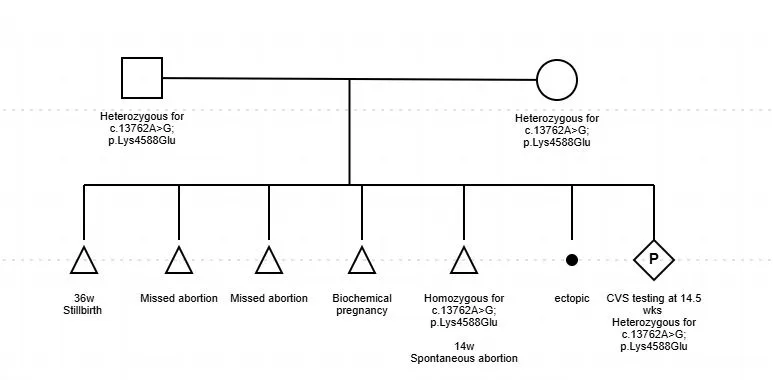
We report a case of a non- consanguineously married couple with a history of repeated miscarriages (G7A5M1). G2 and G3 were missed abortions, whereas G1 was a stillbirth at 36 weeks GA. G4 was a biochemical pregnancy. G6 was an ectopic pregnancy, while G5 was a spontaneous abortion with a morphologically normal fetus at 14 weeks GA.
There is no relevant family history. Following the fifth abortion, the family underwent Trio-whole exome sequencing in December 2022. The results showed a homozygous missense variant of unknown significance (c.13762A>G; p.Lys4588Glu) in exon 78 of the LRP2 gene, which is linked to Donnai-Barrow syndrome. Both partners were found to be heterozygous for the same mutation, indicating that they are carriers of the same VUS.
At 14.5 weeks gestation, the wife had an invasive CVS testing for her current pregnancy. Targeted Sanger sequencing was carried out on fetal DNA in view of the clinical history and confirmed parental carrier status. Maternal cell contamination (MCC) risk was eliminated. The known variation of the LRP2 gene (c.13762A>G; p.Lys4588Glu) was found in the fetus in a heterozygous state.
CONCLUSION
The current classification of the LRP2 mutation as a variant of unknown significance (VUS) was a significant challenge in this scenario. A VUS shouldn't be utilized alone for clinical decision-making, per ACMG standards. Nonetheless, this family's segregation pattern—both parents were heterozygous carriers, and an abortus was discovered to have the variation in the homozygous state—provides evidence in favor of its potential clinical significance. The findings highlight the importance of the incorporation of genetic findings together with clinical and segregation findings, even though they cannot be used to reclassify the variant. This may be useful in the future when more cases and functional studies come up. In genetic counseling, the risk of recurrence and reproductive options for affected families need to be addressed, taking into consideration the uncertainties involved in a VUS.
DISCUSSION
The fact that clinical and molecular results might help determine if LRP2 mutations may contribute to negative reproductive outcomes is highlighted from this case scenario. Megalin, a multiligand endocytic receptor necessary for proper embryonic development, is encoded by gene LRP2 which is found to be mutated in this family. Biallelic pathogenic mutations in LRP2 are associated with Donnai-Barrow syndrome, a multisystemic condition marked by several congenital defects. (2)
Both parents are heterozygous for the same variant; however, one of the aborted fetuses was determined to be homozygous for this mutation. Based on the recurrence of pregnancy loss, the observed segregation pattern raised suspicions of an autosomal recessive condition contributing to the poor pregnancy outcome. While the variant is still considered a VUS, the genotype and correlation with clinical findings provides additional evidence supporting possible pathogenicity.
Most notably, the finding of this familial variant allowed for targeted prenatal testing during the subsequent pregnancy. As the tested fetus carried the mutation in a heterozygous condition, instead of homozygous, it emerged as a successful pregnancy outcome. As a result, outcome of prenatal testing enabled informed reproductive decision-making.
Targeted prenatal screening is a quick, accurate, and economical method for assessing subsequent pregnancies if a familial pathogenic variation has been found. Families in which disease-causing LRP2 mutations have been identified should be offered prenatal and preimplantation genetic testing.(3) Molecular testing allows for a clear diagnosis regardless of phenotypic variability, in contrast to ultrasonography, which may fail to detect defects or may discover them only later in gestation. Furthermore, Donnai-Barrow syndrome is not ruled out by the lack of structural abnormalities on prenatal imaging.
This case illustrates the clinical relevance of prenatal genetic testing in cases where there is a documented history of LRP2 mutation in the family and highlights the necessity of genetic testing of conceptuses in cases of repeated miscarriages. Accurate risk assessment, early diagnosis during pregnancy, and tailored genetic counseling for future pregnancies become feasible through this technique.
Patient Consent-
The patient, parents, and guardians gave their consent for the case and the accompanying photos to be published.
REFERENCES





Antara Joshi, Gauri Dhumal, Manju Kurup, Sanjay Gupte, Sarjan Shah, A Case Study of a familial LRP2 Variant That Offers a Hint for Recurrent Pregnancy Loss and Facilitates Effective Prenatal Care, Int. J. of Pharm. Sci., 2026, Vol 4, Issue 7, 4503-4506, https://doi.org/10.5281/zenodo.21491672
 10.5281/zenodo.21491672