

We use cookies to ensure our website works properly and to personalise your experience. Cookies policy
Post Graduate Institute of Veterinary and Animal Sciences, Akola, Maharashtra, India, Maharashtra Animal and Fishery Sciences University, Nagpur Maharashtra, India.
The present clinical study was conducted to evaluate the efficacy of 10% (w/w) ethanolic extract ointment of whole plant of Euphorbia hirta on wound healing in goats. Twelve clinical cases of fresh lacerated wounds in goats were randomly divided into two groups of six animals each. Group A was treated with 10% ethanolic extract ointment of E. hirta whole plant. Wound contraction, clinico-physiological parameters, wound healing parameters (swelling, colour, exudation, pain, pus and irritation), haematological, biochemical and histochemical parameters were recorded on day 0, 4th, 7th, 14th and 21st day. Mean percent wound contraction in Group A on 4th, 7th, 14th and 21st day was 39.16 ± 6.95, 65.65 ± 4.77, 75.81 ± 8.07 and 94.63 ± 0.67 respectively, with pooled mean of 68.81%. Histochemical examination using van Gieson stain revealed abundant, well-arranged collagen fibres with complete epithelization on day 21. No adverse effects were observed on rectal temperature, heart rate, respiration rate, haematological or biochemical parameters. The study concluded that 10% ethanolic extract ointment of Euphorbia hirta is an effective, safe and easily available herbal preparation possessing antiseptic, antibacterial, anti-inflammatory, haemostatic and immunomodulatory properties for the management of wounds in goats.
Goats are among the major economically important livestock in India with a population of 135.17 million (19th Livestock Census, 2012). Majority of goat population is maintained under free grazing system and comes in contact with shrubs, thorny bushes and trees, predisposing them to various wounds especially around the ear, sternum, fore-legs and hind-legs. Awns of Aristida and Heteropogon species of grasses initially break the continuity of the skin, which is subsequently attacked by flies leading to infection and maggot infestation. Goat pastoralists are often reluctant to approach veterinary dispensaries for minor wounds, resulting in delayed healing.
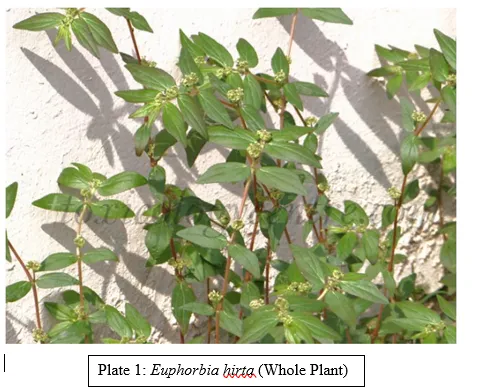
Wound is defined as the disruption of the cellular and anatomic continuity of a tissue (Bennet, 1988). Wound healing is a complex physiological process involving regeneration and restoration of tissue integrity. Plants and their extracts have immense potential for management of wounds as they are cheap, affordable and safe. Euphorbia hirta (family Euphorbiaceae), commonly known as Dudhi or Dugdhika, is a small annual herb common to tropical countries. It possesses antimicrobial, antifungal, antiviral, anti-inflammatory, anti-arthritic and antioxidant properties due to presence of polyphenolic and flavonoid compounds such as myricitrin, quercitrin, quercetin, kaempferol, luteolin and gallic acid (Bigoniya et al., 2013).
Several studies have demonstrated wound healing activity of E. hirta in laboratory animals (Jaiprakash et al., 2006; Mishra et al., 2012; Rathnakumar et al., 2013; Upadhayay et al., 2014). However, limited clinical data are available on its efficacy in goats. Hence, the present study was designed to evaluate the clinical efficacy of 10% (w/w) ethanolic extract ointment of whole plant Euphorbia hirta on wound healing in goats.
MATERIALS AND METHODS
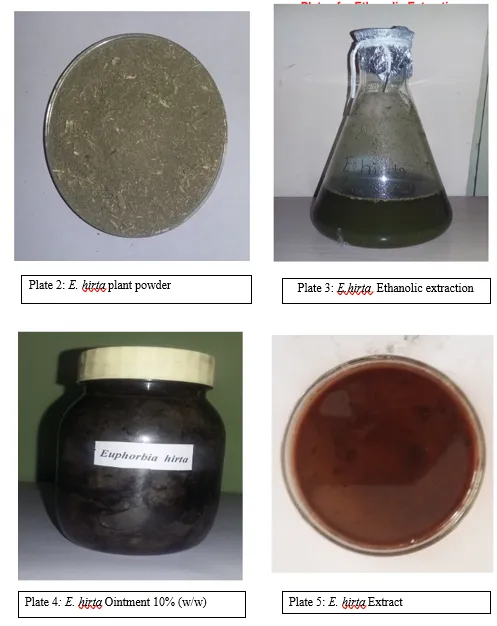
The study was conducted on 06 clinical cases of fresh lacerated wounds in goats presented at Teaching Veterinary Clinical Complex, Post Graduate Institute of Veterinary and Animal Sciences, Akola and adjoining areas. Animals were randomly categorized in one groups irrespective of age, sex, breed, body weight, type and location of wound. Group A (n=6) received topical application of 10% (w/w) ethanolic extract ointment of whole plant Euphorbia hirta till complete healing. (Plate 1,2,3)
Whole plant of E. hirta was collected from the premises of Dr. Panjabrao Deshmukh Krishi Vidyapeeth, Akola and authenticated by a taxonomist. Shade-dried plant material was powdered. 100 g powder was extracted with 500 ml of 60% ethanol in an orbital shaker at 150 rpm for 48 h. The filtrate was evaporated to obtain the extract. For preparation of 10% (w/w) ointment, 10 g extract was mixed with 85 g wax and 5 g glycerine on an ointment slab. (Plate No 5,6)
Wound area was cleaned with normal saline, shaved and the ointment applied daily. Percent wound contraction was calculated on day 0, 4, 7, 14 and 21 using the formula of Kumar and Tyagi (1972): Percent healing = [(A − b)/A] × 100, where A is initial wound area and b is area at a particular interval.
Clinico-physiological parameters (rectal temperature, heart rate, respiratory rate), clinical wound parameters (swelling, colour, exudation, pain, pus formation, irritation) were recorded at regular intervals. Haematological (TEC, TLC, DLC, Hb) and biochemical (total serum protein, ALP, calcium) parameters were estimated on day 0, 4, 7 and 14. Histochemical examination of biopsy samples was performed on day 0 and after complete healing using van Gieson stain for collagen. Data were analysed by two-way factorial CRD using WASP 2.0.
RESULTS
Wound contraction: Mean percent wound contraction in Group A (E. hirta) on day 4, 7, 14 and 21 was 39.16 ± 6.95, 65.65 ± 4.77, 75.81 ± 8.07 and 94.63 ± 0.67 respectively, with pooled mean of 68.81 ± 8.81%. Highly significant (p<0.01) progressive increase in wound contraction was observed.
Table 1. Mean ± SE percent wound contraction in goats treated with 10% E. hirta ointment
|
Interval |
Day 4 |
Day 7 |
Day 14 |
Day 21 |
|
Wound contraction (%) |
39.16 ± 6.95 |
65.65 ± 4.77 |
75.81 ± 8.07 |
94.63 ± 0.67 |
Clinico-physiological parameters: Rectal temperature, heart rate and respiratory rate remained within normal physiological range throughout the study period with non-significant variations, indicating absence of systemic infection and safety of the topical preparation.
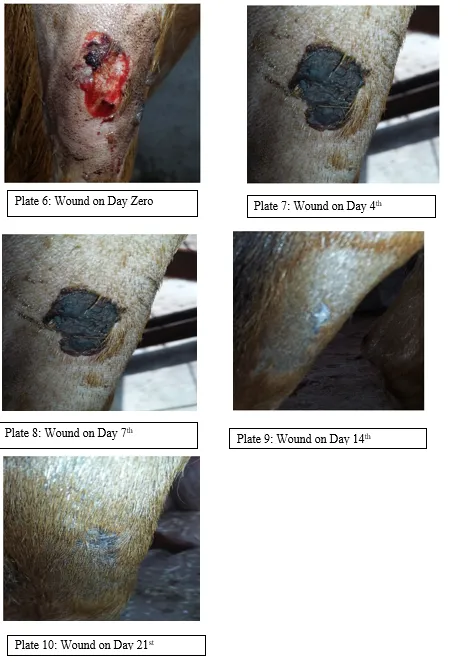
Wound healing parameters: Severe swelling present on day 0 subsided to mild by day 4 and was absent from day 7 onwards. Wound colour progressed from bright red (day 0) to reddish brown (day 4), blackish scab (day 7) and whitish (day 14). Moderate exudation on day 0 disappeared thereafter. Moderate pain on day 0 reduced to mild by day 4 and was absent from day 7. No pus formation was observed in any animal. Mild to moderate irritation noted after day 4 was attributed to progressive contraction rather than the ointment. (Plate No 6,7,8,9,10)0
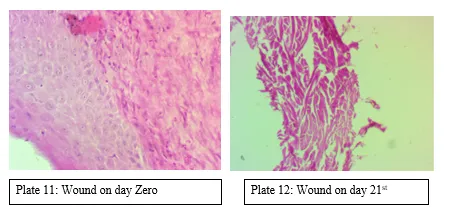
Histochemical study: On day 0, intense inflammatory reaction with meagre collagen fibres was observed. On day 21, abundant well-arranged pinkish-red collagen fibres, complete epithelial lining with cornified epithelium and initiation of hair follicles were evident, confirming superior healing quality. (Plate No 11,12)
Haematological and biochemical parameters: TEC, TLC, differential counts (except mild significant increase in lymphocytes and monocytes), haemoglobin, total serum protein, ALP and serum calcium showed non-significant to mild variations but remained within normal physiological limits, confirming systemic safety of the ointment.
DISCUSSION
Significant wound contraction observed with E. hirta ointment is attributed to its phyto-constituents (tannins, flavonoids) that possess astringent, antimicrobial and antioxidant properties. These findings are in agreement with Jaiprakash et al. (2006), Mishra et al. (2012), Bigoniya et al. (2013), Ganju and Pathak (2013) and Rathnakumar et al. (2013) who reported significant wound healing activity of E. hirta extracts in experimental models.
Absence of adverse effects on clinico-physiological parameters corroborates earlier observations of Kavitha et al. (2000), Boche (2013) and Pandve (2015). Early resolution of swelling, pain and exudation can be linked to the anti-inflammatory and analgesic activities of flavonoids and triterpenoids present in E. hirta (Lanhers et al., 1991; Shih and Cherng, 2012). Lack of pus formation reflects the broad-spectrum antimicrobial activity of the plant (Sudhakar et al., 2006; Akinrinmade and Oyeleye, 2010; Kuta et al., 2013; Hussain et al., 2014).
Histochemical evidence of abundant, well-oriented collagen and complete epithelization supports the findings of Rasik et al. (1996) and Vijaya et al. (1995) who demonstrated enhanced collagen biosynthesis and epithelial regeneration with E. hirta. The mild immunomodulatory effect evidenced by increased lymphocyte count is consistent with the known immunostimulatory activity of the plant (Vijaya and Padmawati, 2010).
CONCLUSION
Topical application of 10% (w/w) ethanolic extract ointment of whole plant Euphorbia hirta is highly effective for the management of fresh lacerated wounds in goats. It promotes rapid wound contraction (94.63% by day 21), complete epithelization and orderly collagen deposition without any adverse systemic effects. The preparation is economical, readily available and possesses antiseptic, antibacterial, anti-inflammatory, haemostatic and immunomodulatory properties, making it a preferred herbal alternative for wound therapy in goats under field conditions.
ACKNOWLEDGEMENT
The authors are thankful to the Associate Dean, Post Graduate Institute of Veterinary and Animal Sciences, Akola for providing necessary facilities to carry out this research work.
REFERENCES
|
Plate 1: Euphorbia hirta (Whole Plant) |
|
HOW TO CITE: Dr. Sayed Mohammadali, Dr. M. G. Thorat, Dr. S. D Chepate, Dr. R. V. Raulkar, Dr. Farheen Fani, Clinical Efficacy of Ethanolic Extract Ointment of Euphorbia hirta on Wound Healing in Goats, Int. J. of Pharm. Sci., 2026, Vol 4, Issue 10, 1386-1391, https://doi.org/10.5281/zenodo.23256424
|
|
Plate 1: Euphorbia hirta (Whole Plant) |


Dr. Sayed Mohammadali, Dr. M. G. Thorat, Dr. S. D Chepate, Dr. R. V. Raulkar, Dr. Farheen Fani, Clinical Efficacy of Ethanolic Extract Ointment of Euphorbia hirta on Wound Healing in Goats, Int. J. of Pharm. Sci., 2026, Vol 4, Issue 10, 1386-1391, https://doi.org/10.5281/zenodo.23256424
 10.5281/zenodo.23256424