

We use cookies to ensure our website works properly and to personalise your experience. Cookies policy
Department of Pharmaceutics, Dattakala College Of Pharmacy, Swami-Chincholi, Daund, Pune, Maharashtra, India, 413130.
The Microspheres are designed notably to mitigate the dose as well as enhance bioavailability. It is an example of a targeted drug delivery system; it delivers the drug to a specific site at a predetermined rate. Microspheres are typically free-flow powders consisting of proteins or synthetic polymers which are biodegradable in nature. And ideally having particle size of less than 200micrometer. They are made from polymeric waxy or other protective materials such as natural , semi-synthetic, and synthetic polymers. The thereupeutic efficacy of microspheres containing drug depends upon their characteristics that can be altered in required terms by altering materials, method, polymers, or technique used. Multiparticulate drug delivery systems known as microspheres are designed to deliver drugs over an extended period or under controlled conditions, which enhances their stability and bioavailability. These systems also allow for the targeted delivery of the drug to a specific location at a controlled rate. Microspheres are composed of natural, semi-synthetic, and synthetic polymers, along with polymeric waxy or other protective materials. They are free-flowing powders made up of proteins or synthetic polymers, with particle sizes ranging from 1 to 1000 micrometers. This review outlines the different types of microspheres, the methods used in their preparation, and their diverse applications. There are various types of microspheres, including bioadhesive, magnetic, floating, radioactive, polymeric, biodegradable, and synthetic forms. These microspheres are prepared using techniques such as spray drying, solvent evaporation, single and double emulsification, phase separation, and solvent extraction. The use of microspheres is broad as they can be manufactured through methods like coacervation, spray drying, and spray congealing, or solvent extraction, enabling controlled and sustained drug release.
Controlled release Oral dosage form deliver the drug in the gastrointestinal (GI) tract at a rate that is controlled by the type of physiological processes of the alimentary canal. (Chu & Traverso, 2022) (Procopio et al., 2022). There is a growing interest in the development of homogeneous monolithic drug release system for various route of administration.(Namdev & Jain, 2019). (Ravindra et al., 2026). (Goyal et al., 2019)This change results unknown bioavalibility of the oral forms.Microspheres are tiny spherical particles with dimensions ranging from micrometers to (usually between 1um and 1000um). Microparticlesare another name for microspheres (Adepu & Ramakrishna, 2021a; Goyal et al., 2019). Numerous synthetic and natural materials can be used to create microspheres.There are three types of commercially accessible microspheres : glass, polymer, and ceramic. Because of their vastly varied densities,solid and hollow microspheres have various uses.
DEFINITION:
Microspheres are in certain cases they are also referred to as microparticles. They consist of biodegradable proteins or synthetic materials. polymers. (Noguez Méndez et al., 2017)
CRITERIA FOR MICROSPHERE PREPARATION:
The selection of microsphere production techniques requires consideration of various elements which include target particle dimensions and administration path and drug release period and mixing velocity and cross-linking type and solvent evaporation duration and co-precipitation settings (Ravindra et al., 2026). To achieve an effective microsphere formulation, the preparation should meet the following essential criteria: The system needs to store large amounts of active pharmaceutical ingredient (API) during encapsulation (GALASKA & RICHEY, 2022). The formulation must exhibit adequate stability after synthesis, ensuring a clinically acceptable shelf life (Chauhan et al., 2021). The injectable microspheres need to have both consistent particle size distribution and excellent water-based dispersion characteristics (Wang et al., 2024). The system needs to deliver controlled active compound release throughout its designated operational timeframe (Adepu & Ramakrishna, 2021b). The material needs to support biocompatibility through its ability to modify degradation speed (Hussain et al., 2024). The polymer matrix demands functional control through chemical transformation to achieve its ideal operational systems (Dobrotă et al., 2025).
TYPES OF MICROSPHERES:
1. Bioadhesive microspheres (Aqueel et al., n.d.)
2. Magnetic microspheres (N et al., 2026)
3. Radioactive microspheres (Sinha et al., 2004)
4. Floating microspheres (BHISE et al., 2022)
5. Polymeric microspheres (Saralidze et al., 2010a)
6. Biodegradable polymeric microspheres (Moritera et al., 1991)
7. Synthetic polymeric microspheres (Saralidze et al., 2010b)
1.Bioadhesive microspheres
Bioadherence can be defined as adhesion to the mucosal membrane of the drug delivery device, including the buccal, ocular, rectal, nasal, and other similar routes. These types of microspheres show a extended stay at the application site, elicit close contact with the absorption site, and produce improved therapeutic Results. Mucoadhesive microspheres help the drug stick to the mucosal surface. This means the drug stays where it is needed for a longer time. The drug can work better and the body can take in more of it. This way, you may also need to take the medicine less often. contact and offer prolonged contact time at the The place where the application or absorption takes place. The underlying surface where absorption is anticipated to take This causes the drug to have a greater therapeutic effectiveness.
2. Magnetic microspheres:
Microspheres are typically free-moving, tiny, spherical particles with a size range of 1–1000 μm that are made of proteins or synthetic polymers and are biodegradable; they are considered one of the most important methods for safely Giving medicines for therapeutic purposes. and regulated A means of delivering it to the desired location.
The various kinds of
a) Therapeutic magnetic microspheres: renowned for treating liver tumors with Chemotherapy; medicinal items such as proteins and This technology can also act on peptides.
b) Diagnostic Microspheres: By producing supramagnetic iron oxide particle nanometers, it can be utilized to visualize liver metastases and to differentiate intestinal loops from other abdominal structures.
3.Radioactive microspheres:
Radio embolization treatment microspheres are 10–30 nm larger than capillary diameters and are inserted into the first capillary a bed as they go by. In all of these situations, they are inserted into the arteries that lead to the A tumor of interest leading to increased radioactivity. microspheres to target regions without causing Injures the normal tissues that surround them. This differs from the medication delivery method in that radioactivity is not released from microspheres but rather functions from a distance characteristicOf a radioisotope, there are three kinds of Microspheres that are radioactive and emit α, β, and π particles.
4. Floating Microspheres:
Floating forms remain buoyant in the stomach without affecting the rate of gastric emptying because their bulk density is lower than That of the gastric fluid; as the body floats on stomach content and reduces gastric residency and plasma, the medication is progressively released at The required rate, changes in concentration. Additionally, this lessens the possibility of striking and dose dumping; in this way it reduces the frequency of dose is by producing a long-lasting therapeutic impact.
5. Polymeric microspheres:
Biodegradable and synthetic polymeric microspheres are the two categories into which the This material can be divided into different types.
6. Biodegradable polymeric microspheres:
Because they are inherently biodegradable, biocompatible, and even bioadhesive, natural polymers like starch are Were employed. This is due to their powerful swelling. capabilities with aqueous media, biodegradable polymers prolong their time in contact with the mucosal membrane. The Polymer concentration and release pattern sustainably control the rate and extent of The way the medication is released is the main drawback because controlling medication release and ensuring the dependability of biodegradable microspheres in Clinical settings are difficult. Nevertheless, they provide a broad range of microsphere-centered therapy applications.
7. Synthetic polymeric microspheres:
Although synthetic polymeric microspheres have been shown to be safe and biocompatible and are frequently employed in therapeutic applications as bulking agents, fillers, embolic particles, drug delivery vehicles, and similar items, their primary disadvantage is that they seem to move away from the injection site, which could cause injury, blood clot, and more organ damage.
Materials used in the microsphere formulation
Polymers are mostly employed in the creation of Microspheres are divided as outlined below.
A. Synthetic Polymers
They are divided into two categories.
Polymers which are not biodegradable Poly methyl methacrylate (PMMA), for instance, and acrolein Methacrylic acid, epoxy polymers Biodegradable materials Lactides, glycolides, and their co-polymers are a few examples. Poly anhydrides and polyalkyl cyano acrylates
B. Natural polymers
They come from a variety of sources, including Proteins, carbohydrates, and carbohydrates which have been chemically altered. Additionally, proteins including albumin, gelatin, and Collagen is used. Agarose, carrageenan, chitosan, starch, as well as chemically altered carbohydrates like poly dextran and poly starch, are Examples of common carbohydrates.[8,9, 10].
METHOD OF PREPARATION:
1. Solvent evaporation method:
a) Single emulsion technique: The microparticulate carriers of natural polymers which are proteins and carbohydrates are prepared by a single emulsion method (Rafiee & Abdul Rasool, 2022). The natural polymers are dissolved/dispersed in an aqueous Dispersion takes place in the non-aqueous medium, for example oil; the following step consists in carrying out the crosslinking of the dispersed globule. Either by means of heat or by using chemical cross-linking agents. The agents used in the chemical cross-linking process lauraldehyde, formaldehyde, terephthalate Chloride, dichloride. Cross-linking is done by means of heat. affected by adding the dispersion to previously oil that has been heated (Jin et al., 2018). It is not appropriate to use heat denaturation for the thermolabile drugs while the chemical crosslinking suffers the disadvantage of excessive exposure of active ingredient to chemicals if added at the time of preparation and then subjected to centrifugation, washing, and separation (Shivane et al., 2013).
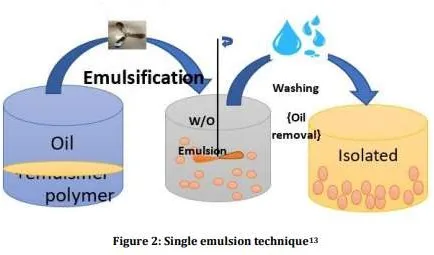
Figure 1: Single Emulsion Technique
b) Double emulsion technique:
This process consumes the formation of the multiple emulsions or the double emulsion of type w/o/w and is best suited to the water-soluble drugs, peptides, proteins, and vaccines (Hema et al., 2022). The water-based protein solution is dispersed in a lipophilic organic continuous phase which is generally consisted of a polymer solution that eventually encapsulates The protein that is in the dispersed aqueous phase (Ramos et al., 2022) . The primary emulsion is then subjected to homogenization before addition to an aqueous solution of PVA; this causes the formation of double emulsion which is then subjected to solvent removal by solvent evaporation maintaining the emulsion at reduced pressure or by stirring so that The organic phase evaporates (Duong et al., 2020). Some examples are hydrophilic drugs like LHRH agonists, vaccines, and proteins. Fig No. 02: Double Emulsion Method (Deshmukh et al., 2025) .
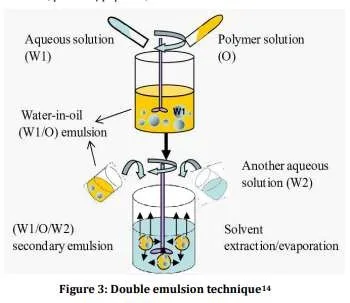
Figure 2: Double Emulsion Technique
2. Coacervation phase separation method:
This method is used to prepare the reservoir type of the system to encapsulate water-soluble drugs Similar to peptides and proteins, it is the case with the matrix too (Klojdová et al., 2023) . For example, when the drug is hydrophobic, such as steroids (Nsairat et al., 2022). In a matrix-type device, the drug or the protein is It dissolves in the polymer phase; the process is based on the principle of decreasing the solubility of the polymer in the organic phase to affect the formation of the polymer-rich phase called the The concordats can be achieved (Deshmukh et al., 2025). by the addition of the third component to the system which results in the formation of the two phases, for example the supernatant, which is depleted of the polymer; in this method the polymer is first dissolved in a suitable solvent and then the drug is dispersed by making its aqueous solution, if hydrophilic or dissolved in the polymer solution itself, if hydrophobic (Makadia & Siegel, 2011a).
3.Spray drying and spray congealing: These methods rely on drying a mist composed of polymer and drug in air (Marante et al., 2020).Spray drying and spray congealing are two distinct processes, differing in whether the solvent is removed through evaporation or the solution is cooled to induce solidification (Bertoni et al., 2019).The polymer is initially dissolved in a suitable volatile organic solvent, such as dichloromethane or acetone, among others (Makadia & Siegel, 2011b).The drug is then incorporated into this solution (Ezike et al., 2023). The solid form is then dispersed in the polymer solution under high-speed homogenization (Giri et al., 2013). This dispersion is then atomized in a stream of hot air (Milanesi et al., 2025). The atomization leads to the formation of the small droplets or the fine mist from which the solvent evaporates instantaneously leading to the formation of the microspheres in a size range of 1- 100 μm (Karajagikar et al., 2025b). Microparticles are separated from the hot air using the cyclone separator while the traces of solvent are removed by vacuum drying (Karajagikar et al., 2025c).
4.Polymerization techniques: The polymerization techniques traditionally used for the preparation of microspheres are mainly classified as (Tanvi et al., 2025b): i) Normal polymerization: • It is carried out using different techniques such as bulk, suspension, precipitation, emulsion, and micellar polymerization processes (Saxena et al., 2021). • In bulk polymerization, a monomer or a mixture of monomers along with the initiator or catalyst is usually heated to start the polymerization process (Schmidt et al., 1985). • The polymer obtained can be shaped into microspheres; the drug loading can be done during the polymerization process (Saralidze et al., 2010c). Suspension polymerization, also known as bead or pearl polymerization, is carried out by heating the monomer or mixture of monomers as droplets dispersed in a continuous aqueous phase (Elbert, 2011). The droplets may also contain an initiator (Hu, n.d.) . Emulsion polymerization is different from suspension polymerization because the initiator is present in the aqueous phase, which later spreads to the surface of the micelles (Polymers, n.d.) . Bulk polymerization has the advantage of producing a pure polymer (Why Does Bulk Polymerization Produce Pure Polymers?, n.d.). ii) Interfacial polymerization: It involves the reaction of various monomers at the interface between two immiscible liquid phases to form a polymer film that essentially surrounds the dispersed phase (“Interfacial Polymerization,” 2026).
5.Solvent Extraction:
The solvent evaporation method is used for the The preparation of microparticles, this involving the removal of the organic phase by extraction of the An organic solvent; the method uses organic solvents that are miscible with water such as isopropanol (Jelvehgari & Montazam, 2012). Organic phases were removed by extraction with Water; this process reduces the hardening time (Krakowska-Sieprawska et al., 2022). Regarding the microspheres, one version of the process involves the direct addition of the drug or protein To the organic polymer solution, the rate of the solvent removal by extraction method depends on the temperature of the water, the ratio of emulsion volume to the water, and the solubility profile of the Polymer (Ahmad et al., 2022).
ADVANTAGES :
The therapeutic effect of microspheres is continuous and lasting. (Deshmukh et al., 2025) It reduces the number of doses, which enhances patient compliance.They were large enough to be inserted into The body was spherical in shape.The way in which the microspheres are arranged enables predictable fluctuations in medication release and breakdown.When the size is reduced, the surface area increases. area, which can improve a drug's poor solubility. (Particle Size Analysis and Reduction Techniques to Enhance Drug Bioavailability in Preclinical Studies - WuXi AppTec DMPK, n.d.) The distribution of drugs is at its highest when the drug is coated with polymers to prevent enzymatic cleavage. (Advances In pH-Triggered Polymers For Oral Drug Delivery: Design Strategies And Applications | IJSRT Journal, n.d.) Try to react less to the environment.With respect to the core. Reducing the size increases the surface area and can boost the effectiveness of the ingredient that isn't easily soluble. Exploring the chemical reactivity and functionalization of sericin for advanced applications (Aad et al., 2025)
DISADVANTAGES:
Microsphere formulations are designed to release the drug (Kim & Pack, 2006).Microsphere formulations also release the drug at different rates, depending upon several factors including food and how the drug enters the stomach (Shewale et al., 2024). Microsphere formulations may also release the drug at different rates from dose to dose (Tanvi et al., 2025a).
Since microsphere formulations contain a higher amount of the active ingredient than other formulations, if there is a problem with the way the formulation releases the active ingredient then this can lead to (Kircik, 2011). Hazardous conditions. It is prohibited to chew or crush microsphere formulations (Karajagikar et al., 2025a)
APPLICATIONS: 1.Regarding the use of microspheres in vaccine delivery: A vaccine’s main purpose is to protect against a microorganism or the harmful substances it produces (Vaccines: Inoculation, Immunization, Safety & Schedule, n.d.). An effective vaccine should fulfill important requirements such as being safe, effective, and easy to administer, especially in minimizing adverse reactions, which is a challenging task (K.B. et al., 2022).The vaccine’s safety profile and its ability to generate antibodies are closely connected to the method of administration (Zhang et al., 2015).Using biodegradable delivery systems for vaccines given through parenteral routes (such as subcutaneous, intramuscular, or intradermal injections) may help overcome some issues with traditional vaccines (Lin et al., 2015a).These methods offer several benefits, including: i) enhancing the antigenic response through the adjuvant effect, ii) enabling controlled release, and iii) stabilizing the antigen (Zhao et al., 2023). 2.Microspheres targeted using monoclonal antibodies: Microspheres that are directed to specific locations using monoclonal antibodies are known as immune-microspheres (Rembaum & Dreyer, 1980). This method helps to guide microspheres to targeted areas.Monoclonal antibodies are very specific molecules that can be used to deliver microspheres containing active substances to the desired site by attaching them covalently (Zhai et al., 2024).This attachment can be achieved through various surface groups such as aldehyde, amino, or hydroxyl groups on the microsphere surface (Chen et al., 2025) .There are several ways to link monoclonal antibodies to microspheres, including: i) non-specific adsorption, ii) specific adsorption, iii) direct coupling, and iv) the use of chemical reagents (Jafarzadeh Chehraghi et al., n.d.). 3.Oral drug delivery: The ability of polymer-based microspheres to form films makes them suitable for use in film dosage forms as an alternative to traditional pharmaceutical tablets ((PDF) APPLICATION OF MICROSPHERES IN PHARMACEUTICAL INDUSTRY, n.d.). Their sensitivity to pH, along with the reactivity of primary amine groups, increases their potential for oral drug delivery.Examples of such polymers are chitosan and gelatin (Mao et al., 2006). 4.Gene delivery: Microspheres can act as efficient oral carriers for genes due to their adhesion and transport properties in the gastrointestinal (GI) tract (Ganju et al., 2025). Materials used for this purpose include chitosan, gelatin, viral vectors, cationic liposome-polycation complexes, DNA plasmids, and insulin (Bolhassani et al., 2014).These microspheres are also beneficial in vaccine delivery, as vaccines aim to protect against microorganisms or their harmful byproducts.Biodegradable delivery systems for parenteral vaccines can help address some of the limitations of conventional vaccines (Lin et al., 2015b). 5.Drug delivery within a tumor and locally: To deliver paclitaxel at therapeutic levels to the tumor site, polymer-based films are used (Mahvi et al., 2023). A combination of drugs shows great promise for controlled delivery within the mouth.Examples of materials used for this purpose include gelatin, PLGA, and chitosan (Desai et al., 2023). 6.Ocular drug delivery: Drug-loaded ocular delivery systems are commonly used to treat glaucoma, especially for cholinergic agonists like pilocarpine (Peter & Panonnummal, 2021). The short half-life of aqueous eye drops, usually between 1 to 3 minutes, can be extended to 15 to 20 minutes by using microspheres made from biodegradable materials, such as polyalkylcyanoacrylate (Renner et al., 2007). 7.Nasal drug delivery: Polymer-based drug delivery systems, including microspheres, liposomes, and gels, have good adhesion properties (Sriwidodo et al., 2022). When these systems come into contact with the nasal mucosa, they tend to swell, which improves drug bioavailability and increases the time the drug remains in the nasal area (Türker et al., 2004).Examples of the polymers used are starch, dextran, and albumin (Why Does Bulk Polymerization Produce Pure Polymers?, n.d.).Top of Form
8.Gastrointestinal drug delivery: Polymer granules with internal cavities, formed through deacidification, become buoyant in acidic or neutral environments, enabling controlled release of drugs (Binauld & Stenzel, 2013). For instance, hollow microcapsules containing melatonin float in the gastrointestinal tract, demonstrating a gastroretentive controlled-release system (Maghsoodi et al., 2011).The release of the drug is significantly slowed, taking between 1.75 and 6.7 hours in simulated gastric fluid (Nabais & Leclair, 2014).These microcapsules remain in the stomach for more than ten hours (Bhadouriya et al., 2012).Examples include chitosan microspheres loaded with Metoclopramide and Glipizide (Ganza-González et al., 1999). 9.Buccal drug delivery: Chitosan is a suitable polymer for buccal drug delivery because of its mucosal and bioadhesive properties, as well as its ability to enhance drug absorption (M. Ways et al., 2018).(Chaudhari et al., 2025).
Even polymer microparticles without any drug incorporated still exhibit antimicrobial properties due to the nature of the polymer itself (Alkarri et al., 2024).Buccal bilayer devices, such as bilaminated films or layered tablets, which combine drugs like Nifedipine and Propranolol hydrochloride along with chitosan, either with or without anionic crosslinking polymers (such as polycarbophil, sodium alginate, or gellan gum), show great potential for controlled drug delivery in the mouth (Patel et al., 2007). 10.Vaginal drug delivery: The polymer, modified by adding thioglycolic acid to its primary amino groups, incorporates Clotrimazole, an imidazole derivative commonly used for treating fungal infections of the genitourinary tract (Grimling et al., 2020). The introduction of thiol groups enhances the mucoadhesive properties of polymer-based drug delivery systems, such as Microspheres, liposomes, and gels—all of these systems show strong bioadhesive characteristics, allowing them to swell upon contact with the nasal mucosa, which improves the bioavailability and extends the residence time of drugs given by the nasal [route. Examples of such Starch, dextran, and albumin are all examples of polymers (Puri et al., 2020).
11.Transdermal drug delivery:
The polymer has very good film-forming properties (Mundada et al., 2011). The drug release from these devices is influenced by factors For example, the thickness of the membrane and the extent of crosslinking of the film (Langner et al., 2024). A chitosan-alginate polyelectrolyte complex has been developed in situ into beads and microspheres for use in various applications, including controlled release systems, packaging, and wound Dressings (Yan et al., 2000). Polymer gel beads show promise biocompatible and biodegradable carriers for treating local inflammation, with drugs like Prednisolone showing With a sustained release and improved therapeutic effects (Khaled et al., 2010). The rate of drug release depends on the type of membrane A combination involving chitosan membranes and chitosan was used (Stefanache et al., 2025). hydrogel, incorporating lidocaine hydrochloride (a local anesthetic), forms an effective transparent system for involving the controlled delivery of drugs and optimal kinetics of release (Jeong et al., 2025).
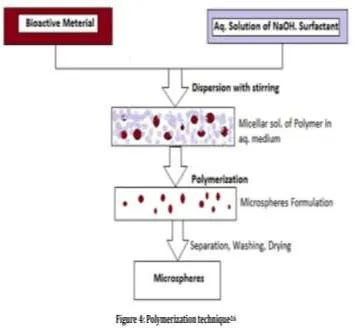
Figure 3: Polymerization Technique
Bottom of Form
CONCLUSION:
When compared with a great many other methods of drug delivery, microspheres represent a better choice. By combining a variety of different techniques, they are likely to take on a key role in new drug delivery systems, particularly in the sorting of diseased cells, in diagnostics, in the delivery of genes and genetic material, and in providing safe, targeted, specific and efficient in vitro delivery, as well as in supplements which act as small replicas of the body's diseased organs and tissues. Compared with existing technology, microspheres have a number of advantages and have therefore become an exciting new platform for biologists to use when investigating the relationships between biomolecules.
There are numerous applications of microspheres, and in recent years they have been used in an increasing number of research projects for a wide range of purposes. It is evident that their potential is great. They have been put to use in studies relating to pulmonary perfusion and inhalation, as well as in scanning the liver, the brain, the heart, and the gastrointestinal tract. Even though the term 'microsphere' is short, it has a number of applications in drug delivery systems in order to produce the desired biological activity. By combining various methods such as cell sorting, genetic engineering, and diagnostics, microspheres will play a key role in innovative drug delivery systems. The study shows that the new medication delivery system functions well when microspheres are used as carriers.
Microspheres are a short-term approach but are used in a wide range of applications in pharmaceutical delivery systems. Some of the important applications are targeted drug delivery (bio-adhesive microspheres for nasal, ocular, buccal, rectal routes, magnetic and radioactive microspheres for tumours), controlled and sustained release (polymeric and floating microspheres). Microspheres will be the heart of new systems for drug delivery by combining different approaches, especially for cell sorting, diagnostics and genetic engineering. The results of this study demonstrate that microspheres can function as effective carriers for novel systems for drug delivery.
REFERENCES

Pratik Pore, Samruddhi Prabhale, Vijay Pawar, Vidya Lonkar, A Comprehensive Review on Microspheres, Int. J. of Pharm. Sci., 2026, Vol 4, Issue 11, 1263-1277. https://doi.org/10.5281/zenodo.24002185
 10.5281/zenodo.24002185