

We use cookies to ensure our website works properly and to personalise your experience. Cookies policy
College of Pharmacy, Kannur Medical College, Anjarakandy.
With consumer demand for ‘natural' cosmetics for personal care, there is a resurgence in herbal cosmetic products containing no synthetic ingredients that can offer more than one benefit, e.g., cleansing, conditioning and coloring. The formulation aspects, phytochemical context evaluation methods, safety aspects and applications of polyherbal hair-dyes shampoos are discussed. Special emphasis is laid on Lawsonia inermis (henna) and Indigofera tinctoria (indigo) along with other complementary herbs like amla, hibiscus, reetha and shikakai that are used as natural dyeing agents. The roles of these botanicals in colour development, cleansing, conditioning, scalp care and protection of underlying hair-fibre, are discussed. The organoleptic properties, pH, viscosity, spreadability, dirt dispersion, foaming behaviour, extractive value, dyeing efficiency, colour persistence, antifungal activity, stability, and safety are analyzed in detail. Based on the available evidence, it is suggested that polyherbal hair dye shampoos could provide a multifunctional and more natural alternative to chemical dyes in hair colouring formulations, but they need to be authenticated as authentic plants and their conditions of extraction, as well as being compatible with the hair dye formulations, to be able to reproduce colours, to be preserved and standardised for testing. They need to be tested by validated analytical techniques, long-term stability testing, irritation and sensitisation testing and controlled testing of colour durability to support their safe effective and stable cosmetic application.
Classification and Morphology of Hair
The hair follicles have several important functions in mammals: protection, thermoregulation and communication in social and sexual relations. About 5 million hair follicles exist in the human body and approximately 80,000-150,000 follicles are on the scalp. There are three types of hair, depending on the features, including size, shape, pigmentation and maturity.Typically, there are three types of hair – lanugo, vellus, and terminal.
Lanugo Hair: Lanugo" refers to fine and soft type of hair that grows during fetal stage. Pigmented and it commonly sheds towards the end of gestation. Some newborns will have another coat of hair which typically drops out between 3-4 months of age.
Vellus Hair: Vellus hair is thin, short and lightly pigmented or unpigmented. It is generally not as large as 30 µm in diameter and often is devoid of a medulla. Applies to most parts of the body (except face and finger tips) and contains a hair bulb in the reticular dermis. Vellus hair is smaller, lighter in colour and is not as well developed as terminal hair.
Terminal Hair: Vellus hair is thin and short, and is usually lightly coloured or colourless. It is generally less than 30 μm in diameter, and generally without a medulla. Applies to most parts of the body and will be found with hair bulb in the reticular dermis. Vellus hair is smaller, lighter in colour and is not as well developed as terminal hair.
Anatomical Structure of Hair
Human hair is made up of two parts: the hair shaft and the hair root. The non-living part of the hair which extends up above the skin is the hair shaft, which is also made of keratin. The skin around the hair follicle, however, is a specialized part of the skin that permits the growth and development of the hair.
Hair Shaft:
The hair shaft is made up of three main layers: the cuticle, cortex, and medulla.
Cuticle: The outermost part of the hair shaft is the cuticle. Made up of flat cells that are overlapping in a scale-like fashion. This layer is responsible for preventing damage to the internal structures of the hair, and for supporting the hair fibre's integrity. During the growth of the hair, it also talks to the other neighbouring root sheath.
Cortex: The outermost thickest and most noticeable part of the hair shaft is the cortex. It has elongated cells that have macrofibrils made up of hard α-keratin intermediate filaments. It is in this layer that melanin pigments are found and responsible for natural hair colour. The cortex also plays an important role in the strength, flexibility and mechanical properties of the hair fibre.
Medulla: Medulla is the central area of the hair shaft and is more likely to be present in coarse hair. It is composed of structural proteins and cellular components which are different from those in cuticle and cortex. The medulla may be continuous, fragmented or absent, depending on the type of hair.
B. Regions of the Hair Follicle
The hair follicle is a complex structure in which, depending on the position of the hair, there are two distinct parts: upper permanent part and lower dynamic part. The regions have certain functions which contribute to the maintenance of the follicle and the normal hair-growth cycle.
1. Upper Follicle (Permanent Region) [6,10]
Infundibulum: The uppermost portion of the hair-follicle is called the infundibium. Is an extension of the skin surface to the opening of the sebaceous gland and serves as a conduit for the passage of the hair shaft to the skin surface. [6,10]
Isthmus: The isthmus can be found between the entrance of the sebaceous gland and the attachment point of the arrector pili muscle onto the hair follicles. The hair bulge is also an important reservoir of multipotent epithelial stem cells for this area. These cells play a role in the renewal and regeneration of the follicular structures, during the hair-growth cycle. [6,10]
2. Lower Follicle (Dynamic or Cyclic Region) [6,10]
Outer Root Sheath (ORS): The outer root sheath is the outer layer of the hair follicle and covers the length of the hair. It offers structural support and also has stem cells which participate in the regeneration of the follicles. The outer and inner root sheaths are separated by a companion layer that aids in moving between the two during hair growth. [6,10]
Inner Root Sheath (IRS): The inner root sheath is the tissue that completely envelops the growing hair shaft and plays an important role in shaping it and guiding its growth. It is composed of three layers: Henle's layer, Huxley's layer and inner root sheath cuticle. This sheath is gradually dissolved at the isthmus area and the hair grows upward. [6,10]
Hair Bulb: The lowest portion of the hair growing follicle is called the hair bulb. It contains the hair matrix as well as the dermal papilla that is responsible for the growth and formation of hair. [6,10]
Hair Matrix: Rapidly dividing keratinocytes that surround the dermal papilla are the cells of the hair matrix. The cells develop into the hair shaft and inner root sheath. New hair can only be produced if they continue to divide and develop in the anagen (active growth) phase. [6,10]
Dermal Papilla (DP): Dermal papilla is an aggregate of specialised cells lying at the root of the hair bulb (follicle), which are of mesenchymal origin. It establishes communication with other matrix cells, which is important to hair growth. It changes the size of the follicles, diameter of hair shafts, activity of follicles and the length of growth phase. The release of growth factors and other signalling molecules from the dermal papilla partially regulates these functions. [6,10]
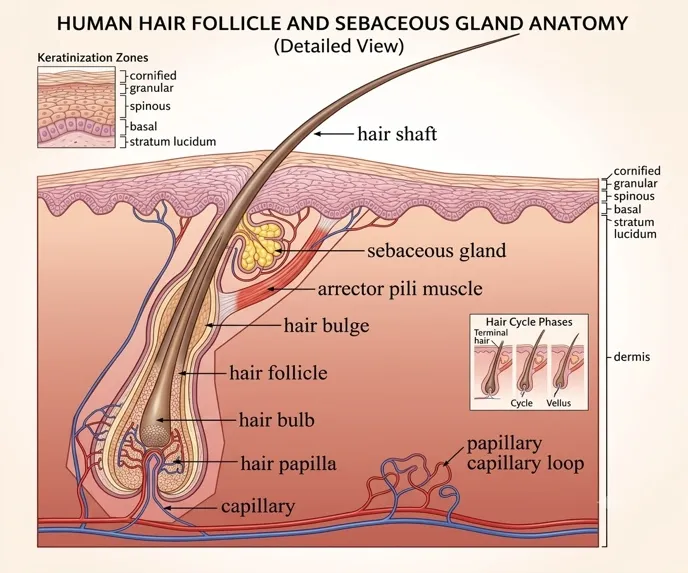
Figure 1: Diagram of an Anagen Follicle
Physiology of Hair
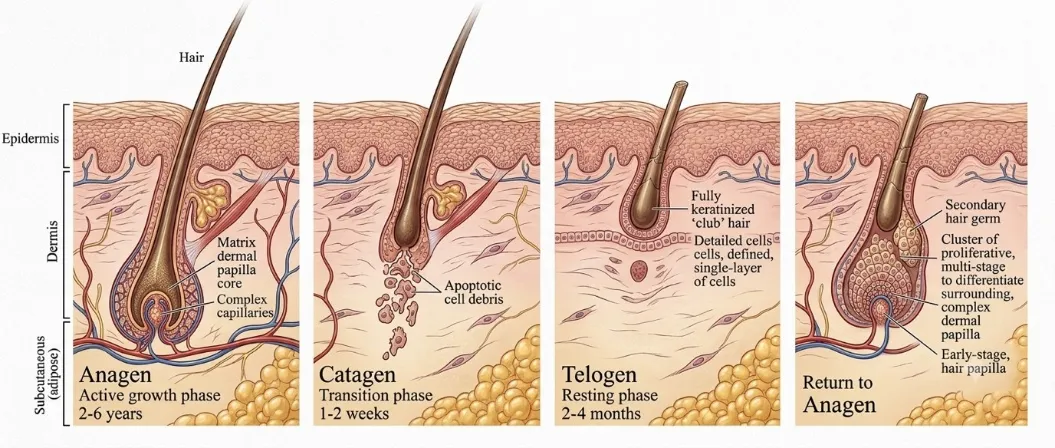
Figure 2: The Hair Cycle
Hair growth is an ongoing dynamic process which is repeated in the hair follicle. This cycle has four main phases: anagen, catagen, telogen and exogen. The duration of each phase varies according to the conditions of the body, such as part of the body, age, hormonal activity, nutritional condition etc. An understanding of the hair-growth cycle helps to understand the hair-care products and how they can affect the condition and appearance of the hair. [6,9,10]
Anagen Phase: The active growth phase of the hair cycle is anagen. In this time the cells of the hair matrix multiply and differentiate very quickly and so the continuous production of the hair shaft takes place. In this phase, about 85-90% of the scalp's hair is in this phase. How long a hair stays in anagen phase is the determining factor in how long the hair will grow. [6,9,10]
Catagen Phase: A brief stage of transition, known as catagen, involves a slowdown in hair production and a little bit of hair-follicle base regression in a controlled fashion. This time period is generally 2-3 weeks and a transitional phase between the growth and rest stages.. [6,9,10]
Telogen Phase: Telogen is the resting phase of the hair-growth cycle, and is typically about two to three months in length. In this time, the hair shaft takes on a club shape, and stays in the follicle until it falls off or gets pushed aside by new hair. [6,9,10]
Exogen Phase: During the shedding phase, Exogen, the old hair shaft is thrown out of the hair follicle. This is a normal healthy process that causes old hair to fall out. The exogen phase can occur concurrently with the growth of a new hair in the same hair follicle. [6,9,10]
PROBLEMS RELATED TO HAIR
The major problems associated with hair and the scalp are discussed below.
1. Dandruff: Dandruff is a kind of skin condition that occurs on the scalp and presents with the loss of small white or greyish flakes. It may also cause itching and irritation. Its occurrence may be caused by factors like the condition of the scalp, production of sebum and presence of naturally occurring microorganisms. [5,8]
2. Dry Hair: Dry hair occurs when the hair loses its ability to retain sufficient moisture or when its outer protective layer becomes damaged. It often feels rough, looks dull, and becomes brittle, making it difficult to comb and manage. [5,8]
3. Split Ends: Split ends form when the protective cap at the ends of the hair are damaged and can split into two or more strands. Some of the main causes of this are frequent heat styling, friction and chemical treatments. [5,7,8]
4. Oily Hair: Excessive production of oil from the sebaceous glands on the scalp is the chief cause of oily hair. This leftover oil ends up on the hair, resulting in an oily look and making the hair appear not so fresh. [5,8]
5. Frizzy Hair: Frizzy hair is rough and uneven looking due to raised or separated individual hair fibres. Frizziness can be caused by humidity, dryness, damage to the outer layers of the hair, or changes in the outer structure of the hair. [5,8]
6. Hair Damage: Damage to the hair structure is caused by excessive heat, UV, rubbing, chemical treatment, etc. This can result in weaker, less smooth and lustrous hair, which can lead to breakage. [5,7,8]
7. Hair Loss: Hair loss is when hair falls out more and/or when the number of hairs in the head decreases. May be related to genetic susceptibility, hormonal changes, nutritional deficiencies, environmental exposure, some medical and other physiological disorders. [5,6]
8. Colour-Related Hair Damage: Chemical processes such as coloring, bleaching and other processes may cause changes in the structure of the hair shaft. These treatments can cause some harm to hair cuticles, weaken the hair fibres and decrease the smoothness and quality of the hair. [7,8]
9. Grey Hair: When melanin production in the hair follicles slows down, the new growth hair has less melanin and becomes grey. While greying hair is usually a sign of age, other factors like genetics and other biological causes can result in early greying. [6,10]
PRINCIPLE OF HAIR COLOURING
Hair colouring involves changing the natural colour of hair by depositing colour on the outside of the hair, altering the natural colour by interacting with the hair fibre, or by chemically modifying the natural colour. Depending on their coloring and/or permanency, hair dyes are either temporary, semi-permanent, demi permanent or permanent or oxidative. Chosen and processing dye specifically will determine the length of colour effect. [7,8,10]
1. Oxidative Hair Colouring: Permanent hair dyes generally work through a chemical reaction involving dye precursors and an oxidizing agent. These small molecules enter the hair fibre and undergo oxidation and coupling reactions to form larger coloured molecules within the hair. As a result, the colour usually lasts longer than that produced by temporary dyes. Conventional oxidative hair dyes commonly contain primary intermediates and couplers that react to form the final-coloured compounds. [7,8]
2. Natural and Herbal Hair Colouring: Herbal hair dye is based on the colourings extracted from the plants. The compounds have different interactions with the hair fibres because of their chemical properties and application. [11,12,14]
For instance, the colouring compound lawsone found in Lawsonia inermis (henna) reacts with keratin in the hair and provides an orange-red colouring effect. Plant material that contains indigo gives shades of blue. If henna and indigo are applied simultaneously, it can achieve a colouring effect from dark brown to almost black, depending on the formulation and application process. [11,12,14]
Several factors such as the type and quality of the plant materials, its concentration, extraction process, application time, initial state of the hair, and interactions between the colouring constituents, affect the final colour. The herbal hair dyes can be developed based on plant derived colouring agents. Using appropriate herbal ingredients in an appropriate shampoo base, it is possible to have a combination of a cleansing effect of a shampoo with colouring properties of selected plant materials. [11,12,14]
The colouring performance, colour retention, stability and safety of the final formulation, however, must be verified by suitable evaluation studies. [20,22,25]
RELEVANCE TO POLYHERBAL HAIR-DYE SHAMPOO
In a polyherbal hair-dye shampoo, the desired colour is developed through the combined action of colouring agents obtained from selected plants. Henna and indigo are particularly important because they contribute directly to hair pigmentation. Other medicinal plants, such as amla, hibiscus, and bhringraj, may also be included in the formulation for their traditional hair-care properties. [11,14,15,17]
The final colour will be determined by several factors such as the concentration and proportion of colouring agents, length of application, pH of the formulation, hair porosity and the initial hair colour. As such, knowing hair colour theory enables the use of the right herbs in the right ratios to achieve brown, dark brown or close-to-black results. However, the experimental evaluation of the actual colouring performance should be carried out to confirm the colouring performance of the formulation. [11,12,14]
HERBAL HAIR DYE
Herbal hair dyes are made with colouring components from plants, and are often utilized as an alternative to synthetic hair dyes. Henna and indigo are common due to their colouring properties. Besides, amla and other medicinal plants can be used in formulations and aid in hair care. Some natural products don't contain chemicals like ammonia and peroxide. But what is in a product and how safe it is, depends on the components used to make it. [11,14,15,17]
A significant advantage of natural hair dyes is the following: They can create various shades by mixing various types of plants in various proportions. Henna typically gives orange-red coloured results and indigo brings about blue hues. These two ingredients combined will create a dark brown to almost black color. Hair softness and manageability are other advantages that some ingredients from plants have. [11,12,14]
Compared with conventional oxidative hair dyes, certain herbal formulations may require a longer application time to achieve the desired colour. Colour intensity and retention may vary according to the formulation, hair type, and method of application. Although the proportions of the ingredients can be adjusted to develop different shades, consistent results cannot always be guaranteed. Producing very light shades or making substantial changes to the natural hair colour can be difficult using plant-derived colouring agents alone. [7,11,12]
Thus, herbal hair dyes provide an alternative approach to hair colouring by combining plant-derived colouring agents with selected hair-care ingredients. Their effectiveness, colour retention, and safety should be evaluated for each formulation. [20,22,25]
TYPES OF HAIR DYES
Hair dyes are typically divided into three categories based on their action and how long the colour stays on the hair: temporary, semi-permanent and permanent hair dyes. [7,8]
A. Temporary Hair Dyes
Temporary hair dyes mainly deposit colour on the outer surface of the hair and penetrate very little into its internal structure. Depending on the product and the condition of the hair, the colour may be removed after one or a few shampoo washes. These dyes are available as rinses, sprays, and other ready-to-use preparations. The colouring agents may be present in aqueous or hydroalcoholic solutions. Some products also use finely divided pigments to provide temporary colour. [7,8]
B. Semi-Permanent Hair Dyes
Semi-permanent dyes contain colouring ingredients that will directly colour the hair, but are not as permanent as permanent dyes. They lay on the hair surface and can to some degree be absorbed by the fibre. They can include nitrophenylenedamines, nitroaminophenols, aminoanthraquinone derivatives, and other direct dyes, depending on their chemical makeup. The colouring matter should be soluble in suitable solvents that help to distribute the colouring agents evenly on the hair. The colour will slowly fade after washing many times. So semi-permanent dyes will not offer as long a colour result as permanent hair dyes. [7,8]
C. Permanent Hair Dyes
A permanent hair dye is preferred for lasting hair dyeing. The last colored compounds in the traditional oxidative dye system are not getting finished prior to dyeing, but they are only forming during the dyeing process. Typically, these formulas include dye intermediates, couplers and an oxidising agent. These components interact to create colored compounds in the hair color, which will last for a relatively long period of time despite repeated washing. Permanent oxidative dyes may also cause the natural color in the hair to lighten, depending on the formulation and application technique. [7,8,23]
ADVANTAGES OF HERBAL HAIR DYES
DISADVANTAGES OF HERBAL HAIR DYES
USES OF HERBAL HAIR DYES
Herbal hair dyes are primarily used to colour the hair by incorporating selected plant-derived ingredients into hair-care formulations. Their common uses include the following:
MATERIALS AND METHOD
PLANT MATERIALS:
Henna: The leaves of Lawsonia inermis contain lawsone, flavonoids, tannins, coumarins, triterpenoids and other phenolic compounds. Lawsone is the most important constituent for hair colouring because it interacts with keratin in the hair fibre. Other reported compounds include gallic acid, catechin, quercetin and scopoletin. [11]
Indigo: Indigofera tinctoria contains indole-derived compounds, including indican, indigotin, indirubin and isatin. Indican is a precursor involved in the formation of indigo pigment during processing. Indigotin contributes the characteristic blue colour, while other constituents include flavonoids, phenolic compounds, tannins and sterols. [14]
Amla: Phyllanthus emblica fruits are rich in hydrolysable tannins, gallic acid, ellagic acid, flavonoids and ascorbic acid (vitamin C). Other compounds reported are emblicanin A, emblicanin B, punigluconin and pedunculagin. These constituents are related to the antioxidant activity of amla. [15,16]
Hibiscus: Hibiscus rosa-sinensis contains flavonoids, anthocyanins, phenolic acids, tannins, sterols and mucilage. Reported flavonoids include quercetin, kaempferol and their glycosides. Flower pigments include anthocyanin-related compounds, although their composition varies among cultivars. Mucilage is relevant to the plant's traditional use in hair-care preparations.  [17]
Reetha: Sapindus mukorossi fruit pericarp is abundantly rich in triterpenoid saponins. The compounds found are sapinmusaponins and other saponins from triterpenoid aglycones like hederagenin. These amphiphilic molecules reduce the surface tension and enhance the cleaning and foaming capacity of reetha. [19]
Shikakai: The fruits of Acacia concinna are known for their saponin content, together with reported tannins, flavonoids and other phenolic constituents. The saponins are particularly relevant to shampoo formulation because they contribute to the plant's natural cleansing properties. The exact phytochemical profile depends on the plant material and extraction procedure. [18]
METHOD
1. Selection and collection of herbal ingredient: Suitable plant materials were selected and collected according to the formulation [3,4]
2. Authentication: Authenticated using appropriate pharmacognostic methods to confirm their identity and their suitability for use in the formulation. [3,4]
3. Cleaning and Drying: The herbal raw materials are thoroughly washed and dried. [3,4]
5. Grinding and Extraction: Herbal materials are ground into using a mixer grinder. Depending on the requirements the plant materials were extracted using suitable solvents. [3,4]
6. Size reduction and weighing: The powders are passed through sieve No. 80 to get uniform materials. The required quantities of plant materials were weighed as part the formulation [3,4]
7. Preparation of shampoo base: The shampoo base is prepared using purified water, suitable surfactants, and other necessary excipients. Glycerine and aloe vera gel may be added to improve the moisturizing and conditioning properties of the shampoo. A suitable preservative may also be incorporated to help control microbial growth and maintain product quality. [1,2,3,24]
8. Incorporation of herbal extract : The prepared herbal extracts or powders are gradually added to the shampoo base with continuous stirring to ensure uniform mixing. Henna and indigo contribute to the colouring properties of the formulation, while reetha and shikakai help improve cleansing and foaming. Traditional hair-care properties of amla and hibiscus might be added. It is essential to ensure that correct proportions and compatibility of all ingredients are kept to ensure a stable formulation is achieved. [11,14,15,17,18,19]
9. pH Adjustment and homogenization: The pH is adjusted, if necessary, using suitable agent’s compatible with the formulation. The viscosity, colour, odour, and consistency of the shampoo are then examined. [1,2,4]
10. Packaging and storage: The product is stored under suitable condition. During storage, changes in colour, odour, pH, viscosity and overall stability study is performed. [1,2,4,21]
10. Evaluation of shampoo: The product is evaluated which includes Organoleptic, PH, viscosity, spreadability, foaming index, foam stability and capacity, dirt dispersion, extractive value, anti-fungal activity, Dyeing efficiency test and Color persistence test, Stability study. [1,3,4,20]
EVALUATION
1.Organoleptic Evaluation
The hair dye shampoo was observed using. [3,4]
2.Determination of pH
pH was determined using a pH meter. One gram of hair dye shampoo was dissolved in 100 ml of distilled water and kept for 2 hours. The pH meter was calibrated and electrode of pH meter placed inside the prepared solution and the reading is taken. [3,4,5]
3.Determination of Viscosity
A Brookfield viscometer was used to measure the viscosity of the shampoo. Using LV 3 [No. 63] spindle and 0.63 rpm the viscometer and the value obtained is noted and adjusted if needed. [1,3,4]
4.Spreadability
The spreadability was determined using the glass-slide method. 0.3 g of shampoo was placed on a glass slide, and another glass slide was placed over it. A weight of 100 g was placed on the slide and the distance travelled by the slide and the time required was recorded. [3,4,20]
5.Dirt Dispersion
Add two drops of shampoo to 10 ml of distilled water in a test tube. Then add one drop of Indian ink, close and shake the test tube for 10 to 12 times, check the amount of ink in the foam and determine the result as none, light, moderate, or heavy. [3,4,8]
6.Foaming Index
This herbal shampoo solution was taken in ten test tubes in sequential portions of 1, 2, 3, 4…10 ml, and the total volume in each was made up to 10 ml with distilled water. The test tubes were shaken for 15 seconds and were allowed to stand for 15 minutes, and the height of the foam was measured. [1,3,4]
7.Foaming Capacity and Foam Stability
2 ml of shampoo taken in a 250 ml graduated cylinder, 50 ml of water is added and shaken for 10 minutes. Foaming capacities of all formulations are measured after 1 minute. Percentage foaming capacities measured over a 60-minute period. [1,3,4]
Using cylinder shake method shampoo was tested for foam stability. At room temperature, 10 ml of shampoo solution poured into a 100 ml graduated cylinder, 50 ml of distilled added and shake it 10 times. Record the total volume of foam 1 minute after shaking and measure height. To check how long, the foam lasts, repeat the same steps and measure the foam volume again after 20 minutes. [1,3,4]
8. Extractive value
The extractive value determines how much active material in a herbal product dissolves in water, alcohol and ether. Weigh 5 g of the herbal hair dye shampoo. Place it into a clean, dry flask, add 100 ml of, water, alcohol and ether and mix it well. Let the mixture stand for 24 to 48 hours, shaking frequently in the first 6 hours, filter the liquid and pour 25 ml of it into an evaporating dish that is already weighed. Warm the dish over a water bath until all the liquid disappears, dry the remaining powder in hot air oven until dry, weigh and calculate. [3,4,20]
9. Anti-fungal activity
The SDA medium was prepared and autoclaved at 121o C, the solution is poured in clean sterilized petri dish the medium is solidified at 40oC. After solidification it is streaked using Candida under aseptic conditions and let it incubate for 24 hours or until growth is seen. Agar well diffusion method is done to find the anti-fungal activity. 6mm (wells) were made in the agar using a sterile cork borer, and equal amounts of each shampoo sample were placed into separate wells. A standard with antifungal drug served as the positive control, while a sample without active ingredients served as the negative control. The plates were kept in an incubator under controlled conditions suitable for Candida albicans, after incubation, the plates were checked for clear rings around the wells, and the diameter of these inhibition zones was measured in millimeters. [21,22]
10. Dyeing efficiency test and Color persistence test
This test checks how well the herbal hair dye shampoo colors grey or white hair. Take equal-sized grey or white hair samples and apply hair dye shampoo evenly to each hair sample. Let the shampoo sit on the hair for a specific period of time, then wash each hair sample with water, let it dry, and look closely at the color change. [11,12,20,25]
After the colour is obtained the hair is washed for 5 to 6 times or until the colour is removed fully. [12,20,25]
CONCLUSION
A study of the formulation and evaluation of a polyherbal hair dye shampoo using natural colouring materials and some medicines plant ingredients. The Henna and Indigo gives a base tone to create brown to dark shades and ingredients like Amla, Hibiscus, Reetha, Shikakai, have traditional properties of hair care and cleansing. The use of these ingredients in the preparation of a shampoo base may provide a solution to the possibility of incorporating hair cleansing and colouring in a single cosmetic product. The evaluation parameters described in this study like pH, viscosity, spreadability, foaming property, dirt dispersion, extractive value, antifungal activity, dyeing efficiency, colour persistence and stability are important parameters to determine the quality and performance of the formulation. However, assessing the suitability of the end product cannot be based on its constituents or method of preparation alone. It should be backed up with the results of the experiments conducted, the relevant experiment stability data and safety evaluations. Hence the formulated polyherbal hair dye shampoo is a possible plant based method of hair colouring and cleansing. Additional systematic studies are needed to completely document its repeatability, colour stability, microbiological quality, safety, and cosmetical acceptability. The results of these investigations would assist in identifying the product's further development potential as an herbal hair-care product.
REFERENCES

Adil Abdul Azeez, Roopesh P. T., Aleena Binoy, Fathimathul Fidha V. K., Nida Fathima, Vismaya Babu K. K., Vismaya Babu, Polyherbal Hair Dye Shampoo: A Review, Int. J. of Pharm. Sci., 2026, Vol 4, Issue 11, 5147-5157. https://doi.org/10.5281/zenodo.24554464
 10.5281/zenodo.24554464