

We use cookies to ensure our website works properly and to personalise your experience. Cookies policy
Department of Pharmaceutical Analysis, Narasaraopet Institute of Pharmaceutical Sciences, Narasaraopet, Andhra Pradesh, 522601, India.
Resmetirom (RMT) a new drug approved for the treatment of metabolic dysfunction associated steatohepatitis. Metabolic dysfunction associated steatohepatitis (MASH) is now the leading cause of chronic liver disease worldwide affecting up to 6-8% of adults. It is characterised by hepatocellular fat accumulation, inflammation, and fibrosis, with fibrosis being the strongest predictor of liver related morbidity and mortality. Lifestyle modification remains first line therapy, but sustained histologic remission is rare. The approval of resmetirom in 2024 by the U.S. FDA marks a historic turning point in the treatment landscape of MASH. This analytical review assesses resmetirom’s pharmacologic basis, efficacy, safety, and clinical potential, integrating data from phase II and III studies and post-approval analyses. Metabolic dysfunction-associated steatohepatitis (MASH) is a liver disease which is different from alcoholic liver disease, as the name implies it is due to metabolic imbalance and hepatic injury which leads to excess fat accumulation in liver, inflammation and progressive fibrosis. This review article focuses on developing and validating precise straight forward UV spectrophotometric methodologies for quantitative determination of resmetirom in pure form and on the various analytical methods performed for the drug like HPLC, RP-HPLC and the method was validated for parameter including linearity, accuracy, precision, limit of detection according to ICH guidelines. For the RP-HPLC Precision and accuracy LOD and LOQ were determined. These developed methods can be utilized to evaluate resmetirom efficacy as analytical data and validated results are currently scarce in the literature.
Metabolic dysfunction-associated steatotic liver disease (MASLD), formerly referred to as non alcoholic fatty liver disease (NAFLD), is a major worldwide health concern. It is defined by the accumulation of macrovascular fat in at least 5% of hepatocytes in the absence of secondary causes, including excessive alcohol consumption or drug- related liver injury. MASLD represents a broad spectrum of hepatic disorders, ranging from simple steatosis to fibrosis and cirrhosis, and includes the condition previously known as non-alcoholic steatohepatitis (NASH), which is now termed metabolic dysfunction-associated steatohepatitis (MASH). (2)
Globally, MASLD is currently considered the most common form of chronic liver disease and its prevalence continues to increase, approximately one- quarter of the world’s population is estimated to have hepatic steatosis, with a substantially greater burden among people with obesity (BMI ≥30 kg/m2). In 2019, an estimated 1.66 billion adults aged 20 years or older were affected by MASLD worldwide, with East Asia reporting the highest prevalence.
According to the revised diagnostic framework, the diagnosis of MASLD requires evidence of hepatic steatosis identified by imaging or liver biopsy together with at least one cardiometabolic risk factor.
The revised nomenclature has also introduced the category of Metabolic and Alcohol-Related Liver Disease (MetALD). This classification applies to individuals who meet the criteria for MASLD but additionally consume alcohol within specified moderate-to-high ranges, namely 140-350g/week in women and 210-420 g/week in men.
The development of these updated definitions and classification reflects an effort to more accurately characterize the interaction between metabolic abnormalities and alcohol exposure. It may also facilitate a clearer understanding of the disease spectrum, reduce stigma associated with the liver disease terminology and support more consistent approaches to clinical care and research. (1)
DRUG INFORMATION
IUPAC Name:
2-[3,5-dichloro-4-((6-oxo-5-isopropyl-4,5,6,7-tetrahydro-1H-pyridazin-3-yloxy) phenyl]-3,5-dioxo-2,3,4,5-tetrahydro-1,2,4-triazine-6-carbonitrile.
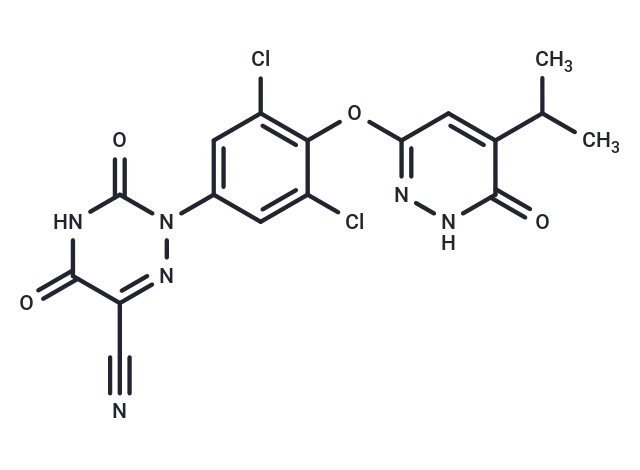
Structure:
Synonym:
MGL-3196
THR-β selective agonist
Molecular Formula:
C20H16CL2N6O4
Molecular weight:
491.29 g/mol
Category:
Thyroid Hormone Receptor-β agonist
BCS Class:
Class IV: (low solubility, low permeability)
Solubility:
Soluble in water and sparingly soluble in organic solvents.
Half – Life:
4-5 hrs (5)
PHARMACOKINETIC AND PHARMACODYNAMIC EFFECTS:
1. Resmetirom is administered orally once daily at 80-100 mg.
2. Absorption: Rapid (T max 2-3 h).
3. Metabolism: Primarily via CYP2C8.
4. Elimination: Half-life of ~5h mainly hepatic.
5. Drug interactions: Avoid strong CYP2C8 inhibitors (e.g. gemfibrozil).
6. Pharmacodynamically, resmetirom increases hepatic fat oxidation and decreases de novo lipogenesis, reflected by rapid reductions in MRI-PDFF liver fat content. (3)
MECHANISM OF ACTION:
ANALYTICAL METHODS
The analytical methods providing an overview of chromatography and spectroscopic methods and emphasizing their applications in pharmaceutical analysis.
UV SPECTROPHOTOMETRY:
The majority of multicomponent analysis uses UV spectrophotometric techniques, which eliminate the need to separate interferents and enable the measurement of additional analytes. This cuts down on study time and expenses. (6)
PRINCIPLE:
The UV visible concept of spectroscopy is based on the idea that different spectrums are produced when chemical compounds absorb ultraviolet or visible light. The interaction between light and matter are the focus of spectroscopy. A spectrum develops as a result of matter being stimulated and de-excited when it absorbs light. (7)
HIGH-PERFORMANCE LIQUID CHROMATOGRAPHY (HPLC):
High-performance liquid chromatography (HPLC), sometimes referred to as high-pressure liquid chromatography, is a method used in a analytical chemistry to separate, identify, and quantify specific components in mixtures, liquid solutions that have been dissolved from food, chemicals, pharmaceuticals, biological, environmental, and agricultural sources, among other sources, may be the source of the mixtures.
The mobile phase mixes of various solvents is supplied by high pressure pumps and flows through the system, gathering the sample mixture along the way. The sample mixture is then delivered into a column, which is a cylinder that contains the stationary phase solid adsorbent particles. Variable rates of component migration are caused by various interactions between the components of the sample and the adsorbent material. Separation results from the species varying rates of migration out of the column and onto particular detectors, like UV detectors. A graph called a chromatogram is produced by the detector. Chromatogram are graphical depictions of signal strength vs time or volume, with peak signifying sample components. Based on quality, each sample has a retention duration and matching area. (8)
REVERSE PHASE HIGH-PERFORMANCE LIQUID CHROMATOGRAPHY (RP-HPLC):
RP-HPLC uses hydrophobic interactions between a polar mobile phase and a non polar stationary phase to separate compounds. Reverse-phase chromatography uses a non-polar (hydrophobic) stationary phase, commonly modified silica with long carbon chains (like C18 or C8), and a polar mobile phase, typically water combined with organic solvents like methanol or acetonitrile. (9)
PARAMETERS OF METHOD VALIDATION:
1. Accuracy
2. Precision
3. Linearity
4. Specificity
5. Range
6. Limit of detection
7. Limit of quantification
8. Robustness
9. Ruggedness
ACCURACY:
The accuracy can be defined as the degree to which the methods test results closely resemble the actual value is a Guage of hoe accurate the analytical technique is.
PRECISION:
The analytical methods repeatability under typical operating conditions is measured by precision. The degree of agreement between a set of measurements made from several identical samples under particular conditions is expressed by the precision of an analytical procedure.
LINEARITY:
The ability of an analytical method to yield test results that are linearly proportional to the analyte concentration in samples within an acceptable range is known as linearity.
SPECIFICITY:
Specificity is the ability of a method to identify particular analytes in a complex mixture without interference from other mixture components.
RANGE:
The range of the analytical procedure is the interval between the greatest and lowest analyte concentration in the sample for which the analytical technique has been demonstrated to have an appropriate degree of precision, accuracy and linearity.
LIMIT OF DETECTION:
The limit of detection (LOD) of an analytical method is the lowest concentration of an analyte in a sample that is detectable but not directly quantifiable.
LIMIT OF QUANTIFICATION:
The limit of quantification (LOQ) of an alternate microbiological method is defined as the lowest number of microorganisms in a test sample that can be enumerated with acceptable accuracy and precision under defined experimental conditions.
ROBUSTNESS:
A capacity of the method to remain unaffected by small but deliberate variations in method parameters e.g. reagent volume, incubation time, or ambient temperature providing an indication of its reliability during normal usage. A measure of robustness is not a comparison between the compendial and alternate methods, it is a necessary component of validation of the alternate method so that the user understands the limit of the operating parameters of the method.
RUGGEDNESS:
The degree of precision of test results obtained by the analysis of the same sample under a variety of typical test conditions such as different analysts, instruments, and reagents lots (the method for demonstration may follow instrument or materials manufacturer recommendations or it could be based solely on data supplied by test method manufacturer. (10)
REPORTED METHODS FOR RESMITIROM:
1. CHROMATOGRAPHIC METHODS: Chromatographic methods are laboratory techniques that uses a mobile phase and a stationary phase to separate, identify, and purify the components of a mixture. Separation occurs because components distribute themselves between the two phases based on their differencing affinities.
HIGH-PERFORMANCE LIQUID CHROMATOGRAPHY METHOD (HPLC):
A common high-performance liquid chromatography method for resmetirom involves a reserved phase system using a C18 column, a mobile phase of phosphate buffer and acetonitrile and a UV detector.
Dahiya and Sharma developed and validated a sustained a sustainable RP-HPLC method for the determination of Resmetirom. The method employed a kromasil C18 column, with acetonitrile and ammonium acetate buffer (pH 3.5) in a 70:30 ratio as the mobile phase. The method was also assessed for its environmental sustainability.
More recently, Hasan et al. developed a validated RP-HPLC method for Rezdiffra. The method used an ODS C18 column. (11)
LCMS METHOD:
Specific LC-MS methods for analysing resmetirom have been developed for both pharmaceutical formulations and bio analytical applications. The most detailed methods use liquid chromatography with tandem mass spectrometry (LC-MS/MS) for high sensitivity and specificity in complex matrices like plasma.
The method employed a kromasil C18 column with acetonitrile and ammonium acetate buffer (pH 3.5), in a 70:30 ratio. UV detection at 298 nm was used for the HPLC method.
A validated reverse phase HPLC method for quantifying resmetirom in tablets has been published, though it is not a mass spectrometry method. It can be adapted for LC-MS/MS detection by adjusting the mobile phase and other parameters for optimal mass ionization. (12)
REVERSE PHASE-HIGH-PERFORMANCE LIQUID CHROMATOGRAPHY (RP-HPLC):
Shuang Wang, Yonghong Zhu and Quin wang developed and validated this method. This study established a reverse phase high-performance liquid chromatography (RP-HPLC) for the separation of resmetirom and its related substances. The analysis was performed using an Agilent 5HC C18 column (250mm x 4.6mm, 5 micrometers) at 35 degrees Celsius, with detection at 220nm. A gradient elution method was employed, achieving effective separation of all impurities within a 45 min run time. The final HPLC method utilized with a mixture of H2O/ACN (90/10, v/v) containing 0.045% TFA as mobile phase A, and ACN as mobile phase B. (13)
2. SPECTROSCOPIC METHODS:
Spectroscopic methods study the interaction of matter with electromagnetic radiation, providing valuable insights into the chemical structure and molecular behaviour of substances like resmetirom. Below are some standard spectroscopic methods:
UV-SPECTROSCOPY:
Shish A. Khan, Amaan Khan, and Megha Pandagale reported the development and validation of a UV-spectrophotometric method for the quantitative estimation of resmetirom in its pure form. In this method, a phosphate buffer and acetonitrile mixture in a 50:50 (v/v) ratio was employed as the solvent system. The drug exhibited its maximum absorbance at 225 nm. A linear response was obtained over the concentration range of 16–24 µg/mL. The developed method was subsequently validated with respect to important analytical parameters, including linearity, accuracy, precision, limit of detection (LOD), and limit of quantification (LOQ). (14)
VOLTAMETRY
Voltammetry is an electroanalytical method in which the current response of an analyte is 6monitored while the applied electrode potential is varied. Resmetirom, a thyroid hormone receptor-β (THR-β) agonist containing an aromatic and functionalized molecular structure, has the ability to participate in oxidation or reduction reactions at the electrode interface. This electrochemical behaviour can be utilized for the quantitative determination and electrochemical characterization of the drug. Among the different voltametric techniques, Cyclic Voltammetry (CV) and Differential Pulse Voltammetry (DPV) are commonly employed for analytical investigations. (15)
X-RAY DIFFRACTION (XRD) METHOD:
This method was developed and validated by the N Rupa naga Sri and K Nikitha.
X-ray powder diffraction (XRPD) is a useful technique for investigating the crystalline characteristics of resmetirom. In this technique, the diffraction pattern generated by the interaction of X-rays with the crystal lattice is recorded as a function of 2θ. The position of diffraction peaks provides information about the crystal structure and interplanar spacing, whereas peak intensity and profile can be used to evaluate crystallinity, phase composition, preferred orientation, and microstructural characteristics. (15)
ANALYTICAL METHOD DEVELOPMENT:
Analytical method development is the process of designing, optimizing and establishing a new analytical method to identify, quantify, and evaluate the quality of drug. Analytical method development is the process of designing a method that provides accurate, precise and reproducible results for drug analysis. Based on the physicochemical properties of the drug, an appropriate analytical technique such as HPLC, RP-HPLC, UV spectrophotometry is selected. The process involves key stages like selection of method, optimization of conditions, validation in terms of specificity, accuracy, precision and robustness, along with ensuring regulatory compliance.
VALIDATION:
Validation of the developed analytical methods was performed for various parameters like linearity, accuracy, precision, limit of detection and limit of quantification in accordance with ICH guidelines. Strict guidelines for validating analytical methods are provided by regulatory agencies like International Council for Harmonisation (ICH), U.S. Food and Drug Administration (FDA). The FDA approved in the year 2024 March 14. Because this is a new drug, we need to develop a method and check the validation parameters like linearity, precision, accuracy, limit of detection (LOD), limit of quantification (LOQ), robustness.
CONCLUSION
Resmetirom is a recently approved drug that selectively acts on the thyroid hormone receptor β
and is used in the management of metabolic dysfunction of metabolic steatohepatitis. As the drug is relatively new, suitable analytical methods are important for its identification, estimation and quality assessment. In this review, different analytical approaches reported for the determination of resmetirom have been discussed.
Chromatography techniques particularly HPLC and RP-HPLC, have been reported for the separation and quantitative estimation of resmetirom, while LC-MS/MS provides a sensitive approach. UV spectrophotometric methods offer a comparatively simple and economical option for routine estimation.
The review also gives the importance of analytical method development and validation in obtaining dependable analytical results. Validation parameters are important for establishing the reliability of an analytical procedure.
Since resmetirom is a newly introduced drug, further research may be help in developing simple, sensitive, accurate and reliable analytical methods for routine quality control and future pharmaceutical and bio analytical applications.
REFERENCES







M. Rama Krishna, J. N. Suresh Kumar, K. Stallen Joseph, K. Venkata Kalyan, M. Sri Anantha Pranavi, T. Mounika, Y. Bhuvaneswari, A Review on Analytical Methods for the Estimation of Resmetirom, Int. J. of Pharm. Sci., 2026, Vol 4, Issue 10, 2348-2354. https://doi.org/10.5281/zenodo.23392325
 10.5281/zenodo.23392325