Cumulative manufacturing, usually referred to as three dimensional (3D) printing, has become a significant development in the pharmaceutics, and medical sectors . This process builds objects layer by layer from digital designs, enabling the production of complex and customized structures with high accuracy .Due to their adaptability, precision , and efficiency, various 3D printing techniques such as selective laser sintering (SLS), stereo lithography (SLA), and fused deposition modelling (FDM) are widely used across different industries. In the pharmaceutical field, 3D printing has gained substantial attention because it allows the creation of personalized medicines tailored to singular patients, with right dosages and disciplined drug release. This leads to improved tolerant outcomes and easier adherence to treatment plans. With advancements in materials, 3D printing is now being used to produce drug delivery systems, medical devices, and implants. It plays a key role in fields like tissue engineering, regenerative medicine, and bio printing, where it helps create synthetic tissues , organs, and lab models that closely resemble body parts. When combined with digital health tools, 3D printing offers even greater potential in healthcare. However, there are still challenges to address, including regulatory issues, scaling up production, material limitations , and maintaining quality. Continued research and collaboration are pivotal to making 3D printing further operative and widely adopted in healthcare and drug manufacturing.
Keywords
Additive Manufacturing, 3D Printing Techniques, Personalized Medicine, Drug Delivery Systems, Bioprinting, Biomaterials, Pharmaceuticals, Controlled Release
Introduction
×
Three-dimensional (3D) bio printing represents a major advancement in regenerative medicine.This technology enables scientists to produce living tissue structures that closely mimic natural tissues (20,25).The method involves layer by layer printing of cells and biomaterials, which helps in repairing damaged tissues, understanding diseases, and creating personalized treatments (21,24,27).Bio inks are made from natural and synthetic materials that support cell growth and tissue development (26,29).Recent studies have focused on making these materials more compatible with the body, more functional, and more sustainable by using ethically sourced and ocean-derived materials (19,24).As research progresses, 3D bio printing has the potential to transform healthcare and the way we grow organs in the future. In the bio printing field, systems that mix different biopolymers are becoming increasingly popular (24,26,and 29).The right combination of these materials enhances the performance, support for tissue growth, and degradation of printed structures. Another strategy involves using smart materials that change their properties in response to their environment (29).For applications requiring precise shapes, such as models that replicate body environments, stereo lithography (SLA) is preferred. It uses a laser to create highly detailed and accurate structures. There are several printing methods in bio printing, each with its own strengths suitable for different applications. Fused Filament Fabrication (FFF) is effective for quickly creating larger structures but lacks the fine detail of Slain works by melting and extruding thermoplastic filaments. Selective Laser Sintering (SLS) uses a laser to fuse powdered materials into intricate shapes without the need for additional support structures (3,18).Inkjet printing and Direct Ink Writing (DIW) are common techniques for producing detailed biological structures. Inkjet bio printing is fast and can print multiple structures at once, while DIW is better suited for controlling the flow of thick, cell-laden materials. Together, these techniques help scientists create structures with different cell types and materials, supporting the goals of tissue engineering and regenerative medicine. This review provides a comprehensive overview of the rapidly growing field of 3D bio printing, covering its basic principles, material properties, new technologies, current challenges, and future possibilities. Unlike earlier studies that focused on specific materials or methods, this review presents a broader perspective of the field’s importance in modern healthcare. It covers recent innovations in technology and materials science, highlighting their applications in tissue engineering, regenerative medicine, personalized therapies, and the development of advanced medical devices. The review also examines existing studies to identify gaps and obstacles that hinder the adoption of 3D bio printing in real-world medical settings. Strategies to enhance the structure, blood vessel formation, functionality, and compatibility of printed tissues are discussed. By consolidating the latest knowledge and suggesting future research directions, this review serves as a valuable resource for researchers, healthcare professionals, and industry experts in the field of 3D bio printing.
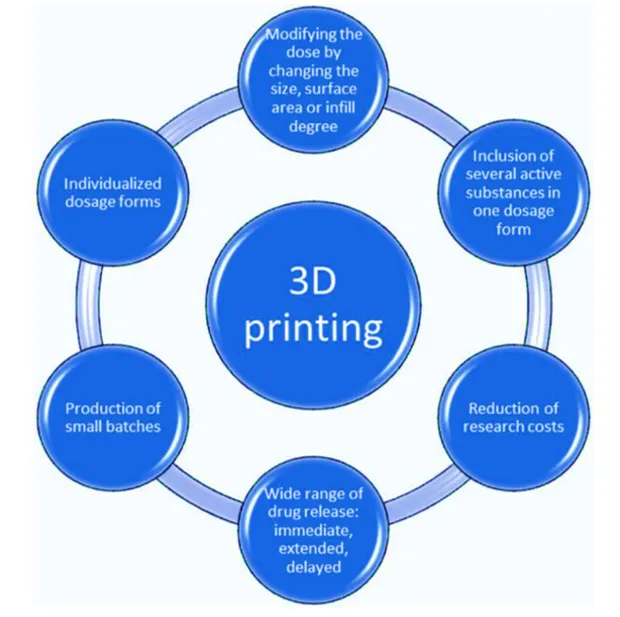
Figure 1: Scope of 3D Printing
ADVANTAGES:
Wide range of excipients are available to choose from, and the system can hold a large amount of drug.
No support material is needed, and the printing process is very accurate (1,5,10).
It works well for medications that release drugs quickly.
The equipment is simple and affordable, with high precision (3,18).
It can create a variety of 3D shapes.
Disposable syringes can be used to easily switch between materials (2,8,12).
The equipment is simple and inexpensive, and printing can take place at room temperature (11,13,15).
DISADVANTAGES:
Designing the product is not very flexible.
Packaging and shipping involve huge expenses.
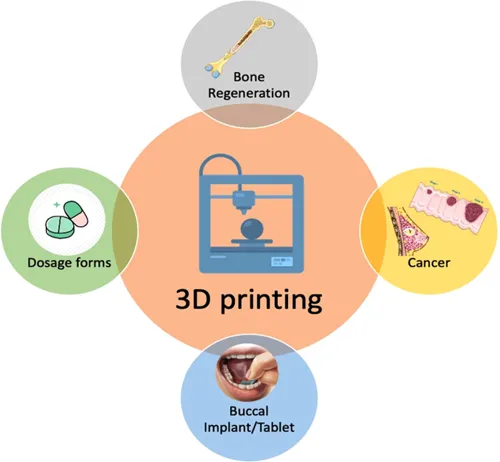
Figure 2: Application of 3D Printing
Types of 3D printing techniques:
Vat Polymerization
Material Extrusion
Sheet Lamination
Directed Energy Deposition
Material Jetting
Binder Jetting
Powder Bed Fusion
VAT POLYMERIZATION (3,16,18):
It is a 3D printing technique that uses a liquid resin and UV light to form solid layers one by one.
How it works: UV light is used to harden specific parts of the liquid resin, forming each layer.
Examples: SLA, DLP
Key feature: It produces very smooth and detailed prints.
Use: For dental, medical models, and prototypes.
By using customizable architectures, manufacturers can design complex geometrical structures that dictate exactly how and when a drug is released into the body.
MATERIAL EXTRUSION(5,6,17):
A thermoplastic material is heated and pushed through a nozzle, then laid down layer by layer to produce a 3D object.
Instrumentation includes
Filament spool: supplies the material (such as PLA or ABS)
Heated nozzle (extruder): melts and pushes the material
Build platform (bed): where the layers are placed
Motion system: moves the nozzle in different directions
SHEET LAMINATION(18):
Working principle: Thin sheets are stacked, glued together, and cut layer by layer.
Instrumentation includes
Sheet feeder: provides the material layers
Laser cutter / blade: cuts the layers
Build platform: holds the object during printing
Idea: It works like stacking and cutting coloured paper sheets.
Use: For making concept models and low-cost prototypes.
It Provides multi-layered sheets of material for pharmaceutical grade packaging
It provides the laminated sheets which protects the medication from moisture and
DIRECTED ENERGY DEPOSITION(17):
Working principle: A focused energy source is used to melt and deposit material.
Laser/electron beam nozzle: delivers the energy
Metal wire/powder feeder: supplies the material
Robotic arm: moves the nozzle around
Idea: It is like a welding gun that builds various shapes
Use: It can design multi layered drug tablets (printlets), as it can have a control over the geometric structures. Thereby the pharmacokinetic profile of the drug can be adjusted as per the requirement.
MATERIAL JETTING(28):
How it works: Tiny droplets of material are sprayed and quickly hardened using UV light.
Instrumentation includes
Inkjet print head: sprays the material
UV curing lamp: hardens the droplets
Build tray: holds the object during printing
Idea: It functions like a colour inkjet printer but in three dimensions.
Use: For creating high-detail medical and prototype models.
It delivers micro sized droplets ( containing drug) through the nozzle, layers them to form a complex dosage forms.
BINDER JETTING(10):
Working principle: A liquid binder joins powder particles one layer at a time.
Instrumentation includes
Binder spray head
Powder bed
Roller/spreader
Idea: Similar to sprinkling sand and gluing it in specific areas.
Use: For making tablets and creating casting moulds.
POWDER BED FUSION(1):
Working principle: A laser or electron beam melts the powder into solid layers.
Instrumentation includes
High-energy laser
Powder bed
Recoater blade
Idea: similar to use of a laser to draw shapes on a bed of powder.
Use: It helps in designing patient specific, polymeric implants in orthopaedic sector.
Applications of 3 D printing in the pharmaceutical sector:
Personalized Medicine: 3D printing allows the preparation of medicines tailored to a specific persons age, weight, genetics and disease condition, improving treatment effectiveness.
Customized Drug Dosages: Different strengths of a drug can be printed according to tolerant requirements, reducing the risk of underdosing or overdosing.
Polypill Manufacturing: binary drugs can be combined into a exclusive tablet, improving tolerant compliance and simplifying medication schedules.
Disciplined Drug Release: 3D-printed tablets can be designed to release drugs immediately, slowly or at special times, enhancing sanative outcomes.
Complex Tablet Geometries: unparalleled tablet shapes and domestic structures can be produced to control drug dissolution and absorption rates.
Orodispersible Tablets: Fast dissolving tablets can be manufactured for pediatric , geriatric, and dysphagic patients who have difficulty swallowing.
Pediatric Formulations: Medicines with child friendly doses, shapes, and flavors can be easily prepared using 3D printing technology .
Geriatric Formulations: Customized medications for aged patients can improve safety and ease of administration.
On Demand Drug Production : Medicines can be produced when needed, reducing storage requirements and minimizing wastage.
Implant Fabrication: Drug loaded implants can be printed for long term and localized drug delivery.
Transdermal Drug Delivery Systems: Customized patches with right drug doses can be manufactured using 3D printing techniques.
Personalized Drug Combinations: Different medications can be incorporated into a exclusive dosage form according to singular patient needs.
Uninterrupted Release Tablets: Tablets can be designed to release drugs over large periods, reducing dosing frequency.
Retarded Release Formulations: Drug release can be delayed until the medication reaches a special region of the gastrointestinal tract.
Pulsatile Drug Delivery Systems: Medicines can be programmed to release drugs at predetermined intervals, matching the body's biological rhythms.
Tissue Engineering Scaffolds: 3D printing is used to create scaffolds that support tissue growth and regeneration for pharmaceutics research.
Drug Testing Models: synthetic tissues and organs can be printed for preclinical drug testing, reducing reliance on carnal studies.
Pharmaceutical Research and Development: speedy prototyping enables researchers to cursorily develop and evaluate modern dosage forms .
Personalized Cancer Therapy: Patient specific chemotherapy dosages and delivery systems can be produced to improve treatment outcomes.
Wound sanative Products: Drug loaded dressings and wound care materials can be fabricated for controlled medication release.
Microneedle Systems : 3D printing can produce microneedle patches for pain free and effective drug administration through the skin.
Dental Drug Delivery Devices: Customized dental implants and drug releasing oral devices can be manufactured for dental treatments.
Vaccine Delivery Systems: fresh vaccine formulations and delivery devices can be developed using 3D printing technologies.
Vagabond Drug Delivery Systems: particular dosage forms that float in the stomach can prolong drug residence time and improve absorption .
Gastro retentive Formulations: 3D-printed systems can remain in the stomach for large periods, enhancing sanative effectiveness .
Medical Device Manufacturing: Drug containing medical devices such as inhalers and implantable systems can be customized for patients.
Non subjective Trial Medication Production: little batches of investigational drugs can be produced cursorily and accurately for non subjective studies .
ReducedManufacturingWaste: 3D printing uses materials efficiently, minimizing waste during pharmaceutics production.
Decentralized pharmaceutics manufacturing: Medicines can be produced in hospitals, pharmacies, or outside locations, improving access to essential drugs.
Limitations of 3d printing:
3D printing mostly works with materials like plastics, metals, ceramics, and glass, but these materials often don’t have the same qualities as products made using traditional methods.
Plastics can bend, shrink, or not stick well together between layers, while metals may have tiny holes, which weakens them and makes them less durable.
Materials like glass or gold are still being developed and aren’t widely used yet, which limits how many different things can be made with 3D printing.
Designing complex shapes can be tough.
Things like overhangs, bridges, or tiny inside parts often need temporary supports to hold them up during printing. These supports have to be removed later and can leave marks on the final product. Also, the 3D model needs to be perfect, with no holes or mistakes, otherwise the print won’t work.
The size of the object you can print depends on the printer’s build area.
Home printers usually can only handle objects up to around 8 to 12 inches on each side. So big items need to be printed in parts and put together later, which can make the final product weaker. Industrial printers can make bigger objects, but they are costly and not easy to get.
3D printing is slower than methods like traditional manufacturing, especially for big or detailed parts.
Printing can take hours or even days based on how big the object is, how thick each layer is, and how complex the design is. This makes it not great for making lots of copies of the same item, where methods like injection moulding are much faster.
Since 3D printing builds things layer by layer, parts can be weaker along the lines where the layers meet.
This can make the final object break more easily or not perform as well as something made with traditional techniques. The type of material used and the way the object is positioned during printing also affect how strong it ends up being.
High-quality 3D printers and materials can cost a lot, with machines ranging up-to thousands of dollars.
Beyond this, 3D printing uses a lot more energy than methods like injection moulding, which makes it less efficient for making many products at once.
Some 3D printers can release very small particles and harmful chemicals into the air, which can be dangerous in closed spaces.
There’s also a risk of making dangerous things like weapons, and there are concerns about copying designs without permission, since digital files can be easily shared.
The level of detail you can get from a 3D print depends on the size of the printer’s nozzle or laser spot, usually around 100 to 200 microns.
This makes it hard to create very fine details or very complex features.To get better detail; you need thinner layers, which take longer to print.
Most 3D printed objects need extra work after printing, like sanding, cleaning, or curing, to look or function properly.This extra step takes more time and effort.
Future of 3D Printing:
Future progress is likely to focus on advanced bioinks, tissues with blood vessels, and the creation of working organs (10,12).
Combining 3D printing with digital health tools and personalized medicine could speed up the use of these technologies in real medical settings (7,11,13).Ongoing improvements in materials and printing techniques could eventually allow for the making of fully working tissues and organs for use in transplants (7,11,13).
The big idea behind 3D printing is to have "a factory in every home." Even though it might seem odd, the idea of having a machine that can quickly create a wide variety of customizable items is very appealing.
Just like computers and smartphones have helped billions of people, 3D printers have the potential to do the same for manufacturing (9,5,10).
According to Grandview Research, the global 3D printing market was worth $20.37 billion in 2023 and is expected to grow to over $88.25 billion by 2030, with an average yearly growth rate of 23.3%.
This growth is likely to be driven by increased research and development and a higher need for prototyping in many industries, such as automotive, aerospace, defence, and healthcare.
Future developments are expected to focus on advanced bioinks, vascularized tissue constructs, and functional organ fabrication (13,14). Integration with digital healthcare technologies and personalized medicine approaches is expected to accelerate clinical translation (7,11,13). Continued advances in biomaterials and bioprinting technologies may enable the production of fully functional tissues and organs for transplantation (17,18).
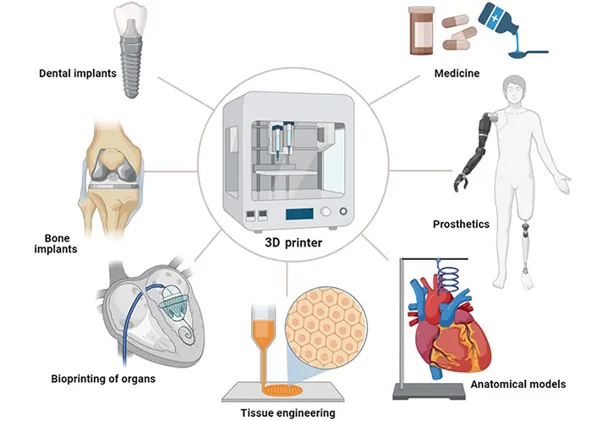
Figure 3: Use of 3D Printing technique at different levels of Healthcare
REFERENCES
Goyanes A, Wang J, Buanz A, Martínez-Pacheco R, Telford R, Gaisford S, Basit AW.3D Printing of Medicines: Engineering Novel Oral Devices with Unique Design and Drug Release Characteristics.Mol Pharm.2015;12(11):4077–4084.
Khaled SA, Burley JC, Alexander MR, Yang J, Roberts CJ.3D Printing of Five-in-One Dose Combination Polypill with Defined Immediate and Sustained Release Profiles.J Control Release.2015;217:308–314.
Wang J, Goyanes A, Gaisford S, Basit AW. Stereolithographic (SLA) 3D Printing of Oral Modified-Release Dosage Forms.Int J Pharm.2016;503(1–2):207–212.
Konta AA, García-Piña M, Serrano DR. Personalised 3D Printed Medicines: Which Techniques and Polymers Are More Successful Bioengineering.2017;4(4):79.
Pinho LAG, Lima AL, Sa-Barreto LL, Gratieri T, Gelfuso GM, Cunha-Filho M.Preformulation Studies to Guide the Production of Medicines by Fused Deposition Modeling 3D Printing.AAPS PharmSciTech.2021;22:1–12.
Quodbach J, Bogdahn M, Breitkreutz J, et al.Quality of FDM 3D Printed Medicines for Pediatrics.TherInnovRegul Sci.2022;56:910–928.
Beer N, Hegger I, Kaae S, et al. Scenarios for 3D Printing of Personalized Medicines—A Case Study.Explor Res Clin Soc Pharm.2021;4:100073.
Fernández-García R, Prada M, Bolás-Fernández F, Ballesteros MP, Serrano DR.Oral Fixed-Dose Combination Pharmaceutical Products: Industrial Manufacturing Versus Personalized 3D Printing.Pharm Res.2020;37:132.
Genina N, Boetker JP, Colombo S, Harmankaya N, Rantanen J, Bohr A. Antimicrobial 3D-Printed Tablets for Personalized Therapy.Int J Pharm.2017;547(1–2):327–335.
Norman J, Madurawe RD, Moore CMV, Khan MA, Khairuzzaman A. A New Chapter in Pharmaceutical Manufacturing: 3D-Printed Drug Products.Adv Drug Deliv Rev.2017;108:39–50.
Trenfield SJ, Awad A, Goyanes A, Gaisford S, Basit AW.
3D Printing Pharmaceuticals: Drug Development to Frontline Care.TrendsPharmacol Sci.2018;39(5):440–451.
Jamróz W, Szafraniec J, Kurek M, Jachowicz R.3D Printing in Pharmaceutical and Medical Applications – Recent Achievements and Challenges.Pharm Res.2018;35(9):176.
Awad A, Trenfield SJ, Goyanes A, Gaisford S, Basit AW.
Reshaping Drug Development Using 3D Printing.DrugDiscov Today.2018;23(8):1547–1555.
U.S. Food and Drug Administration.Spritam (Levetiracetam): First FDA Approved 3D Printed Drug Product.FDA; 2015.
Ventola CL.Medical Applications for 3D Printing: Current and Projected Uses.Pharm Ther.2014;39(10):704–711.
Hull CW.Apparatus for Production of Three-Dimensional Objects by Stereolithography.U.S.Patent 4,575,330; 1986.
Gibson I, Rosen D, Stucker B.Additive Manufacturing Technologies: 3D Printing, Rapid Prototyping, and Direct Digital Manufacturing.2nd ed.New York: Springer; 2015.
Reference
Goyanes A, Wang J, Buanz A, Martínez-Pacheco R, Telford R, Gaisford S, Basit AW.3D Printing of Medicines: Engineering Novel Oral Devices with Unique Design and Drug Release Characteristics.Mol Pharm.2015;12(11):4077–4084.
Khaled SA, Burley JC, Alexander MR, Yang J, Roberts CJ.3D Printing of Five-in-One Dose Combination Polypill with Defined Immediate and Sustained Release Profiles.J Control Release.2015;217:308–314.
Wang J, Goyanes A, Gaisford S, Basit AW. Stereolithographic (SLA) 3D Printing of Oral Modified-Release Dosage Forms.Int J Pharm.2016;503(1–2):207–212.
Konta AA, García-Piña M, Serrano DR. Personalised 3D Printed Medicines: Which Techniques and Polymers Are More Successful Bioengineering.2017;4(4):79.
Pinho LAG, Lima AL, Sa-Barreto LL, Gratieri T, Gelfuso GM, Cunha-Filho M.Preformulation Studies to Guide the Production of Medicines by Fused Deposition Modeling 3D Printing.AAPS PharmSciTech.2021;22:1–12.
Quodbach J, Bogdahn M, Breitkreutz J, et al.Quality of FDM 3D Printed Medicines for Pediatrics.TherInnovRegul Sci.2022;56:910–928.
Beer N, Hegger I, Kaae S, et al. Scenarios for 3D Printing of Personalized Medicines—A Case Study.Explor Res Clin Soc Pharm.2021;4:100073.
Fernández-García R, Prada M, Bolás-Fernández F, Ballesteros MP, Serrano DR.Oral Fixed-Dose Combination Pharmaceutical Products: Industrial Manufacturing Versus Personalized 3D Printing.Pharm Res.2020;37:132.
Genina N, Boetker JP, Colombo S, Harmankaya N, Rantanen J, Bohr A. Antimicrobial 3D-Printed Tablets for Personalized Therapy.Int J Pharm.2017;547(1–2):327–335.
Norman J, Madurawe RD, Moore CMV, Khan MA, Khairuzzaman A. A New Chapter in Pharmaceutical Manufacturing: 3D-Printed Drug Products.Adv Drug Deliv Rev.2017;108:39–50.
Trenfield SJ, Awad A, Goyanes A, Gaisford S, Basit AW.
3D Printing Pharmaceuticals: Drug Development to Frontline Care.TrendsPharmacol Sci.2018;39(5):440–451.
Jamróz W, Szafraniec J, Kurek M, Jachowicz R.3D Printing in Pharmaceutical and Medical Applications – Recent Achievements and Challenges.Pharm Res.2018;35(9):176.
Awad A, Trenfield SJ, Goyanes A, Gaisford S, Basit AW.
Reshaping Drug Development Using 3D Printing.DrugDiscov Today.2018;23(8):1547–1555.
U.S. Food and Drug Administration.Spritam (Levetiracetam): First FDA Approved 3D Printed Drug Product.FDA; 2015.
Ventola CL.Medical Applications for 3D Printing: Current and Projected Uses.Pharm Ther.2014;39(10):704–711.
Hull CW.Apparatus for Production of Three-Dimensional Objects by Stereolithography.U.S.Patent 4,575,330; 1986.
Gibson I, Rosen D, Stucker B.Additive Manufacturing Technologies: 3D Printing, Rapid Prototyping, and Direct Digital Manufacturing.2nd ed.New York: Springer; 2015.
Archana Terala
Corresponding author
Assistant professor, Department of Pharmaceutics, Surabhi Dayakar Rao college of Pharmacy, Rimmanaguda, Telangana, India, 502312
Bandi Shravani
Co-author
Student, Surabhi Dayakar Rao college of Pharmacy, Rimmanaguda, Telangana, India, 502312
Neerudi Bhuvana
Co-author
Student, Surabhi Dayakar Rao college of Pharmacy, Rimmanaguda, Telangana, India, 502312
Chinnamatam Sowjanya
Co-author
Student, Surabhi Dayakar Rao college of Pharmacy, Rimmanaguda, Telangana, India, 502312
Sameera Begum
Co-author
Student, Surabhi Dayakar Rao college of Pharmacy, Rimmanaguda, Telangana, India, 502312
Archana Terala, Bandi Shravani, Neerudi Bhuvana, Chinnamatam Sowjanya, Sameera Begum, A Review on Applications of 3D Printing in the Pharmaceutical Sector, Int. J. of Pharm. Sci., 2026, Vol 4, Issue 7, 970-978. https://doi.org/10.5281/zenodo.21194128



 10.5281/zenodo.21194128