

We use cookies to ensure our website works properly and to personalise your experience. Cookies policy
P.S.G.V.P .M'S College of Phramacy.
Acorus calamus Linn., commonly known as sweet flag or Vacha, is an important medicinal plant belonging to the family Acoraceae. It is a perennial, aromatic, semiaquatic herb widely distributed across different temperate and tropical regions. The plant has been traditionally used in Ayurveda and other traditional systems of medicine for various conditions, including digestive disorders, cough, fever, neurological disorders, and memory-related problems. The rhizome is the primary medicinally utilized part of the plant and contains several important phytochemical constituents, including ?-asarone, ?-asarone, eugenol, acorone, calamene and other volatile compounds. Various experimental studies have reported its potential antioxidant, antimicrobial, anti-inflammatory, antidiabetic, antispasmodic, and neuroprotective activities. The present review focuses on the botanical characteristics, taxonomical classification, traditional importance, phytochemical constituents, pharmacological activities, medicinal uses and safety aspects of Acorus calamus. It also highlights the importance of standardization, quality control and future research for its pharmaceutical applications. However, the presence of ?- asarone raises important toxicological concerns, particularly regarding its potential carcinogenic effects observed in experimental studies. Therefore, further toxicological investigations and well-designed clinical studies are necessary to establish its safety and therapeutic effectiveness.
Acorus calamus Linn., commonly known as sweet flag, calamus, or Vacha, is a perennial, aromatic, semiaquatic medicinal herb belonging to the family Acoraceae. It is characterized by creeping, aromatic rhizomes and long, sword-shaped leaves. The plant generally grows in moist habitats such as marshes, wetlands, ponds, and the banks of streams. The rhizome is the principal medicinally used part of the plant. It is traditionally collected, cleaned, dried, and used in different herbal preparations. Due to its characteristic aromatic properties, it has been utilized in traditional medicine for several centuries. Acorus calamus is widely distributed in different regions of Asia, Europe, and North America. In Ayurveda, it is known as Vacha and is traditionally used for digestive complaints, respiratory disorders, and certain neurological conditions. Various traditional formulations containing Vacha include Vachadi Churna, Vachadi Ghrita, and Vacha Avaleha. Phytochemical investigations have identified several important constituents in the plant, particularly α-asarone, β-asarone, eugenol and different sesquiterpenoids. These compounds have attracted scientific interest because of their potential pharmacological activities. Experimental investigations have reported antioxidant, antimicrobial, anti-inflammatory, antidiabetic, antispasmodic, and neuroprotective properties. However, the presence of β-asarone raises important safety concerns because of its toxicological potential. Therefore, the present review aims to discuss the botanical characteristics, classification, traditional importance, phytochemical constituents, pharmacological activities, medicinal applications, and toxicity of Acorus calamus, along with the importance of its standardization and future research.[1,2]
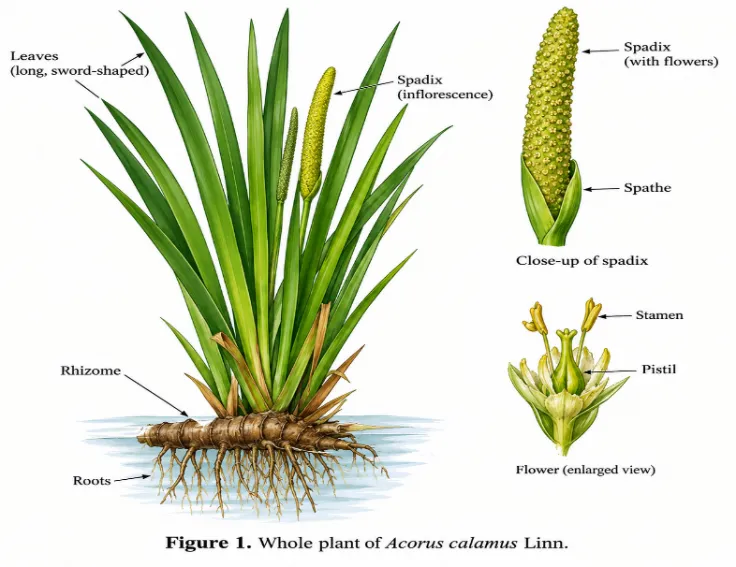
1.1. COMMON NAME
Acorus calamus is commonly known as sweet flag and Calamus, with other vernacular names including beewort, flag root, myrtle flag, sweet cane, sweet cinnamon, sweet sedge, myrtle grass, and Wada Kaha. The generic name Acorus is derived from the Greek acoron used by Dioscorides, believed to originate from kore (pupil), as the root juice was used for eye disorders. The specific epithet calamus comes from the Greek kalamos, meaning "reed," a a cognate with the Latin culmus (stalk) and Arabic qalam (pen), referring to its reed-like leaves. The common name "sweet flag" refers to its sweet aroma and resemblance to iris species, known as flags since the 13th century [3].
1.2 TRADITIONAL IMPORTANCE OF AYUTVEDA
Acorus calamus Linn., also referred to as Vacha in Ayurveda, is a significant medicinal herb that has long been utilized in Indian medicine. It is frequently found in India's marshy, high-rainfall areas, such as Himachal Pradesh, Kashmir, Sikkim, Manipur, and Nagaland. The plant typically thrives in clayey loam, light alluvial soil, and moist soil. The rhizome of Vacha has long been prized in Ayurveda for its use in treating neurological and digestive issues. Vachadi Churna, Vachadi Ghrita, and Vacha Avaleha are among the traditional Ayurvedic formulations that contain it. [4]
2. TAXONOMICAL / CLASSIFICATION
Table 1: Taxonomical Classification of Acorus Calamus [5]
| Kingdom | Plantae |
|---|---|
| Subkingdom | Tracheobionta |
| Super division | Spermatophyta |
| Division | Magnoliophyte |
| Class | Liliopsida |
| Sub Class | Arecina |
| order | Arales, |
| Family | Acoraceae, |
| Genus | Acorus |
| Species | calamus |
3. VERNACULAR NAME
Table 2: Vernacular Names of Acorus Calamus [5]
| English | Sweet Flag |
|---|---|
| Bengali | Bach |
| Gujarat | Ghodvach |
| Unani | Bacch |
| Hindi | Bach ,Gora-bach |
| Gora | bach, Vasa Bach, |
| Marathi | Vekhand a a a |
| Tamil | Vasambu |
| Telugu | Vadaja , Vasa |
| Kannada | Baje , Narru Berua |
| Malayalam | Vayambu |
| Sanskrit | Bhutanashini , Ugragandh, |
4. BOTANICAL DESCRIPTION:
In moist environments such as marshes, ponds, and streams, Acorus calamus Linn. is a perennial, fragrant marsh herb that can reach heights of one to two meters. Herbaceous with creeping growth is its habit
Acorus calamus L. is an aromatic, perennial herb that grows in aquatic and marshy environments and usually attains a height of approximately 1–2 metres. It is commonly found in wetlands, ponds, marshes and near water streams. The plant is recognized by its creeping underground rhizome, elongated sword-like leaves and characteristic spike-shaped inflorescence.
4.1 RHIZOME: The rhizome is a thick, branched and horizontally spreading underground structure with a cylindrical shape. It may reach approximately 2.5 cm in diameter. Its outer surface is generally light brown, whereas the inner portion is whitish to pinkish. It possesses a distinct aromatic smell and bitter taste. Numerous fibrous roots develop from its lower surface.
4.2 LEAVES: The leaves are elongated, narrow and erect, with a sword-like appearance. They are arranged alternately in two opposite rows and generally measure about 0.7–1.7 cm in width. The leaf surface exhibits parallel venation, a prominent central midrib and slightly wavy margins. Their appearance resembles the leaves of iris plants.
4.3 FLOWERS: The flowers are minute, sessile and bisexual, usually appearing greenish-yellow to brownish in colour. They are closely arranged on a cylindrical structure called a spadix, which generally measures approximately 3–8 cm in length. The inflorescence develops laterally and is associated with a leaf-like spathe.
4.4 FRUITS: The fruits are small, berry-like structures that may contain a few seeds. Their development and seed production depend on the cytotype and geographical origin of the plant. In certain populations, particularly sterile triploid forms, fruit and seed formation may be poorly developed or completely absent. [6]
5. TYPES / VARIETIES OF ACROUS CALAMUS
The number of chromosomes, geographic distribution, and essential oil composition of Acorus calamus vary. These differences are linked to three different ploidy levels: diploid, triploid, and tetraploid cytotypes. In general, x = 12 is regarded as the basic chromosome number. Acorus calamus var. americanus is frequently linked to the diploid cytotype (2n = 24). It is mostly found in regions of temperate Asia and North America. The amount of β-asarone in its essential oil is usually very low or undetectable. Acorus calamus var. calamus is linked to the triploid cytotype (2n = 36). In addition to being naturalized in Europe and North America, it can be found in some regions of Asia. The amount of β-asarone in its essential oil varies. Acorus calamus var. verus is linked to the tetraploid cytotype (2n = 48). It is mostly found in temperate and tropical parts of Asia, including India. Geographically, the composition of its essential oil varies, and β-asarone may be present in relatively high concentrations. There have also been sporadic reports of hexaploid cytotypes (2n = 66 or 72). Different cytotypes and geographic populations have different essential oil chemical compositions. The toxicological and carcinogenic potential of β-asarone has been shown in animal studies, making it a significant safety concern. For the purpose of evaluating [6].
6. PLANT PARTS USED
Traditional medical systems have long used Acorus calamus L. Although leaves, roots, and other aerial parts have also been reported in traditional practices, the rhizome is the main part of the plant used medicinally. Ayurveda has long used the rhizome to treat rheumatic conditions, fever, asthma, cough, digestive issues, and nervous system disorders. Additionally, it is utilized in a variety of conventional preparations, such as pastes, powders, and formulations based on ghee. The stem has historically been used to treat colds and coughs, while the leaves have been reported to be applied externally to wounds in traditional medicine. Additionally, the plant has been utilized in various regional traditional medical systems, such as Chinese, Unani, and Ayurvedic medicine. The rhizome's phytochemical components and aromatic nature make it the most widely used medicinal part. [6]
7. PHYTOCHEMICAL CONSTITUENTS
Acorus calamus L. contains a wide range of phytochemicals, mainly present in its aromatic rhizome and essential oil. The major chemical constituents belong to three important groups: phenylpropanoids, sesquiterpenoids, and monoterpenes. Among these compounds, α-asarone and β-asarone are considered the principal phenylpropanoids.
7.1 Phenylpropanoids: Several phenylpropanoid compounds have been identified in Acorus calamus, including α-asarone, β-asarone, γ-asarone, eugenol, methyl eugenol, isoeugenol, elemicin and eugenyl acetate. These compounds contribute to the chemical composition of the plant.
7.2 Sesquiterpenoids: The rhizome is also a source of different sesquiterpenoid compounds, such as acorone, shyobunone, calamenenol and calameone. In a phytochemical investigation, Dong et al. (2010) reported the isolation of three previously unreported sesquiterpenes together with 25 known compounds from the rhizome.
7.3 Monoterpenes: The essential oil of Acorus calamus also contains monoterpenes, including α-pinene, β-pinene, camphene, p-cymene, 1,8-cineole and camphor.
7.4 Variation in Chemical Composition: The chemical profile of Acorus calamus is not constant and may differ depending on its geographical location, chromosome number, environmental conditions and extraction procedures. Diploid cytotypes usually possess very low or undetectable levels of β-asarone, whereas triploid and tetraploid forms may contain different concentrations of this compound. Therefore, phytochemical analysis and chemical standardization are essential for ensuring the identity and quality of the plant material.
The presence of these different phytochemical groups makes Acorus calamus an important subject of pharmacological investigation. Several constituents have been studied for their potential biological activities [7].
8. PHARMACOLOGICAL ACTIVITY
Acorus calamus shows diverse pharmacological activities—mainly CNS-related.
8.1 NOOTROPIC / CNS: Brahmi Ghrita containing Vacha improves learning and memory in Morris water maze and elevated plus maze models at 30-100 mg/kg, useful as a memory enhancer, anticonvulsant, sedative, and anxiolytic (α-asarone shows anxiolytic activity in EPM/HBT).
8.2 ANTI-INFLAMMATORY: ethanolic leaf extract (ACL) inhibits NF-κB, IRF3, IL-6 and IL-8 in HaCaT cells induced by polyI:C/PGN. Antifungal: rhizome ethanol/acetone extract shows 100% inhibition of phytopathogenic fungi and 29.5 mm zone against Fusarium oxysporum at 1000 mg/ml.
8.3 ANTIDIABETIC: 200 mg/kg extract for 21 days in STZ-induced (40 mg/kg) diabetic rats reduces blood glucose, lipid profile, glucose-6-phosphatase, and fructose-1,6-bisphosphatase and restores insulin, glycogen, and pancreatic histology.
8.4 ANTIOXIDANT: Methanolic rhizome extract shows strong DPPH scavenging (IC50 143.35 µg/ml), reducing power, and metal chelating activity.
8.5 ANTIBACTERIAL: ethanolic extract active against B. subtilis, S. aureus, E. coli, P. mirabilis, P. aeruginosa; aqueous active only against Gram-positive.
8.6 ANTICANCER: Rhizome and oil inhibit AGS gastric cancer cells, induce G1 arrest, downregulate Oct4/NS, and inhibit HUVEC angiogenesis (contains epiprezizaene, valencene).
8.7 ANTISPASMODIC: crude rhizome extract inhibits spontaneous and K+ (80 mM)-induced contraction in rabbit jejunum (EC50 0.42 and 0.13 mg/ml) via calcium channel blockade like verapamil.
8.8 INSECTICIDAL: ethanolic extract LC50 109.54, 52.51, 41.11 mg/l against Drosophila melanogaster larvae, male and female adults.[1].
9. TRADITIONAL / AYURVEDIC USES
In Ayurveda, the rhizome of A. calamus (Vacha) is considered as Medhya drug - aphrodisiac, laxative, diuretic, antispasmodic, carminative, aromatic, stimulant, bitter tonic, emetic, expectorant, and emmenagogue. It is used for chronic diarrhea, dysentery, bronchial catarrh, intermittent fever, tympanitis, colic, otitis media, cough, asthma, epilepsy, schizophrenia, memory weakness, liver-kidney disorders, rheumatism and eczema. Rhizome skin is hemostatic. It is used as powder, balm, enema, tablet and in ghee formulations
9.1 WEAK MEMORY /INTELLECT —improves memory, focus and grasping power.
9.2 EPILEPSY/NERVOUS DISORDER—traditional anticonvulsant.
9.3 DIGESTIVE ISSUES—indigestion, flatulence, loss of appetite. For colds/coughs—bronchitis and phlegm.
9.4 SPEECH DISORDER in children, rhizome paste with honey applied on the tongue in rural South India is a a traditional speech and intelligence booster. Garhwali tribals use decoction as a beverage to prevent intoxication and gastroenteritis in children and jaundice by knotting rhizome around the abdomen; the Tirumala Hills use it for dental problems.[8]
10. TOXICITY AND SAFETY
The use of Acorus calamus L. requires safety consideration because of the presence of β-asarone. Its concentration varies with the plant variety and geographical location. Toxicological studies have raised concerns regarding its prolonged exposure.
10.1 TOXICOLOGICAL EFFECT
Experimental studies have indicated that β-asarone may produce harmful effects, including carcinogenic potential in animals. Therefore, its toxicity must be carefully evaluated.
10.2 VARIATION IN β- ASARONE CONTENT
The β-asarone level differs among diploid, triploid and tetraploid varieties. Diploid plants generally contain very low amounts, while other cytotypes may contain higher levels.
10.3 SAFETY EVALUATION
Most safety findings are based on laboratory and animal studies. Further research is needed to establish the safety of Acorus calamus in humans.
10.4 IMPORTANCE OF STANDARDIZATION
Techniques such as HPLC, HPTLC, and GC-MS help determine β-asarone content and maintain the quality and consistency of plant materials [9, 10].
11. FUTURE NEED
Acorus calamus L. has shown promising pharmacological potential; however, further research is needed to establish its safety and therapeutic effectiveness.
11.1 CLINICAL RESEARCH: Human clinical studies are required to confirm its efficacy, safety, suitable dosage, and possible long-term effects.
11.2 NOVEL FORMULATIONS: Advanced formulations, such as nanoparticles, phytosomes and nanoemulsions, may improve the stability and delivery of its bioactive constituents.
11.3 EXTRACT STANDARDIZATION: Standardized extracts with controlled phytochemical composition are essential for ensuring consistent quality and safety.
11.4 TOXICOLOGICAL STUDIES: Further investigations are necessary to evaluate the toxicity of different extracts, particularly those containing β-asarone.
11.5 QUALITY CONTROL: Techniques such as HPLC, HPTLC and GC-MS are useful for identifying phytochemicals, detecting adulteration and maintaining product quality.
11.6 BIOACTIVE COMPOUNDS: Further studies are needed to isolate and identify compounds responsible for the plant's reported pharmacological activities.
11.7 SCIENTIFIC VALIDATION: Traditional Ayurvedic uses should be evaluated through modern experimental and clinical research to establish their therapeutic value.. [4]
CONCLUSION
Acorus calamus Linn. is a historically significant medicinal plant extensively employed in Ayurveda and other traditional systems of medicine. The present review provides a comprehensive account of its botanical features, ethnomedicinal importance, phytochemical constituents, pharmacological activities, and therapeutic applications. The rhizome is the primary medicinally valuable part, containing important bioactive principles, especially α-asarone and β-asarone, together with various essential oil components. A wide range of experimental studies have evidenced its antioxidant, antimicrobial, anti-inflammatory, antidiabetic, antispasmodic, neuroprotective, and cognition-enhancing potential. Such findings substantiate its traditional therapeutic relevance and highlight its promise for future pharmaceutical investigations. Nevertheless, the phytochemical composition of Acorus calamus exhibits variation depending on geographic source, ploidy level, and chemotype. The occurrence of β-asarone poses a significant safety concern due to its documented toxic and carcinogenic effects in animal studies. Hence, accurate botanical identification, standardization, quality control, and systematic toxicity assessment are imperative prior to its pharmaceutical utilization. Overall, Acorus calamus is a valuable medicinal herb with considerable pharmacological potential. Further studies encompassing detailed phytochemical profiling, development of standardized formulations, comprehensive toxicological evaluation, and well-designed clinical trials are warranted to confirm its safety and efficacy. Such efforts will facilitate the development of safe, effective, and scientifically validated herbal medicines.
REFERENCES





Sejal Patil, Neha Patil, Mrunal Pendharkar, Jayshri Chavan, Dr. Sunil Pawar, A Review on Phytochemicals of Acorus Calamus [Sweet Flag], Int. J. of Pharm. Sci., 2026, Vol 4, Issue 11, 3072-3077. https://doi.org/10.5281/zenodo.24339536
 10.5281/zenodo.24339536