

We use cookies to ensure our website works properly and to personalise your experience. Cookies policy
Department of Pharmacology, SHEAT College of Pharmacy, Ghani Ayer, Varanasi, Uttar Pradesh
Herbal plants act as a significant source for discovering new compounds with potential therapeutic activities. Polyalthia longifolia, which is commonly known as an Indian mast tree, has various pharmacological properties, such as an anticancer, ulcer protective, hypoglycemic, hypotensive, a corrosion inhibitor, a bio-adsorbent, and few more. Moreover, it is known as false ashoka owing to its close resemblance with Saraca indica (ashoka tree). Various compounds have been reported from the extract of some parts of the plant, such as leaves, bark, root, and seeds. These extracts possess an ability to treat a number of human ailments, such as fever, ulcer, skin diseases, helminthiasis, and cardiac problems. Studies performed on the leave extract shows evidence that some compounds cause cell death in various cancer cell lines. The plant also has some biological applications, such as antibacterial, antiviral, and antimicrobial, which makes it clinically significant and useful. This review is an effort to explore and gather plant information in an organized manner. It reveals detailed information about the propagation, synonyms, vernaculars, varieties of plant, medicinal significance, ecology and distribution, botanical and ethnobotanical description, phytochemical constituents, and pharmacological activity of the plant.
Medicinal plants play an important role in human’s life. Herbs and humans have a great relation with each other. At present days medicinals plants plays vital role in scientific development and holds much more hidden treasure to be explored as almost eighty percent human population in developing countries dependent on plant resources for their primary health care1. Plant based therapy has been used as a vital component in traditional medicine system and also serves as the main source of inspiration for pharmaceutical drugs used in the defence against various diseases2. The genus Polyalthia includes about 120 species found mainly in Africa, South and South Eastern Asia, Australia and New Zealand. Polyalthia longifolia is one of the most important indigenous medicinal plant in indian medicinal literature. Almost all the parts of this plant are used in india for medicinal purposes for the treatments of various ailments and the significant medicinal properties was further reported through scientific researches3. The plant grows throught the tropical and subtropical parts of India up to an altitude of 1500 meter. A tall, evergreen, handsome, pyramid like, columnar tree, unvided, growing up to 12m or more. Branches short about 1-2 m or long, glabrous and pendulous. Leaves are alternate, exstipulate, midly aromatic and it’s belonging to the family Annonaceae4. Number of chemical constituents has been identified from the leaves such as azafluorene alkaloid and three new Aporphin N- oxide alkaloids.
Scientific Name: Polyalthia longifolia L.
Common Names: False Ashoka, Buddha Tree, Green champa, Indian mast tree, and Indian Fir tree.
TAXONOMICAL CLASSIFICATION (According to Bentham & Hooker)
Kingdom: Plantae
Sub kingdom: Phanerogams
Class: Dicotyledons
Sub class: Polypetalae
Series: Thalamiflorae
Order: Ranales
Family: Annonaceae
Genus: Polyalthia
Species: longifolia L.
GEOGRAPHIC DISTRIBUTION
The native geographic distribution includes India Andaman & Nicobar Islands, Andhra Pradesh, West Bengal, Assam, Arunachal Pradesh, Bihar, Punjab, Rajasthan, Maharashtra, Manipur, Mizoram, Tamil Nadu, Gujarat, Jharkhand, Karnataka, Uttar Pradesh, Delhi, Goa, Kerala, Madhya Pradesh5, and Sri Lanka. The exotic geographic distribution includes Bhutan, China, Pakistan and Nigeria, Philippines, Malaysia, East Africa, Madagascar, Northern Australia and Melanesia, Bangladesh, and the Caribbean Islands of Trinidad and Tobago6.
BOTANICAL DESCRIPTION:
The plant grows throughout the tropical and subtropical parts of India up to an altitude of 1500 m. The plant is tall, evergreen, pyramid-like, columnar tree. Main stem straight, undivided, growing up to 12 m or more. Branches slender, short, about 1-2 m long, glabrous, and pendulous. Young plants have straight trunks and weeping pendulous branch. The longest branch is seen at the base and shorter at the end of the trunk, it gives conical crown appearance. Leaves are long narrow dark green and glossy. Leaf blade are ovate oblong shape to ovate-lanceolate shape with wavy margins7. Flowers are delicate pale green colour with wavy petals. The flowers last for a short period. It is usually two to three weeks. Seals are ovate triangular. Petals are greenish yellow. Fruits are borne in clusters of 10-20. It is usually void in shape. Initially fruits are green in colour but later it turns in to purple or black when ripe. Seeds are pale brown in colour and ovoid in shape8.
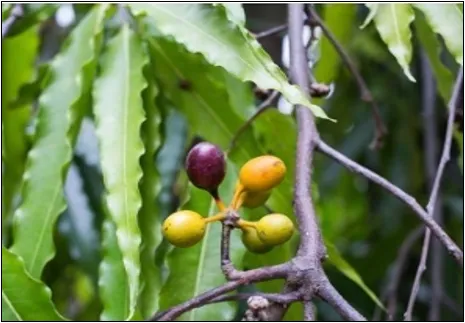
Figure 1: Polyalthia longifolia Seeds
Chemical Constituents Extracted from Seeds and Fruits
An analysis of the seeds of P. longifolia revealed the presence of percentage moisture (5.0 g), crude oil (7.5 g), crude protein (14.0 g), crude fiber (7.3 g), and total carbohydrate (65.3 g) per 100 g sample. The seeds showed the presence of macro- and micronutrients as well as various minerals like potassium, magnesium, calcium, iron, sodium, manganese, copper, zinc, nickel, cobalt, lead, and chromium9. Atolani et al. studied the seed oil of the plant obtained by the Soxhlet extraction. Fatty acids in major proportions were oleic acid (30.31%), linoleic acid (19.27%), palmitic acid (15.11%), and little proportions of tricosylic acid (6.10%) and stearic acid (5.56%) had been isolated from the seeds of the P. longifolia10. Amino acids present in the P. longifolia seeds were detected using paper chromatography technique. Results showed the presence of proline, l-glutamic acid, dl-threonine, l-tyrosine, dl-methionine, glycine, dl-isoleucine, l-hydroxy-proline11. Various minerals were reported from powdered ripe and unripe pericarps, namely calcium, potassium, sodium, and magnesium. Some minor elements, such as zinc, manganese, iron, nickel, chromium, lithium, and copper were also reported.
Ethnomedicinal uses
Traditionally dried bark powder is given with milk for relief in menorrhagia and leucorrhoea, decoction made from bark is used to cure mouth ulcers, the seeds of this plant were used as febrifuge, the bark is also used as a febrifuge in Balasore district of Orissa. It is also used as a very popular herb in Bangladesh due to its traditional uses in treatment of rheumatism, bone fracture and gastric ulcer12. The bark is used in skin diseases, fever, diabetes, hypertension and helmenthiasis. The leaves, stem bark and root extracts of Polyalthia longifolia var. Pendula possess high antipyretic activities comparable to aspirin. This may provide scientific evidence for its use as a traditional remedy for fever. The bark is used for the treatment of pyrexia and other bleeding disorders in India. Tribal people of Khargone, Madhya Pradesh use stem bark to cure malignant tumor also the fresh stem bark juice is used in the treatment of the various digestive disorders13. The leaves of Polyalthia longifolia is also prescribed as herbal recipe by traditional medicine practitioners (TMP) in Ilorin, Kwara State for the treatment of Diabetes mellitus, malarial fever, cough and hypertension. It shows its uterine disorder, and wound healing activity in rats from the ethanolic extract of leaves of Polyalthia longifolia. The plant has its utility in colitis, diarrhea, anorexia, sore throat, cough14 and helminthiasis as well as vitiated condition of Vatta and Pitta.
PHARMACOLOGICAL ACTIVITIES
Wound healing property
The wound healing effect of the ethanolic leaf extract of P. longifolia was examined using an excision wound model in rats. The study was assessed up to 14 days on the antero-dorsal side of the rats’ skin. The extract showed wound healing action by wound contraction upon topical application15. The bark extract of P. longifolia in different solvents, such as methanolic, n-hexane, and ethyl acetate for the isolation of active compounds, were responsible for the significant wound healing action. It increased the epithelization speed and contraction property of myofibroblasts and exhibited healing activity.
Antihyperglycemic activity
Lakshmi et al. evaluated the antidiabetic activity by administrating the bark extract of P. longifolia for 21 days in alloxan-induced diabetic rats. The study showed that the bark extract exhibited similar effectiveness to that of glipizide in controlling Type 1 diabetes. The bark extract in methanol, ethylacetate, and n-Hexane solvents showed a promising hypoglycemic activity by decreasing insulin levels. The extract also revealed homeostasis in biochemical parameters, such as cholesterol, urea, creatinine, and total protein as well as in enzyme activities16. The solvent extract of P. longifolia leaves had the ability to lower glucose levels; however it did not modify biochemical parameters. The extract showed an antihyperglycemic effect against sucrose-induced hyperglycemia17. The α-amylase and α-glucosidase enzymes catalyzed carbohydrate metabolism and increased plasma glucose level. The ethanol and chloroform extracts of the P. longifolia leaves had the ability to inhibit such enzymes. Therefore, the extract had the ability to reduce the rate of glucose absorption, which consequently inhibited a postprandial rise in plasma glucose.
Antibacterial Activity
Ghosh G. et al, 2011 described that the petroleum ether extract of Polyalthia longifolia var. angustifolia stem bark can yield a highly potent form of novel antibacterial molecule due to presence of steroidal alkaloid, by the process of tube dilution of petroleum ether extract against Escherichia coli, Bacillus subtilis, Salmonella typhi, Proteus mirabilis, Pseudomonas aeruginosa, Klebsiella sp., Staphylococcus aureus. Manasa M. et al. 2014 described antibacterial activity of methanolic extract of Polyalthia longifolia against a Gram-positive bacterium Staphylococcus aureus NCIM-2079 and two Gram negative bacteria Salmonella typhi MTCC-734 and klebsiella pneumoniae NCIM-2957 by inoculation in sterile nutrient broth at 37° C for 24-hour incubation, by the process of Agar well diffusion method Kavitha P A. et al, 201318 described that the flavanoids of leaves of Polyalthia longifolia from methanolic extract is very effective bioactive compound against Staphylococcus aureus, Streptococcus faecalis, Pseudomonas aeruginosa, Bacillus subtilis and Escherichia coli.
Anticancer Activity
Hepatocellular carcinoma (HCC) is one of the most common life-threatening malignancies which accounts for nearly 85% of the primary malignant tumours of liver and is the third most common causes of cancer. A.J.M Christina. et al, 2014 described that the methanolic extract of fruit of Polyalthia longifolia shows antioxidant activity, which reduced the effect of Diethylnitrosamine that causes DNA mutation in rats by dose dependent manner. S Rupachandra and D V L Sarada 201419 shows the cytotoxic peptide isolated from the seeds of Polyalthia longifolia with an average mass of 679.8 by the process of Liquid chromatography-electrospray ionization-Mass spectrometry (LC-ESI-MS/MS) analysis, plays significant antiproliferative role against lung (A549) cancer cells at concentration of 10 µg/ml and cervical (HELA) cancer cell lines at 30 µg/ml, respectively. Verma Monika et al, 200820 described that the leaves extract (A001) and its chloroform fraction (F002) of Polyalthia longifolia inhibited cell proliferation of various human cancer cell lines in which colon cancer cells SW-620 showed maximum inhibition with IC50 value 6.1 μg/ml. According to Gaurav Mahesh Doshi and Hemant D. Une, 2015 leaves and root extract of Polyalthia longifolia and Carissa congesta respectively, shows good anticancer activity on human leukemia cell line MOLT4 and human breast cancer cell line MCF7, respectively by the process of sulforhodamine B (SRB) assay.
Antiulcer activity
The methanolic extract of P. longifolia leaves was evaluated for in vivo ulcer-protective function. The experiment involved the use of wistar albino rats, in which ulcers were induced by ethanol and ethanol/HCl. Results showed that the extract possessed a good dose-dependent antiulcer activity 21. The aqueous and ethanolic extracts of the plant leaves showed an ability to reduce total acidity, ulcer index, and gastric content and enhance the pH of gastric pylorus ligation ulcer model22.
Antifungal Activity
Satish S, et al. 2010 shows the fraction of petroleum ether extract of leaves of Polyalthia longifolia recorded highly significant antifungal activity against all the test bacteria like Fusarium equiseti, Fusarium lateritium, Aspergillus candidus and Penicillium chrysogenum etc, by the process of poisoned food technique. Dileep N, et al. 2013 described antifungal activity of leaf and pericarp of Polyalthia longifolia against mycelial growth of two pathogenic fungi Fusarium oxysporum and Pythium aphanidermatum which are isolated from soft rot specimen of ginger by the process of poisoned food technique23. K.V Katkar. et al, 2010 shows the diterpenoids like 16α-hydroxy-cleroda 3,13(14)-Z-diene-15,16-olide and 16-oxo-cleroda 3,13(15)-E-diene-15-oic acid, isolated from the hexane extract of the seeds of Polyalthia longifolia, demonstrated significant antibacterial and antifungal properties by the method of Bioassay monitored isolation. Swami Narsinghchandra Dev and Kantishree De, 2016 described that the ethanolic and methanolic extract of bark and leaf of Polyalthia longifolia showed antifungal potential against Candida albicans and Candida krusei by agar well diffusion method.
Anti-malarial Activity
D. Santha kumari. et al, 2016 concluded that the methanolic extract of fruit of Polyalthia longifolia contain major chemical classes such as phenols and alkaloids which exhibits good in vitro antiplasmodial activity against CQ- Resistance strain of plasmodium falciparum24. Bethel Kwansa-Bentum. et al, 2019 described that the ethyl acetate extract of leaves of Polyalthia longifolia exhibits antiplasmodial activity with IC50 value of 9.5 µg/ml by using SYBR Green assay method. Stephen Y Gbedema. et al, 2015 4described that the obtained compounds such as 16-hydroxycleroda 3,13(14)-dien-16, 15-olide,16-oxocleroda-3,13(14)E dien-15-oic acid and 3,16- dihydroxycleroda 4(18),13(14) Z-dien-15,16-olide from the ethanolic extract of stem bark of Polyalthia longifolia shows potent antiplasmodial activity for treating malaria24.
Anti-inflammatory activity
Sharma et al. investigated the anti-inflammatory activity by using a subacute inflammation model, namely cotton pellet granuloma. It provided evidence for the anti-inflammatory activity of ethanolic and aqueous fresh leaves extract of the plant. Both extracts showed the anti-inflammatory activity owing to the presence of flavonoids and phenolic compounds. An active clerodone diterpenoid of P. longifolia plant, 16-hydroxycleroda-3,13(14)E-dien-15-oic acid, had the ability to inhibit human neutrophil proinflammatory responses by blocking Ca2+, p38 mitogen-activated protein kinase, and Akt signaling pathways25.
Antipyretic activity
K Annan et al. examined the antipyretic activity of the methanol extract of the leaves, stem bark, and roots of the plant by using a lipopolysaccharide-induced antipyretic activity model. The plant extracts showed a significant antipyretic activity, which was typically higher than acetylsalicylic acid. The order of percentage of inhibition was root extract, leaf extract, and stem bark extract, respectively. The dose-dependent antipyretic activity of the plant made it suitable for the treatment of various ailments26.
Hepatoprotective activity
Jothy and Aziz et al. demonstrated the hepatoprotective action of the plant by using a liver injury model. According to the study, P. longifolia had the ability to cure and protect various biochemical and histopathological changes occurring in various organs. In mice, the plant protected oxidative damage possibly by increasing the antioxidant protection mechanism27. The methanolic extract of P. longifolia fruits had the ability to protect from hepatic injuries and liver damage by decreasing elevated serum enzymes, bilirubin, and lipid peroxidation28.
Analgesic activity
The methanol, ethyl acetate, and benzene extracts of mature P. longifolia leaves had ability to exhibit analgesic activity. The methanol extract showed a potent analgesic activity followed by ethyl and benzene extracts. Moniruzzaman et al. assessed the antinociceptive effects (action of blocking the detection of a painful stimulus) of the ethanolic extract of the stem bark of P. longifolia29. The experiment was performed by using thermal and chemical models of nociception, such as glutamate and formalin-induced licking tests, hot-plate, and tail-immersion tests and acetic acid-induced writhing test. The extract showed a good antinociceptive activity in a dose-dependent manner30.
Antioxidant Activity
According to Goutam Ghosh. et al, 2010 the methanolic extract of Polyalthia longifolia showed increased scavenging activity against free radicals due to presence of more antioxidant principles. The phytochemical study on extract of Polyalthia longifolia has showed that flavonoids and tannins are abundant in this plant. Flavonoids and tannins have been reported to be antioxidative action in biological system, acting as scavenger of singlet oxygen and free radicals. From the study, Dileep N. et al, 201231 found that the phenolic content in the ripe pericarp of Polyalthia longifolia could be responsible for the antioxidant activity which was observed by the DPPH free radicle scavening method. Shibajee Mandal et al, 2012 shows antiinflammatory activity in both the ethanolic and aqueous extracts of leaves of Polyalthia longifolia due to the presence of flavonoids and phenolic compounds at various time intervals that was evaluated by Carrageenan-induced paw edema model in the presence of standard Indomethacin against Albino rats32. Santhepete N Manjula. et al, 2010 shows DPPH scavenging activity of Polyalthia longifolia in methanol at room temparature with the presence of ascorbic acid as standard, which reduce ferric ion and inhibited lipid peroxidation which proves its antioxidant activity. According to Subramanion L Jothy. et al, 2015 the antioxidant molecules in Polyalthia longifolia leaf extract might also play an important role in the prevention of genotoxic damage, Therefore, the genoprotective effect of Polyalthia longifolia leaf extract may have also rendered a radioprotective effect as observed in the present study.
CONCLUSION
In this review we attempted to bring together the pharmacological, phytochemical and ethnomedicinal information on Polyalthia longifolia, a medicinally important Polyalthia longifolia used in the traditional system of medicine and an ancient remedy to be explored for novel therapeutic uses. The medicinal applications of this plant and the countless possibilities for investigation still remain in relatively newer areas of its function. So, we can say that the plant is not only used for an ornamental purpose but its good medicinal plant that can be further studied with phytochemistry aspects..
REFERENCES

Reetesh Kumar Maurya, Radhika Patel, A Review on Phytopharmacology of Polyalthia longifolia, Int. J. of Pharm. Sci., 2026, Vol 4, Issue 9, 2186-2194. https://doi.org/10.5281/zenodo.22841789
 10.5281/zenodo.22841789