

We use cookies to ensure our website works properly and to personalise your experience. Cookies policy
1,2,4,5,6Research Scholar, Shree Swaminarayan Sanskar Pharmacy college, Zundal, Gandhinagar Gujarat.
3Assistant Professor, Department of Pharmacognosy Shree Swaminarayan Sanskar Pharmacy college, Zundal, Gandhinagar Gujarat.
7Assistant Professor, Department of Pharmaceutics Shree Swaminarayan Sanskar Pharmacy college, Zundal, Gandhinagar Gujarat.
The increasing awareness of ultraviolet (UV) radiation's harmful effects and the limitations of synthetic sunscreen agents have driven the demand for safer, eco-friendly alternatives. This study focuses on formulating and evaluating a herbal sunscreen stick using natural ingredients with photoprotective, antioxidant, and skin-nourishing properties. The formulation incorporated Clitoria ternatea (blue pea flower) extract, raspberry seed oil, carrot seed oil, aloe vera, and vitamin E, along with natural waxes including beeswax, cocoa butter, and shea butter for structural integrity. Mineral UV filters (zinc oxide and titanium dioxide) were included for broad-spectrum protection. The stick formulation was evaluated for physicochemical parameters including appearance, melting point (50-52°C), spreadability, pH (6-7), stability, and Sun Protection Factor (SPF). In vitro SPF determination using UV spectrophotometry yielded a value of 21, indicating moderate UVB protection. Stability studies over 35 days under different storage conditions showed no significant changes in physical characteristics. The formulation demonstrated good consistency, homogeneity, non-irritancy, and satisfactory stability. Chloroform proved superior to ethanol as a solvent for SPF determination. The herbal sunscreen stick represents a promising alternative to conventional formulations, offering advantages of portability, targeted application, reduced contamination risk, and enhanced skin benefits through natural antioxidants. This study highlights the potential of herbal ingredients in developing safe, effective sunscreen products with minimal side effects, aligning with the growing preference for natural and sustainable cosmetic products.
Cosmeceuticals are cosmetic products with biologically active ingredients purporting to have medical or drug-like benefits.The "Cosmeceutical" label applies only to products applied topically, such as creams, lotions and ointments.6
Herbal cosmetics is a type of cosmetics where herbal products/ drugs are derived from vegetable sources from various parts of the plants like roots, leaves; flower fruit extrude, or plant.5
Skin and Sunlight: A Protective Perspective
The largest organ in the human body is skin. For the adult human the average surface area of the skin is between 1.5 2.0 square meters. The thickness of the skin varies over all parts of the body and between men (1.3 mm) and women (1.26 mm). The skin is composed of three primary layers, the epidermis, the dermis and the hypodermis. The pH of the varies from 4.5 to 6.
Epidermis: It is the outer most layer of the skin. The epidermis does not contain blood vessels and by diffusion from the dermis, the epidermis gets nourished. The main type of cell which makes up the epidermis are keratinocytes, melanocytes, langerhans cells and merkels cells. Epidermis is divided into 5 sublayer or strata,
• Stratum corneum
• Stratum lucidum
• Stratum granulosum
• Stratum spinosum
•Stratum germinativum (also called "stratum basale").
Dermis: It is the layer of skin beneath the epidermis that consist of epithelial tissue and cushions the body from stress and strain. The dermis is tightly connected to the epidermis by basement membrane. It contains hair follicles, sweat gland, sebaceous gland and apocrine.
Hypodermis: It is not the part of skin and lies below the dermis. It consists of loose connective tissue, adipose tissue and elastin. The cell types that hypodermis consists are fibroblasts, macrophages and adipocytes. Fat serves as padding and insulation for the body.7
Sunlight : Sun is the source of energy. It is vital for life. Exposure to UV light has number of different effects on the human body. UV radiation is absorbed by photoreceptors in the skin, after which substances that suppress cell-mediated immunity may be released. As a consequence, both local and systemic immune functions may be modulated.8
Ultraviolet radiation
The electromagnetic energy between the X-rays and visible light i.e. between the wavelengths of 200 and 400 nm, is known as ultraviolet (UV) radiation.9
Sunlight reaching the surface of the earth contains: Visible rays, Ultra-violet rays, Infra-red rays, UV Rays (particularly wavelength below 320 mµ) are responsible for most of the therapeutic as well as noxious effects that we attribute to sun light.
| Radiation Type | Wavelength | Characteristics / Effects on Human Skin |
|---|---|---|
| UVC | 200–290 nm (Short-wave UV) | Causes DNA damage |
| UVB | 290–320 nm (Mid-range UV) | Causes sunburn, DNA damage, and skin cancer |
| UVA | 320–400 nm (Long-wave UV) | Causes tanning, skin aging, DNA damage, and skin cancer |
| Visible Light | 400–800 nm | No harmful effects on skin currently known |
| Infrared (IR) | 800–120,000 nm | Produces heat sensation (especially at high IR levels) |
Sunscreeen
Sunscreen is a topical product designed to protect the skin from harmful ultraviolet (UV) radiation emitted by the sun. Sunscreen is also recognized as sun blocks, suntan lotion, or sun-cream.
Sunscreen formulations play a vital role in protecting the skin from harmful effects such as sunburn, photo aging, skin pigmentation, and even melanoma. These topical products act by absorbing, reflecting, or scattering UVA and UVB rays to prevent premature aging, inflammation, and skin damage.
Classification :
Sunscreens can be classified as follows:
1. Based on the mode of action they can be classified as
a. Physical sunscreen: Reflect harmful rays away from skin.
b. Chemical sunscreen: Absorbs UV rays
2. Based on application
a. Topical: They either absorb or reflect radiation to protect from harmful radiation
Topical sunscreens are divided into two classes based on their mechanism of protection
rays into heat .it is thin and ideal for everyday use allow for skincare ingredients to be added easily. Organic sunscreen actives chemical carbon based compound .it contains non mineral active ingredient.
b. Systemic/oral: These are consumed orally to avoid skin damage. Eg: Carotenoids
Types of sunscreen formulation
Sunscreens are available as lotions, sprays, gels, foam lotions, whipped lotion, sticks, powders and other topical forms.
Sunscreens : Topical
Organic UV filters : examples – Benzophenone, avobenzone
– PABA derivatives, cinnamates, octocrylene
–Ecamsule, silatriazole
Inorganic UV filters : examples – Zinc oxide (micro and nano), titanium dioxide (micro and nano)
Hybrid UV filters: examples – organic + inorganic agent Bisoctrizole
Natural phytoprotectants – polyphenols, vitamins, animal and plant extracts
Sunscreens : systemic
Beta-carotene, antimalarials, retinol, selenium,corticosteroids
Botanical and phytochemical profiles
Blue pea flower
Synonyms: Butterfly pea flower, Aparajita, Asian pigeonwings, Blue vine, Bunga telang. Biological source: It consists of the dried flowers of Clitoria ternatea L.
Family: Fabaceae (Leguminosae).
Chemical constituents: The flowers contain polyacylated anthocyanins known as ternatins, which are derivatives of delphinidin-3,3’,5’-triglucoside.15
Carrot seed oil
Synonyms: Daucus carota seed oil.
Biological source : Essential oil obtained by steam distillation of dried seeds of Daucus carota.
Family: Apiaceae.
Chemical constituents: Major constituents include carotol, daucol, β-carotene, flavonoids, and terpenoids.16
Raspberry seed oil
Synonyms: Red raspberry seed oil.
Biological source : Fixed oil obtained from the seeds of Rubus idaeus.
Family: Rosaceae.
Chemical constituents: It contains essential fatty acids such as linoleic acid, α-linolenic acid, oleic acid, tocopherols, carotenoids, and phytosterols.17
Beeswax
Synonyms: Cera alba (white beeswax), Cera flava (yellow beeswax).
Biological source (BS): Beeswax is a purified wax obtained from the honeycomb of the honeybee Apis mellifera.
Family: Apidae.
Cocoa butter
Synonyms: Theobroma oil, Oleum cacao.
Biological source : It is the fixed oil obtained from the seeds of Theobroma cacao.
Family: Malvaceae (formerly Sterculiaceae).
Chemical constituents: Cocoa butter mainly contains triglycerides of fatty acids such as oleic acid, stearic acid, and palmitic acid. Minor components include polyphenols, tocopherols, and sterols which contribute to antioxidant activity.18
Shea butter
Synonyms: Karite butter, Shea fat.
Biological source : It is the fat obtained from the kernels of Vitellaria paradoxa.
Family: Sapotaceae.
Chemical constituents: Shea butter contains triglycerides mainly of oleic, stearic, palmitic, and linoleic acids. It also contains unsaponifiable matter such as tocopherols, triterpenes, phytosterols, and phenolic compounds responsible for antioxidant and anti-inflammatory properties.19
Zinc oxide and titanium oxide
Aloe vera
Synonyms: Aloe gel, Kumari.
Biological source : Aloe vera gel is obtained from the fresh leaves of Aloe barbadensis Miller.
Family: Asphodelaceae (formerly Liliaceae).
Chemical constituents: Aloe contains polysaccharides such as acemannan, anthraquinones (aloin, emodin), vitamins, amino acids, enzymes, and minerals.20
Vitamin E
Synonyms: Tocopherol, α-Tocopherol.
Biological source: Vitamin E is a fat-soluble vitamin naturally present in vegetable oils, nuts, and seeds.
Chemical constituents: Vitamin E consists of tocopherols and tocotrienols, with α-tocopherol being the most biologically active form.21
Coconut oil
Synonyms: Oleum cocos, Copra oil. Biological source : Fixed oil obtained from the dried kernels of Cocos nucifera.
Family: Arecaceae.
Chemical constituents: Coconut oil mainly contains saturated fatty acids such as lauric acid, myristic acid, palmitic acid, and caprylic acid along with small amounts of tocopherols and sterols.22
Jasmine oil
Synonyms: Jessamine oil, Jasmin oil, King of Oils.
Biological Source: Essential oil obtained from the flowers of Jasminum grandiflorum and Jasminum sambac.
Chemical Constituents: Alkaloids, flavonoids (such as rutoside), terpenes, phenols, and iridoid glucosides.23
Trial batch formulation table
| Ingredient | F1 | F2 | F3 |
|---|---|---|---|
| Blue pea flower Extract |
4gm | 3gm | 2.4gm |
| Carrot seed oil | 0.6gm | 1.1gm | 0.8gm |
| Raspberry seed oil | 0.8gm | 1.1gm | 2gm |
| Bees wax | 4gm | 4gm | 4gm |
| Cocoa butter | 4gm | 2gm | 2gm |
| Shea butter | - | 2gm | 2gm |
| Zinc oxide | 6gm | 4gm | 4gm |
| Titanium dioxide | - | 2gm | 2gm |
| Aloe vera gel | 0.4gm | 0.6gm | 0.6gm |
| Vitamin-e | Q.S | Q.S | Q.S |
| Jasmine oil | Q.S | Q.S | Q.S |
| Total | 20gm | 20gm | 20gm |
Formulation table
| Sr no. | Name of Ingredients | Quantity | Role of ingredient |
|---|---|---|---|
| 1. | Blue pea flower extract | 2.4gm | Anti oxidant & antiaging |
| 2. | Carrot seed oil | 0.8gm | Natural UV Absorber |
| 3. | Raspberry seed oil | 2gm | Reduces oxidative stress |
| 4. | Bees wax | 4gm | Stick former |
| 5. | Cocoa butter | 2gm | Emollient |
| 6. | Shea butter | 2gm | Soothes skin |
| 7. | Zinc oxide | 4gm | Physical UV Filter |
| 8. | Titanium Dioxide | 2gm | UV filter |
| 9. | Aloe vera gel | 0.6gm | Soothing effect |
| 10. | Vitamin-e | Q.s | Stabilizer |
| 11. | Jasmine oil | Q.s | Aromatic |
| Total | 20 gm |
METHODOLOGY
Preparation of Blue Pea flower extract:
Dried flowers (coarsely powdered)

Transfer to clean beaker

Add coconut oil (1:10)

Water bath at 20° C for 10 min

Cool mixture to room temperature

Filter
Preparation of sunscreen stick:
1.Prepare Blue-Pea coconut oil extract
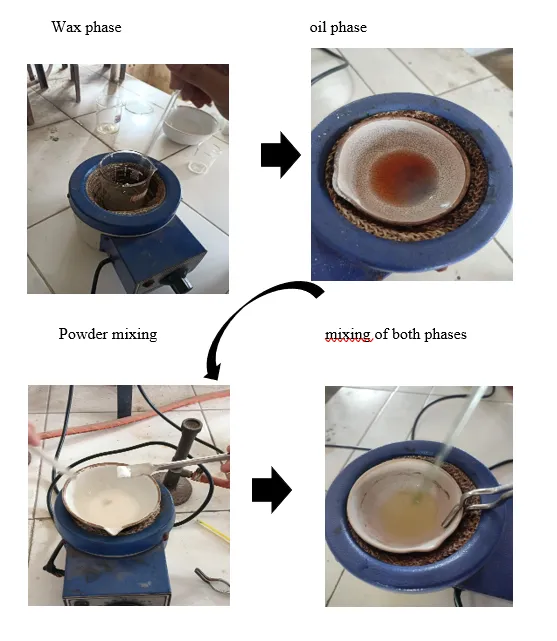
2.Wax Phase:
In a beaker, add Bees wax and cocoa/shea butter

Place in water bath and heat to 60°-70° C with gentle stirring until fully melted
3.Oil Phase:
Raspberry seed oil, carrot seed oil and Blue Pea flower extract are
added and mix thoroughly

Slowly add zinc oxide and Titanium dioxide, mix with
spatula until a smooth, lump-free paste form
4.Mix both phases
Maintain both phases temperature

Wax phase - 50 ° C, Oil Phase - 40 ° C
Mix both phases (zinc oxide & titanium oxide slurry

in remaining oil + wax phase)

Let it cool to molten state
Add vitamin E capsule and mix
Add slowly Aloe vera gel in small portion with gentle stirring and mix

(Note : If too much water content in gel then heat the gel for 4-5min)
Once homogenous mixture forms (no visible phase separation or clumps)

Quickly pour it to the stick molds and tapped gently to remove air bubbles

Allow to cool at room temperature
Refrigeration for 10 min
Wax phase oil phase
Evaluation :
In Vitro Sun Protection Factor (SPF) determination
The sunscreen formulation’s efficacy can be identified by calculating sun protection factor which is commonly abbreviated as SPF. It is given by the following equation SPF = Minimal erythema dose in sunscreen protected skin / Minimal erythema dose in non-sunscreen protected skin
The Minimal Erythemal dose (MED) is generally defined as lowermost time interval or dosage of an UV light irradiation which is sufficient enough to generate minimal, perceptible erythema on the unprotected layer of skin. In Vitro SPF values for oily preparations comprising vegetable oils and/or organic UV filters were frequently calculated with spectrophotometric procedure and the observed absorbance values at 5 nm intervals between 290-320 nm were calculated by the following equation. Mansur et al, developed a simple equation which substitutes in vitro method proposed by Sayre et al., 1979, using UV spectrophotometry and the Mansur equation is as follows
SPF = CF × Σ [EE(λ) × I(λ) × Abs(λ)]
Where:
SPF = Sun Protection Factor
CF = Correction Factor (10)
EE (λ) = Erythemal Effect Spectrum
I (λ) = Solar Intensity Spectrum
Abs (λ) = Absorbance of the sample at wavelength λ
λ = Wavelength (nm)
Procedure
The procedure involves weighing 1.0 g of cream sample and it was transferred into 100 mL volumetric flask, which is further diluted to its volume with ethanol as solvent. It is further sonicated for duration of 5 min and filtered. A 5.0 mL aliquots was again transferred into 50 mL volumetric flask and it is further diluted to its volume with ethanol as solvent. Then again 5.0 mL was transferred to a 25 mL flask and made to volume with ethanol. The absorption spectra data were determined in range of 290 to 320, at every 5 nm, then the equation was applied for further calculation of SPF.
| Sr no | Wavelength | Absorbance | EE*I | EE*I*Abs |
|---|---|---|---|---|
| 1 | 290 | 1.0786 | 0.0150 | 0.026 |
| 2 | 295 | 2.180 | 0.0817 | 0.017 |
| 3 | 300 | 2.318 | 0.0287 | 0.666 |
| 4 | 305 | 2.298 | 0.3278 | 0.753 |
| 5 | 310 | 2.226 | 0.1864 | 0.414 |
| 6 | 315 | 2.171 | 0.0839 | 0.182 |
| 7 | 320 | 2.149 | 0.0180 | 0.056 |
| Total | 1 | 2.1159 |
RESULT
Sun Protection Factor (SPF) Determination
SPF = CF × Σ [EE (λ) × I (λ) × Abs (λ)]
where the correction factor (CF) was taken as 10.
The calculated summation value of EE × I × Abs was found to be 2.1159. Therefore,
SPF = 10 × 2.1159
SPF = 21.16
Physical evaluation :
| Parameter | Procedure | Observation |
|---|---|---|
| Color | Visual inspection against white background | Pale white |
| Odour | Apply on hand feel fragrance | Pleasant (jasmine) |
| Appearance | Visual examination | Smooth , no defects |
| Washability | Wash the sunscreen applied area | Easily washable |
| Smoothness | Rub on hand | Good |
| Force of application | Apply on skin with pressure | Good ease of application |
| Homogeneity | Visual and touch | Good |
Physicochemical evaluation
1. pH determination :
The pH of herbal sunscreens was determined using a digital pH meter. pH was measured after 1 g of the formulation was Dissolved in 100 ml of newly prepared distilled water for 2 hours. The purpose of this study was to guarantee that the pH of The produced herbal sunscreens is similar to the pH of the skin after 24 hours of use.
Result : 6-7 pH
2. Melting point : 55℃
3. Solubility test : It is soluble in Chloroform and Alcohol
4. Stability test : Stored the formulation at room temperature (25 ℃) and elevated temperature (40 ℃)
Result : stable at elevated temperature 36-40 ℃ for 28 days
5. Spreadability test :
1gram of sample is applied between two glass slides and is compressed between two glass slides to uniform thickness by placing 50 gram of weight is placed for 1minutes .Their weight can be further added. Then diameter of sample between plates is measured. The spread ability test showed that the formulation has good spreadable property.
CONCLUSION
The study successfully formulated a stable herbal sunscreen stick using Clitoria ternatea extract, carrot seed oil, raspberry seed oil, zinc oxide, and titanium dioxide. The formulation exhibited desirable properties: pH 6–7, melting point 50–52°C, smooth spreadability, homogeneous texture, and non-irritant nature. In vitro SPF determination yielded a value of 21, indicating moderate UVB protection. Stability studies over 28 days confirmed no significant physical changes. The stick offers practical advantages including portability, targeted application, and reduced contamination risk. This herbal sunscreen represents a promising, eco-friendly alternative to synthetic products with added antioxidant benefits.
Acknowledgement
The authors would like to thank Shree Swaminarayan Sanskar Pharmacy College, Zundal, Gandhinagar, Gujarat, India for providing the necessary facilities to carry out the research work.
REFERENCES

Komal Parmar, Keval Parmar, Pankti Shah, Diya Patel, Jinal Parmar, Hinal Panchal, Reshma Lakhani, Formulation and Evalaution of Herbal Sunscreen Stick, Int. J. of Pharm. Sci., 2026, Vol 4, Issue 11, 3236-3245. https://doi.org/10.5281/zenodo.24361997
 10.5281/zenodo.24361997