

We use cookies to ensure our website works properly and to personalise your experience. Cookies policy
Department of Pharmacy Practice, Visveswarapura Institute of Pharmaceutical Sciences, Bengaluru-560070, Karnataka, India.
Background: Prescription errors are a major concern in healthcare settings and may affect patient safety and the quality of treatment. These errors can occur due to incomplete prescription information, illegible handwriting, incorrect dosage and other prescribing-related problems. Early identification and analysis of prescription errors are essential to prevent medication-related problems and improve the quality of patient care. This study aimed to assess the prevalence, types and severity of prescription errors among hospitalized patients in a tertiary care hospital. Methods: A six-months prospective observational study was conducted among 200 prescriptions at KIMS Hospital. Inpatient medical records and prescriptions were reviewed to identify and analyse prescription errors. Patient demographic details, clinical information, medication details and prescription-related errors were recorded. The identified errors were classified according to their type and severity using the NCC MERP classification system. The collected data were analysed statistically to determine the frequency and distribution of prescription errors. Results: Among 200 prescriptions, 120 (60%) were males and 80 (40%) were females. Prescription errors were identified in 128 prescriptions (64%), whereas 72 prescriptions (36%) had no identified prescription errors. General Medicine accounted for the highest number of patients, with 99 (49.5%), followed by General Surgery with 47 (23.5%). Missing prescription information was the most common type of error, accounting for 74 (57.8%) cases, followed by illegible handwriting in 35 (27.3%) cases. A combination of illegible handwriting and missing information was observed in 18 (14.1%) cases, while wrong dose with missing information was identified in 1 (0.8%) case. All identified errors were classified under Category B (100%), indicating that the errors did not reach the patients.
Prescription errors are defined as mistakes occurring during the prescribing process that may result in inappropriate medication use or patient harm. These errors can occur due to various factors such as lack of knowledge, negligence, workload pressure, poor handwriting, incorrect calculations, inadequate patient information, and failure to follow prescribing guidelines.
A prescription (Rx) is defined as document that states the plan of care for an individual patient to be carried out by a qualified practitioner. The errors of prescription are the commonest form of avoidable medication errors and are considered to be the most important target for improvement. They occur in consultant clinic set-up as well as in hospitals. Although they are rarely fatal, they can affect patient safety and quality of healthcare. A prescribing error is defined as an unintentional significant reduction in the probability of treatment being timely and effective or increase in the risk of harm when compared with generally accepted practice.1
Prescription errors in prescription writing, instead, involve illegibility, ambiguous abbreviations, lack of an important piece of information such as date of prescription, dose, route, frequency of administration, etc. Since the later can be more easily determined and detected through chart review, we focused our attention on them. Prescription errors have been defined as a defect in the process of prescribing that results in an unintentional reduction in the probability of treatment being delivered in a timely and effective manner or increases the risk of harm from the medication.2
The Pharmacist cannot identify an old prescription brought for refill if the prescribing date is not available. Superscription, a sign of practice, makes any written piece of paper a prescription by law. Inscription is the most important part as illegible handwriting and too many confusing similar generic and brand names can cause difficulties to the pharmacist to dispense the drug and thereby may increase chances of errors during dispensing by the pharmacist. Subscription, is also important for dispensing of correct and proper medication to the patient. Patient needs to know the quantity of tablets, capsules, liquid dosage forms and number of times the medicine needs to be taken. Oral instructions to patients are most of the times forgotten. Written instructions will also enable the clinical pharmacist to counsel the patient.3
An error can occur at any stage of the prescription process:
The prescriptions not written clearly or which can be misunderstood, inappropriate and irrational prescriptions, also over- and under-prescriptions all will lead to prescription error (PE).5 Prescription errors can cause hindrance in the treatment of the patient. Therefore identifying, solving and preventing such errors are supposed as the main functions of the pharmaceutical care.6
Prescribing errors may be defined as incorrect drug selection for a patient or errors involving wrong drug, dose, quantity and indication for use or a contraindication. Prescription errors also include illegible handwriting, misspelling of a drug with a similar name and use of abbreviation.7
Types of prescribing errors
1. Illegible prescription:
Writing a legible prescription is the legal responsibility of the prescriber. Illegible handwriting is one of the causes of prescription errors leading to all of errors.8
2. Abbreviation prone to error:
The use of medication abbreviations accounts of a subset of errors. Staff responsible for the reading, interpretations and processing medication orders may not recognize an abbreviation, resulting in the alteration of the intended meaning.
3. Incorrect drug:
When a medicine is prescribed to a person who has a known allergy to that medicine; when a medicine which is contra-indicated to a patient is prescribed; when a medicine name which is not intended is written by a prescriber in the medication order.
4. Drugs not prescribed:
Situations where a patient is diagnosed with a particular indication but left untreated.
5. Incorrect dose:
When the quantity of medicine recommended being taken at a particular time is incorrect, applicable when the dose needs to be calculated by the weight of the patient.
6. Dose not mentioned:
Mentioning the dose of medicine becomes inescapable especially with a narrow margin of safety, which if taken in over dose may cause more harm.
7. Incorrect frequency:
Frequency is the time at which the drug is administered when the prescribed frequency of a drug is different from the current evidence-based treatment guidelines.
8. Frequency not mentioned:
Prescriber does not mention the frequency of the drug.
9. Incorrect dosage form:
Prescriber does not mention the correct dosage form of the drug.
10. Formulation dosage is not mentioned:
Dosage form of the drug is not mentioned by prescriber.
11. Incorrect quantity /Strength:
This error happens when the prescriber does not mention the concentration of IV infusion to be mixed and prepared.
12. Incorrect route of administration:
When a route not intended by the prescriber is written in medication order.
13. Route of administration not mentioned:
Whether it is IM, IV, Subcutaneous, Intrathecal, Inhalation orally or rectally.
14. Incorrect instruction for use:
Incorrect instruction is given to the patient by the prescriber.
15. Instruction for use of the drug not mentioned:
When no instruction for use of the drug is mentioned by the prescriber.
16. An incorrect rate of administration:
The wrong rate of administration of the IV infusion may lead to serious harm in patients.
17. The rate of administration is not mentioned:
The error mainly occurs in the case of IV infusion.
18. Wrong duration:
When the duration of medication is different from current evidence-based treatment guidelines.
19. Duration not mentioned:
Duration of the drug should be taken into consideration, not mentioning the duration can lead to drug resistance, especially in case of antibiotics.
20. Repetition of same drug/duplication and incomplete writing of prescriptions are also included in prescribing errors.9
MATERIALS AND METHODS
Study design and setting
A prospective, hospital-based observational study was conducted over a period of six months at Kempegowda Institute of Medical Sciences Hospital and Research Centre (KIMS), Bengaluru. KIMS is a tertiary-care teaching and super-speciality hospital with approximately 1200 beds.
Study population
A total of 200 prescriptions admitted to the In-Patient Department (IPD) of Kempegowda Institute of Medical Sciences Hospital and Research Centre (KIMS), Bengaluru, were included in the study. Patients admitted to various specialty departments during the six-month study period were considered eligible for enrolment. The study population consisted of male and female patients aged 18 years and above who received prescribed medications during their hospital stay. Patient prescriptions, medical records and medication charts were reviewed to identify and analyse prescription errors. Demographic details, clinical information, prescribed medications and identified prescription errors were recorded for each patient.
Inclusion criteria
Patients were eligible for inclusion if they:
Exclusion criteria
Patients were excluded if they met any of the following criteria.
Ethical considerations
The study was conducted following approval from the Institutional Ethics Committee of KIMS (Reference No. KIMS/IEC/D801/P/2026). Informed consent was obtained from all participants or their legally authorised representatives before enrolment. The confidentiality and anonymity of participant information were maintained throughout the study and after its completion.
Data collection and monitoring
Data were collected from the In-Patient Department (IPD) of Kempegowda Institute of Medical Sciences Hospital and Research Centre (KIMS), Bengaluru, over a period of six months. Prescriptions of hospitalized patients admitted to various specialty departments were reviewed to identify and assess prescription errors. Information regarding demographic characteristics, clinical diagnosis, department, prescribed medications, dosage, frequency, route of administration and other relevant prescription details was collected using a structured, self-designed data collection form.
Data were obtained from patient case records, prescription sheets, medication charts and relevant medical records. The collected information included patient age, gender, diagnosis, comorbidities, number of prescribed medications and details of prescription errors. Each prescription was carefully reviewed to identify errors such as missing information, illegible handwriting, incorrect dosage and other prescribing-related problems.
Identified prescription errors were documented in the data collection form and brought to the attention of the concerned prescribing clinicians. The errors were communicated to the respective clinicians for necessary correction. The clinician's response and corrective actions taken were recorded. Patient records and prescription details were maintained confidentially throughout the study.
Classification of prescription errors
Prescription errors identified during the study were classified according to their type and severity using the National Coordinating Council for Medication Error Reporting and Prevention (NCC MERP) classification system. The errors were categorized based on whether they reached the patient and whether they caused harm. The identified prescription errors included missing prescription information, illegible handwriting, a combination of illegible handwriting and missing information, and wrong dosage with missing information. All identified prescription errors were classified under Category B, indicating that an error occurred but did not reach the patient. The errors were communicated to the prescribing clinicians, and necessary corrections were made immediately.
Statistical analysis
The collected data were entered into Google Forms, exported to Microsoft Excel for coding and organization, and subsequently analysed using JAMOVI version 2.6.44. Descriptive statistical methods were used to summarize the collected data. Categorical variables such as age group, gender, department, comorbidities, number of prescribed medications, presence of prescription errors, types of errors and severity were expressed as frequencies and percentages. The distribution of prescription errors among different demographic and clinical characteristics was evaluated using appropriate statistical methods. The results were presented in the form of tables and graphs for better interpretation. A p-value of less than 0.05 was considered statistically significant wherever inferential statistical tests were performed.
RESULTS
Table 1: Gender Wise Distribution
| SL.NO, | Gender | Counts | % of Total |
|---|---|---|---|
| 1 | Female | 80 | 40 % |
| 2 | Male | 120 | 60% |
| TOTAL | 200 | 100% |
[Figure - see the formatted PDF]
Figure 4: Gender Wise Distribution
[Figure - see the formatted PDF]
Table None: It Represents the Majority Were Male, Accounting for 120 Prescriptions (60%). Female Prescriptions Constituted 80 Prescriptions (40%) of the Study Population. Thus, Male Patients Represented the Highest Proportion of Prescriptions Included in the Study, While Female Patients Represented the Lower Proportion.
Table 2: Age Wise Distribution
| SL. NO. | Age | Counts | % of Total |
|---|---|---|---|
| 1 | 18-27 | 14 | 7% |
| 2 | 28-37 | 20 | 10% |
| 3 | 38-47 | 45 | 22.5 % |
| 4 | 48-57 | 57 | 28.5 % |
| 5 | 58-67 | 33 | 16.5 % |
| 6 | >68 | 31 | 15.5 % |
| TOTAL | 200 | 100% |
Figure 5: Age Wise Distribution
Table 2: It represents the majority belonged to the 48–57 years age group, accounting for 57 prescriptions (28.5%). This was followed by the 38–47 years age group, with 45 prescriptions (22.5%). A total of 33 prescriptions (16.5%) belonged to the 58–67 years age group, while 31 prescriptions (15.5%) were above 68 years. The 28–37 years age group included 20 prescriptions (10%), whereas the 18–27 years age group had the lowest representation, with 14 prescriptions (7%). Thus, the 48–57 years age group constituted the highest proportion of the study population, while the 18–27 years age group constituted the lowest proportion.
Table 3: Department Wise Distribution
| SL.NO. | Department | Counts | % of Total |
|---|---|---|---|
| 1 | General Medicine | 99 | 49.5 % |
| 2 | General Surgery | 47 | 23.5 % |
| 3 | Orthopaedics | 20 | 10% |
| 4 | Others | 34 | 17 % |
| TOTAL | 200 | 100% |
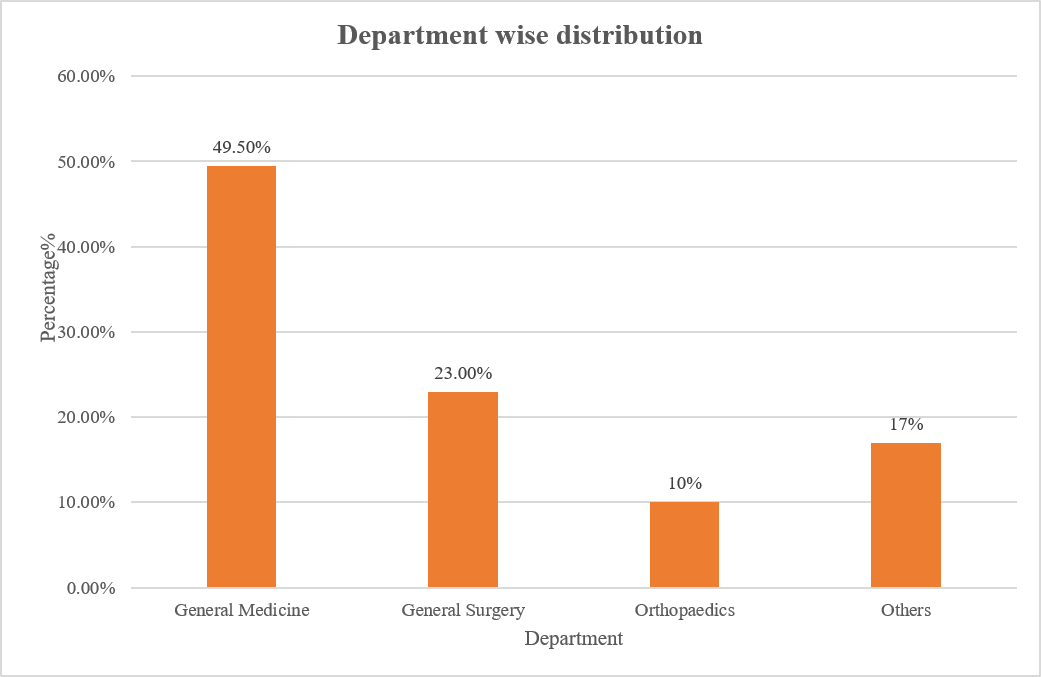
Figure 6: Department Wise Distribution
Table 3: It represents the General Medicine department, accounting for 99 prescriptions (49.5%). This was followed by the General Surgery department, with 47 prescriptions (23.5%). A total of 34 prescriptions (17%) belonged to other departments, while the Orthopaedics department accounted for 20 prescriptions (10%). Thus, General Medicine contributed the highest proportion of prescriptions, whereas Orthopaedics contributed the lowest proportion of the study population.
Table 4: Comorbidities
| SL.NO. | Comorbidities | Counts | % of Total |
|---|---|---|---|
| 1 | CKD | 2 | 1% |
| 2 | COPD/Asthma | 4 | 2% |
| 3 | Diabetes | 18 | 9% |
| 4 | HTN | 26 | 13% |
| 5 | HTN+CKD | 1 | 0.5% |
| 6 | HTN+Diabetes | 14 | 7% |
| 7 | HTN+Diabetes+COPD/Asthma | 1 | 0.5% |
| 8 | None | 126 | 63% |
| 9 | Other | 8 | 4% |
| TOTAL | 200 | 100% |
[Figure - see the formatted PDF]
Figure 7: Comorbidities
Table 4: It represents the majority, 126 prescriptions (63%), had no documented comorbidities. Hypertension (HTN) was the most common individual comorbidity, observed in 26 prescriptions (13%), followed by diabetes in 18 prescriptions (9%). A total of 14 prescriptions (7%) had both hypertension and diabetes, while 8 prescriptions (4%) were classified under other comorbidities. COPD/asthma was recorded in 4 patients (2%), and CKD was observed in 2 prescriptions (1%). Combined conditions, including HTN with CKD and HTN with diabetes and COPD/asthma, were each recorded in 1 prescription (0.5%). Thus, most patients had no documented comorbidities, while hypertension was the most frequently reported individual comorbidity.
Table 5: Number of Medications Prescribed on the Active Chart
| SL.NO. | Number of medications prescribed on the active chart | Counts | % of Total |
|---|---|---|---|
| 1 | 1 | 19 | 9.5 % |
| 2 | 2 | 50 | 25% |
| 3 | 3 | 61 | 30.5 % |
| 4 | 4 | 31 | 15.5 % |
| 5 | 5 | 20 | 10% |
| 6 | 6 | 9 | 4.5 % |
| 7 | 7 | 4 | 2% |
| 8 | 8 | 4 | 2% |
| 9 | 9 | 1 | 0.5 % |
| 10 | 13 | 1 | 0.5 % |
| TOTAL | 200 | 100% |
[Figure - see the formatted PDF]
Figure 8: Number of Medications Prescribed on the Active Chart
Table 5: It represents the number of medications prescribed on the active chart showed that the majority received three medications, accounting for 61 prescriptions (30.5%). This was followed by two medications in 50 prescriptions (25%) and four medications in 31 prescriptions (15.5%). A total of 20 prescriptions (10%) received five medications, while 19 patients (9.5%) received one medication. Nine prescriptions (4.5%) received six medications, and four patients each (2%) received seven and eight medications. Only one prescription each (0.5%) received nine and thirteen medications. Thus, prescribing three medications was the most common pattern, while prescribing nine or thirteen medications was the least common.
Table 6: Number of Prescription Errors Identified
| SL.NO. | Number of prescription errors identified | Counts | % of Total |
|---|---|---|---|
| 1 | 0 | 72 | 36% |
| 2 | 1 | 77 | 38.5 % |
| 3 | 2 | 42 | 21% |
| 4 | 3 | 8 | 4% |
| 5 | 5 | 1 | 0.5 % |
| TOTAL | 200 | 100% |
[Figure - see the formatted PDF]
Figure 9: Number of Prescription Errors Identified
Table 6: It represents the number of prescription errors identified per chart showed that 77 prescriptions (38.5%) had one prescription error, while 72 prescriptions (36%) had no prescription errors. A total of 42 prescriptions (21%) had two prescription errors, and 8 prescriptions (4%) had three prescription errors. Only one prescription 0.5%) had five prescription errors. Thus, one prescription error per chart was the most common finding among the study population, whereas five errors per chart was the least common.
[Figure - see the formatted PDF]
Table 7: Prescription Errors Identified
| SL.NO | Prescription errors identified | Counts | % of Total |
|---|---|---|---|
| 1 | No | 72 | 36.0 % |
| 2 | Yes | 128 | 64.0 % |
| TOTAL | 200 | 100% |
Figure 10: Prescription Errors Identified
Table 7: It Represents That Prescription Errors Were Identified in 128 Prescriptions (64%), Whereas 72 Prescriptions (36%) Had No Identified Prescription Errors. Thus, the Majority of the Study Population Had at Least One Prescription Error, Highlighting the Importance of Careful Prescription Review and Monitoring to Improve Medication Safety in Hospitalized Patients.
Table 8: Type of Error
| SL.NO. | Type of Error | Counts | % of Total |
|---|---|---|---|
| 1 | Illegible Handwriting | 35 | 27.3 % |
| 2 | Illegible Handwriting+Missing Information | 18 | 14.1 % |
| 3 | Missing Information | 74 | 57.8 % |
| 4 | Wrong Dose+Missing Information | 1 | 0.8 % |
| TOTAL | 128 | 100% |
[Figure - see the formatted PDF]
Figure 11: Type of Error
Table 8: It represents the distribution of prescription errors among 128 prescriptions with identified errors showed that missing information was the most common type, accounting for 74 prescriptions (57.8%). This was followed by illegible handwriting in 35 prescriptions (27.3%). A combination of illegible handwriting and missing information was observed in 18 prescriptions (14.1%), while wrong dose combined with missing information was the least common type, recorded in 1 prescription (0.8%). Thus, missing information was the predominant prescription error identified in the study, highlighting the importance of complete and clear prescription documentation.
Table 9: Severity Category
| SL.NO. | Severity Category | Counts | % of Total |
|---|---|---|---|
| 1 | Category B | 128 | 100.0 % |
Table 9: It Represents the Severity Category Showed That All 128 Identified Prescription Errors (100%) Were Classified as Category B. According to the NCC MERP Classification, Category B Refers to an Error That Occurred but Did Not Reach the Patient. This Indicates That All Recorded Errors Were Classified as Not Reaching the Patient, Based on the Data Provided.
Table 10: Error Communicated to the Prescribing Clinician
| SL.NO. | Error communicated to the prescribing clinician | Counts | % of Total |
|---|---|---|---|
| 1 | No | 200 | 100.0 % |
Table 10: It Represents That Errors Were Not Communicated to the Prescribing Clinician in All 200 Prescriptions (100%). No Records Indicated That the Errors Had Been Communicated. This Finding Highlights the Need to Review and Improve Communication and Reporting Practices Between Healthcare Professionals to Support Patient Safety.
Table 11: Staff Nurse Outcome/ Feedback
| SL.NO. | Staff nurse outcome/ Feedback | Counts | % of Total |
|---|---|---|---|
| 1 | Error accepted and prescription corrected immediately | 128 | 100.0 % |
Table 11: It Represents That All 128 Identified Prescription Errors (100%) Were Accepted by the Staff, and the Prescriptions Were Corrected Immediately. No Cases of Rejection or Non-Correction Were Reported. This Finding Highlights the Importance of Collaboration Between Healthcare Professionals in Identifying and Correcting Prescription Errors to Improve Medication Safety Among Hospitalized Patients.
DISCUSSION AND CONCLUSION
The present six-months prospective observational study conducted at Kempegowda Institute of Medical Sciences Hospital and Research Centre (KIMS), Bengaluru, assessed the prevalence, types and severity of prescription errors among 200 prescriptions. The study aimed to identify common prescribing-related problems and evaluate the importance of prescription monitoring in improving medication safety. Among the 200 prescriptions included in the study, males constituted the majority, accounting for 60% (n=120), while females accounted for 40% (n=80). Patients belonging to the 48–57 years age group represented the largest proportion of the study population, accounting for 28.5% (n=57). This indicates that a considerable number of hospitalized patients in this study belonged to the middle-aged and older adult population.
General Medicine accounted for the highest number of prescriptions, with 49.5% (n=99), followed by General Surgery, which contributed 23.5% (n=47). Other specialty departments accounted for the remaining proportion of the study population. This distribution indicates that prescription monitoring is important across different clinical departments, particularly in departments where patients receive multiple medications during their hospital stay. Regarding medication utilization, three prescribed medications were most frequently observed, accounting for 30.5% (n=61) of prescriptions, followed by two medications in 25% (n=50) of patients. The use of multiple medications highlights the importance of reviewing prescriptions carefully to identify incomplete information and other prescribing-related errors.
Prescription errors were identified in 128 prescriptions, representing 64% of the total study population, whereas 72 prescriptions (36%) had no identified prescription errors. This finding indicates that prescription errors occurred in a considerable proportion of hospitalized patients and emphasizes the need for proper prescription writing and regular monitoring of medication orders. Among the different types of prescription errors identified, missing prescription information was the most common, accounting for 57.8% (n=74) of the errors. Illegible handwriting was the second most common error, accounting for 27.3% (n=35), followed by a combination of illegible handwriting and missing information in 14.1% (n=18) of cases. Wrong dosage combined with missing information was observed in 0.8% (n=1) of cases. These findings indicate that incomplete prescription documentation and difficulties in reading handwritten prescriptions were the major problems identified during the study. Proper documentation of medication details, including dose, frequency, route of administration and other essential prescribing information, is therefore important to minimize prescription errors.
According to the National Coordinating Council for Medication Error Reporting and Prevention (NCC MERP) classification system, all 128 identified prescription errors (100%) were classified under Category B. This indicates that an error occurred but did not reach the patient. The classification findings demonstrate the importance of early identification and correction of prescription errors before they can cause harm to patients. Regarding communication and management, all 128 identified prescription errors were accepted by the prescribing clinicians, and the prescriptions were corrected immediately. This reflects the importance of effective communication and cooperation between healthcare professionals in preventing medication-related problems and maintaining patient safety.
The findings of the present study highlight that prescription errors are an important concern in inpatient healthcare settings, particularly those related to missing prescription information and illegible handwriting. Although the identified errors did not reach the patients, their occurrence indicates the need for continuous prescription review, proper documentation and improved prescribing practices. The involvement of clinical pharmacists in prescription screening, identification of medication errors and communication with prescribing clinicians can help prevent potential medication-related problems. Regular monitoring, improved prescription-writing practices, appropriate clinical documentation and collaboration among healthcare professionals are essential measures to reduce prescription errors.
In conclusion, the present study identified prescription errors in 64% of hospitalized patients, with missing prescription information being the most common type of error. All identified errors were classified under NCC MERP Category B, and immediate corrective action was taken by the prescribing clinicians. The study emphasizes the importance of systematic prescription monitoring and the role of clinical pharmacists in identifying and preventing prescribing errors. Strengthening prescription documentation, promoting clear and complete medication orders and encouraging effective communication among healthcare professionals can contribute significantly to reducing prescription errors and improving medication safety and the overall quality of patient care.
ACKNOWLEDGMENT
The authors sincerely thank Department of Pharmacy Practice. We also extend our gratitude to the doctors, postgraduate doctors, nursing staff and other healthcare professionals of KIMS Hospital for their valuable cooperation and support throughout the study.
FUNDING
None
CONFLICT OF INTEREST
The authors declare that there is no conflict of interest.
REFERENCES






C. Sanjay, Rohith S. N., Deeksha A. S., Roshitha C. S., Ganavi S., Dr. K. S. Prasanna Babu, Assessment and Analysis of Prescription Errors in Hospitalized Patients: A Prospective Study in a Tertiary Care Hospital, Int. J. of Pharm. Sci., 2026, Vol 4, Issue 11, 3246-3257. https://doi.org/10.5281/zenodo.24362098
 10.5281/zenodo.24362098