

We use cookies to ensure our website works properly and to personalise your experience. Cookies policy
Department of chemistry B.N.N. College, Bhiwandi,Thane Maharashtra, India
Solvents are indispensable components of pharmaceutical manufacturing, playing a crucial role in drug synthesis, extraction, purification, formulation, and quality control processes. While conventional organic solvents offer high processing efficiency, their toxic nature, environmental persistence, and occupational hazards have raised serious sustainability concerns. In response to these challenges, the pharmaceutical industry is increasingly shifting toward eco-friendly solvent systems that support greener and safer manufacturing practices. Green solvents are characterized by low toxicity, enhanced biodegradability, reduced volatility, and improved recyclability. Emerging solvent technologies such as water-based systems, bio-derived solvents, ionic liquids, deep eutectic solvents, and supercritical fluids have demonstrated significant potential across various pharmaceutical applications. This review presents a comprehensive evaluation of eco-friendly solvent systems, focusing on their characteristics, classification, industrial applications, benefits, limitations, and future prospects. The adoption of sustainable solvent strategies is expected to play a key role in minimizing environmental impact while maintaining pharmaceutical quality and regulatory compliance
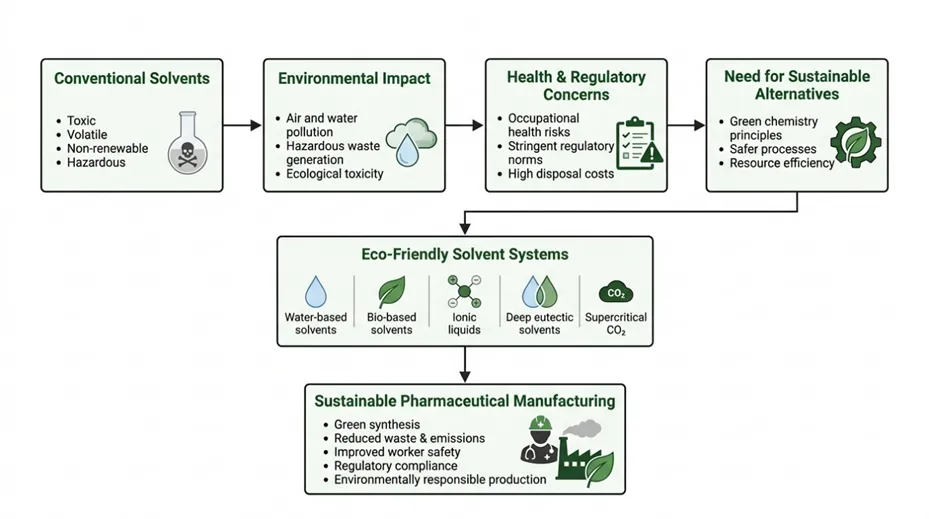
The pharmaceutical industry plays a vital role in improving global health by ensuring the availability of safe and effective medicines. However, pharmaceutical manufacturing is also associated with significant environmental challenges, primarily due to the extensive use of organic solvents in drug synthesis, extraction, purification, and formulation processes. It is estimated that solvents account for nearly 80–90% of the total mass used in pharmaceutical manufacturing, contributing substantially to waste generation, environmental pollution, and occupational health risks. Conventional organic solvents such as benzene, toluene, dichloromethane, and acetonitrile are often volatile, toxic, non-renewable, and hazardous to both human health and the environment.Growing environmental concerns, stricter regulatory requirements, and increased awareness of sustainable development have driven the pharmaceutical sector to explore greener and safer alternatives. In this context, the principles of green chemistry provide a framework for minimizing the environmental footprint of chemical processes while maintaining product quality and economic viability. One of the most critical aspects of green chemistry in pharmaceuticals is the selection and design of eco-friendly solvent systems that reduce toxicity, improve safety, and enhance process sustainability.Eco-friendly solvents are characterized by low toxicity, biodegradability, renewability, reduced volatility, and recyclability. Over the past decade, several alternative solvent systems have gained attention, including water-based solvents, bio-derived solvents, ionic liquids, deep eutectic solvents (DESs), and supercritical fluids such as supercritical carbon dioxide. These solvent systems not only offer environmental benefits but also demonstrate improved performance in terms of reaction efficiency, selectivity, and product yield in various pharmaceutical applications.Water-based solvents are widely regarded as the greenest solvent option due to their non-toxic, non-flammable, and abundant nature. Similarly, bio-based solvents derived from renewable resources, such as ethanol, ethyl lactate, and glycerol, provide sustainable alternatives to petroleum-based solvents. Ionic liquids and deep eutectic solvents have emerged as novel solvent systems owing to their negligible vapor pressure, tunable physicochemical properties, and high solvating power. Supercritical CO? has also attracted significant interest because of its non-toxic, residue-free, and recyclable characteristics, making it suitable for extraction and purification processes.The adoption of eco-friendly solvent systems has shown promising results in key pharmaceutical operations, including drug synthesis, extraction of natural products, crystallization, drug delivery system development, and analytical procedures. These solvents contribute to reduced waste generation, lower energy consumption, enhanced worker safety, and improved compliance with environmental regulations. Despite these advantages, challenges such as high initial costs, limited large-scale industrial data, and regulatory acceptance still hinder their widespread implementation.This review aims to provide a comprehensive overview of advanced eco-friendly solvent systems used in sustainable pharmaceutical manufacturing. The paper discusses different categories of green solvents, their physicochemical properties, advantages, pharmaceutical applications, and associated challenges. By highlighting recent developments and future prospects, this study emphasizes the role of eco-friendly solvents as a key driving force toward a cleaner, safer, and more sustainable pharmaceutical industry.
2. Role of Solvents in Pharmaceutical Manufacturing
Solvents function as reaction media during drug synthesis, influencing reaction rates, selectivity, and yield. In extraction processes, they assist in isolating active pharmaceutical ingredients from complex matrices, particularly in herbal and natural product-based medicines. Solvents are also essential in crystallization, formulation development, tablet coating, equipment cleaning, and analytical testing.Despite these benefits, the widespread use of volatile and toxic solvents contributes to hazardous waste generation and air pollution. These concerns have led to a gradual transition toward greener solvent alternatives that reduce environmental burden without compromising pharmaceutical performance.
3. Characteristics of Eco-Friendly Solvent Systems:
Eco-friendly solvents are specifically designed to reduce environmental toxicity and occupational hazards. Key characteristics include low human and ecological toxicity, high biodegradability, and minimal bioaccumulation. Reduced volatility is desirable, as it limits solvent loss and atmospheric emissions.
From an industrial viewpoint, green solvents should be recyclable, cost-effective, and compatible with existing pharmaceutical infrastructure. Additionally, they must ensure drug stability, reproducibility, and compliance with regulatory standards. The development of sustainable solvent systems therefore focuses on achieving optimal performance while minimizing environmental impact.
4. Classification of Eco-Friendly Solvent Systems:
Eco-friendly solvents can be categorized based on their origin, physicochemical behavior, and application potential in pharmaceutical processes.
Table 1: Classification of Eco-Friendly Solvent Systems Used in Pharmaceutical Manufacturing
|
Sr.No. |
Solvent System |
Key Properties |
Major Applications |
Limitations |
|
|
Water-based solvents |
Non-toxic, non-flammable |
Enzymatic reactions, extraction
|
Poor solubility for hydrophobic drugs |
|
|
Bio-based solvents Limited thermal stability |
Renewable, biodegradable |
Herbal extraction, formulations |
Limited thermal stability |
|
|
Ionic liquids |
Low vapor pressure, recyclable |
Drug synthesis, catalysis
|
Cost, toxicity concerns |
|
|
Deep eutectic solvents |
Low toxicity, easy preparation |
Drug solubilization, nanocarriers
|
High viscosity |
|
|
Supercritical CO? |
Residue-free, recyclable High equipment cost
|
API purification, particle engineering High equipment cost |
High equipment cost |
Eco-friendly solvents have gained wide acceptance in pharmaceutical synthesis due to their ability to enhance reaction efficiency while reducing hazardous by-products. In herbal medicine production, green solvents such as ethanol and deep eutectic solvents preserve phytochemical integrity while ensuring safety.
Sustainable solvents are also increasingly used in nanotechnology-based drug delivery systems, where they assist in producing biodegradable nanoparticles with improved biocompatibility. In purification and analytical laboratories, green solvents replace hazardous mobile phases, improving laboratory safety and reducing chemical waste.
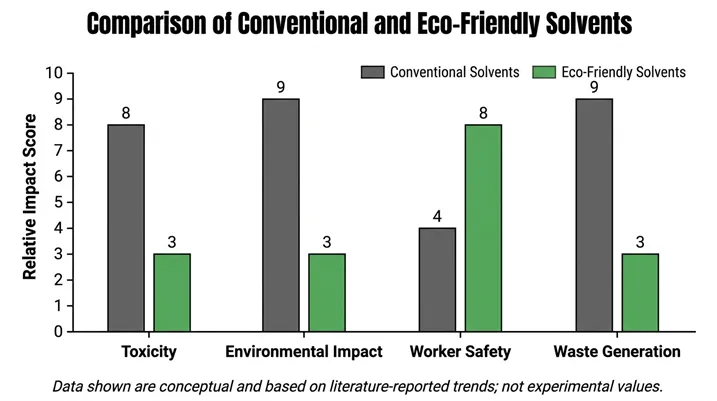
Figure -1
Figure -1
Presents a comparative assessment of conventional and eco-friendly solvents based on toxicity, environmental impact, worker safety, and waste generation. The graph shows that conventional solvents exhibit higher toxicity and environmental impact, reflecting their hazardous and volatile nature. In contrast, eco-friendly solvents demonstrate lower adverse impacts and improved safety profiles. Overall, the figure highlights the sustainability and occupational safety advantages of eco-friendly solvent systems.
The adoption of eco-friendly solvent systems significantly reduces hazardous waste generation and environmental contamination. Their biodegradable nature minimizes long-term ecological damage, while recyclability lowers solvent consumption and operational costs.
From an industrial perspective, green solvents improve workplace safety and support compliance with environmental regulations. Although initial implementation may require higher investment, long-term benefits include improved process efficiency, reduced disposal costs, and enhanced sustainability performance.
Table 2: Comparison Between Conventional and Eco-Friendly Solvents:
|
Sr.No. |
Parameter |
Conventional Solvents |
Eco-Friendly Solvents |
|
|
Toxicity |
High |
Low |
|
|
Environmental impact |
Severe |
Minimal |
|
|
Worker safety |
Low |
High |
|
|
Waste generation |
High |
Reduce |
|
|
Sustainability |
Poor |
Excellent |
Despite their advantages, eco-friendly solvent systems face challenges such as high initial costs, scalability issues, and limited solubility for certain APIs. Regulatory approval can also be time-consuming, as new solvent systems must demonstrate long-term safety and stability.
Future research is expected to focus on low-cost biomass-derived solvents, recyclable solvent technologies, and intelligent solvent selection using computational tools. Integration of artificial intelligence with green chemistry principles may further accelerate sustainable pharmaceutical manufacturing.
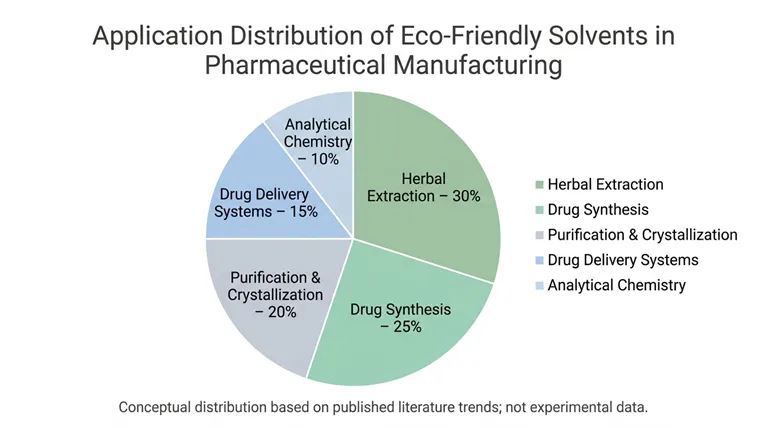
Figure -2
Figure -2
Illustrates the distribution of eco-friendly solvent applications in pharmaceutical manufacturing. The highest utilization is observed in herbal extraction and drug synthesis processes, indicating their compatibility with green processing techniques. Significant application is also seen in purification and crystallization, while moderate use occurs in drug delivery systems and analytical chemistry. This distribution reflects the versatility and broad applicability of eco-friendly solvents across pharmaceutical operations.
CONCLUSION
Eco-friendly solvent systems represent a vital advancement toward sustainable pharmaceutical manufacturing. By replacing hazardous conventional solvents with safer alternatives, the pharmaceutical industry can significantly reduce environmental impact while maintaining product quality. Water-based solvents, bio-based solvents, ionic liquids, deep eutectic solvents, and supercritical fluids have demonstrated strong potential across multiple pharmaceutical applications. Continuous innovation and regulatory support will further enhance the adoption of green solvent systems, contributing to a cleaner and more sustainable pharmaceutical future.
REFERENCES

Shaikh Arif Mohammad Salim, Advanced Eco-Friendly Solvent Systems for Sustainable Pharmaceutical Manufacturing, Int. J. of Pharm. Sci., 2026, Vol 4, Issue 6, 1225-1231, https://doi.org/10.5281/zenodo.20551812
 10.5281/zenodo.20551812