

We use cookies to ensure our website works properly and to personalise your experience. Cookies policy
Assistant Professors-KES's Late Shri P .C. B. College of D. Pharmacy & Late Prof. R. K. kele College of B. Pharmacy, Amalner, Dist Jalgaon, India.
Patient recruitment remains one of the most critical challenges in clinical research, often leading to delays, increased costs, and compromised trial outcomes. Artificial intelligence (AI) and predictive analytics offer transformative solutions by leveraging large-scale datasets such as electronic health records, pharmacy dispensing data, and demographic information to identify eligible participants more efficiently. Machine learning algorithms and natural language processing tools enable precise screening, optimize site selection, and anticipate recruitment barriers. These approaches not only accelerate timelines but also enhance diversity and retention in clinical trials. However, ethical considerations, data privacy, and regulatory acceptance remain essential for widespread adoption. By integrating AI-driven predictive models into recruitment strategies, modern drug development can achieve greater efficiency, inclusivity, and reliability, ultimately advancing patient-centered innovation in healthcare
The history of clinical research has always been intertwined with the barriers of patient recruitment. From the earliest controlled trials in the 18th century, when James Lind tested citrus fruits to combat scurvy among sailors, to the large-scale randomized controlled trials of the 20th century, the success of medical innovation has depended on the timely and effective enrollment of participants. Yet, despite advances in methodology, recruitment has consistently remained a bottleneck, often delaying drug development and inflating costs. Alongside these barriers, advances in computing and artificial intelligence (AI) have reshaped the scientific landscape.The roots of AI can be traced back to the mid-20th century, when pioneers such as Alan Turing and John McCarthy envisioned machines capable of learning and reasoning. Over the decades, AI matured from rule-based expert systems in the 1970s and 1980s to machine learning and deep learning models in the 21st century. These developments coincided with the digital revolution in healthcare, marked by the widespread adoption of electronic health records (EHRs), genomic databases, and real-world evidence platforms. In the pharmaceutical sciences, AI first found applications in drug discovery, molecular modeling, and pharmacovigilance. Predictive algorithms began to accelerate lead identification, optimize formulation design, and detect adverse drug reactions. As the scope of AI expanded, its potential in clinical research became evident. Recruitment strategies, traditionally reliant on manual screening and physician referrals, started to integrate predictive analytics—leveraging large datasets to identify eligible participants, forecast enrollment rates, and anticipate challenges in trial implementation. 1
AI in Clinical Research:
Clinical research has traditionally struggled with patient recruitment, trial efficiency, and effective data management. Artificial intelligence and predictive analytics are emerging as transformative solutions to these problems. By leveraging large datasets including electronic health records, pharmacy dispensing information, genomic data, and demographic profiles. AI-driven models can more accurately identify eligible participants and predict recruitment outcomes. 3
Machine learning algorithms and natural language processing enhance screening procedures, streamline site selection, and help anticipate recruitment challenges before they arise. Predictive analytics also supports greater trial diversity by ensuring broader representation across age groups, genders, and socio-economic backgrounds. These innovations reduce delays, lower costs, and improve the reliability of trial findings. 4
Beyond recruitment, AI contributes to adaptive trial designs, real-time monitoring, and predictive modeling of patient outcomes. Nevertheless, ethical considerations such as data privacy, algorithmic bias, and regulatory approval remain critical for widespread adoption. Overall, AI and predictive analytics mark a paradigm shift in clinical research, offering scalable solutions that align with modern drug development and patient-centered healthcare. 5
Table 1: Overview of AI Applications in Clinical Research
|
Section |
Focus Area |
Description |
Key Benefits |
|
Adaptive Trial Designs |
Dynamic study frameworks |
Researchers use AI to modify trial parameters based on interim results, improving flexibility and efficiency. |
Faster decision-making, reduced trial duration |
|
Real-Time Monitoring |
Continuous patient data tracking |
AI systems analyze live data from monitoring devices to detect anomalies and ensure patient safety. |
Early detection of adverse events, improved compliance |
|
Predictive Analytics |
Data-driven forecasting |
Machine learning models predict recruitment success, patient outcomes, and trial performance. |
Optimized recruitment, enhanced accuracy |
|
Ethical & Regulatory Concerns |
Governance and transparency |
Focus on data privacy, algorithmic fairness, and regulatory compliance for AI adoption. |
Trustworthy implementation, ethical integrity |
Predictive Analytics in Clinical Research
Predictive analytics has become a cornerstone of ongoing clinical research, providing data‑driven insights that enhance trial efficiency and patient outcomes. By harnessing large datasets such as electronic health records, genomic information, and demographic profiles, predictive models can forecast recruitment success, identify eligible participants, and anticipate potential barriers to enrollment. 8
Machine learning techniques further strengthen trial design by estimating dropout rates, predicting timelines, and optimizing site selection. These approaches also support adaptive trial frameworks, where interim data can guide protocol modifications while maintaining scientific rigor. Importantly, predictive analytics promotes greater diversity in clinical trials by ensuring representation across age, gender, and socio‑economic groups, thereby improving the generalizability of results.
Beyond recruitment, predictive models are increasingly applied to real‑time monitoring and outcome forecasting, enabling early detection of adverse events and enhancing patient safety. Despite these advances, challenges remain in ensuring data quality, mitigating algorithmic bias, and achieving regulatory acceptance. Nevertheless, predictive analytics represents a paradigm shift in clinical research, aligning with the broader movement toward precision medicine and patient‑centered healthcare. 1
Table 2: Key Components and Impacts of Predictive Analytics in Clinical Research.
|
Aspect |
Description |
Impact on Clinical Research |
|
Data Utilization |
Uses large datasets such as electronic health records, genomic data, and demographic profiles to generate insights. |
Improves participant selection and recruitment forecasting. |
|
Machine Learning Applications |
Employs algorithms to predict dropout rates, estimate timelines, and optimize site selection. |
Enhances trial design efficiency and adaptability. |
|
Adaptive Trial Frameworks |
Integrates interim data to modify protocols while maintaining scientific validity. |
Reduces trial duration and improves flexibility. |
|
Diversity Enhancement |
Ensures representation across age, gender, and socio-economic groups. |
Strengthens generalizability and inclusivity of results. |
|
Real-Time Monitoring |
Applies predictive models to detect adverse events and monitor patient outcomes. |
Improves patient safety and trial reliability. |
|
Challenges |
Data quality, algorithmic bias, and regulatory acceptance. |
Requires ethical oversight and transparent governance. |
|
Overall Contribution |
Predictive analytics aligns with precision medicine and patient-centered care. |
Represents a paradigm shift in modern clinical research. |
Patient Recruitment in Clinical Research
Patient recruitment is one of the most critical and complex stages of clinical research, directly influencing trial validity and timelines. Traditional approaches often face delays due to strict eligibility criteria, limited outreach, and patient hesitation, which can increase costs and compromise study outcomes. 4
Modern strategies, particularly those supported by artificial intelligence (AI) and predictive analytics, are transforming recruitment by analyzing large datasets such as electronic health records, pharmacy data, and demographic profiles. These tools improve screening accuracy, accelerate enrollment, and enhance diversity, ensuring trials are more representative. Despite these advances, ethical challenges remain, including patient privacy, informed consent, and algorithmic bias. Addressing these concerns is essential to build trust and achieve regulatory compliance. Overall, AI‑enabled recruitment methods represent a paradigm shift toward faster, more inclusive and cost‑effective clinical trials. 1
Trial Design and Optimization
Real-Time Monitoring and Safety
Outcome Prediction and Data Analytics
Ethical and Regulatory Considerations
Future Directions
Clinical Trials in the Era of Artificial Intelligence
Clinical trials are the foundation of evidence‑based medicine, providing the data necessary to evaluate the safety, efficacy, and effectiveness of new therapies. Traditionally, trials have faced challenges such as lengthy timelines, high costs, recruitment difficulties, and limited diversity among participants. These barriers often delay drug development and restrict the generalizability of findings.
Artificial intelligence (AI) and predictive analytics are redefining the conduct of clinical trials. By leveraging large datasets—including electronic health records, genomic information, and demographic profiles—predictive models enhance patient recruitment, optimize site selection, and forecast dropout rates. Adaptive trial designs, supported by machine learning, allow interim data to guide protocol modifications without compromising scientific integrity. Furthermore, predictive analytics enables real‑time monitoring of participants, early detection of adverse events, and outcome forecasting, thereby improving patient safety and trial efficiency. Importantly, these technologies also promote inclusivity by ensuring representation across diverse populations, strengthening the external validity of results. Despite these advances, challenges remain in ensuring data quality, addressing algorithmic bias, and meeting regulatory standards. Ethical considerations such as patient privacy and informed consent must be carefully managed. Nevertheless, AI‑driven clinical trials represent a paradigm shift toward precision medicine, offering faster, more reliable, and patient‑centered research outcomes. 10.11
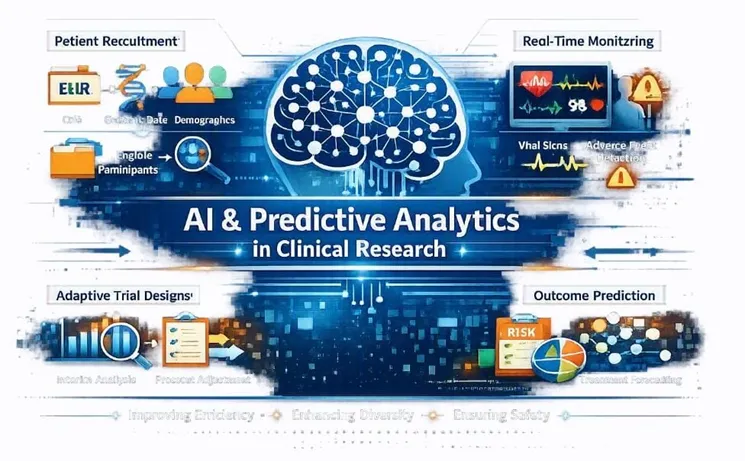
Figure 1: Applications of AI and predictive analytics in clinical trials, highlighting recruitment, monitoring, adaptive design, and outcome forecasting.
CONCLUSION
Artificial intelligence and predictive analytics are transforming clinical research by overcoming persistent barriers in patient recruitment, trial design, monitoring, and outcome prediction. These innovations enable faster enrollment, enhance trial diversity, and improve efficiency through adaptive frameworks and real‑time safety monitoring. By integrating large datasets with advanced algorithms, predictive models deliver more reliable, inclusive, and cost‑effective studies, aligning closely with the vision of precision medicine. At the same time, their adoption introduces important ethical and regulatory considerations. Safeguarding patient privacy, ensuring informed consent, and minimizing algorithmic bias are essential to maintain trust and compliance. Transparency, accountability, and robust governance will determine the sustainability of these technologies in clinical research. Overall, predictive analytics and AI represent a paradigm shift toward patient‑centered, data‑driven, and globally relevant trials. Continued collaboration among researchers, regulators, and technology developers will be vital to fully realize their potential and ensure equitable benefits across diverse populations.
REFERENCES




Devesh Bhavsar, Pragati Patil, Chhaya Mahajan, Gitanjali Patil, Artificial Intelligence and Predictive Analytics: Transforming Recruitment Strategies in Clinical Research, Int. J. of Pharm. Sci., 2026, Vol 4, Issue 8, 1678-1683, https://doi.org/10.5281/zenodo.21870687
 10.5281/zenodo.21870687