

We use cookies to ensure our website works properly and to personalise your experience. Cookies policy
College of Pharmaceutical Sciences, Pravara Institute of Medical Sciences (DU), Loni
Developing a new medicine takes years of research and requires many decisions along the way. Researchers must identify a promising biological target, find or design a suitable compound, test its safety, and determine whether it benefits patients. Artificial intelligence (AI) is beginning to support each of these steps. Machine-learning systems can analyse large biological and chemical datasets, while newer generative models can suggest molecules for further study. AI can also help predict drug properties, identify possible new uses for existing medicines, and improve aspects of clinical-trial planning. These developments are encouraging, but they need to be viewed realistically. A computer-generated prediction is only a starting point: it must be tested in the laboratory and, ultimately, in people. AI systems can also be affected by incomplete or biased data, may not work well on unfamiliar problems, and can be difficult to interpret. This review discusses how AI is being used across drug discovery and development, what its current strengths and limitations are, and what will be needed for its responsible use. The central message is that AI is most valuable when it works alongside experimental science and clinical expertise—not as a replacement for them.
A promising idea for a medicine is only the beginning of a long process. Researchers must understand what is going wrong in a disease, identify a biological target that can be influenced, and find a compound that affects it in a useful way. That compound must then be tested for activity, safety, and suitability for use in the body. Even after successful laboratory studies, clinical trials are needed to determine whether the treatment helps patients.
Many potential medicines fail along the way. A compound may not behave as expected in living systems, may cause unwanted effects, or may not provide enough benefit in a clinical trial. Drug research also produces enormous amounts of information—from molecular structures and genetic data to laboratory measurements and patient records. Finding useful connections in that information can be challenging.
Artificial intelligence (AI) offers new ways to analyze this complexity. In drug research, the term usually refers to methods such as machine learning, deep learning, natural-language processing, and generative modeling. These tools can learn patterns from existing data and use them to make predictions. For instance, a model might rank compounds that could bind to a protein, estimate whether a molecule may have toxic properties, or help identify a biological pathway connected to a disease.
The promise of AI is not that it can “invent a drug” on its own. Rather, it may help researchers decide what to investigate next. It can narrow down large lists of possibilities, highlight patterns that deserve attention, and suggest experiments. Those suggestions still need to be checked by scientists. A model that performs well on data it has already encountered may not perform as well on a new molecule, a different laboratory’s results, or a diverse patient population.
This review looks at where AI is being used across drug discovery and development, what its current contributions are, and what challenges remain. It also considers how the field can move from promising predictions toward results that are reproducible and meaningful for patients.[1]
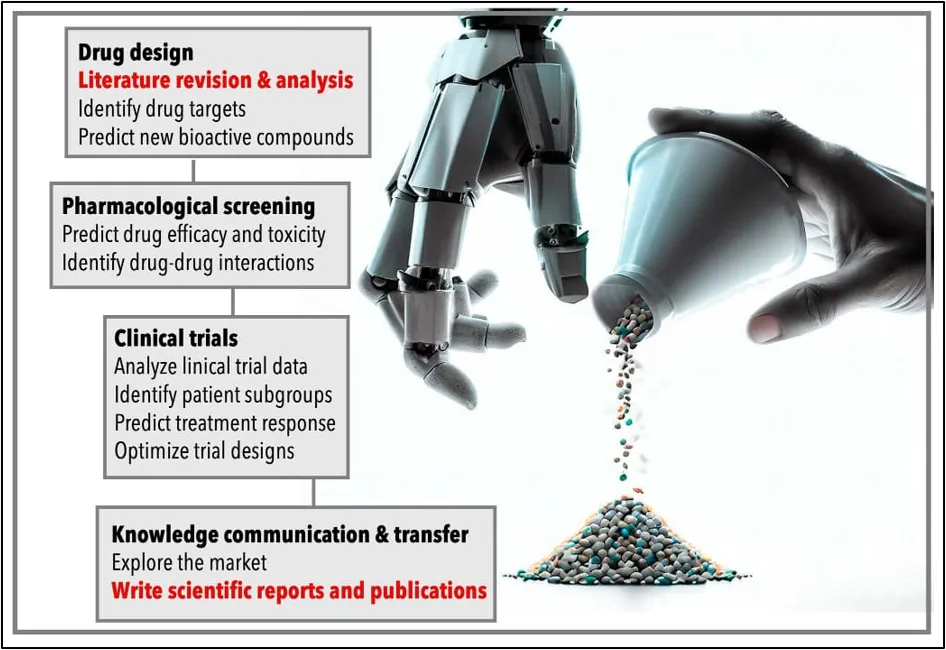
2. AI methods and the data they use
AI is an umbrella term rather than a single technique. Supervised learning, for example, uses examples with known outcomes. A model might learn from compounds already labeled as active or inactive against a particular target. Unsupervised learning looks for patterns in data without being given those labels. Deep-learning methods use neural networks to learn complex relationships, while generative models can propose new examples, such as candidate molecular structures. Natural-language processing can help extract information from scientific papers, patents, or clinical records.
Drug research draws on many kinds of data. Chemical datasets describe molecular structures and measured properties. Biological datasets may include gene activity, protein interactions, or results from cell-based experiments. Clinical data can include diagnoses, treatment histories, laboratory values, and patient outcomes. These sources are often collected for different purposes and in different formats, so combining them is not always straightforward.
The quality of the data matters enormously. Laboratory results can vary because experiments were performed using different equipment, protocols, or biological samples. Published research may also contain more positive findings than negative ones. Clinical datasets can have missing information or may not represent all the people affected by a disease. If these issues are overlooked, a model may learn misleading patterns.
It is also important to test a model fairly. If very similar compounds appear in both the training and test data, a model may appear more capable than it really is. Stronger tests use independent data or ask the model to make predictions about new compounds, targets, or settings. Clear reporting of data sources, methods, and validation is essential for judging whether a result is trustworthy.[2]
3. WHERE AI IS BEING USED IN DRUG DISCOVERY AND DEVELOPMENT
3.1 Finding and assessing drug targets
A drug target is a biological molecule or process that researchers hope to influence to treat a disease. AI can help search for potential targets by bringing together evidence from genetics, gene-expression studies, protein networks, patient data, and published research.
Natural-language processing can scan scientific literature to find reported links between diseases, genes, proteins, and drugs. Network-analysis methods can also show how biological components interact and may suggest which parts of a pathway are worth investigating.
These tools help researchers form hypotheses; they do not prove that a target will make a good medicine. A gene may be associated with a disease without being the cause of it. Even when a target is involved, changing its activity may not improve a patient’s condition—or it may lead to unwanted effects. Laboratory studies are needed to test whether the proposed relationship is real and therapeutically useful.
3.2 Predicting protein structures and molecular interactions
Knowing a protein’s structure can help researchers understand how it works and where a drug might bind. AI-based protein-structure prediction has made structural information available for many proteins and has helped scientists generate ideas for further study.
A predicted structure, however, is not always a complete picture of the protein. Proteins can move, change shape, and interact with other molecules. A predicted structure may be useful for guiding experiments, but it should not automatically be treated as an experimentally confirmed answer.
AI can also be used to estimate whether a small molecule might interact with a protein and how strongly it might bind. These predictions help prioritize compounds, but results depend on the model and its training data. A prediction is a reason to investigate a molecule—not proof that it will work as a drug.
3.3 Screening compounds
Virtual screening uses computers to search through large collections of molecules and identify those most likely to be worth testing. AI can help rank these molecules using information about their structures and known biological activities. Researchers can then focus laboratory testing on a smaller, more promising group.
This may save time and experimental resources. AI can also help compare compounds using several properties at once, such as predicted activity, solubility, and safety. That broader view is useful because a compound that affects its target but cannot be safely or effectively used in the body is unlikely to become a medicine.
Still, a high ranking does not guarantee success. A molecule may fail to bind in an experiment, may affect the wrong target, or may not behave well in a living organism. The laboratory remains the place where computational suggestions must be put to the test.
3.4 Designing and improving molecules
Generative AI models can propose new molecular structures based on design goals set by researchers. For example, a model might be asked to suggest molecules that could interact with a target while meeting certain predicted chemical or physical properties.
This is an exciting possibility because the number of potential molecules is enormous. Yet a computer-generated structure may be difficult to synthesize, unstable, or inactive when tested. Models can also optimize a score that looks good on a computer but does not capture what matters in a real experiment.
AI can be especially useful as part of lead optimization. Once researchers have found an active compound, they may want to improve its potency, selectivity, or other properties. A model can suggest modifications, and experimental results can then be used to guide the next round of design. This works best when computational predictions and laboratory testing are closely connected.
3.5 Predicting drug properties and safety
Before a compound can be considered for further development, researchers need to understand how it behaves in the body. This includes how it is absorbed, distributed, metabolized, and eliminated—often grouped under the term ADME. Researchers also need to assess possible toxicity.
AI models can help estimate properties such as solubility, permeability, metabolic stability, and toxicity. Early warnings about a potential problem may help researchers improve a compound or decide not to pursue it.
These predictions should be treated cautiously. Safety can depend on dose, duration of treatment, a person’s health, and the presence of other medicines. A model trained to predict one laboratory result may not be able to predict a patient’s clinical response. AI can support safety assessment, but it cannot replace the necessary experimental and clinical testing.
3.6 Finding new uses for existing medicines
Drug repurposing involves investigating whether a medicine developed for one condition might help with another. AI can look for connections between drug targets, disease biology, molecular patterns, and clinical information.
Repurposing can be attractive because researchers may already know something about the medicine’s safety and how it behaves in the body. But a medicine that is appropriate for one disease may not work—or may not be safe—when used for another. The dose, treatment length, and patient group may all be different. AI can help identify ideas to investigate, but studies are needed to determine whether those ideas hold up.
3.7 Supporting clinical trials
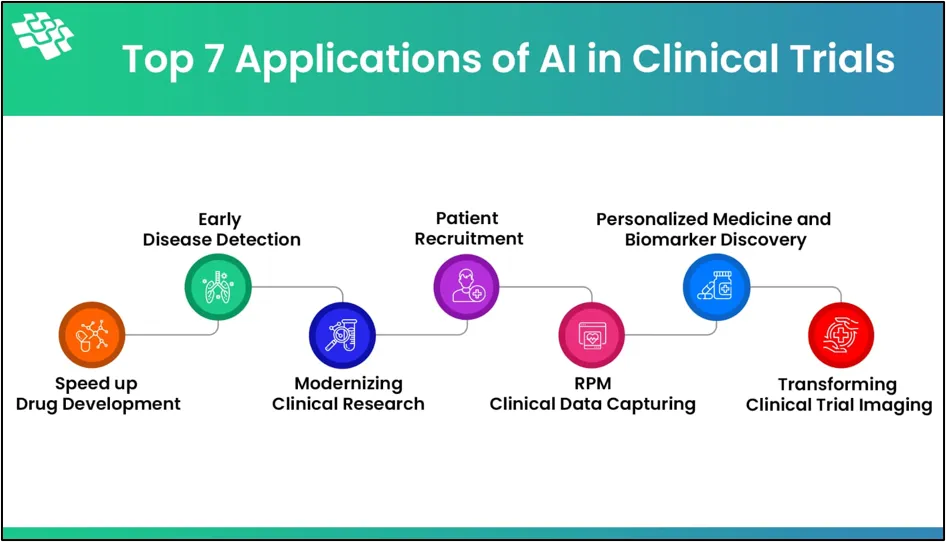
Clinical trials test whether a medicine is safe and effective in people. AI may help with parts of trial planning, such as estimating how many eligible participants may be available, finding potential participants in health records, or identifying patient subgroups that might respond differently to a treatment.
This could be helpful in diseases where patients have different underlying biology. In the future, combining clinical and molecular information might help researchers design trials that better reflect those differences. However, patient data may not represent every population equally. If a model has been trained mostly on data from one group, it may give less reliable results for others.
Clinical applications require careful oversight. Patient privacy must be protected, and clinicians should understand what a model can and cannot tell them. AI can help organize information, but decisions about trial participation, treatment, and safety require human judgment and established safeguards.[3]
4. WHAT THE EVIDENCE SHOWS—AND WHAT IT DOES NOT
AI has produced important advances in computational research. Models can help analyze biological data, predict molecular properties, suggest compounds for testing, and generate new hypotheses. Advances in protein-structure prediction have also made structural information more accessible to researchers.
But not all evidence represents the same level of success. A model performing well on a computer test is different from a molecule showing activity in a laboratory. Laboratory activity is different again from benefit in an animal model or a clinical trial. Each step provides new evidence, and success at one stage does not guarantee success at the next.
One concern is whether a model can work beyond the data used to build it. A system may perform well on familiar examples but struggle with a new chemical structure or a different patient group. Researchers should therefore look for independent validation and, where possible, prospective testing—testing predictions on new data collected after the model has been developed.
Another concern is interpretability. Some complex models provide a prediction without making the reasoning easy to understand. Researchers may find it harder to spot a mistake or decide whether a result makes biological sense. Making a model easier to interpret does not guarantee that it is right, but it can help scientists assess its output.
Finally, promising research tools are not automatically easy to use in practice. Laboratories need the staff and resources to test AI-generated ideas. Clinical teams need systems that fit into their work and meet appropriate standards. Collaboration among computer scientists, biologists, chemists, clinicians, and regulators will be important if AI is to make a lasting contribution.[4]
5. ETHICAL AND PRACTICAL CONSIDERATIONS
AI systems can reflect problems in their training data. If certain communities are underrepresented, a model may work less well for them. In drug development, this could affect which patients are invited to take part in trials or which groups are considered when a treatment is developed. Researchers should examine model performance across relevant populations and be open about limitations.
Privacy is another important issue, particularly when models use health or genetic information. Data should be handled responsibly, with clear protections for individuals. Researchers also need to be clear about who owns data, how it may be used, and how AI-generated results are interpreted.
Regulatory expectations are developing as AI becomes more common in healthcare and drug research. Developers and sponsors may need to explain how a model was trained, how it was tested, and what role it played in decision-making. Models that change over time may require ongoing monitoring to make sure they continue to perform reliably.[5]
6. FUTURE PERSPECTIVES
AI is likely to become more useful as researchers find better ways to combine different kinds of information. A model that can consider chemical, biological, and clinical data together may help researchers see connections that would be difficult to find using one data source alone. The benefit, however, will depend on whether those data are reliable, compatible, and representative.
Another promising direction is a closer link between AI and laboratory experiments. In a “closed-loop” approach, a model suggests what to test, scientists carry out the experiment, and the results help guide the model’s next suggestions. This could help researchers use laboratory resources more efficiently. It will still depend on well-designed experiments and careful interpretation.
The field also needs stronger ways to evaluate AI systems. Researchers should report not only how accurately a model predicts an outcome, but also whether its predictions led to useful experiments, saved time, or improved decisions. Testing on independent data and sharing enough methodological detail for others to assess the work will strengthen confidence in results.
Most importantly, AI should be developed and used responsibly. Researchers should pay attention to data quality, privacy, bias, uncertainty, and the limits of a model’s predictions. Training that helps scientists and clinicians understand these issues will be just as important as technical progress.
AI is most likely to make a meaningful difference when it supports, rather than replaces, human expertise. A model may suggest what to test next; the experiment determines whether the suggestion is correct. A prediction may point to a possible treatment; clinical research determines whether it helps patients.[6]
7. CONCLUSION
AI is being explored throughout drug discovery and development, from identifying potential targets and screening compounds to predicting safety and supporting clinical trials. It can help researchers work with complex datasets and decide which possibilities to investigate first. Newer approaches, including protein-structure prediction and generative molecular design, have broadened the range of questions that computational tools can address.
At the same time, a computer prediction is not a medicine. Models can be limited by poor or biased data, may not work well in unfamiliar situations, and can be difficult to interpret. Their predictions need to be tested in the laboratory and, when appropriate, in clinical studies. Progress will depend on careful validation, transparent reporting, responsible data use, and close collaboration across disciplines. Used thoughtfully, AI can make drug research more focused and help scientists ask better questions—while experiments and clinical trials remain essential for finding out what actually works.[7]
ACKNOWLEDGMENT
The author Mr Sahil Dhabale, would like to thank Dr. Yogita Charde Mam for giving me right path in my Graduation phase at Shree Sainath College of Pharmacy, Nagpur and also support me and I also would like to thank my friends Parimal Khedkar, Sameer Sheikh and Harshal Usendi for helping me in Project, Parimal Khedkar for helping me in the Project, Sameer Sheikh for helping me in improving the manuscript, Harshal Usendi for helping me in the Editing Portion. I would also like to thank Mr. Dhananjay R. Tidke Sir for helping me in referencing portion. We wish to gratefully acknowledge all the staff of Shree Sainath College of Pharmacy, Nagpur.
REFERENCES





Kartik Deshmukh, Shubham Kanawade, Sakshi Dengle, Gaytri Dalvi, Sandhya Nivdunge, Artificial Intelligence in Drug Discovery and Development: Current Advances and Future Perspectives, Int. J. of Pharm. Sci., 2026, Vol 4, Issue 10, 2668-2675. https://doi.org/10.5281/zenodo.23424413
 10.5281/zenodo.23424413