

We use cookies to ensure our website works properly and to personalise your experience. Cookies policy
Womens College of Pharmacy, Peth-Vadgaon
Globally, healthcare systems are confronted with increasing issues, such as mounting expenses, a lack of workers, and differences in access and quality, especially in low- and middle-income nations. By improving diagnosis, treatment planning, patient monitoring, and healthcare efficiency, artificial intelligence (AI) has emerged as a game-changing tool that can address these problems. AI is used in telemedicine, wearable health devices, drug research, disease diagnosis, personalised treatment, and predictive analytics. AI can analyse complicated data sets, such as genomic profiles, medical imaging, and electronic health records, using machine learning and deep learning to find trends, forecast the course of diseases, and suggest the best course of action. By enabling affordable, resource-efficient solutions in remote and low-resource environments, such as wearable biosensors, mobile diagnostics, and lightweight algorithms, AI also has the potential to advance equity.Critical issues such data privacy, algorithmic bias, model interpretability, regulatory monitoring, and preserving human clinical oversight must be resolved for deployment to be successful. The use of resource-efficient tools, physician training in AI literacy, international collaboration, and strong regulatory frameworks to guarantee accountability, safety, and transparency are important initiatives that emphasise scalable, ethical, and evidence-driven implementation. AI may lower errors, maximise resources, enhance patient outcomes, and increase access to high-quality care by supporting healthcare workers rather than taking their place. The proper integration of AI as a potent engine for innovation, sustainability, and equity in healthcare delivery globally is highlighted in this paper
The goal of the quickly expanding scientific subject of artificial intelligence (AI) is to develop computer technology that can carry out tasks that typically require human intelligence. Artificial intelligence has become more well-known because of its remarkable capacity to use deep learning models to carry out tasks that typically need human intellect. Artificial intelligence has been observed in a variety of fields, including quiet and the creative arts. Although the intricate integration with healthcare systems shows great promise, it also presents a number of ethical and legal issues in addition to the possibility of bettering patient outcomes (1).
Growing expectations, rising healthcare expenditures, and overburdened systems are causing a radical change in the healthcare industry (2). There has never seemed to be a better opportunity to use an emerging technology to supplement clinical practice, especially in light of the recent Covid-19 outbreak, which appeared to exacerbate already-existing health disparities (30). AI has recently emerged into every aspect of healthcare, from acute hospital medicine and surgery to preventative medicine and public health, from potential time and cost savings in drug discovery and medical diagnostics (30) to revolutionary insights into genomic sequencing and disease susceptibility (30). Applications of AI in healthcare have moved beyond an algorithm-based model of medicine to a more individualised approach since the advancement of machine learning and deep learning (30). Recent advancements in AI systems have raised the possibility that AI will enhance or possibly replace doctors' current roles (7). However, a number of obstacles prevent its widespread implementation, such as the lack of transparency in AI algorithms, which contradicts the medical ethos of clinical medicine, which depends on decision-making transparency with the present application of evidence-based medicine in clinical practice(30). Despite the fact that healthcare is one of the industries most in need of innovation, the quick adoption of AI in non-medical sectors is the driving force behind this review. Few evaluations have thoroughly studied AI's cross-disciplinary influence, including under-represented sectors like generative AI and allied health professions, whereas earlier assessments have focused on AI in particular domains like radiology or surgery. The goal of this work is to present a multidisciplinary synthesis of AI applications in biomedical research, allied health, surgery, and medicine. Additionally, we sought to critically assess the implementation's constraints and regulatory obstacles. Lastly, we sought to suggest future lines of inquiry that could influence the responsible, egalitarian, and safe integration of AI. The review is organised so that the history and development of AI are presented first, followed by its limitations, clinical and research uses, and future integration directions into healthcare systems(30).
The purpose of this essay is to examine the development of AI and its growing significance in clinical practice, especially in the last several years. It covers the application of AI in a number of healthcare fields, such as surgical and medical specialities, as well as health promotion and prevention. The present restrictions on the application of AI in clinical practice are also discussed in this study, along with potential remedies. This assessment also takes into account techniques for more efficient adoption into broader healthcare systems as well as possible future applications. This review also looks at under-represented fields like generative AI (GenAI) and allied healthcare professions. This paper examines the use of AI in physiotherapy, speech therapy, nutrition, and mental health, in contrast to the conventional emphasis on physician-led applications. Additionally, we want to investigate how large language models (LLMs) can enhance and automate communication, documentation, and decision-making. This is a practical overview of the potential future application of AI in health.
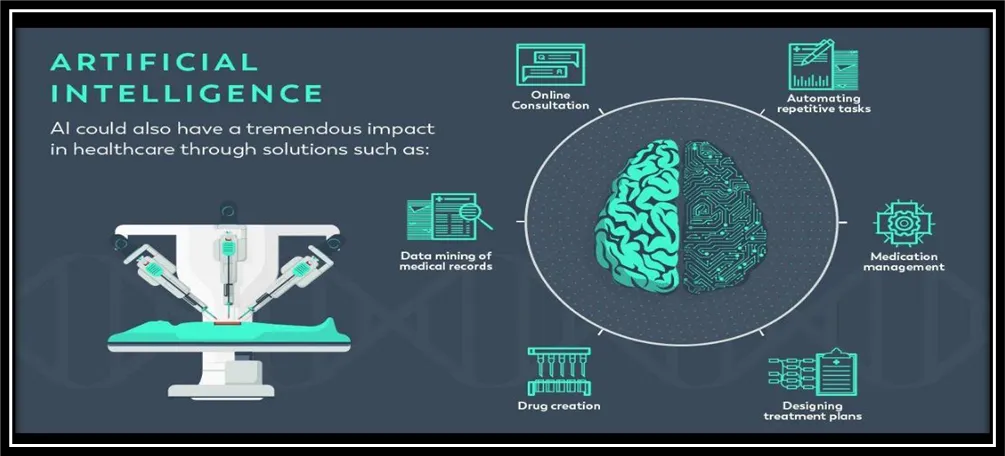
Fig no. 1: Artificial Intelligence
Need for the study :-
By facilitating advancements in diagnostics, personalized medicine, treatment planning, and operational efficiency, artificial intelligence (AI) is quickly changing the healthcare industry. Despite increased interest and a large number of studies, previous reviews frequently concentrate on particular applications or technologies; additionally, there is little analysis of AI's potential to address disparities in healthcare access and quality across diverse resource settings. This thorough review attempts to close these gaps by examining the range of AI applications in medicine while emphasizing equitable healthcare delivery. By synthesizing recent developments and challenges, this study offers crucial information to inform future research, clinical implementation, and policymaking.
Understanding AI and its history :-
Since Christopher Strachey created the first AI software in 1951, AI has seen substantial development. Initially, it was primarily an academic study area. Over the next 20 years, there were significant innovations in engineering, including the first basic robot that could follow simple instructions and electronic arms in assembly lines.
Despite this advancement, the use of this technology in medicine was sluggish at the time. However, there were significant developments in medicine during this period that would lay the groundwork for AI in medicine later on, such as the creation of clinical informatics databases and medical record systems (8). During this period, the National Library of Medicine developed the web-based search engine PubMed, a crucial digital tool that helped advance biomedicine as we know it.
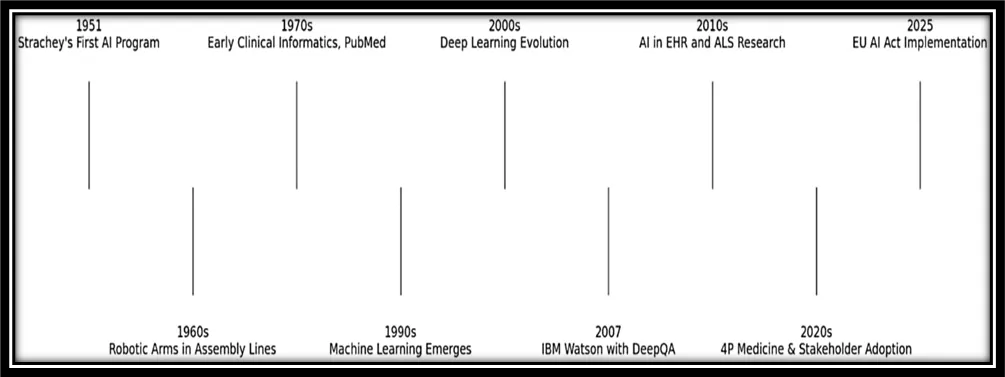
Fig no 2 :- Timeline of major milestones in AI and healthcare.
Machine learning, a branch of artificial intelligence that focuses on pattern recognition and analysis with the goal of enhancing machines with experience from data sets, became more popular in the decades that followed. This was followed by the development of Natural Language Processing, another branch of artificial intelligence that includes computers extracting information from human language and using that knowledge to make judgements.
Machine learning advanced into Deep Learning in the late 1990s and early 2000s. Deep Learning is a system of multi-layer neural networks that allows machines to learn and make decisions on their own, functioning similarly to the human brain (30). AI began to make significant strides in the 2000s. Watson, a question-answering system created in 2007 by the International Business Machines Corporation (IBM), was based on a technique known as DeepQA, which employed natural language processing to assess data and produce responses (30). This technology was more economical and simple to maintain.
DeepQA technology created new opportunities for evidence-based clinical decision making by leveraging data from electronic medical records and other electronic resources. Bakkar et al. employed this approach to discover changed RNA-binding proteins in amyotrophic lateral sclerosis (ALS), precisely demonstrating this.
Applications of AI like this were previously nonexistent due to financial and computational constraints. However, there is now a more optimistic outlook for the application of AI in medicine due to improvements in computer power, more data volume, and additional financing.
These new developments have increased stakeholder interest in its application in clinical medicine and beyond, from diagnostics to operational management of healthcare. Because technology allows for the "4P" model of medicine (predictive, preventative, personalised, and participatory) (30), which was previously challenging to achieve, the general public has usually welcomed this with great excitement.
Methodology :-
In order to obtain up-to-date information on the therapeutic, diagnostic, and equity-focused uses of artificial intelligence in healthcare, this review's methodology comprised a thorough and methodical search of scholarly literature.
Foundation AI Technologies :-
1.Machine learning :-
Machine learning (ML) is an essential branch of artificial intelligence that allows computers to learn from data and identify patterns without the need for direct programming [12]. It is widely used in healthcare for outcome prediction, patient risk stratification, and illness classification [13]. It encompasses a variety of learning paradigms, including unsupervised learning, which finds hidden patterns in unlabelled health data to uncover new disease subtypes or patient cohorts, supervised learning, which trains models on data sets with known outcomes to forecast future instances, and reinforcement learning, which, although less commonly used in clinical settings, determines optimal treatment strategies through trial and error [14]. ML improves the precision and customisation of medical decision-making by making it easier to analyse large and complex healthcare data sets.
2.Deep learning :-
DL, a specialized subset of ML, employs multilayered artificial neural networks to represent complex and high-dimensional healthcare data. Because of its remarkable ability to handle complexity, particularly in image and sequence data analysis, this technology has transformed medical AI applications [15]. Convolutional Neural Networks (CNNs) are frequently employed in medical imaging to precisely identify and segment abnormalities in X-rays, CT scans, MRIs, and pathology slides [16]. Transformer topologies and recurrent neural networks (RNNs) are adept at processing sequential data, such as physiological time-series signals and electronic health records, which enhances patient monitoring and outcome prediction [17]. More accurate and automated clinical insights are made possible by ongoing improvements to these designs that improve feature extraction and predictive efficacy.
3. Natural language processing :-
AI systems can understand, assess, and generate human language thanks to Natural Language Processing (NLP), which also extracts useful information from unstructured clinical documents including doctor's notes, discharge summaries, radiology reports, and scientific articles [18]. In the healthcare industry, natural language processing (NLP) automates the extraction of clinical concepts, enhances the detection of adverse events, and enables patient communication through chatbots and virtual assistants [19]. The contextual understanding of medical language has been significantly improved by developments in transformer-based NLP models, like as BERT and GPT, enabling sophisticated applications like clinical trial matching and a comprehensive summary of medical literature. These improvements allow for more effective data processing and better clinical judgement.
4.Generative models :-
By creating realistic synthetic data that mimics real patient information, generative models like variational autoencoders and generative adversarial networks (GANs) have provided novel functionalities in healthcare AI [21]. These models are crucial for improving limited data sets, particularly in medical imaging, which boosts AI models' robustness and generalisability [22]. Apart from imaging, generative models facilitate drug discovery through the creation of novel molecular structures and the simulation of patient sickness trajectories to forecast patterns of progression [23]. Even though these developments significantly accelerate the development of healthcare AI, concerns about data quality, privacy, and potential biases in synthetic data sets must be carefully considered.
Advantages of AI In Healthcare
AI-equipped technology can analyse data much faster than any human, including clinical studies, medical records and genetic information that can help medical professionals come to a diagnosis.
AI can automate many routine tasks, such as maintaining records, data entry and scan analysis. With less time being spent on administrative tasks, medical professionals can place more focus on patient care.
From wearable health tech, such as the Apple Watch and FitBit, to digital consultations via your smartphone, AI can allow people to monitor their own health, while also providing healthcare professionals with essential data.
Current applications in Disease Diagnosis, Screening of artificial intelligence in modern clinical practice :-
Due to time restrictions and diagnostic uncertainty, surgeons frequently have to make difficult decisions that can significantly impact patient outcomes
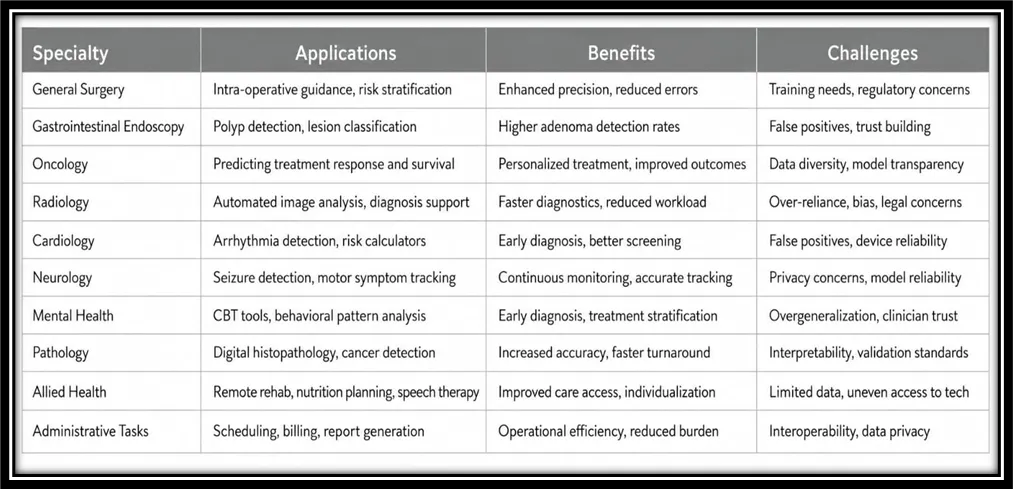
Table no 1 :- Summary of AI applications in healthcare
1. Plastic and reconstructive surgery :-
Artificial intelligence has shown promise in risk assessment, preoperative planning, and surgical simulation outcome prediction(30). However, AI-assisted robots in the field of plastic surgery allow for more technical capabilities and precision, particularly in microsurgery. Postoperative symmetry, volume, and aesthetic results are objectively evaluated using AI's image processing capabilities. Additionally, AI-driven diagnostic technologies are frequently able to identify problems earlier than conventional clinical techniques, helping to identify complications such flap ischaemia.
2. General surgery :-
Dexterity is essential for high-risk procedures in the field of general surgery. By enabling real-time recognition of anatomical features and providing surgeons with guidance throughout numerous difficult procedures, artificial intelligence reduces the possibility of error and enables intraoperative risk classification and help. Yagi et al.'s systematic evaluation examined how real-time instrument tracking improves technical performance and clinical outcomes in customised surgical training.
AI's ability to improve current risk prediction models has also greatly enhanced preoperative decision-making. APACHE III and POSSUM are two well-known scoring systems that are still essential for determining surgical morbidity and mortality. However, numerous scenarios in the field have shown that those algorithms fail to account for individual risk (17, 18). These models can be improved by machine learning, which will boost their predictive capacity and enable more customised risk assessment.
3.Gastrointestinal surgery :-
Some of the most significant advances in gastrointestinal (GI) surgery have come from AI, especially in the area of endoscopic imaging. AI-based models have significantly increased the diagnosis accuracy of endoscopic ultrasound (EUS), a crucial technique for distinguishing between pancreatic cancer and chronic pancreatitis(30).
AI-assisted colonoscopy has demonstrated a definite therapeutic benefit in lower GI endoscopy. Systems for computer-aided detection (CADe) have increased the rate of adenoma identification and made it easier to distinguish between benign and malignant tumours (23). AI-guided colonoscopy significantly increases adenoma identification when compared to traditional techniques, according to a randomised controlled research (24). In a similar vein, AI technologies used in upper GI endoscopy have improved early identification and intervention by diagnosing neoplastic Barrett's oesophagus with 89% accuracy (90% sensitivity and 88% specificity).
4 Oncological surgery :-
By combining several tumor-related and patient-related factors, artificial intelligence has been able to forecast cancer patients' outcomes in oncologic surgery. The models were able to identify variables that affected outcomes and provided a strong prediction of patient survival. By combining clinical, imaging, and pathology data, a customised treatment plan was made possible, significantly advancing the field of precision oncology.
5 Surgical education and skill assessment(30) :-
Surgical education across disciplines is being redefined by AI. AI can provide objective and scalable performance measures and feedback by tracking surgeon hand and tool motions in real-time through computer vision. This technology has the potential to improve surgical proficiency and standardise training worldwide. In addition to different sensors like optical, inertial, electromagnetic, ultrasonic, and hybrid sensors, machine learning and its subcategories—supervised learning, unsupervised learning, reinforced learning, and deep learning(30)—offer distinct advantages and could be used in a variety of surgical training and patient care contexts.
All phases of the surgical procedure, from preoperative risk assessment to intraoperative guiding and postoperative(30) results, have the potential to be revolutionised by the integration of AI. It will be essential to carefully integrate the technology into clinical operations as it develops. To optimise its benefits while guaranteeing safe and ethical application, ongoing research, stringent clinical trials, and robust regulatory control are crucial, as is covered in further detail in this review.
Many medical specialities have used AI technologies, and each has benefited from increased diagnostic precision, predictive modelling, and individualised treatment planning. Current applications are categorised by physiological system or clinical domain in the section that follows.
1 Cardiovascular system :-
Risk assessment and cardiovascular diagnostics have benefited greatly from AI. One of the first and most important uses was the identification of atrial fibrillation (AF). Kardia, a mobile ECG gadget with AI capabilities, was shown in the REHEARSE-AF trial to detect AF more correctly than standard care (26). Despite criticism for their high false-positive rates (27), wearable ECG devices are nevertheless useful for widespread screening. Additionally, when it comes to forecasting cardiovascular disorders like acute coronary syndrome and heart failure, artificial intelligence (AI) applied to electronic health records (EHRs) has beaten conventional risk calculators.(30)
2 Neurological system (30):-
AI-powered wearable sensors have shown promise in neurology for tracking and evaluating motor symptoms related to multiple sclerosis, Parkinson's disease, and Huntington's disease (29). These tools enable diagnosis and illness progression tracking by measuring posture, tremors, and irregularities in gait with great sensitivity. AI has potential for epilepsy seizure monitoring as well. AI-powered continuous ambulatory systems are more accurate than traditional techniques at identifying seizure occurrences.
3 Gastrointestinal system (endoscopy & imaging) :-
When it comes to identifying gastrointestinal disorders, artificial intelligence has greatly improved diagnostic accuracy. For instance, artificial intelligence is more accurate than a typical doctor in detecting colonic polyps and determining whether they are benign or cancerous (23). AI significantly increased adenoma detection rates as compared to conventional colonoscopy, according to a randomised controlled experiment (24). AI has been used in upper gastrointestinal diagnostics with an accuracy of 89% (90% sensitivity, 88% specificity) to differentiate between neoplastic and non-dysplastic Barrett's oesophagus.
4 Oncology :-
The preferred clinical strategy is precision medicine, which aims to tailor treatment according to each tumour patient's unique genomic profile. Consider a computer technique that uses the target cells' genomic profile to predict the medication response. Artificial intelligence models were able to predict patient responses with over 80% accuracy, according to a study by Huang et al. The high positive predictive value implies that an I might be used to find promising second-line treatments for choices that don't work with first-line medications that are considered standard of care.
5 Mental health(30) :-
In the field of mental health, it's critical to find structured treatment programs, keep an eye on the care he receives, and seek advice from mental health experts. Early identification, risk assessment, and treatment planning are all supported by AI-assisted platforms. Online cognitive behavioural therapy (CBT) tools with AI enhancements have demonstrated proven efficacy in treating common mental health conditions (30). AI models can also examine linguistic clues and behavioural patterns to help doctors diagnose schizophrenia, anxiety, and depression.
6 Radiology and medical imaging(30) :-
Although medical imaging is essential for providing diagnostic data, it is highly reliant on clinical interpretation and faces growing resource constraints. The future lies in artificial intelligence-based automated diagnosis from medical imaging. Numerous research have shown that deep learning models have both matched and surpassed human diagnostic ability, which has greatly excited scientists and physicians. Despite the claims, 99% of these studies lacked robust methodology, which limited their clinical trustworthiness, according to a 2019 meta-analysis (33). These results highlight how important it is to conduct excellent clinical trials to verify AI applications in radiology prior to their widespread use.
7 Pathology :-
Artificial intelligence is being utilised to diagnose cancer more quickly, accurately, and with superior quality. Algorithms on diagnostic approaches are being applied to support, enhance, and empower computational histopathology with the aid of sophisticated artificial intelligence. These days, whole slide imaging scanners may provide high-resolution images of the complete glass slide. When combined with digital pathology tools, they can integrate all aspects of pathology reporting, including anatomical, clinical, and molecular pathology.(30)
8 AI applications in allied healthcare professions(30) :-
It is important to note that a variety of allied health professionals, such as physiotherapists, dieticians, speech and language therapists, and mental health specialists, are using artificial intelligence more and more. For example, physiotherapists are using wearable AI gadgets to help remote rehabilitation and gait analysis. Additionally, dieticians are developing customised diet programs depending on each person's genetic makeup and way of life. Additionally, artificial intelligence is being used by speech and language therapists to identify language impairment and track advancement.
9. Generative AI and large language models (LLMs) in clinical practice(30)
It is important to note that a variety of allied health professionals, such as physiotherapists, dieticians, speech and language therapists, and mental health specialists, are using artificial intelligence more and more. For example, physiotherapists are using wearable AI gadgets to help remote rehabilitation and gait analysis. Additionally, dieticians are developing customised diet programs depending on each person's genetic makeup and way of life. Additionally, artificial intelligence is being used by speech and language therapists to identify language impairment and track advancement.
In order to effectively guide health activities, public health and population health strategies rely on prospective analytical data due to limited resources. In order to effectively identify people who are more likely to acquire chronic health diseases like endocrine disorders like type 2 diabetes or cardiac conditions like heart failure,(30) predictive analytics may be crucial. AI technology can be utilised to create efficient algorithms that analyse data more accurately and create a more reliable predictive model, which can lower expenses and enhance patient outcomes (30). Predictive models can help use targeted interventions for patients who are considered to be at higher risk by analysing data such as a patient's medical history and lifestyle characteristics.
The use of artificial intelligence (AI) in biomedical research is one of the most revolutionary applications of AI in healthcare. AI is simplifying and transforming several phases of the research process, from discovery to clinical translation, as a catalyst for innovation(30).
1 Drug discovery and repurposing :-
DeepMind's AlphaFold, which has greatly improved protein structure prediction—a crucial step in target identification for drug development—is a seminal example (30). The expansion of the antibiotic arsenal has been made possible by artificial intelligence and deep learning networks' shown ability to recognise unique antibacterial chemical structures. In order to reduce the time and expense involved in early-stage drug discovery, machine learning models are increasingly used to design new compounds, predict drug-target interactions, and evaluate toxicity and pharmacokinetics in silico.(30)
2 Clinical trial optimization :-
By assisting with patient recruitment, phenotype matching and classification, and predictive modelling, AI enhances the effectiveness and success of clinical studies. Adherence has also been tracked via mobile apps and variable devices. Large language models also make it possible to search unstructured clinical data, improving the trial's accuracy and inclusion. Adaptive trial designs made possible by predictive modelling allow for dynamic adjustments depending on interim results, which can boost trial effectiveness and save operating expenses.
3 Genomics and precision medicine :-
Large-scale genomic data analysis relies heavily on AI, especially deep learning. It makes it easier to identify pathogenic mutations, allows for molecular signature-based patient categorisation, and guides individualised treatment plans. These developments are essential to the advancement of the precision medicine project.
4 Natural language processing in scientific literature :-
By identifying and summarising important discoveries, natural language processing (NLP) technologies enable AI systems to quickly analyse and synthesise findings from enormous archives of scientific literature. These systems are unable to expedite systematic reviews and meta-analyses that allow both physicians and non-clinicians to stay current with the literature. By offering real-time insights into new research trends, this improves hypothesis creation, speeds up systematic reviews, and helps evidence-based clinical decision-making.(30)
5 Promoting equity in research :-
Recent initiatives have concentrated on using AI to enhance inclusivity and lessen prejudice in biomedical research. In order to improve the generalisability and equality of research findings across varied groups, AI methods are being developed to detect and address demographic under-representation in clinical datasets(30). Typically, machine learning models are trained using historical data. As a result, data that has previously been subjected to human bias will be vulnerable to inaccurate forecasts or resource withholding (46). This leads us to the conclusion that proactive employment of machine learning systems is necessary to promote equity. Distributive justice could be incorporated into the model's design and implementation to accomplish this.
Limitations of AI in healthcare(30) :-
AI has proven to improve medical practice in a variety of domains. Despite this, there has been some opposition to it, especially from medical professionals rather than patients.
First, a medico-legal framework that incorporates AI must be taken into account. From an ethical perspective, some accountability is required, especially when mistakes are made. Validating clear lines of responsibility in cases when a medical error has occurred is already challenging due to existing rules (7), and it gets considerably more problematic with AI systems. To have more clarity than there is now, this is undoubtedly a crucial issue that will require strong cooperation with legal authorities, medical personnel, and other important healthcare partners.
The creation of more AI services in the healthcare industry should be led by healthcare personnel, not only closely involved. This will provide a more equitable level of accountability by guaranteeing that any data produced by algorithms can be examined (7). Furthermore, increasing physicians' involvement in the development and testing of AI applications helps foster a sense of confidence in the system. Historically, doctors have been sluggish to accept new technologies in the healthcare industry and have relied on tried-and-true ways for clinical treatment (30). However, greater early engagement could potentially lower the barriers to deploying a new system for clinicians to use in routine care.
The widespread lack of education and training in the field of digital medicine is another broad reason against the quick adoption of AI in healthcare (48). The absence of education in this area raises concerns about a general lack of readiness for this change. There is also concern that AI will "take over" and replace clinicians, while more recent perspectives suggest that AI will enhance and supplement clinicians' skills and intellect in the future.
Reliance on institution-specific data, which might not translate well across healthcare systems, the possibility of models losing accuracy over time as practice patterns change, challenges integrating AI with current electronic records, and the possibility of increasing rather than decreasing workload if systems are poorly integrated(30) are some additional challenges. These problems show that thorough validation is necessary prior to widespread adoption.
Potential for future :-
Particularly in recent years, there has been a noticeable seismic shift toward the use of AI and digital medicine in healthcare. It appears to be a particularly advantageous moment to direct future systems to automate and enhance healthcare delivery in general.
Artificial intelligence is anticipated to assist public health by assessing patient data and environmental factors to predict possible diseases. Additionally, we anticipate that AI will be better able to analyse medical pictures, including x-rays, MRIs, and CT scans, increasing the tests' sensitivity and specificity. Other fields include personalised medicine, in which your genetic composition determines how you are treated. In order to expedite billing, appointment scheduling, and patient enquiries, artificial intelligence will also be utilised in administrative activities (51). Additionally, we will be able to rely on telemedicine services for distant consultations and gather patient data via wearable technology.
The ethical ramifications of the widespread use of AI in healthcare are also taken into account. With a market worth of $1,000 billion in 2019, it is one of the most promising markets of the contemporary era in terms of revenue (28). A growing percentage of revenue comes from sales of medical devices, such as the ECG monitors(30). As a result, governments and insurance providers are negotiating agreements with these businesses.
Medical monitoring's ethical ramifications are often debated, including the possibility of privacy violations and the likelihood of increased stigma against patients who are more impoverished or who have more chronic conditions (52). Ownership and data protection are obvious ideas that should be carefully taken into account in order to reduce these hazards in the future.
To begin addressing the need to teach upcoming medical leaders about the difficulties associated with AI systems, a number of universities have developed new medical curricula (53). These clinicians with a wider range of abilities could be extremely beneficial to healthcare organisations and society at large, serving as both a safety tool for AI systems in clinical delivery and a catalyst for additional study in this area.
AI has enormous potential to further reduce healthcare costs. There are several instances when successful cost-effectiveness has been proven, despite the fact that there are currently very few cost-benefit analyses for the application of AI in healthcare (54).
Optimising treatment results can be achieved by using AI for personalised medicine and using predictive algorithms to predict each patient's reaction to medical or surgical therapy by assessing their genetic and environmental characteristics.
Drug development and manufacturing can benefit greatly from AI's ability to optimise dosages and identify adverse drug responses (56), which can improve patient safety and therapeutic results. In addition to improving patient safety, using AI algorithms to optimise drug dosages customised for each patient will increase healthcare providers' productivity and save costs. The application of AI has sped up the creation of new medications and their release onto the market.
Additionally, one of the most promising applications of AI is in robotics, where several kinds of robots, including mobile autonomous and educational robots, are utilised in healthcare (7). Increased cost-effectiveness may result from the broader application of robotics. Due to the increasing use of surgical robots, common minor surgical procedures may eventually be performed by robotic systems.
Future directions include: (1) Explainable AI to enhance trust;
(2) Federated learning to safeguard privacy during cross-institution training;
(3) Broader robotics integration;
(4) AI designed for low-resource environments; and
(5) Green AI to lessen environmental effect. Strong policy and international cooperation are necessary for these paths.(30)
REFERENCES

Siddhi Karande, Mahek Shikalgar, Mubina Shaikh, Sakshi Powar, Pooja Koli, Dr. Dhanraj Jadge , Artificial Intelligence In Healthcare: Applications In Disease Diagnosis, Screening And Future Perspectives, Int. J. of Pharm. Sci., 2026, Vol 4, Issue 6, 28-42, https://doi.org/10.5281/zenodo.20483005
 10.5281/zenodo.20483005