

We use cookies to ensure our website works properly and to personalise your experience. Cookies policy
¹ Lecturer, College of Pharmacy, Integral University, Lucknow
² Assistant Professor, Loknete Dr. J. D. Pawar College of Pharmacy, Manur, Kalwan
³ Head of the Department, S.G.S.S. College of Pharmacy, Manur, Kalwan
? Lecturer, College of Pharmacy (Poly), Sawarde
? Lecturer, College of Pharmacy (Poly), Sawarde
? Lecturer, AIMS College of Pharmacy, Vadavali, Dombivli
Self-medication happens a lot, especially in rural parts of developing countries, where seeing a doctor can be tough. This review digs into how often people treat themselves, what medicines they reach for, why they do it, and what it means for their health. Take rural India, for example—over 60% of people there turn to self-medication. Most folks use painkillers, fever reducers, or antibiotics to handle everyday issues like headaches, fevers, or colds. It’s easy to see why—taking care of things yourself saves time and money. But it’s risky. People can misdiagnose themselves, react badly to medication, or make problems like antibiotic resistance worse. To make self-medication safer, we need to boost awareness, enforce stricter rules, and get pharmacists more involved.
Self-medication is defined as the selection and use of medicines by individuals to treat self-recognized illnesses or symptoms without consulting a qualified healthcare professional. According to the World Health Organization, self-medication is considered an integral component of self-care, enabling individuals to manage minor ailments such as headaches, fever, common cold, or gastrointestinal disturbances. When practiced responsibly, it can reduce the burden on healthcare systems, save time, and provide quick relief. However, inappropriate or irrational self-medication poses serious health risks, including misdiagnosis, drug interactions, adverse drug reactions, and antimicrobial resistance.
In rural communities, the practice of self-medication is particularly widespread and often influenced by a combination of socio-economic, cultural, and healthcare accessibility factors. One of the primary drivers is the limited availability of healthcare infrastructure. Rural areas frequently suffer from a shortage of hospitals, clinics, and qualified healthcare professionals, making it difficult for residents to access timely medical consultation. Long distances to healthcare facilities and inadequate transportation further discourage individuals from seeking professional advice.
Financial constraints also play a crucial role in promoting self-medication. Many individuals in rural settings belong to low-income groups and may not afford consultation fees, diagnostic tests, or prescribed medications. As a result, they often resort to over-the-counter (OTC) drugs or previously prescribed medicines as a cost-saving measure. In addition, lack of health insurance coverage in many rural populations exacerbates this issue.
Another significant factor is the lack of awareness and health literacy. Individuals may have limited knowledge about diseases, appropriate drug use, dosage, duration of therapy, and potential side effects. This often leads to improper drug selection, incorrect dosing, and premature discontinuation of treatment. Cultural beliefs and traditional practices also influence self-medication behavior, where advice from family members, neighbors, or local healers is preferred over professional medical guidance.
The easy availability of medicines, including prescription drugs, without proper regulatory enforcement further contributes to the problem. In many regions, pharmacies and local drug vendors dispense medications without requiring a valid prescription. This is particularly concerning in the case of antibiotics, where misuse and overuse significantly contribute to the global threat of antimicrobial resistance.
Globally, self-medication has emerged as a major public health concern due to its increasing prevalence and associated risks. Studies indicate that self-medication rates are particularly high in developing countries, including India, where healthcare access disparities are more pronounced. The irrational use of drugs not only affects individual health outcomes but also places a broader burden on healthcare systems through increased morbidity, drug resistance, and healthcare costs.
Therefore, while self-medication can be beneficial when practiced responsibly, there is a critical need for awareness programs, stricter regula tory policies, and active involvement of healthcare professionals—especially pharmacists—to ensure the safe and rational use of medicines in rural communities.
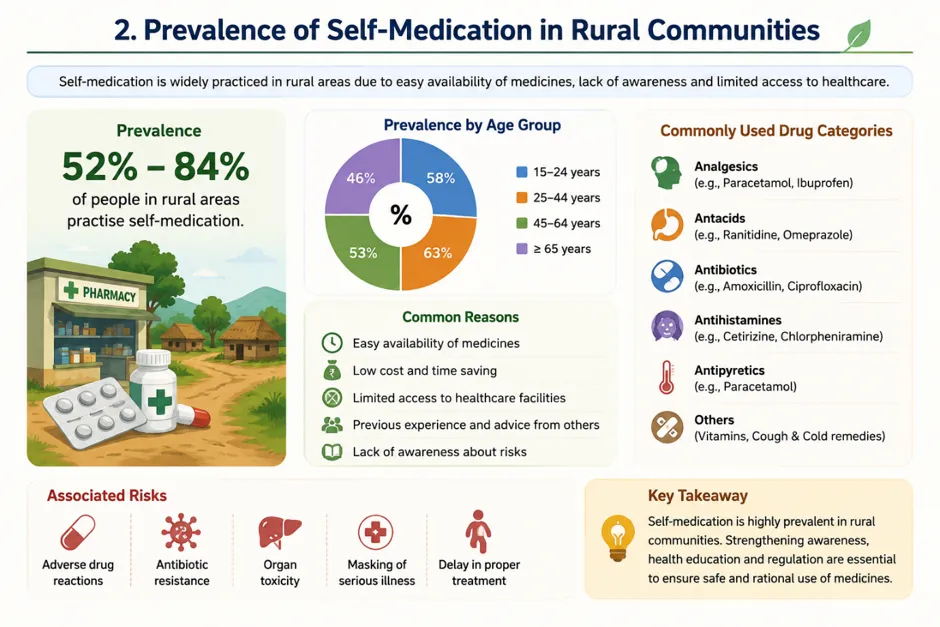
2. Prevalence of Self-Medication in Rural Communities
Self-medication is everywhere in rural India. People just don’t wait around for a doctor when they have a minor issue: they grab whatever medicine they know or have on hand. This isn’t just one village or state—it's happening all over the country.
Take Tamil Nadu, for example. One study found about 60% of people out there picking up their own medication for problems like fevers, headaches, or stomach issues. Andhra Pradesh showed even higher numbers—almost 68%. So, it’s clear: folks rely heavily on prescription-free medicines.
When researchers looked at studies from all across India, they came up with an average that’s hard to ignore: about 64% of rural people self-medicate. It doesn’t matter where you look; this is a nation-wide thing. It’s turning into a real public health challenge.
Now, if you dig deeper, the reasons are pretty interesting. Age matters—young adults tend to self-medicate more, probably because they feel confident diagnosing themselves and can find information easily online. Education plays a part too. It sounds counterintuitive, but people with more education actually self-medicate more, maybe because they know a bit about medicines—though that doesn’t mean they always use them wisely. On the other side, people with less education often turn to old family remedies or advice from whoever’s around.
Money is a big factor. If your family doesn’t have much, you're way more likely to skip the doctor and save cash by buying drugs directly. Jobs, access to clinics, and even cultural beliefs all shape this behavior.
With so many people in rural areas self-medicating, it's obvious that something needs to change. We need smarter health campaigns, tighter rules about selling drugs, and—most importantly—better access to proper healthcare so people stop relying on self-medication as their go-to.
3. Common Indications for Self-Medication
Most people turn to self-medication when they’re dealing with minor health issues—things that seem simple enough not to bother a doctor about. In rural areas, seeing a doctor isn’t always easy, so folks often grab over-the-counter medicine, use leftover prescription drugs, or just take advice from friends and family.
Headaches top the list. Almost everywhere you look, people treat headaches on their own. They’re seen as just part of life, nothing serious, so people usually reach for whatever painkillers are handy. Studies from rural areas actually show headaches make up close to a third of all self-medication cases—way more than anything else.
Fever is another big one, especially in places where things like viral infections, malaria, and typhoid pop up a lot. People often just take something for the fever, like antipyretics, without really knowing what’s causing it. This can put off a proper diagnosis and real treatment.
Coughs and colds? People hardly ever go to the doctor for these. They’re viewed as mild stuff that’ll go away on their own, so folks use cough syrups, antihistamines, and decongestants freely—sometimes over and over as the seasons change and these minor illnesses come back around.
Stomach problems are just as common. Stuff like acidity, diarrhea, constipation, or indigestion usually gets handled at home. Since antacids, laxatives, and other gut medicines are easy to get, people treat themselves and often ignore what’s actually causing the problem.
Then there’s body pain—anything from sore muscles to feeling wiped from a long day. People grab painkillers or anti-inflammatories, sometimes for too long or when they aren’t really needed. That can backfire and cause more trouble.
Other times, self-medication happens for things like rashes, mild allergies, or small cuts and scrapes. The risk here is that without actual medical advice, people might pick the wrong medicine or mask a serious issue, which only leads to bigger problems down the line.
So, most self-medication happens with minor illnesses because people think these issues are simple, or they just can’t get to a doctor easily. But this habit highlights the need for better health education and smarter drug use—otherwise, taking medicine on your own can do more harm than good.
4. Commonly Used Drugs
People in rural areas often turn to self-medication, mostly because it’s tough to get proper healthcare guidance. They usually pick drugs they’ve used before, or go with what friends, family, and even shopkeepers suggest. Experience and what’s easy to get often shape their choices.
Painkillers—analgesics—top the list. Folks grab them the most, using them for headaches, backaches, and all kinds of muscle pain. Studies say about 46% of self-medication is just painkillers. Why? They’re everywhere, and most people assume they’re safe. But when you use them too much or for too long, you run into problems like stomach irritation, kidney issues, or even liver damage.
Fever comes up, too. When it hits, people often reach for antipyretics like paracetamol. It’s cheap, it's everywhere, and it works fast. At normal doses, it’s safe, but if you keep taking it—especially without figuring out what’s causing the fever—there are risks.
Antibiotics are a whole different beast. In a lot of rural areas, you don’t need a prescription; you just walk in and buy them. People often use the wrong ones, take the wrong dose, or stop too early. This isn’t just a minor mistake—abusing antibiotics is pushing up drug resistance and making it harder for everyone to fight infections.
You also see antihistamines in the mix, mostly for allergies, coughs, and colds. Many people don’t realize these meds can make you drowsy. For someone working a physically demanding job, that’s a real concern.
Antacids and other digestive drugs are common, too. People use them for things like heartburn and indigestion, but relying on them too much can cover up bigger problems like ulcers or stomach infections, meaning real diagnoses and treatment get delayed.
There are other drugs in the background: cough syrups, vitamins, herbal remedies. People grab whatever’s easy, affordable, or familiar—scientific evidence rarely plays a role.
In the end, these meds might help with symptoms for now, but using them carelessly or without real guidance can backfire. Side effects, allergic reactions, hidden illnesses, and drug resistance can crop up. Clearly, there’s a big need for stronger regulations and better education, so people in rural areas can use medication safely and effectively.
5. Sources of Information
In rural communities, people often turn to whoever’s around for advice when it comes to picking and using medicine. With healthcare out of reach and not much health know-how, folks depend less on doctors and more on whatever’s close by and familiar.
Pharmacists and local drug vendors are the go-to sources for most people. They’re easy to find, and everyone assumes they know what they’re talking about, so it’s common to ask them about which medicine to use, how much to take, and for how long. In these areas, pharmacists are usually the first stop for anything health-related. Studies show that more than 70% of people head straight to the pharmacy and buy medicine without a prescription, which really puts the pharmacist at the center of self-medication. Sometimes, they help people use drugs responsibly. But when rules aren’t enforced, they hand out prescription-only meds—like antibiotics—without much oversight, and that can cause problems.
Old prescriptions are another big influence. People often dig up previous prescriptions and reuse them for what they think are similar symptoms, believing the same medicine will work. But that’s risky, since symptoms can have different causes, and the old remedy might not fit the new problem.
Advice from family and friends plays a big part too. In tight-knit communities, people lean on each other. If someone’s aunt or neighbor had a headache and took a certain pill, chances are others will try the same thing based on their recommendation. That kind of word-of-mouth spreads fast, but the downside is that it’s not always grounded in medical facts, leading to some questionable choices.
Technology’s made its mark as well. More folks in rural areas have smartphones now, so they’re exposed to drug ads, online health info, and posts on social media. This stuff influences how they see diseases and treatments. But the quality of information varies, and there’s plenty of bad advice floating around, which only adds to unsafe self-medication.
Traditional healers and local practitioners still play a role in some places. Sometimes people mix modern medicine with traditional remedies, blending different ways of treating illness.
All this shows how much people in rural areas rely on whatever sources they can find because formal healthcare isn’t always available. To fix this, it’s important to give pharmacists better training, crack down on improper drug sales, and teach people about the dangers of taking medicine without guidance. That’s how you start to make medicine use safer and smarter in these communities.
6. Determinants of Self-Medication
Self-medicating is common in rural communities, and it’s not just about convenience—it’s a mix of economics, culture, and gaps in healthcare. When people live far from clinics and hospitals, with hardly any doctors around, getting medical help becomes a project. The long trips, unreliable transportation, and scarce services make folks think twice about visiting a professional, so grabbing whatever medicine is handy feels easier.
Money's another big problem. Many families in these areas struggle to pay for doctor visits, tests, or prescriptions, so handling things themselves seems cheaper and more practical. If someone has a cough or pain, they’re likely to use what they can get—usually without much advice.
Time is precious, especially for people working tough jobs day in and day out. Taking a day off for a doctor’s appointment can mean missing out on wages. So, self-medicating feels faster and less disruptive. Surveys in these communities found that half the people said they didn’t have time to wait around for a doctor—self-medication was just the obvious choice.
Personal experience plays a part too. If someone’s been sick with the same symptoms before, they’ll dig up old prescriptions or use the same treatment. It’s understandable, but sometimes it leads to the wrong kind of care if the new illness isn’t exactly like the old one.
Education shapes these habits as well. People with more schooling might feel more confident about diagnosing themselves and picking drugs, but that doesn’t mean they always get it right. Lack of real knowledge about medications, side effects, or how to use them can make things worse, regardless of their education level.
Family traditions, community advice, easy access to medicine without prescriptions, and loose regulations all feed into the cycle. Everyone’s got an opinion, and pharmacies rarely ask questions, so it’s easy to keep the habit going.
So, what’s the fix? Tackling self-medication means looking at the whole picture—making healthcare easier to reach, spreading reliable information, tightening drug laws, and getting professionals involved in rural health. Without all those pieces in place, people just keep doing what they know—sometimes, at a cost to their health.
7. Benefits of Self-Medication
8. Risks and Adverse Consequences
Self-medication can make life easier sometimes, but honestly, when people do it without any real guidance, it’s risky. The dangers are even bigger in rural areas, where folks often don’t have much information or access to proper healthcare. This leads to all kinds of problems.
For starters, people often misjudge their own symptoms. Instead of getting an accurate diagnosis, they end up treating the wrong thing, picking medicines that do nothing or even make things worse. Waiting too long without the right care means diseases progress, and fixing them gets harder later.
Mixing medications is another huge problem. When people grab whatever pills they have without understanding how they interact, it’s easy to run into dangerous side effects. Wrong doses, using medicines for too long, or taking them when you shouldn’t—any of these can cause serious harm. Sometimes, this goes beyond a simple reaction and actually becomes life-threatening.
People also tend to mask real problems. For example, taking painkillers or fever reducers might make symptoms go away for a bit, but it doesn’t fix what’s actually causing them. This means serious illnesses can hide out, getting worse until it’s finally obvious something’s really wrong—and often, that’s too late.
Polypharmacy—using several medicines at once—is pretty common when people self-medicate. Mixing different drugs for different symptoms without knowing how they work together can lead to overdose, mistakes, or a loss of effectiveness. A lot of the time, it just creates more health issues.
Antimicrobial resistance stands out as a critical issue worldwide. When antibiotics get used incorrectly—wrong drug, wrong dose, or people cutting the prescribed course short—it leads to stronger bacteria that our medicines can’t defeat. The World Health Organization calls this one of the biggest threats we face, since it makes treatments less effective and pushes up sickness, death rates, and healthcare costs.
Besides all that, self-medication can lead to dependence, allergic reactions, and bigger financial headaches from complications. The bottom line: We need tighter rules about how medicine gets dispensed, much more public education, and stronger involvement from healthcare professionals, especially pharmacists, to keep people safe and make sure they’re using medicine the right way.
9. Role of Pharmacists
Pharmacists really step up in rural areas. They’re often the ones people turn to first—especially since doctors and clinics are pretty scarce. If someone has a mild health issue and needs advice or some medicine, they don’t head to the nearest hospital, they just go straight to the local pharmacist.
A big part of their job is making sure folks use drugs responsibly. Pharmacists know their stuff—what medicine works for what problem, how much to take, and for how long. If you’ve ever wondered what to take for a headache or a cough, odds are the pharmacist can tell you exactly what you need. This sort of guidance cuts down on wrong choices and helps prevent misuse.
They also sit people down and explain things like how to take the meds, what side effects to watch for, and which drugs you shouldn’t mix. When people get clear instructions, they're more likely to stick to the treatment and less likely to run into trouble with bad reactions.
There’s another big responsibility—they stop people from misusing drugs, especially powerful meds like antibiotics, painkillers, or sleeping pills. Pharmacies follow the rules; they won’t hand over prescription-only stuff without the proper paperwork. This keeps people from taking meds they shouldn’t, which helps fight things like antibiotic resistance.
In rural areas, pharmacists do a bit of everything. They often assess patients on the spot and decide if it’s something simple that they can handle, or if the person needs to see a doctor. They act as a sort of gatekeeper, making sure people get the right care when it’s really needed.
Plus, pharmacists take time to educate people about the risks of self-medicating, why it matters to finish all your prescribed antibiotics, and when it’s important to get professional help. All this outreach makes a real difference in community health.
If we give pharmacists better training and support, and make them a bigger part of rural healthcare, self-medication problems go down. Empowering them means safer medicine, better care, and more accessible health services for everyone living out in those communities.
|
Sr. No. |
Role of Pharmacist |
Key Contribution |
|
1 |
First point of contact |
Provides basic healthcare advice and medication support. |
|
2 |
Medication counselling |
Guides patients on dose, duration, side effects, and precautions. |
|
3 |
Rational drug use |
Promotes safe and appropriate use of medicines. |
|
4 |
Prevents drug misuse |
Helps control inappropriate use of antibiotics and prescription medicines. |
|
5 |
Patient referral |
Identifies serious conditions and refers patients to doctors. |
|
6 |
Health education |
Creates awareness about self-medication and treatment adherence. |
|
7 |
Rural healthcare support |
Improves access to safe and effective healthcare in rural communities. |
10. Strategies to Improve Rational Use
You can’t tackle the self-medication problem with a single fix—it takes a whole system working together. Especially in rural areas, we need clear, practical steps to help people use medicines responsibly. This means everyone has a role: healthcare providers, regulators, pharmacists, and regular folks.
Start with education. People need to know the risks of treating themselves—wrong doses, dangerous drug reactions, even growing resistance to antibiotics. If we get the message out in schools, community meetings, and through online campaigns, folks are more likely to ask a doctor before popping pills.
Regulation matters, too. Pharmacies shouldn’t hand out prescription-only drugs to anyone who asks, especially antibiotics or other risky medicine. Authorities need to crack down on illegal sales, keep shops in check, and make the penalties for breaking the rules more serious.
Pharmacists are in a unique spot. They’re the bridge between doctors and patients, and they need to make sure every customer gets the right medicine, at the right dose, for the right amount of time—and that it won’t cost an arm and a leg. Honest counseling goes a long way toward stopping bad habits.
Rural health centers are often stretched thin, and that pushes people to treat themselves. By building more clinics, hiring skilled professionals, and making sure there’s a steady supply of medicine, we encourage folks to get real medical advice instead of guessing.
Local involvement helps, too. Health workers, community leaders, and grassroots groups can spread reliable information and shape healthier choices. Programs that fit local customs and needs stand a better chance of sticking.
A little tech also helps. Digital health tools, smart media campaigns, and pharmacist-led projects can boost everything else we’re doing.
Put all these pieces together—and do it consistently—and you start to see fewer risky self-medicating routines. That means safer medicine use and better health for rural communities.
11. Future Perspectives
Addressing the growing challenge of self-medication in rural communities requires forward-looking strategies that integrate research, technology, healthcare workforce strengthening, and policy-level interventions. Future efforts should focus on developing sustainable and evidence-based approaches to promote the rational use of medicines.
One key area is the need for large-scale epidemiological studies in rural settings. Although several regional studies exist, there is a lack of comprehensive, nationwide data capturing the patterns, determinants, and outcomes of self-medication. Well-designed multicentric studies can provide robust evidence to guide public health policies and targeted interventions.
The adoption of digital health interventions for awareness holds significant promise. With increasing penetration of smartphones and internet connectivity even in rural areas, digital platforms such as mobile health (mHealth) applications, telemedicine services, and social media campaigns can be leveraged to disseminate accurate health information. These tools can help educate individuals about the risks of self-medication, proper drug use, and when to seek medical advice.
Another important direction is the integration of pharmacists into primary healthcare systems. Expanding the role of pharmacists beyond dispensing to include patient counseling, screening, and referral services can significantly improve medication safety. Structured training programs and policy support can empower pharmacists to act as key stakeholders in rural healthcare delivery.
Policy reforms for over-the-counter (OTC) drug regulation are also essential. Strengthening legislation and ensuring strict enforcement regarding the sale of prescription-only medicines can reduce misuse. Clear classification of OTC drugs, better labeling, and monitoring mechanisms can further support safe self-medication practices.
Additionally, future perspectives may include the use of artificial intelligence for monitoring drug use patterns, community-based participatory research, and integration of traditional and modern healthcare systems in a regulated manner.
Overall, a combination of research-driven policies, technological innovation, and strengthened healthcare infrastructure will be crucial in addressing the challenges of self-medication and ensuring safer healthcare practices in rural populations.
CONCLUSION
Self-medication runs deep in rural communities. People turn to it because money’s tight, clinics can be far away or hard to reach, and there’s often not much reliable health information available. When you look at how common it is, it really shines a light on all the ways the healthcare system falls short—especially when folks need quick, affordable help.
There are a few upsides. For smaller problems, grabbing something from the local shop can be a fast fix, easier on the wallet, and keeps hospitals from getting overloaded. But when people treat themselves without the right guidance, it can get risky fast. The wrong drug, the wrong dose, or the wrong guess about what’s actually going on inside the body—these can all lead to nasty side effects, drugs clashing with each other, or even bigger issues staying hidden. Plus, when antibiotics get overused, suddenly it’s not just one person at risk—everyone gets dragged into the battle against resistant bacteria.
Honestly, self-medicating is a tangled mess. Fixing it takes more than just one approach. People need straight talk—clear, real information on what’s safe and when it’s time to see a pro. Rules around selling certain drugs have to be much tighter. And pharmacists? They could be real game changers, making sure people get the right advice and steer clear of bad choices, especially where doctors are hard to find.
If we build up local clinics and give pharmacists a bigger role in the community, self-medicating doesn’t have to be so dangerous. In the end, it takes everyone—health workers, government folks, local leaders, everyday families—pulling together. That’s how we keep people safe and healthy, even when the system isn’t perfect.
REFERENCES

Layeeq Ahmad, Sagar Gangurde, Dr. Ansari Zaki Iqbal, Amita Vasave, Dhanashri Mahadik, Poonam Kasar, Assessment of Self-Medication Practices in Rural Communities: A Review, Int. J. of Pharm. Sci., 2026, Vol 4, Issue 9, 2259-2270. https://doi.org/10.5281/zenodo.22846789
 10.5281/zenodo.22846789