

We use cookies to ensure our website works properly and to personalise your experience. Cookies policy
PRES’s College of Pharmacy for Women Chincholi, Nashik, Maharashtra, India 422102
Bilayer and multilayer tablets are specialized oral solid medicines that pack two or more distinct layers into one single unit. These systems work exceptionally well for combination therapies, especially when two active pharmaceutical ingredients (APIs) show clashing traits in terms of dose, solubility, stability, or how they compress. This narrative review breaks down the core logic behind layered tablet architecture. It explores modern formulation paths, industrial production setups, layer bonding issues, and quality control metrics. We also discuss recent shifts toward Quality-by-Design (QbD) frameworks and advanced engineering tools.Past data proves that adding a well-crafted separation or placebo layer cuts down unwanted physical contact between reactive ingredients. Furthermore, these platforms can roll out multiple release phases—like immediate, sustained, or timed patterns—simultaneously. However, introducing new interfaces creates manufacturing vulnerabilities. Operators frequently face issues like layer weight shifts, powder separation, weak interface tracking, peeling (delamination), and cross-mixing. Common market examples include drug combinations like metformin–glipizide, telmisartan–amlodipine, and montelukast–levocetirizine. Recently, the field has grown to adopt experimental designs (DoE), process analytical tools (PAT), and even 3D printing. Ultimately, while layered tablets offer fantastic structural freedom, their complex production is only worth it if they deliver a clear clinical or therapeutic edge over standard, single-layer tablets.
This review highlights the real-world link between structural formulation choices, factory settings, layer-to-layer adhesion, quality checks, and new delivery techniques for combination treatments. Solid oral tablets remain a dominant choice in modern medicine. They are easy for patients to swallow, ensure accurate dosing, stay physically stable, and do not cost a fortune to manufacture on a large scale. Even so, standard single-layer tablets fall short when different active pharmaceutical ingredients (APIs) demand completely unique processing conditions or need to dissolve at different times. Clinicians frequently choose combination therapies to trigger synergistic actions, manage complex diseases better, or simply cut down the number of pills a patient must track daily. [22]
Blending these different components into a single, uniform mix often triggers heavy formulation roadblocks. These struggles stem from wide gaps in drug dosages, chemical stability, water sensitivity, and compression behavior.Bilayer and multilayer techniques solve this by physically separating the formulas within one solid unit [1].
Each layer can hold a separate active drug, the same drug engineered at a different release speed, or purely protective barrier agents. When timing matters, this layout allows sequential therapy. For instance, it can deploy a fast-acting dose followed by a slow, controlled maintenance release. Consequently, this engineering works beautifully for fixed-dose combinations (FDCs), particularly where traditional mixing would ruin shelf-life or disrupt dissolution pathways[13].
Scientific literature frequently highlights successful bilayer systems like metformin paired with glipizide [2], telmisartan with amlodipine [5], or stomach-targeted duos like pantoprazole and clarithromycin [3]. Newer research focuses on keeping aspirin and ticagrelor apart [6], alongside multi-layer drug coating methods for montelukast and levocetirizine combinations [4]. The true value of a layered setup lies in its power to give each section a specific job without breaking the single-tablet format. Naturally, engineers must balance this freedom against a significant spike in factory complexity. The danger peaks when touching layers show wildly mismatching compression profiles or elastic recovery tendencies. If ignored, these joint lines turn into weak spots prone to structural cracking, shifting weights, or erratic drug release [17].
2. AIM AND OBJECTIVE
3. LITERATURE SEARCH METHODOLOGY
This paper is structured as a thematic narrative review rather than following a strict systematic meta-analysis blueprint. The core goal was to collect and interpret representative manufacturing workflows and pharmaceutical metrics regarding layered combination tablets.
We used PubMed and ScienceDirect as our foundational search engines to pull and verify peer-reviewed pharmaceutical literature. To expand our reach, we also included search strings compatible with Google Scholar. The primary search concepts focused on terms like: bilayer tablets, fixed-dose combination (FDC), layer adhesion metrics, interfacial bonding strength, delamination flaws, quality by design (QbD), process analytical technology (PAT), and pharmaceutical 3D printing.
We gave strict priority to peer-reviewed studies and review papers backed by a valid Digital Object Identifier (DOI) or PubMed record. Older classic papers were intentionally kept if they provided essential baseline data on bilayer compression stress, joint toughness, or early manufacturing physics. The collected data was sorted into clean sections covering formulation chemistry, process engineering, quality checks, clinical uses, and next-generation tech. We interpreted all Quality-by-Design and product development ideas using the official ICH Q8(R2) [14, Q9(R1) [15], and Q10 [16] regulatory guidebooks.Because this is a narrative overview, we did not attempt any pooled statistical calculations or deep quantitative pooling. Consequently, this paper does not claim to index every single document ever printed on layered tablets; instead, it focuses on delivering a sound technical breakdown of representative milestone studies.
4. BILAYER TABLETS
4.1 Definition and Concept
A bilayer tablet is created by compressing two distinct powder blends sequentially inside a single die to forge one integrated unit. Each independent layer can house a specific API, a unique release-controlling matrix, or tailored functional additives. This clever setup lets developers control drug concentrations, customize excipient mixes, balance mechanical properties, and trigger completely different release behaviors inside a single pill.
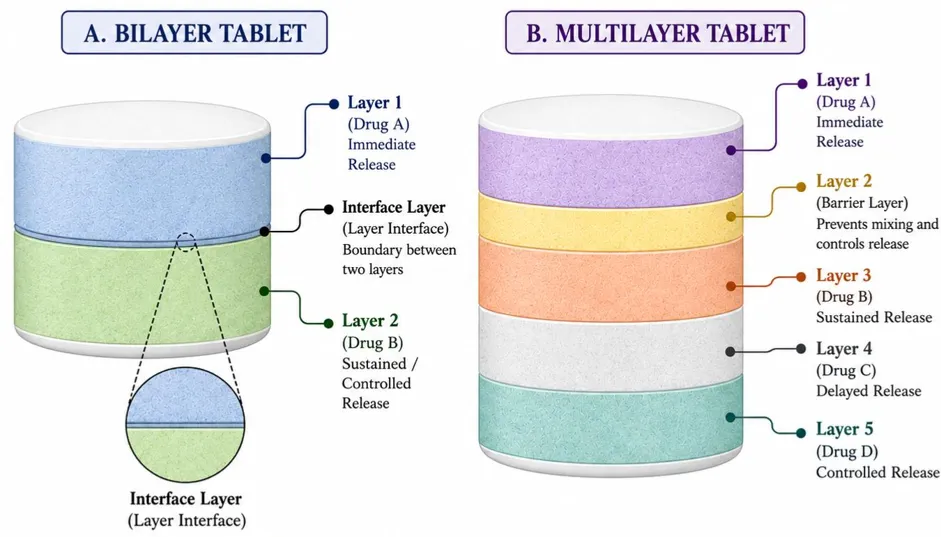
Fig. 1: Schematic representation of bilayer tablet (two layers) and multilayer tablet (multiple layers) showing layer names and their functions.
Source: Original schematic prepared for this review; conceptual basis supported by published bilayer-tablet literature [1,2].
4.2. RATIONALE FOR BILAYER TABLETS DESIGN
Splitting a tablet into a bilayer layout becomes incredibly valuable when two drugs call for different delivery speeds, or when you must prevent reactive ingredients from touching each other directly. For example, the first layer can be engineered to dissolve rapidly for an immediate therapeutic effect, while the second layer uses a water-loving (hydrophilic) or water-repelling (hydrophobic) matrix to stretch out drug delivery over hours. If chemical stability is a major threat, a middle placeholder or placebo layer can act as a protective wall. This technology also handles wide gaps in drug dosages and accommodates clashing processing demands effortlessly.
4.3 TYPES OF BILAYER SYSTEMS
|
Type |
Typical design |
Primary purpose |
|
Immediate + immediate |
Two rapidly disintegrating layers |
Simultaneous delivery of two APIs |
|
Immediate + sustained |
Fast-release layer + matrix layer |
Rapid onset followed by prolonged exposure |
|
Immediate + delayed |
Immediate-release layer + delayed-release layer |
Sequential or site-oriented exposure |
|
Sustained + sustained |
Two controlled-release layers |
Independent control of two APIs |
|
API + barrier layer |
Drug layer separated by functional barrier |
Reduce direct interaction and control release |
5. MULTILAYER TABLETS
5.1 Definition and Structure
Multilayer tablets stack three or more functional zones on top of each other. These extra layers can hold a variety of different APIs, chemical blocks, release-modifying matrices, or outer shields. While adding more layers naturally introduces extra process variables and structural risks, it gives developers unparalleled freedom to orchestrate complex, multi-stage delivery timelines.
5.2 ADVANTAGES AND CONSTRAINTS OF MULTILAYER ARCHITECTURE
Multilayer designs excel at building timed dosing patterns, chaining multiple release profiles, and isolating chemically volatile ingredients that crash upon contact. The main drawback is the heavy spike in factory assembly trouble caused by multiple joint lines. As you stack more layers, controlling joint adhesion, individual layer weights, powder movement inside the machinery, compression pressure memories, and batch consistency becomes much tougher.
6. RATIONALE FOR COMBINATION THERAPY
Doctors opt for combination therapies when deploying multiple active ingredients can trigger synergistic effects, tap into complementary biological pathways, or offer superior disease management. Merging these medicines into a single fixed-dose combination (FDC) pill makes life much easier for patients, reducing daily pill burdens and boosting compliance. However, if you simply dump multiple APIs into a basic single-layer tablet, you often trigger severe formulation failures due to conflicting dosages, stability issues, poor compression traits, or clashing dissolution patterns.
|
Formulation challenge |
How a layered tablet may help |
|
Different release requirements |
Assign separate layers with independently optimized release-controlling excipients. |
|
Drug–drug incompatibility |
Use spatial separation or a barrier layer when supported by compatibility studies. |
|
Different dose levels |
Optimize each layer independently for drug loading and content uniformity. |
|
Immediate + maintenance therapy |
Combine immediate-release and sustained-release functions in one dosage unit. |
|
Sequential delivery |
Design layers to disintegrate, dissolve or release at different times. |
|
Different processing requirements |
Select suitable granulation and compression conditions for each layer. |
7. FORMULATION STRATEGIES
7.1 Immediate- and Modified-Release Combination
A highly popular approach in layered design is loading one active drug into a fast-melting (immediate-release) zone and embedding the second drug into a slow-release (sustained or controlled-release) matrix. To slow things down, developers often turn to water-loving polymers like hydroxypropyl methylcellulose (HPMC) [30].
The moment this material meets digestive fluids, it hydrates rapidly to form a thick, protective gel wall. This gooey barrier steadily controls how fast the drug escapes, balancing both matrix erosion and molecular diffusion. On the flip side, water-repelling (hydrophobic) polymers can be mixed in to further choke off water entry and fine-tune the release speed. Meanwhile, the fast-acting layer is packed with aggressive disintegrants and fast-dissolving additives to guarantee a rapid therapeutic onset [31].
7.2 Separation of Incompatible APIs
Using a layered structure can effectively isolate two clashing active drugs, minimizing direct contact during factory compression or long-term shelf storage [1,7]. However, inserting a wall should never replace a thorough preformulation compatibility check. When mapping out drug-containing zones split by a middle barrier, developers must pick shielding materials based on the exact degradation pathways, moisture vulnerabilities, and expected chemical interactions. For instance, to block reactive triggers, boost product stability, and schedule sequential dosing, researchers recently utilized a smart core tablet wrapped in a middle barrier coat, finished off with an outer active drug film [4].
7.3 Fixed-Dose Combination Strategy
Bilayer fixed-dose combinations (FDCs) let formulators custom-build each section of a tablet to fit specific dosage volumes and release timelines while keeping everything in a single, user-friendly pill [22].
A prime example is a dual-matrix setup combining fast-dissolving glipizide with slow-release metformin hydrochloride [2]. Advanced development protocols frequently combine experimental designs (DoE), Raman tracking, thorough aging tests, and bioequivalence checks to successfully pair high-dose, long-acting drug bases with low-dose, fast-acting components [5,6].
7.4 Gastro-retentive and Site-Oriented Systems
To maximize drug absorption, layered tablets can be engineered to puff up or float, effectively locking them inside the stomach for extended periods. A classic application features a stomach-retained bilayer pill packing pantoprazole and clarithromycin, built using a balanced mix of sodium alginate, chitosan, and HPMC [3]. Engineering these specialized platforms requires extreme precision, as developers must meticulously test their structural endurance, floating buoyancy, gastric survival times, and shifting drug delivery tracks.
7.5 Release-Controlling and Barrier Layers
A functional layer does not always need an active drug to be useful. Purely inactive placeholders or barrier walls can easily control contact between separate drug zones, manipulate internal moisture levels, or dictate exactly when a compound gets exposed to body fluids. Naturally, the overall thickness, microscopic pore layout, material mix, and compression elasticity of these blank layers directly impact both the structural integrity of the joints and the final drug dissolution profiles.
8. MANUFACTURING APPROCHES
Industrial production typically starts by creating and processing each layer blend completely independently. If the raw ingredients possess good flow and compression traits, direct tableting can be used right away [29]. However, if the powders are difficult to handle, engineers turn to wet or dry granulation to upgrade their physical properties. The finished tablet is born by dropping these granular mixes into a single pressing die in a strict, step-by-step sequence before hitting them with a final compression stamp. The ultimate engineering battle in this workflow is creating a rock-solid inter-layer bond without over-compacting the granules, which can trigger trapped residual stress, alter pill porosity, or ruin the drug release curves [18].
|
Technique |
Principle |
Key considerations |
|
Direct compression |
Each layer blend is compressed sequentially. |
Flow, segregation, compressibility, lubrication and layer adhesion. |
|
Wet granulation |
Drug/excipient mixtures are granulated before compression. |
Moisture exposure, drying, granule size and API stability. |
|
Dry granulation |
Powders are densified without liquid binder. |
Roller compaction, ribbon/granule strength and flow. |
|
Sequential layer compression |
The first layer is partially compressed before addition of the next layer. |
Precompression force, surface condition and interfacial strength. |
|
Compression coating / layered coating |
Drug or barrier material is deposited around a core. |
Coating uniformity, adhesion, layer thickness and release control. |
|
API-layering approaches |
Drug is applied as a separate functional layer or coating. |
Drug distribution, stability, layer integrity and sequential release. |
8.1 Critical Process Parameters
Successfully running a multi-layer press requires strict control over individual layer weights, die fill depths, powder movement, pre-compression force, main compression pressure, turret rotation speeds, feeder calibration, machine lubrication, and punch dwell times. The exact weight of each factor shifts based on the machinery setup and raw material behaviors. Extensive compression studies show that operational speeds and pressing conditions directly dictate how well layers stick together, especially when touching formulas expand at different speeds when the pressure lets go [8,18].
8.2 Delamination and Layer Adhesion
Delamination occurs when the compressed layers of a tablet split apart right at their joint line [1]. This structural breakdown can happen unexpectedly during machine ejection, routine handling, automated packaging, or long-term storage [7]. A variety of factors drive this structural failure, including material warping, surface textures, trapped inner stress, extreme compaction force, punch dwell times, and manufacturing line speeds. When adjacent powder blends display vastly different elastic recovery profiles, they expand at unequal rates the moment the compression pressure releases. This physical mismatch triggers heavy mechanical stress across the boundary line, causing the layers to peel apart [19].
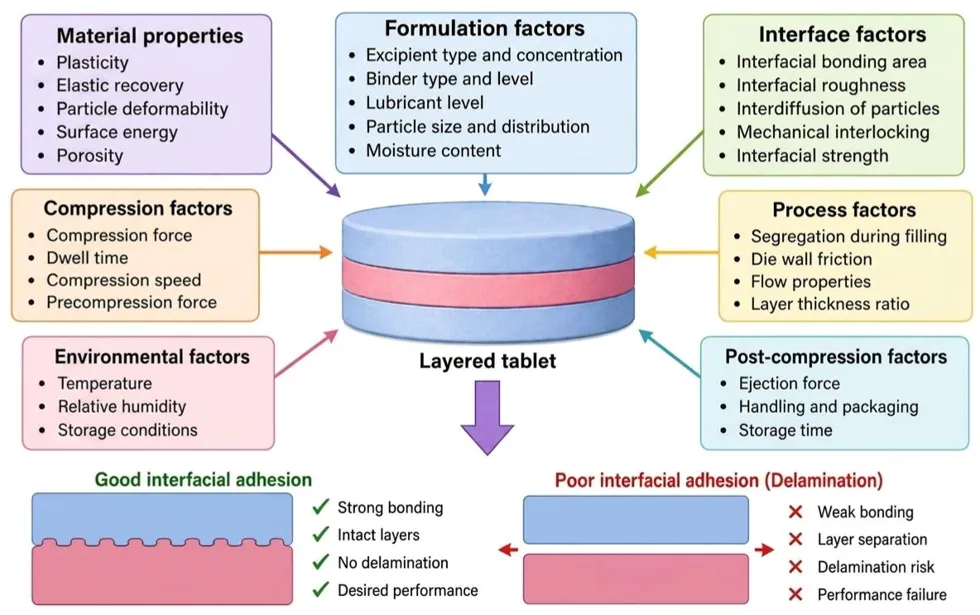
Fig. 2: Simplified representation of factors that can influence interfacial adhesion and delamination in layered tablets.
Source: Original schematic prepared for this review; mechanism and process-risk concepts supported by [2,3,16].
Engineers must evaluate the overall crushing strength of the tablet and its specific joint toughness (interfacial strength) as two completely separate metrics. It is highly common for a tablet to pass standard hardness tests with acceptable crushing scores while actually harboring a critically weak internal interface. To accurately map out the physical durability of these internal boundaries, researchers rely on specialized structural testing setups like diametral split tests, direct shear testing, or indentation-based mechanical trials [8,9].
9. EXCIPIENTS AND MATERIALS
When picking additives for a multi-layer tablet, formulators cannot just look at how each layer behaves on its own. They must deeply analyze how touching materials interact across the dividing line. Drastic shifts in particle elasticity, plasticity, brittleness, water absorption, and lubrication levels across layers directly dictate the final joint toughness and the mechanical survival of the pill.
|
Excipient category |
Examples |
Primary function |
|
Diluent/ filler |
Microcrystalline cellulose, lactose, mannitol, calcium phosphate |
Provide bulk and influence compaction. |
|
Binder |
Povidone, pregelatinized starch |
Improve granule and tablet strength. |
|
Disintegrant |
Croscarmellose sodium, crospovidone, sodium starch glycolate |
Promote tablet breakup. |
|
Matrix former |
HPMC, ethyl cellulose |
Form a matrix and control drug release. |
|
Glidant |
Colloidal silicon dioxide |
Improve powder flow. |
|
Lubricant |
Magnesium stearate |
Reduce friction during compression and ejection. |
|
Barrier material |
Polymeric or inert functional layer |
Separate selected APIs and modify interaction/release. |
|
Release-modifying polymer |
HPMC, ethyl cellulose, polymer blends |
Control hydration, diffusion and erosion. |
10. CRITICAL QUALITY ATTRIBUTES AND EVALUATION
Testing a multi-layer tablet requires looking beyond standard quality checkpoints to analyze unique structural challenges introduced by the multi-tier design. On top of tracking classic parameters like visual appearance, overall weight, thickness, crushing hardness, and friability, quality control teams must rigorously evaluate individual layer weights, dosage uniformity across layers, interface bonding strength, and API-specific dissolution tracking [1,10].
|
Evaluation parameter |
Purpose / relevance |
|
Appearance |
Detect visible defects, layer non-uniformity and separation. |
|
Overall tablet weight |
Assess consistency of the finished dosage unit. |
|
Individual layer weight |
Monitor layer-to-layer fill consistency during development and manufacturing. |
|
Thickness |
Monitor dimensional uniformity. |
|
Hardness / crushing strength |
Assess overall mechanical resistance. |
|
Friability |
Evaluate resistance to abrasion and handling. |
|
Layer adhesion / interfacial strength |
Determine resistance to delamination. |
|
Content uniformity |
Confirm uniform API distribution within the relevant dosage unit/layer. |
|
Disintegration |
Assess breakup of immediate-release components where applicable. |
|
Dissolution / drug release |
Establish the intended release profile of each API. |
|
Stability |
Assess physical and chemical integrity during storage. |
|
In-process controls |
Monitor layer weight, compression and process consistency. |
Because different active ingredients in these setups are intentionally engineered to release at contrasting speeds, dissolution testing becomes highly complex [20]. Analytical methods must be sharp enough to quantify each separate drug independently without any molecular cross-interference. This is especially true for fixed-dose combinations where one component dissolves in minutes while the other slowly bleeds out over twelve hours. Standard hardness and friability tests often miss these critical interior defects, making specialized interface testing absolutely essential [8,9].
11. QUALITY BY DESIGN, RISK MANAGEMENT AND PROCESS ANALYTICAL TECHNOLOGY
Quality by Design (QbD) offers a highly organized blueprint that connects raw material traits, factory process settings, and measurable quality benchmarks directly to how the tablet performs in the real world[14]. When mapping out the Quality Target Product Profile (QTPP) for a multi-layer tablet, engineers must factor in the total number of layers, the exact clinical purpose of each tier, specific drug dosages, the planned delivery sequence, structural joint endurance, and chemical shelf-life.
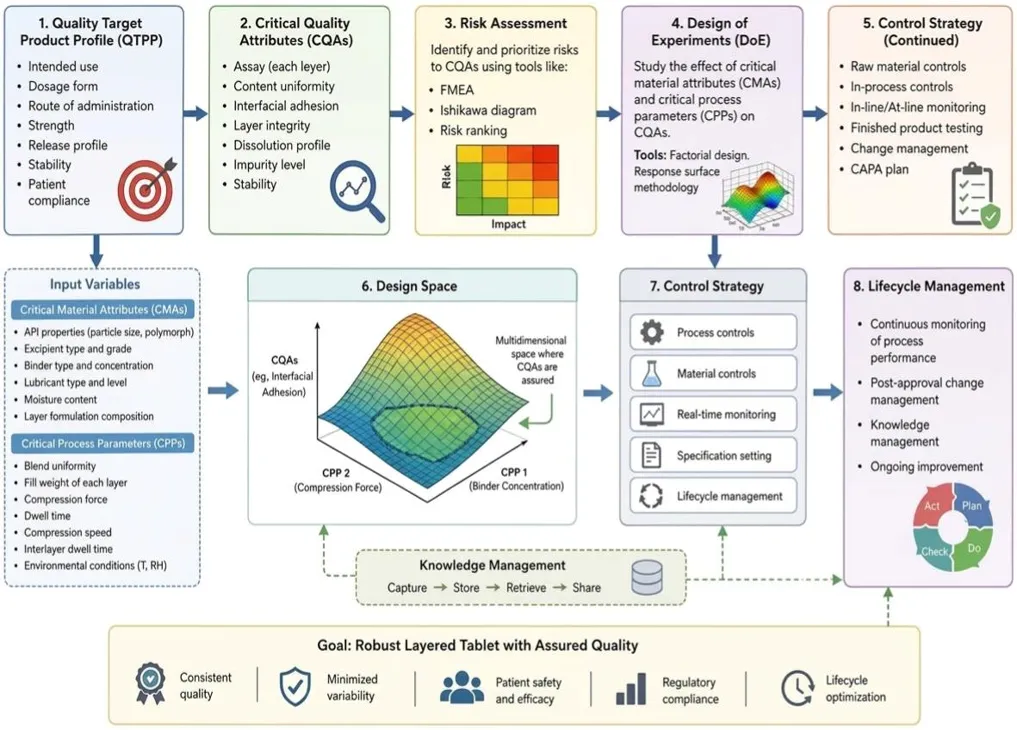
Fig. 3: Simplified QbD framework for development and control of layered tablets.
Source: Original schematic prepared for this review; principles aligned with ICH Q8(R2), Q9(R1) and Q10 [22–24].
Critical Material Attributes (CMAs) like particle size distributions, powder flowability, compression mechanics, elasticity, and moisture levels must be balanced against Critical Process Parameters (CPPs) [18,33]. These manufacturing variables include die fill depths, pre-compression pressure, main punch force, turret speeds, machine dwell times, and lubrication rates.
Instead of tweaking one single formulation ingredient at a time, researchers rely on Design of Experiments (DoE) to study how raw material setups and machine settings cross-interact [33]. This multi-variable approach is incredibly helpful because final drug dissolution profiles, layer ingredient choices, and punch pressures are heavily dependent on each other. A great example of using QbD to perfect a multi-tier medicine is the high-dose sustained-release metformin and low-dose immediate-release evogliptin combination setup [5].
Deploying Process Analytical Technology (PAT) right on the manufacturing line delivers rich, real-time insights during scale-up. For instance, teams routinely use inline Raman spectroscopy to monitor layer characteristics during tablet compression. The ultimate commercial value of any PAT tool relies on its ability to track a critical quality trait instantly and support a validated, tight factory control strategy.
Quality risk management is uniquely vital for layered medicines because multi-tier systems trigger hidden failure modes rarely seen in standard single-layer production [15]. Subtle factory slip-ups can easily cause incorrect layer weights, powder separation inside the hopper, cross-batch contamination, critically weak layer boundaries, and unexpected shifts in drug release curves driven by punch pressure variations. Teams rely on structured risk ranking systems and Failure Mode and Effects Analysis (FMEA), aligned with ICH Q9(R1) guidelines, to prioritize and eliminate these production hazards before they occur [15,16].
12. REPRESENTATIVE APPLICATIONS IN COMBINATION THERAPY
|
Combination / approach |
Layering strategy |
Key objective |
|
Metformin HCl + glipizide |
Sustained-release metformin + immediate-release glipizide |
Prolonged metformin exposure with rapid glipizide release [4]. |
|
Metformin HCl + evogliptin tartrate |
High-dose sustained-release + low-dose immediate-release layer |
QbD-based FDC development and process optimization [5]. |
|
Clarithromycin + pantoprazole |
Gastro-retentive bilayer design |
Gastro-retentive combination therapy for H. pylori [6]. |
|
Telmisartan + amlodipine |
Separate drug-containing layers |
QbD optimization of a combination antihypertensive product [8]. |
|
Ticagrelor + aspirin |
Separate drug layers with a separation layer |
Single-dose approach for dual antiplatelet therapy [9]. |
|
Montelukast + levocetirizine |
Core + barrier + API coating |
Chemical separation and sequential release [7]. |
|
Telmisartan + simvastatin |
Conventional-release + slow-release layers |
Different release rates within one dosage form [14]. |
|
Metformin + pioglitazone |
Gastro-floating bilayer |
Sustained metformin with immediate pioglitazone release [15]. |
13. RECENT ADVANCES AND EMERGING MANUFACTURING
Modern laboratory breakthroughs have pushed multi-layer engineering way beyond basic two-tier compression presses toward highly integrated formulation mechanics. When active drugs are completely incompatible and cannot touch, advanced multi-layer API coating setups offer an excellent alternative route. Teams utilize deep experimental designs (DoE) to uncover exactly how shifting coating chemistry impacts machine processing trails.
A great example of this evolution is the montelukast and levocetirizine combination design [4]. Instead of pushing powders in a die, this formulation uses a solid core tablet, seals it with an inactive protective barrier wall, and sprays a second drug-rich active coating on the outside. When chemical clashing is a major hurdle during development, this fluid-bed layering path shows how multi-tier design can step past traditional mechanical compression limits.
Next-generation additive manufacturing is another highly promising frontier. While industrial teams are experimenting with droplet deposition modeling and automated injection molding to customize the internal microstructures of layered medicines [23,24], dual-nozzle fused deposition modeling (FDM) 3D printing has emerged as a powerhouse for building custom bilayer pills[11,12]. Injection molding excel at forging ultra-dense tablet structures that guarantee smooth, long-term drug release tracks. On the flip side, droplet deposition prints let engineers manipulate microscopic pill porosity to trigger immediate, high-speed drug dissolution loops [25,26].
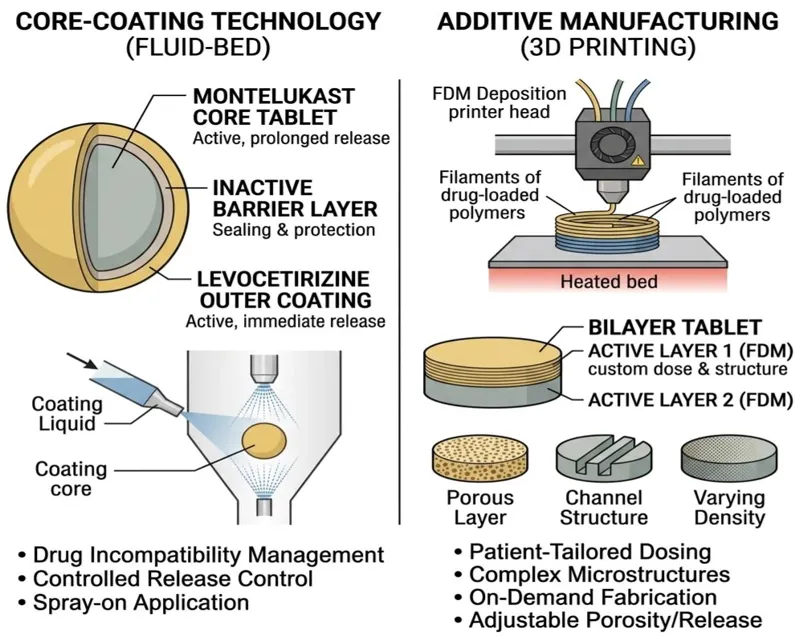
Fig. 4: Emerging manufacturing routes relevant to complex and personalized layered tablets.
Source: Original schematic prepared for this review; technologies discussed in [18,21].
14. ADVANTAGES AND LIMITATIONS
14.1 Advantages
14.2 Limitations
15. Current Challenges and Future Perspectives
The ultimate test for layered pills is forcing multiple zones to do their unique jobs perfectly without letting the extra joint lines trigger structural defects on the factory floor. Instead of treating formulation steps, compression physics, joint adhesion, and final dissolution as separate hurdles, modern pharmaceutical science is shifting toward an all-inclusive approach. It is about studying how raw material physics, machine stress, and internal particle layouts cross-interact across the full life cycle of the medicine.
Frameworks like QbD, multi-variable experimental designs (DoE), and inline PAT monitoring provide a reliable blueprint to make industrial scale-up predictable and efficient. Advanced digital layering toolsets can take this a step further, letting formulators adjust dosages, geometry profiles, and dissolution tracks all inside a single unit. However, how quickly advanced routes like 3D printing or droplet deposition step into commercial factories depends on a few heavy factors: raw material stability, batch consistency, printing speeds, regulatory compliance pathways, and validation tracking.
Chemically isolated multi-tier tablets are incredibly promising for multi-drug treatments where active compounds fall apart if they touch. Ultimately, look beyond basic laboratory dissolution graphs—developers must rigorously track how these complex profiles hold up over multi-year aging tests and ensure the manufacturing loop remains simple. Proving these advanced systems outperform existing single-pill options in real clinical pharmacokinetic trials remains the biggest obstacle to widespread medical adoption.
16. DEVELOPMENT CONSIDERATIONS FOR LAYERED COMBINATION TABLETS
16.1 Compatibility Assessment Before Layer Selection
Formulators must uncover the exact chemical mechanisms driving drug clashing before choosing to physically split them into layers. Active ingredients and excipients can react in dozens of hidden ways, and simply stacking them will not stop moisture or volatile gases from traveling across layer zones. During preformulation screening, developers must carefully track thermal stability, moisture sensitivity, impurity generation, and assay drops when mixing drugs with proposed additives. If direct contact is the main issue, a physical barrier wall works beautifully. However, if ambient moisture or gas exchange is driving the degradation, environmental controls and protective packaging become just as critical as the tablet architecture.
16.2 Selection of Layer Architecture
Never choose the layout or count of tablet layers simply based on what your current factory line can handle easily. The decision must stem directly from the exact therapeutic performance required by the patient. If your therapy only calls for two distinct release speeds, a basic bilayer setup is perfect. If you must completely isolate two sensitive drug zones, a three-layer placeholder configuration is ideal. Complex sequential release tracks demand highly intricate multi-layer setups—but remember, every extra layer introduces a fresh boundary line prone to manufacturing defects. Formulators should screen multiple layer architectures right at the start and lock in the simplest possible design that hits the target profile.
16.3 Material and Mechanical Considerations
Powder characteristics dictate whether a layer joint holds together or fails. Particle shape distributions, moisture contents, bulk densities, and deformation behaviors govern how evenly a die fills and how much surface contact is forged under the punch face. Brittle excipients shatter under high pressure to create fresh, clean bonding surfaces, whereas plastic compounds warp and link closely. If two neighboring layers display mismatching elastic recovery profiles when the punch pressure lets go, severe internal stress forms right at the interface. Selecting additives is a balancing act—you must optimize how materials behave within their own zone and how they cross-bond with neighboring layers in the finished tablet.
16.4 Scale-Up and Manufacturing Control
Scaling up a layered tablet is far more complex than just making a massive batch of powder. Shifting turret speeds, powder feeder dynamics, die residence times, and compression history profiles heavily alter how layers form and stick together. The physical setup of an industrial press can radically modify powder flow loops. To transition to a commercial scale smoothly, engineers must establish wide operational windows for every key machine setting while proving the finished pill hits all quality benchmarks. Do not just rely on final product sorting—monitoring real-time punch pressures and layer weight trends during tableting lets you catch defects before they ruin a batch.
16.5 Dissolution Method Development for Multiple APIs
Testing a tablet that packs contrasting active ingredients designed to dissolve at completely different speeds requires advanced analytical layouts. The dissolution test must be sensitive enough to capture real-world shifts in how each layer behaves. Formulators frequently need specialized sample handling loops or separate detection wavelengths to map out overlapping curves without cross-interference. When building a new method, check that the chosen media volume and sampling intervals truly mirror the planned drug delivery tracks without masking subtle, critical flaws between layers.
16.6 Patient-Centred Value of Layered Dosage Forms
The true clinical value of a multi-layer tablet relies entirely on what real-world problem it solves for the patient. A well-designed pill can deliver a medicine at multiple speeds so people do not have to disrupt their day for repeated doses, or pack separate therapies into a single unit to ease swallow burdens. Never assume a complex tablet automatically boosts patient compliance. During the initial design phase, formulators should walk through practical user details: daily dosing schedules, the clarity of the instructions, physical tablet sizes for easy swallowing, and whether it makes therapeutic sense to link those specific drugs together.
17. RESEARCH GAPS AND OPPORTUNITY
Despite the flood of advanced engineering concepts in modern literature, standardized testing protocols are still missing. Different research groups utilize completely unique testing rigs to track interface bonding strength, making it incredibly difficult to compare data across studies. Furthermore, the vast majority of published work remains confined to small laboratory settings—papers routinely showcase flawless dissolution charts but skip over process scalability, machine repeatability, or long-term manufacturing viability.We need deep comparative studies that track how material physics, compaction history, and joint layouts cross-interact across diverse tableting platforms. There is a massive opportunity to advance the field by linking real-time factory process analytical tools (PAT) with multi-variable experimental setups and deep mechanical compaction profiles.
Inline monitoring of layer masses, punch forces, and powder behaviors can spot structural flaws early before they turn into batch rejections.Advanced additive manufacturing offers unparalleled geometric freedom, but developers cannot celebrate design flexibility without locking down tight quality loops. You need reliable controls to guarantee every single printed pill hits the correct dosage, maintains long-term stability, and scales up efficiently. The field will progress rapidly when formulation science, industrial engineering, advanced analytical chemistry, and regulatory quality frameworks are merged into a unified development loop.
Connecting how a tablet performs in a lab to what patients actually need in daily life is another wide-open opportunity. Layered setups are typically engineered to match a target laboratory dissolution line, but the real impact relies on internal pharmacokinetics, clinical therapeutic windows, and how well the dosing layout fits into a patient’s routine. Instead of just proving a machine can compress multiple release patterns, the focus must shift to identifying when a layered setup delivers a meaningful, proven advantage for drug delivery and patient therapy.
18. PRACTICAL POINTS FOR FORMULATION STUDENTS
For a pharmaceutics student, the core logic behind bilayer or multilayer tablets is straightforward: different sections of a single tablet are assigned unique therapeutic jobs. One zone can throw out a drug immediately, a second zone acts as a slow-release matrix, and a middle layer can sit between them to separate clashing ingredients. This complex layout is only worth choosing if keeping things separate works significantly better than simply blending all components into a standard single-layer tablet.
When evaluating a new formulation, four simple questions will help guide your design pathway: Do the active drugs coexist safely or do they clash chemically? Do they need to dissolve at the same speed or completely separate paces? Can both blends be compressed using the exact same machine configuration? Do you actually need a physical barrier? Your answers here will point you toward a standard pill, a basic bilayer, or a complex multilayer design.
On the practical side, students should focus on four foundational quality targets: ensuring every independent layer maintains the exact right weight and uniform drug dose, keeping the layer interfaces tightly bonded so they never split, making sure each active drug dissolves exactly as planned, and confirming the tablet resists chemical degradation while sitting on the shelf.
|
Question |
Simple answer |
Why it matters |
|
Why use two layers? |
To give different functions to different parts of one tablet. |
The APIs may need different release or processing conditions. |
|
Why use a barrier layer? |
To keep selected ingredients physically apart. |
It may reduce direct contact when compatibility is a concern. |
|
Main manufacturing risk? |
Weak bonding or separation between layers. |
The tablet may fail during ejection, handling or storage. |
|
Main performance check? |
Mechanical quality plus drug release. |
The tablet must remain intact and release each API as planned. |
19. CONCLUSION
These multi-tier systems are becoming far more controllable, repeatable, and versatile thanks to rapid industrial leaps in QbD frameworks, PAT tools, multi-layer fluid-bed coatings, and 3D printing paths. However, cutting-edge engineering paths should only be deployed when they deliver a clear, measurable upgrade to pharmaceutical or clinical outcomes. All things considered, bilayer and multilayer tablets hold incredible potential for combination treatments, particularly when wide dosage gaps, contrasting release speeds, or severe drug clashing must be handled inside a single oral unit.
The primary benefit of this approach is unparalleled structural formulation flexibility. Even so, adding extra layers naturally introduces a heavy layer of complexity to the manufacturing line. Factory operators must maintain tight, unwavering control over individual layer weights, powder hopper flows, pre- and main compression settings, layer joint toughness, multi-drug dissolution lines, and long-term chemical stability. Layer peeling remains a significant, practical engineering threat that teams must proactively address right from the very first preformulation trial.
When multiple active compounds cannot be easily blended into a single uniform layer without crashing, bilayer and multilayer designs stand out as highly valuable solid dosage forms for combination therapy. They empower independent sections of a single pill to perform completely distinct tasks—whether that means creating an airtight physical wall between clashing molecules or deploying immediate-release triggers alongside long-acting maintenance bases simultaneously.
19. ABBREVIATION
|
Abbreviation |
Full form |
|
API |
Active Pharmaceutical Ingredient |
|
AM |
Additive Manufacturing |
|
CPP |
Critical Process Parameter |
|
CQA |
Critical Quality Attribute |
|
CMA |
Critical Material Attribute |
|
DDM |
Droplet Deposition Modeling |
|
DoE |
Design of Experiments |
|
FDC |
Fixed-Dose Combination |
|
FDM |
Fused Deposition Modeling |
|
GI |
Gastrointestinal |
|
HME |
Hot-Melt Extrusion |
|
HPMC |
Hydroxypropyl Methylcellulose |
|
ICH |
International Council for Harmonisation |
|
IM |
Injection Molding |
|
MCC |
Microcrystalline Cellulose |
|
PAT |
Process Analytical Technology |
|
QbD |
Quality by Design |
|
QTPP |
Quality Target Product Profile |
20. ACKNOWLEDGEMENT
The authors wish to express their deep gratitude to Dr. Rahul D. Khaire for his constant encouragement, expert supervision, and valuable suggestions during the compilation of this review paper. We are also highly grateful to PRES’s college of Pharmacy for women chincholi, nashik, maharashtra India 422102 Tal-Sinnar, Dist-Nashik, for providing access to the necessary online journals, research databases, and administrative infrastructure required to successfully complete this work.
REFERENCES


Sharvari Mhaske, Rahul Khaire, Vaishnavi Devhad, Namrata Godhari, Kiran Rayate, Bilayer and Multilayer Tablet for Combination Therapy, Int. J. of Pharm. Sci., 2026, Vol 4, Issue 8, 5378-5395. https://doi.org/10.5281/zenodo.22220680
 10.5281/zenodo.22220680