

We use cookies to ensure our website works properly and to personalise your experience. Cookies policy
1Third BHMS student, Mahesh Bhattacharyya Homoeopathic Medical College & Hospital. Sailen Manna Sarani, Doomurjala, Howrah - 711104, Howrah, West Bengal, India.
2Post Graduate Trainee, Department of Homoeopathic Materia Medica, Mahesh Bhattacharyya Homoeopathic Medical College & Hospital. Sailen Manna Sarani, Doomurjala Howrah - 711104, Howrah, West Bengal, India.
3Post Graduate Trainee, Department of Homoeopathic Materia Medica, Mahesh Bhattacharyya Homoeopathic Medical College & Hospital. Sailen Manna Sarani, Doomurjala Howrah - 711104, Howrah, West Bengal, India.
Introduction: Plantar corn is a localised hyperkeratotic lesion associated with repetitive pressure and friction that may cause pain during walking. This case report describes the clinical course of a painful plantar lesion in a 42-year-old woman who received individualised homoeopathic care. Case Summary: The patient presented with a painful lesion on the plantar surface of the left foot, reportedly developing after barefoot walking. The pain was stitching and stinging in character, aggravated by walking and direct pressure, and ameliorated by cold application. Following individualised case analysis and repertorisation, Antimonium crudum 200 was prescribed for two days, followed by placebo. Results: Serial clinical photographs documented progressive regression of the lesion, with complete resolution recorded on 13 September 2026. Improvement in pain was also reported during follow-up. Conclusion: This case documents the clinical course of a plantar lesion diagnosed as a corn during individualised homoeopathic care. Serial photographic documentation provides a record of changes in the lesion's appearance. Although the MONARCH criteria may help structure the assessment of homoeopathic case reports, the findings of a single case cannot establish treatment efficacy or a causal relationship between the intervention and the observed outcome.
A corn (clavus, heloma) is a well-delimited, focal area of hyperkeratosis and is classed as a type of callosity. It is better regarded as a symptom of mechanical stress than as a disease in itself.[1] It forms when repeated pressure or friction acts on skin overlying a bony prominence. The skin responds with increased keratinocyte activity and excess horny layer, a protective reaction that produces the hard, centrally cored lesion if the stress continues. [1,2] Ill-fitting footwear, foot deformity or abnormal foot mechanics, and high levels of activity are the usual contributing factors. [1–3] Histologically, a corn shows acanthosis, parakeratosis, a thinned or absent granular layer, and dense fibrous tissue with hypertrophied nerves in the dermis. Pain is attributed to pressure from the core on the underlying dermal nerves.[1]
Reported frequencies of corns on the feet range from 14% to 48%.[1] They are described as more common in older people, with a slight female predominance attributed to narrow footwear. They are also more common where the plantar fat pad has atrophied and in people with diabetes or amputation.[1] The burden is not trivial. In a survey of people with corns, plantar lesions had a greater adverse effect on quality of life than dorsal or interdigital ones.[4]
A plantar corn must be separated from other hyperkeratotic lesions of the sole. A callus is a diffuse thickening with undefined margins, whereas a corn is sharply defined and has a central core. [1,2] The most important differential diagnosis is the plantar wart, which is viral in origin and can look similar.[2] In a corn, the skin lines continue across the lesion, whereas in a wart they are interrupted. Direct pressure over a corn reaches the underlying bony prominence and is painful. After paring, a corn shows no capillary dotting, while a wart tends to bleed. [1,2] Dermoscopy helps by showing hyperkeratosis without the vascular structures seen in warts. [1,5] Other conditions listed in the differential include poroma, porokeratosis plantaris discreta, palmoplantar keratoderma, lichen simplex chronicus, interdigital neuroma, calcinosis cutis and gout.[1]
Within the homoeopathic framework, the concept of one-sided diseases described in Aphorism 173 of Hahnemann's Organon of Medicine may be considered when a case presents with a limited number of prominent symptoms. According to J.H. Allen, skin eruption represents either a secondary or tertiary manifestation of an underlying miasm. Allen notes that while corns are undoubtedly triggered by mechanical pressure, not everyone develops them; thus, an underlying diathesis acts as the predisposing cause. [6]
Conventional treatment includes surgical removal and cryotherapy. Cryotherapy uses liquid nitrogen, which can damage the normal skin surrounding the corn, and delay healing. [1] Surgical intervention entails potential complications, including postoperative infection, fibrosis or scarring, and subsequent recurrence.
Now according to homoeopathic philosophy: There are no diseases, there are only diseased persons.
The concept of disease in homoeopathy revolves around the concept of Vital force as stated in aphorism 9, “In the healthy condition of man, the spiritual vital force (autocracy), the dynamis that animates the material body (organism), rules with unbounded sway, and retains all the parts of the organism in admirable harmonious, vital operation, as regards both sensations and functions, so that our indwelling, reason-gifted mind can freely employ this living, healthy instrument for the higher purposes of our existence.”
This case report describes the clinical course of a plantar corn during individualised homoeopathic treatment.
In Boenninghausen’s lesser writings, a case of corns has been reported. Violent extraction led to inflammation of the whole foot with severe swelling and violent burning. The case improved considerably with Sepia 200 followed by Pulsatilla 200. The same book, Von Boenninghausen, provides indications of Thuja for burning corns. [7]
Boericke's Repertory lists 15 medicines under the rubric Skin – Callosities (corns). Antimonium crudum, Ferrum picricum, Graphites, Nitricum acidum, Ranunculus bulbosus, and Thuja occidentalis are listed in grade 3, while Elaeis, Hydrocotyle asiatica, Lycopodium clavatum, Petroleum, Rhus toxicodendron, Salicylicum acidum, Sarsaparilla, Sepia, and Silicea are listed in grade 2. [8]
CASE REPORT
PATIENT INFORMATION
A 42-year-old married woman, a housewife, presented with a painful lesion on the plantar surface of the left foot that had persisted for approximately one year. She described a sensation of an obstruction beneath the foot, accompanied by pain during walking and direct pressure. The lesion reportedly developed following barefoot walking to a temple. She usually wore ordinary footwear. Previous Ayurvedic treatment had not resulted in improvement, and she reported no history of similar lesions. Based on the available clinical history and appearance, the lesion was clinically described as a plantar corn.
HISTORY OF PRESENTING COMPLAINT
The principal complaint was stitching and stinging pain associated with the plantar lesion. The pain was aggravated by walking and direct pressure and ameliorated by cold application. The patient also described a sensation of an obstruction beneath the foot, particularly while walking. The complaint had reportedly developed after barefoot walking to a temple and persisted despite previous Ayurvedic treatment.
PAST HISTORY
The patient reported a history of jaundice in 2021 and had undergone two caesarean sections. She was receiving long-term medication for hypertension.
PHYSICAL GENERALS
The patient reported a hot thermal reaction, adequate appetite, and the ability to tolerate hunger. Her daily water intake was approximately 3–4 litres. She expressed a desire for sour foods and an aversion to sweets and reported intolerance to milk. Bowel and urinary functions were reported to be normal. Perspiration was described as profuse and generalised.
MENTAL GENERALS
The patient experienced occasional worry and tension regarding her daughter's examination results.
SYSTEMIC AND LOCAL EXAMINATION
General Examination
The patient had a history of hypertension and was receiving long-term antihypertensive medication.
Local Examination
The lesion was located on the plantar surface of the left foot and was clinically described as a plantar corn. It was associated with stitching and stinging pain, aggravated by walking and direct pressure and ameliorated by cold application. The patient also described a sensation of an obstruction beneath the foot, particularly during walking.
Serial clinical photographs were available from 1 May, 27 June, 5 July, 2 August, and 13 September 2026, documenting the lesion's appearance at successive follow-up visits.
ANALYSIS OF THE CASE
The case analysis focused on the painful plantar lesion and its characteristic symptoms, including stitching and stinging pain, aggravation from walking and direct pressure, amelioration from cold application, and the sensation of an obstruction beneath the foot. The patient's physical and mental generals were also considered during individualised homoeopathic case analysis.
The selected symptoms were evaluated through repertorisation, followed by comparison with the Materia Medica, to guide remedy selection.
REPERTORIAL TOTALITY
The following five rubrics were selected for repertorisation based on the presenting complaint and associated symptoms:
1. Extremities – Corns
2. Extremities- Pain - Leg - Cold application amel
3. Stomach – Desires sour acids, etc.
4. Extremities – Callosities, horny: Soles on etc.
5. Extremities – Pain, sore, bruised, foot, sole: stone pavement, agg
Repertorisation was performed using these rubrics, and the remedies were compared according to their repertorial coverage and scores. Antimonium crudum obtained the highest displayed score of 10 points across four covered rubrics, followed by Calcarea carbonica with 6 points across three covered rubrics.
Considering the repertorial findings alongside the clinical presentation and Materia Medica, Antimonium crudum 200 was prescribed for two days, followed by placebo.
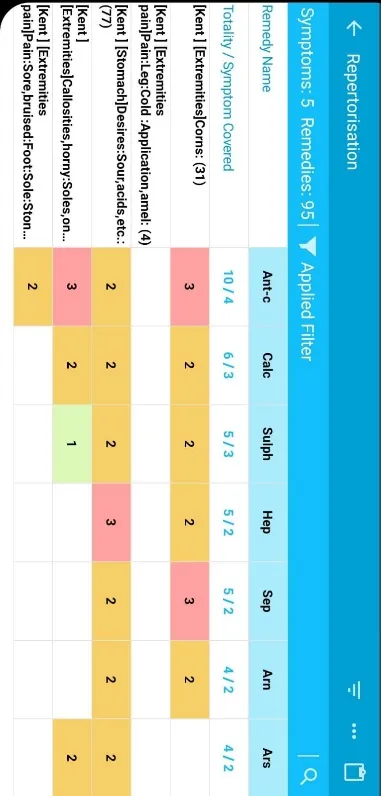
Figure 1: Repertorisation Sheet of Case
THERAPEUTIC INTERVENTION
Following individualised case analysis, repertorisation, and consultation of the Materia Medica, Antimonium crudum was selected and prescribed in 200 potency for two days. Placebo was prescribed subsequently during follow-up.
FOLLOW-UP AND OUTCOME
Serial clinical photographs dated 1 May, 27 June, 5 July, 2 August, and 13 September 2026 were used to document changes in the appearance of the plantar lesion during the observation period.
Following the initial prescription of Antimonium crudum 200 for two days, placebo was prescribed during subsequent follow-up. The photographic record showed progressive changes in the lesion's appearance. The final photograph, dated 13 September 2026, documented the reported resolution of the lesion.
The observed outcome was the disappearance of the clinically identified plantar lesion during the observation period. As this is a single case without a control group, the temporal association between the intervention and the outcome does not establish that the prescribed treatment caused the resolution.
| Date of Visits | Observation | Prescription | Pictures |
|---|---|---|---|
| 01/05/26 | Baseline observation of a localised, hyperkeratotic lesion on the plantar surface of the left foot. | Antimonium crudum 200, for 2 days | |
| 27/06/26 | Reduction in lesion size and keratinisation recorded. Improvement in pain was reported. | Placebo | |
| 05/07/26 | Further regression of the lesion recorded. | Placebo | |
| 02/08/26 | Further regression of the lesion recorded. | Placebo | |
| 13/09/26 | Complete resolution recorded. | Placebo |
DISCUSSION
Plantar corn is a localised hyperkeratotic lesion commonly associated with repetitive pressure and friction. In this case, the patient presented with a painful lesion on the plantar surface of the left foot, characterised by stitching and stinging pain aggravated by walking and direct pressure and ameliorated by cold application. The patient also described a sensation of an obstruction beneath the foot while walking. Based on the available clinical history and appearance, the lesion was clinically described as a plantar corn.
The individualised homoeopathic case analysis considered the characteristic local symptoms alongside the patient's physical and mental generals. Repertorisation was performed using five selected rubrics, and Antimonium crudum obtained the highest repertorial score, followed by Calcarea carbonica. The remedy selection was subsequently considered in conjunction with the clinical presentation and Materia Medica. Antimonium crudum 200 was prescribed for two days, followed by placebo during subsequent follow-up. This describes the clinical decision-making process used in the case; the repertorial score itself does not establish the therapeutic effectiveness of the selected remedy.
Serial clinical photographs documented changes in the lesion's appearance over the observation period, with complete resolution recorded on 13 September 2026. Improvement in pain was also reported during follow-up. These observations provide a chronological record of the clinical course. However, the absence of standardised lesion measurements and a quantified pain scale limits the precision with which the magnitude of improvement can be assessed. Furthermore, photographic documentation alone cannot establish the cause of the observed changes.
Several limitations should be acknowledged. The report lacks detailed morphological documentation and clearly specified diagnostic criteria to support differentiation of a corn from other plantar lesions, such as a plantar wart. Standardised outcome measures were not used, and information regarding possible concurrent interventions during follow-up was not available. In addition, the natural course of the lesion and other potential explanations for its resolution cannot be excluded.
As this is a single case without a control group, the observed improvement cannot establish a causal relationship between the individualised homoeopathic intervention and the resolution of the lesion. Further systematic clinical observations using clearly documented diagnostic criteria, standardised outcome measures, and transparent reporting of concurrent interventions would be required to investigate similar cases more rigorously.
Table 2: Assessment of the Case According to Monarch (Modified Naranjo Criteria for Homeopathy)
| Domains | Yes | No | Not sure |
|---|---|---|---|
| 1. Was there an improvement in the main symptom or condition for which the homeo-pathic medicine was prescribed? | +2 | ||
| 2. Did the clinical improvement occur within a plausible timeframe relative to the drug intake? | +1 | ||
| 3. Was there an initial aggravation of symptoms? | 0 | ||
| 4. Did the effect encompass more than the main symptom or condition (i.e., were other symptoms ultimately improved or changed)? | 0 | ||
| 5. Did overall well-being improve? (Suggest using validated scale) | +1 | ||
| 6A. Direction of cure: did some symptoms improve in the opposite order of the development of symptoms of the disease? | 0 |
| Domains | Yes | No | Not sure |
|---|---|---|---|
| 6B. Direction of cure: did at least two of the following aspects apply to the order of improvement of symptoms: from organs of more importance to those of less importance? from deeper to more superficial aspects of the individual? from the top downwards? |
0 | ||
| 7. Did “old symptoms” (defined as non-seasonal and non-cyclical symptoms that were previously thought to have resolved) reappear temporarily during the course of improvement? | 0 | ||
| 8. Are there alternate causes (other than the medicine) that—with a high probability—could have caused the improvement? (Consider known course of disease, other forms of treatment, and other clinically relevant interventions) |
0 | ||
| 9. Was the health improvement confirmed by any objective evidence? (e.g., laboratory test, clinical observation, etc.) | +2 | ||
| 10. Did repeat dosing, if conducted, create similar clinical improvement? | 0 | ||
| Total Score = +6 |
CONCLUSION
This case describes the clinical course of a painful plantar lesion clinically diagnosed as a corn in a 42-year-old woman receiving individualised homoeopathic care. Improvement in pain and complete resolution of the lesion were recorded during follow-up, with serial photographs documenting changes in its appearance. The patient reportedly expressed satisfaction with the outcome. However, observations from a single case cannot establish a causal relationship between the prescribed intervention and the clinical resolution. Further systematic investigation using clearly defined diagnostic criteria and standardised outcome measures is required to evaluate the effectiveness of individualised homoeopathic treatment for plantar corns.
DECLARATION OF PATIENT’S INFORMED CONSENT
Written informed consent was obtained from the patient for publication of the clinical details and accompanying photographs. The patient was informed that identifying information would be withheld; however, complete anonymity cannot be guaranteed.
ACKNOWLEDGEMENT:
The authors thank the patient for her cooperation and consent.
CONFLICT OF INTEREST:
The authors declare no conflict of interest.
REFERENCES



Shreyosi Paul, Sudipta Mahata, Apurba Pratihar, Clinical Course of a Plantar Corn Following Individualized Homoeopathic Treatment: A Case Report, Int. J. of Pharm. Sci., 2026, Vol 4, Issue 10, 4806-4812. https://doi.org/10.5281/zenodo.23793308
 10.5281/zenodo.23793308