

We use cookies to ensure our website works properly and to personalise your experience. Cookies policy
Department of Pharmaceutical Chemistry, Channabasweshwar Pharmacy College (Degree), Latur-413512, Affiliated to SRTMU, Nanded, Maharashtra, India
Clitoria ternatea L., a perennial twining herb belonging to the Fabaceae family, has garnered growing scientific attention due to its varied pharmacological properties and extensive traditional use. The plant, commonly known as Aparajita, is used in Ayurveda, Siddha, and traditional medicine in India to treat fever, inflammation, respiratory conditions, metabolic diseases, and memory enhancement. According to recent research, flavonoids, anthocyanins, phenolic acids, tannins, saponins, terpenoids, sterols, and glycosides are found in the leaves, flowers, and roots. These compounds collectively account for a number of the plant's documented antioxidant, antidiabetic, anti-inflammatory, antipyretic, and anticancer properties. Its multitarget antidiabetic mechanism has been better understood thanks to contemporary techniques like network pharmacology and molecular docking, particularly through enzyme inhibition and pathway regulation. Docking therefore functions best as a link between chemistry, molecular biology, and biological efficacy rather than on its own. DFT analysis can be used for the structural confirmation and characteristics of the phytoconstituents for the further study of the activity.
The Fabaceae family includes the medicinally significant twining herb Clitoria ternatea L., which has long been used in Ayurveda, Siddha, and traditional medicine. It is commonly known as Aparajita in India, where it is grown for both ornamental and medicinal purposes.1 Beyond its aesthetic value, the plant has drawn scientific interest due to its wide pharmacological profile. The species is easily identified by its eye-catching blue flowers with a white center, though white-flowered forms also occur.
The plant is described as a memory enhancer, nervine tonic, anxiolytic, antidepressant, sedative, and anti-inflammatory agent in traditional Ayurvedic literature and ethnomedicinal use.1 These assertions have been reinforced by contemporary pharmacological research demonstrating that Clitoria ternatea extracts can affect inflammation, oxidative stress, glucose metabolism, and neuronal function. Because of this, the plant is currently being researched not only as a traditional medicine but also as a source of lead compounds for drug development, functional foods, and nutraceuticals.
The renewed interest in Clitoria ternatea is also due to its diverse phytochemistry. The plant contains triterpenoids, flavanol glycosides, anthocyanins, steroids, phenolics, tannins, saponins, alkaloids, and other secondary metabolites that explain its biological action.1 Clitoria ternatea leaves are a significant medicinal component of the plant and include a number of bioactive substances that support its pharmacological effects. The leaves have not gotten as much attention as the flowers, but they are becoming more widely acknowledged as a valuable source of antioxidant-rich components such as phenolics, flavonoids, alkaloids, tannins, saponins, terpenoids, and glycosides. The plant's antimicrobial, antioxidant, anti-inflammatory, and possibly antidiabetic properties are primarily attributed to these substances.2
In vitro enzyme inhibition, in vivo antidiabetic testing, network pharmacology, and molecular docking are examples of current research that goes beyond basic antioxidant screening. These methods provide an explanation for the potential benefits of a traditionally used plant in a number of disease states, such as diabetes, inflammation, fever, and cancer-related pathways. This makes Clitoria ternatea an excellent illustration for a review article of the relationship between ethnomedical knowledge and contemporary pharmacological validation.
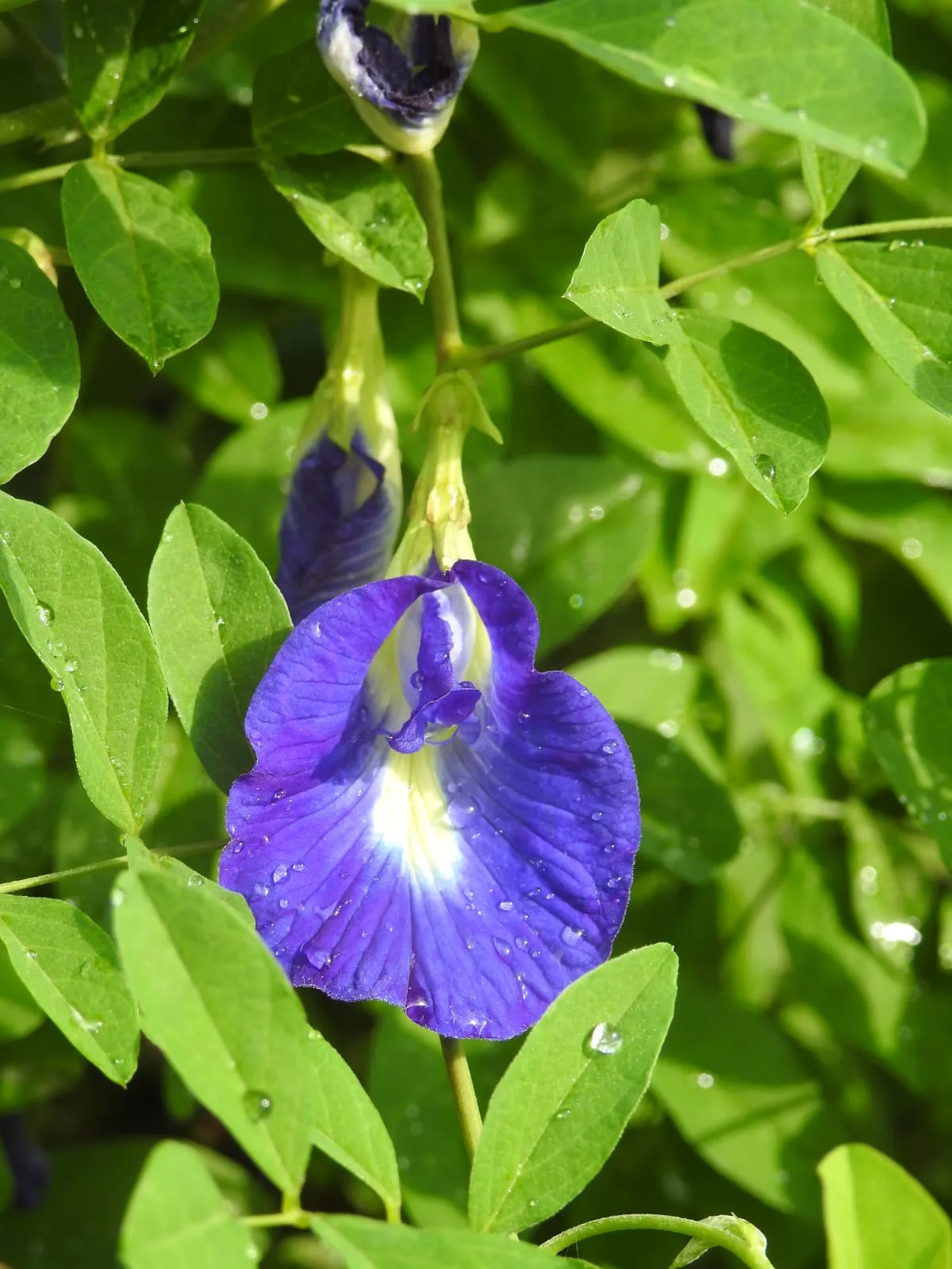

Fig. 1: Flower part Fig.2: Fruit part
Scientific Classification: The following scientific classification table gives the description of the Clitoria ternatea plant. 4
Table No.1 Scientific classification
|
Kingdom |
Plantae |
|
Clade |
Tracheophytes |
|
Clade |
Angiosperms |
|
Clade |
Eudicots |
|
Clade |
Rosids |
|
Order |
Fabales |
|
Family |
Fabaceae |
|
Subfamily |
Faboideae |
|
Tribe |
Phaseoleae |
|
Subtribe |
Clitoriinae |
|
Genus |
Clitoria |
|
Species |
ternatea |
Regional names in India
Table No.2: List of the local names.
|
Language/region |
Local name |
|
Hindi |
Aparajita, Aparajit |
|
Bengali |
Aparajita |
|
Marathi |
Gokarna, Gokarni |
|
Tamil |
Sankupushpam, Shankhapushpam |
|
Telugu |
Duhparige, Dintena |
|
Kannada |
Shankhapushpa |
|
Malayalam |
Sankhapushpam |
|
Sanskrit |
Girikarnika, Vishnukranta |
|
Panjabi |
Koyal |
|
Assamese |
Aparajita |
|
Gujrati |
Aparajita |
|
Konkani |
Aparajita |
The most widely used Indian name is Aparajita, while regional names vary across languages and states. Some sources list additional vernacular forms, so in a manuscript it is best to mention that nomenclature differs by region and local tradition.
MORPHOLOGY:
Clitoria ternatea is a slender, perennial, twining herb or climber with a weak stem and alternate, pinnate leaves. The flowers are large, axillary, solitary, and typically blue with a pale center, although white-flowered forms are also present. The fruit is a flattened pod, and the plant shows the characteristic floral structure of the Fabaceae family, making it easy to recognize in the field.4,11
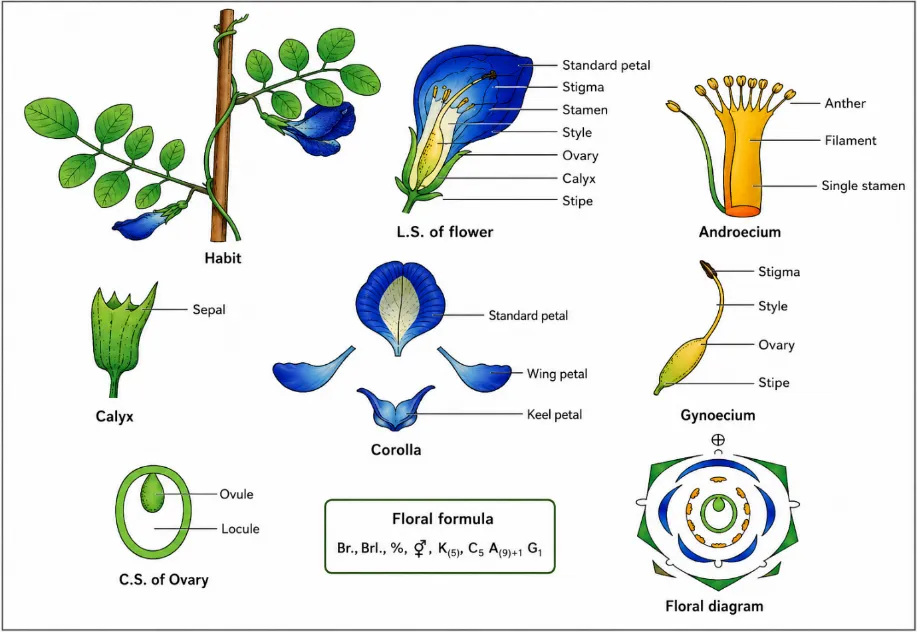
Fig.no. 3: Morphological diagram of Clitoria ternatea L
PHYTOCONSTITUENTS:
The plant has a variety of secondary metabolites; anthocyanins are particularly abundant in flower extracts, and phenolics, flavonoids, tannins, saponins, alkaloids, steroids, glycosides, and terpenoids are found in the leaves.5 Quercetin, kaempferol derivatives, anthocyanins, and triterpenoids are among the reported compounds from the larger plant that have significant biological and pharmacological effects. In network pharmacology and docking studies, these substances are also the top contenders.12
Blue-flowered leaves have been reported to contain alkaloids, flavonoids, phenols, terpenoids, glycosides, coumarins, catechol, quinones, gum, and mucilage, while white-flowered leaves contain alkaloids, glycosides, catechol, gum, and mucilage.13 GC-MS analysis of leaf extracts identified compounds such as 1-decanol, 2-ethyl-, 1-eicosanol, eicosanoic acid, oleic acid, and L-(+)-ascorbic acid 2,6-dihexadecanoate. These findings suggest that leaves are chemically rich and may serve as a source of lead molecules for pharmacological studies.8
BIOLOGICAL ACTIVITIS OF LEAF:
With documented DPPH radical-scavenging and total antioxidant activity, leaf extracts have demonstrated potent antioxidant potential. Additionally, they demonstrated antifungal and antibacterial activity against organisms like Candida species, S. aureus, E. coli, K. pneumoniae, and P. aeruginosa. These results imply that the leaves may be a valuable source of bioactive substances for use in nutraceutical and medical applications.
Anti-diabetic activity:
One of the most significant characteristics of Clitoria ternatea that has been researched scientifically is its antidiabetic activity. In diabetic models, experimental research demonstrates lowered blood glucose levels, better glycemic control, inhibition of enzymes that break down carbohydrates, and decreased oxidative stress. According to research conducted both in vivo and in vitro, the plant may aid in the management of both postprandial hyperglycemia and diabetic complications linked to oxidative stress.6,9,14,20
Antitumor activity:
Clitoria ternatea is anticancer potential has mostly been studied in vitro and through review-based research. Cytotoxicity, anti-proliferative activity, and apoptosis-related mechanisms have been reported; these effects are probably related to anthocyanins, phenolics, and flavonoids. Although encouraging, more mechanistic and in vivo validation is still required in this field.10
Anti-inflammatory properties
Numerous pharmacological studies have revealed anti-inflammatory activity, which is consistent with the plant's traditional use in painful and inflammatory conditions. Antioxidant flavonoids and other phenolic compounds that alter inflammatory signaling and lessen tissue damage are probably responsible for the effect.3,7,17
Antioxidants activity:
One of Clitoria ternatea is most well-established characteristics is its antioxidant activity. Free radicals and oxidative stress are scavenged by anthocyanins and other polyphenols, which is crucial for overall health as well as diabetes, inflammation, and age-related conditions. The flower's antioxidant profile is particularly notable because it supports the plant's use as a functional ingredient and natural food colorant.3,6,16,18
Antipyretic activity
Preclinical research has shown antipyretic activity, confirming the plant's traditional use in treating fever. This effect is frequently assessed in conjunction with analgesic and anti-inflammatory properties, indicating that Clitoria ternatea may have an impact on common inflammatory mediators implicated in feverish conditions.7
Antimicrobial activity
E. coli, S. aureus, K. pneumoniae, P. aeruginosa, Proteus mirabilis, Candida albicans, C. tropicalis, and C. krusei have all been shown to be susceptible to the antibacterial and antifungal effects of leaf extracts. Furthermore, methanolic leaf extract inhibited the formation of bacterial biofilms, indicating that it may be used to treat infectious diseases.3-27
Relevance to antidiabetic
While flowers are more frequently investigated for their direct antidiabetic properties, leaves also play a role through enzyme-inhibitory and antioxidant mechanisms. Their phenolics and flavonoids may aid in lowering oxidative stress, which is crucial for diabetes and its complications. Leaf extracts may be helpful as supportive phytotherapeutic material in metabolic disorders because they also exhibit bioactivity against microbes and oxidative stress.20
NETWORK PHARMACOLOGY FOR THE PREVENTION OF DIABETES
Because Clitoria ternatea contains several compounds that probably act on several biological targets, network pharmacology is a great fit for the plant. Candidate phytochemicals are connected to diabetes-related protein targets in antidiabetic research, and the resulting networks often show insulin signaling, PI3K-Akt, AMPK, AGE-RAGE, oxidative stress, and inflammatory pathways. This helps explain the multitarget behavior of the plant and provides a systems-level basis for its antidiabetic efficacy.28
DOCKING FOR ANTIDIABETIC ACTIVITY:
An essential supplementary method for elucidating the potential anti-diabetic effects of Clitoria ternatea phytochemicals is molecular docking. Because these enzymes regulate the breakdown of carbohydrates and the release of glucose after meals, α-amylase and α-glucosidase are typically the primary docking targets. Strong ligand binding to these enzymes' active sites may lower enzymatic activity and slow the rise in blood glucose, which is exactly the mechanism needed to manage postprandial diabetes.
In docking studies, compounds such as quercetin, kaempferol derivatives, anthocyanin-related molecules, and other phenolics are commonly evaluated for binding affinity and interaction patterns. Important parameters include hydrogen bonding, hydrophobic contacts, π-π stacking, and occupancy of the catalytic pocket. When a phytoconstituent forms stable interactions with key active-site residues, it can be considered a promising inhibitor candidate for further validation.
The best way to discuss docking results is in conjunction with pharmacological data and enzyme inhibition assays. For instance, the hypothesis that docked ligands might obstruct the digestion of carbohydrates is supported by the experimentally observed α-glucosidase inhibition by Clitoria ternatea extracts. Similarly, by lowering oxidative stress, which plays a significant role in β-cell dysfunction and insulin resistance, antioxidant activity may increase the antidiabetic benefit. Docking therefore functions best as a link between chemistry, molecular biology, and biological efficacy rather than on its own.
The limitations of docking should also be mentioned in a thorough review. Although it cannot verify bioavailability, metabolism, toxicity, or in vivo efficacy, docking predicts binding behavior. Docking should thus be combined with pharmacokinetic prediction, molecular dynamics, in vitro enzyme assays, diabetic animal models, and eventually clinical studies in future research. A more solid scientific foundation for creating antidiabetic formulations based on Clitoria ternatea would be provided by such an integrated approach.31,32

Fig. 4: Docking analysis of Hesperidine the chemical constituents present in the leaf by using PDB-3A4A
DFT ANALYSIS FOR PHYTOCONSTITUENTS:
Density Functional Theory (DFT) is a quantum mechanical computational method used to investigate the electronic structure and properties of phytoconstituents. In the context of Clitoria ternatea, DFT analysis provides theoretical insights into the chemical behavior, reactivity, and molecular properties of bioactive compounds that contribute to antidiabetic and antioxidant activities. This computational approach complements experimental molecular docking studies by understanding the electronic properties that govern ligand-enzyme interactions.33
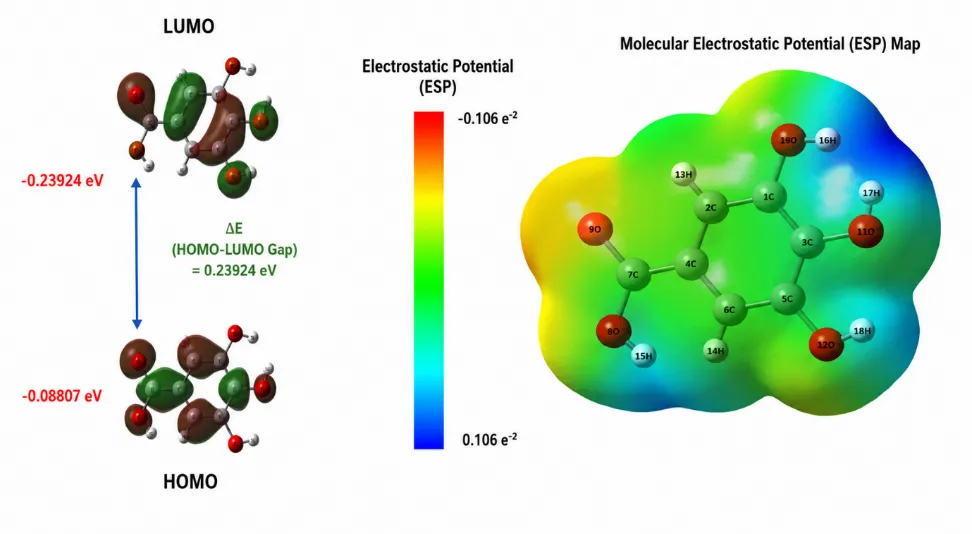
Fig. 5: Dft analysis of Hesperidine the chemical constituents present in the leaf.
CONCLUSION
Clitoria ternatea L. represents an important medicinal plant with a strong foundation in traditional medicine and increasing scientific validation. The antidiabetic activity of C. ternatea has been supported by various experimental studies showing improvement in glucose regulation, enzyme inhibition, and reduction of oxidative damage. Molecular docking and network pharmacology approaches indicate that its bioactive compounds may interact with multiple therapeutic targets involved in glucose metabolism, inflammation, and oxidative stress pathways. DFT analysis further provides valuable information regarding the electronic properties and chemical reactivity of phytoconstituents, supporting their possible biological interactions.
REFERENCES
Patel R, Kumar S, Sharma A. Density functional theory (DFT) analysis of phytoconstituents from medicinal plants for antioxidant and antidiabetic activity. J Comput Chem. 2021;45(3):234-48.

Aarti Kalshetti, Dr. Vivek Panchabhai, Namrata Shivankar, Shraddha Belkunde, Kalyani Atkare, Vaishnavi Pinjare, Clitoria Ternatea L.: A Review of Its Ethnobotany, Phytochemistry and Antidiabetic Potential, Int. J. of Pharm. Sci., 2026, Vol 4, Issue 6, 6151-6158, https://doi.org/10.5281/zenodo.20828149
 10.5281/zenodo.20828149