

We use cookies to ensure our website works properly and to personalise your experience. Cookies policy
1Research scholar at Maharashtra Institute of Pharmacy, Betala, Bramhapuri, Chandrapur
2Professor at Maharashtra Institute of Pharmacy, Betala, Bramhapuri, Chandrapur
3 Principal and Professor at Maharashtra Institute of Pharmacy, Betala, Bramhapuri, Chandrapur
The increasing clinical use of combination therapy containing Dapagliflozin, Sacubitril, and Valsartan for the management of heart failure and type 2 diabetes mellitus has created a need for reliable analytical methods capable of simultaneously estimating these drugs in pharmaceutical dosage forms. Reverse-phase high-performance liquid chromatography (RP-HPLC) has emerged as one of the most effective analytical techniques because of its high accuracy, precision, sensitivity, and reproducibility. This review summarizes the current literature on the development and validation of RP-HPLC methods for the simultaneous estimation of Dapagliflozin, Sacubitril, and Valsartan. It discusses the physicochemical and pharmacological characteristics of the three drugs, the principles and instrumentation of RP-HPLC, chromatographic method development strategies, and validation parameters according to ICH Q2(R2) guidelines, including specificity, linearity, accuracy, precision, robustness, limit of detection, and limit of quantification. The review also highlights important chromatographic performance parameters, pharmaceutical applications, and the challenges associated with simultaneous drug estimation. Furthermore, recent advancements such as Green Analytical Chemistry, Analytical Quality by Design (AQbD), artificial intelligence-assisted method optimization, UHPLC, and hyphenated analytical techniques are discussed as future directions. Overall, this review emphasizes the pharmaceutical and regulatory significance of validated RP-HPLC methods in ensuring the quality, safety, and efficacy of fixed-dose combination products containing Dapagliflozin, Sacubitril, and Valsartan.
1.1 Background
The development of reliable analytical methods is a fundamental requirement in pharmaceutical research, quality assurance, and regulatory compliance. Analytical techniques are extensively employed throughout the lifecycle of pharmaceutical products, from drug discovery and formulation development to routine quality control and post-marketing surveillance. Accurate and reproducible analytical methods ensure the identity, purity, potency, and safety of active pharmaceutical ingredients (APIs) as well as finished dosage forms. With the increasing availability of fixed-dose combination products containing multiple therapeutic agents, there is a growing need for analytical methods capable of simultaneously determining several drugs within a single chromatographic run.
Cardiovascular diseases and type 2 diabetes mellitus frequently coexist and are associated with an increased risk of heart failure, renal impairment, and other serious complications. Recent advances in pharmacotherapy have led to the introduction of combination therapies that target multiple pathological mechanisms simultaneously. Among these, the combination of dapagliflozin, sacubitril, and valsartan has attracted considerable clinical attention because it provides complementary therapeutic effects for patients with heart failure and diabetes. Consequently, the development of efficient analytical methods for the simultaneous estimation of these drugs has become increasingly important for pharmaceutical quality control and regulatory evaluation.[1]
1.2 Analytical Method Development
Analytical method development is a systematic process aimed at establishing suitable experimental conditions for the accurate, precise, and reproducible determination of pharmaceutical compounds. The process involves careful optimization of chromatographic variables, including the selection of stationary phase, mobile phase composition, pH, flow rate, detection wavelength, column temperature, and injection volume. Proper optimization ensures adequate separation of analytes with acceptable peak symmetry, resolution, sensitivity, and analysis time.
For combination drug products, analytical method development becomes more challenging because each component possesses different physicochemical characteristics, such as polarity, ionization behavior, and retention properties. Therefore, chromatographic conditions must be optimized to achieve complete separation of all analytes while minimizing interference from degradation products, impurities, and formulation excipients. A well-developed analytical method improves laboratory efficiency, reduces solvent consumption, shortens analysis time, and ensures consistent analytical performance during routine quality control. [2]
Table 1: Analytical Method Development
|
Parameter |
Description |
|
Definition |
Process of developing a reliable analytical procedure for identification and quantification of drugs. |
|
Objective |
To obtain an accurate, precise, specific, and robust analytical method. |
|
Techniques |
RP-HPLC, HPLC, UV-Visible Spectrophotometry, HPTLC, LC-MS. |
|
Selection Criteria |
Nature of analyte, dosage form, sensitivity, specificity, and regulatory requirements. |
|
Optimization Parameters |
Mobile phase, column type, flow rate, pH, wavelength, injection volume, and column temperature. |
|
Outcome |
A validated analytical method suitable for routine quality control and pharmaceutical analysis. |
1.3 Importance of RP-HPLC in Pharmaceutical Analysis
Reverse-phase high-performance liquid chromatography (RP-HPLC) is one of the most widely utilized analytical techniques in pharmaceutical laboratories due to its excellent sensitivity, selectivity, reproducibility, and versatility. It enables the separation and quantification of compounds with diverse chemical structures in a relatively short period while providing highly accurate and precise results.
The widespread application of RP-HPLC is attributed to its compatibility with a broad range of pharmaceutical compounds and its ability to analyze complex mixtures without extensive sample preparation. The technique is routinely employed for assay determination, impurity profiling, stability studies, dissolution testing, pharmacokinetic investigations, and validation of pharmaceutical formulations. Furthermore, RP-HPLC methods developed according to International Council for Harmonisation (ICH) guidelines provide scientifically acceptable procedures that satisfy regulatory requirements for pharmaceutical quality assurance. [3]
1.4 Need for Simultaneous Drug Estimation
The simultaneous estimation of multiple active pharmaceutical ingredients has become increasingly important with the growing use of fixed-dose combination therapies. Compared with individual analytical methods, simultaneous estimation offers several practical advantages, including reduced analysis time, lower solvent consumption, decreased operational costs, and improved laboratory productivity. It also minimizes analytical variability because all components are quantified under identical chromatographic conditions.
The combination of dapagliflozin, sacubitril, and valsartan presents unique analytical challenges due to significant differences in their chemical structures, polarity, and chromatographic behavior. Developing a single RP-HPLC method capable of accurately separating and quantifying these drugs requires careful optimization of chromatographic parameters. A validated simultaneous estimation method is therefore essential for routine quality control, stability testing, dissolution studies, and regulatory compliance throughout pharmaceutical manufacturing. [4]
1.5 Scope and Objectives of the Review
The present review aims to provide a comprehensive overview of the development and validation of RP-HPLC methods for the simultaneous estimation of dapagliflozin, sacubitril, and valsartan in combined pharmaceutical dosage forms. The review summarizes the physicochemical and pharmacological characteristics of the three drugs, discusses important considerations in chromatographic method development, and critically evaluates validation parameters based on current ICH Q2(R2) guidelines.
Additionally, this review highlights recently published analytical methods, compares different chromatographic conditions, examines current challenges associated with simultaneous drug estimation, and discusses recent advancements in RP-HPLC technology. The information presented may serve as a useful reference for researchers, academicians, pharmaceutical scientists, and quality control laboratories involved in analytical method development for combination drug products. [5]
2. Drug Profile
2.1 Dapagliflozin
Chemistry
Dapagliflozin is a synthetic C-aryl glucoside derivative belonging to the sodium-glucose co-transporter-2 (SGLT2) inhibitor class. It possesses the molecular formula C₂₁H₂₅ClO₆ and a molecular weight of 408.87 g/mol. The molecule contains a glucose moiety linked to an aromatic ring through a stable carbon-carbon bond, which contributes to its metabolic stability and prolonged pharmacological activity. [6]
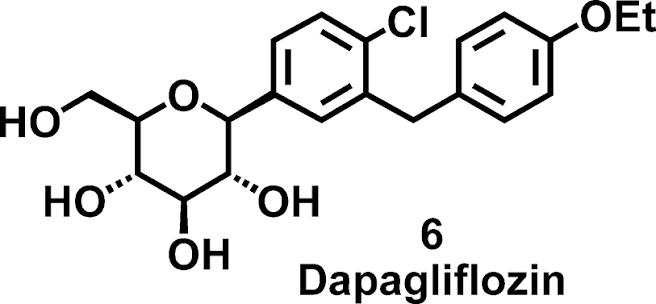
Figure 1: Dapagliflozin
Mechanism of Action
Dapagliflozin selectively inhibits SGLT2 transporters located in the proximal renal tubules, reducing renal glucose reabsorption and increasing urinary glucose excretion. This mechanism lowers blood glucose levels independently of insulin secretion while also contributing to reductions in body weight and blood pressure. [7]
Pharmacokinetics
Dapagliflozin is rapidly absorbed following oral administration, with peak plasma concentrations generally achieved within 1–2 hours. It exhibits high oral bioavailability, extensive plasma protein binding, and is primarily metabolized through glucuronidation before being eliminated via urine and feces. [8]
Therapeutic Uses
Dapagliflozin is approved for the treatment of type 2 diabetes mellitus, heart failure with reduced or preserved ejection fraction, and chronic kidney disease. Clinical studies have demonstrated significant cardiovascular and renal protective benefits beyond glycemic control. [9]
Analytical Importance
Because dapagliflozin is increasingly incorporated into fixed-dose combination products, reliable analytical methods are required for its accurate quantification during formulation development, routine quality control, dissolution testing, and stability assessment. [10]
Table 2: Drug Profile of Dapagliflozin
|
Parameter |
Details |
|
Category |
SGLT2 Inhibitor |
|
Molecular Formula |
C₂₁H₂₅ClO₆ |
|
Molecular Weight |
408.87 g/mol |
|
Indication |
Type 2 Diabetes Mellitus, Heart Failure |
|
Dosage Form |
Tablet |
2.2 Sacubitril
Chemistry
Sacubitril is a neprilysin inhibitor administered as part of the angiotensin receptor-neprilysin inhibitor (ARNI) combination with valsartan. It has the molecular formula C₂₄H₂₉NO₅ and a molecular weight of 411.49 g/mol. [11]
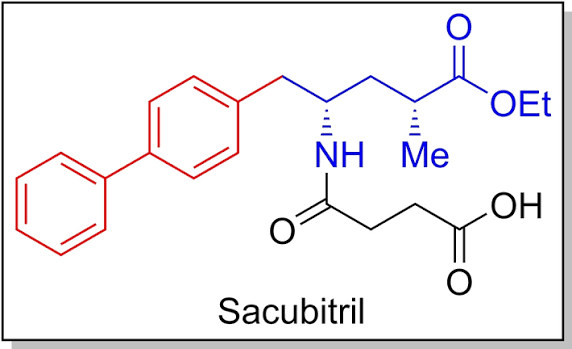
Figure 2: Sacubitril
Mechanism of Action
Following oral administration, sacubitril is converted into its active metabolite, sacubitrilat, which inhibits neprilysin. This inhibition increases circulating concentrations of natriuretic peptides, leading to vasodilation, natriuresis, diuresis, and reduced cardiac workload. [12]
Pharmacokinetics
Sacubitril is rapidly absorbed and extensively converted to sacubitrilat by esterases. The active metabolite undergoes minimal CYP450 metabolism and is primarily eliminated through renal excretion. [13]
Therapeutic Uses
Sacubitril is widely prescribed in combination with valsartan for the management of chronic heart failure, where it reduces cardiovascular mortality and hospitalization rates while improving cardiac function. [14]
Analytical Importance
Accurate estimation of sacubitril is essential during pharmaceutical development because of its susceptibility to hydrolysis and degradation. Reliable RP-HPLC methods are therefore necessary for assay determination, stability studies, and routine quality control. [15]
Table 3: Drug Profile of Sacubitril
|
Parameter |
Details |
|
Category |
Neprilysin inhibitor |
|
Molecular Formula |
C₂₄H₂₉NO₅ |
|
Molecular Weight |
411.49 g/mol |
|
Indication |
Heart failure (with valsartan) |
|
Dosage |
24/26, 49/51, or 97/103 mg (with valsartan) |
|
Route |
Oral |
2.3 Valsartan
Chemistry
Valsartan is an angiotensin II receptor blocker (ARB) with the molecular formula C₂₄H₂₉N₅O₃ and a molecular weight of 435.52 g/mol. It contains a biphenyl tetrazole structure responsible for its high affinity toward angiotensin II receptors. [16]
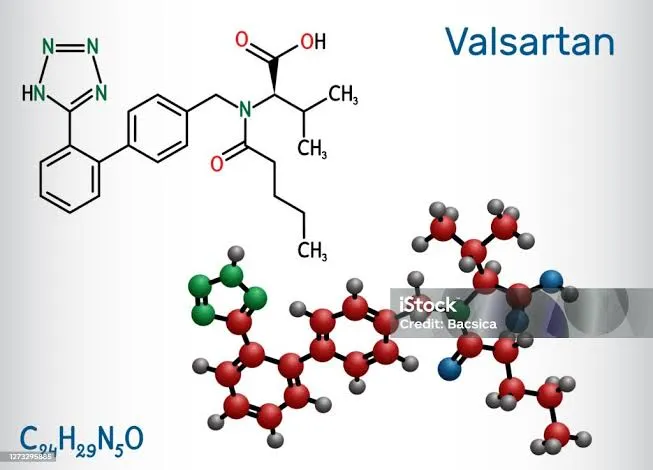
Figure 3: Valsartan
Mechanism of Action
Valsartan selectively blocks angiotensin II type-1 (AT₁) receptors, thereby inhibiting vasoconstriction, aldosterone secretion, and sodium retention. This results in reduced blood pressure and improved cardiovascular function. [17]
Pharmacokinetics
Valsartan is moderately absorbed after oral administration and exhibits approximately 23% bioavailability. It undergoes minimal metabolism and is largely excreted unchanged through biliary and renal pathways. [18]
Therapeutic Uses
Valsartan is extensively used in the treatment of hypertension, heart failure, and post-myocardial infarction patients to reduce cardiovascular morbidity and mortality. [19]
Analytical Importance
Due to its widespread clinical use in fixed-dose combinations, accurate determination of valsartan is essential for quality control, stability evaluation, dissolution testing, and regulatory compliance. [20]
Table 4: Drug Profile of Valsartan
|
Parameter |
Details |
|
Category |
Angiotensin II Receptor Blocker (ARB) |
|
Molecular Formula |
C₂₄H₂₉N₅O₃ |
|
Molecular Weight |
435.52 g/mol |
|
Indication |
Hypertension, heart failure |
|
Dosage |
80–320 mg/day |
|
Route |
Oral |
3. Combined Dosage Form
3.1 Clinical Importance
The fixed-dose combination of dapagliflozin, sacubitril, and valsartan represents an advanced therapeutic approach for patients with heart failure associated with type 2 diabetes mellitus. By combining three complementary mechanisms of action into a single dosage form, the formulation provides comprehensive cardiovascular, renal, and metabolic benefits while reducing pill burden and improving treatment adherence. [21]
3.2 Advantages of Triple Combination Therapy
Triple combination therapy offers several clinical and pharmaceutical advantages, including improved therapeutic efficacy, better patient compliance, reduced dosing frequency, enhanced cardiovascular protection, improved glycemic control, renal preservation, and simplified treatment regimens. Combining these agents also supports long-term disease management by targeting multiple disease pathways simultaneously. [22]
3.3 Challenges in Simultaneous Drug Analysis
The simultaneous estimation of dapagliflozin, sacubitril, and valsartan is analytically challenging because of differences in their chemical structures, polarity, pKa values, UV absorption characteristics, and retention behavior. [23] Developing a single RP-HPLC method capable of providing complete separation with acceptable resolution, peak symmetry, and sensitivity requires careful optimization of chromatographic conditions. Additionally, potential interference from formulation excipients, impurities, and degradation products necessitates thorough method validation to ensure specificity, accuracy, precision, and robustness for routine pharmaceutical analysis. [24]
Table 5: Combined Dosage Form
|
Parameter |
Description |
|
Definition |
A pharmaceutical formulation containing two or more active pharmaceutical ingredients (APIs) in a single dosage form. |
|
Purpose |
To improve therapeutic efficacy and patient compliance. |
|
Advantages |
Reduced pill burden, enhanced treatment outcomes, improved convenience, and better medication adherence. |
|
Applications |
Management of chronic diseases such as diabetes, hypertension, and heart failure. |
|
Example |
Dapagliflozin + Sacubitril + Valsartan tablets. |
4. RP-HPLC
4.1 Principle
Reverse-phase high-performance liquid chromatography (RP-HPLC) is one of the most widely used analytical techniques for the separation, identification, and quantification of pharmaceutical compounds. In RP-HPLC, separation is achieved based on differences in the hydrophobic interactions between analytes and the non-polar stationary phase. [25]The stationary phase typically consists of silica particles chemically bonded with long-chain hydrocarbons, such as octadecylsilane (C18), while the mobile phase is relatively polar and generally comprises water or buffer mixed with an organic solvent such as methanol or acetonitrile. Compounds with lower polarity interact more strongly with the stationary phase and therefore exhibit longer retention times, whereas polar compounds elute more rapidly. Due to its excellent sensitivity, precision, reproducibility, and versatility, RP-HPLC is extensively employed for pharmaceutical quality control, stability studies, dissolution testing, and analytical method validation. [26]
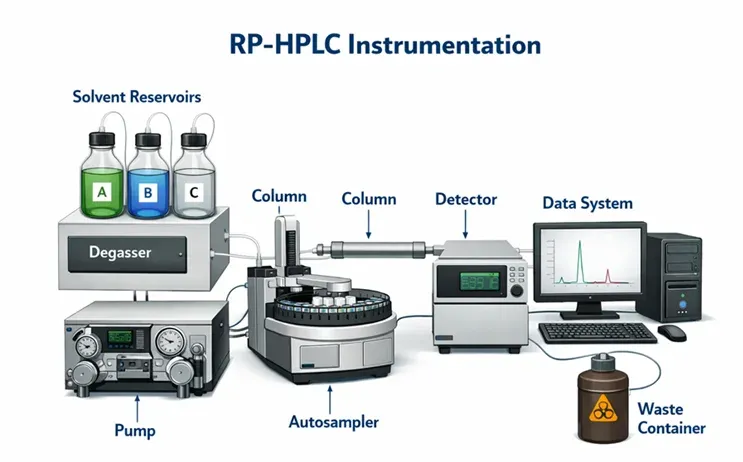
Figure 4: RP-HPLC instrumentations
4.2 Instrumentation
An RP-HPLC system consists of several integrated components that work together to achieve efficient chromatographic separation and accurate quantification of analytes. The system includes a solvent delivery unit, sample injector, chromatographic column, detector, and computerized data acquisition system. Proper selection and optimization of each component are essential for obtaining high-resolution chromatograms with acceptable peak symmetry and reproducibility. Modern HPLC systems equipped with diode-array or UV detectors provide rapid and reliable analysis suitable for routine pharmaceutical applications. [27]
4.3 Components of RP-HPLC
Solvent Reservoir
The solvent reservoir stores the mobile phase used for chromatographic separation. It contains the aqueous buffer and organic solvent in the required composition and supplies them continuously to the pumping system. The mobile phase is usually filtered and degassed before use to prevent air bubble formation and maintain stable baseline performance.
Pump
The HPLC pump delivers the mobile phase through the chromatographic system at a constant and accurately controlled flow rate. High-pressure pumps ensure reproducible solvent delivery, which is essential for consistent retention times, peak resolution, and quantitative analysis. [28]
Injector
The injector introduces a precise volume of sample solution into the flowing mobile phase without disturbing chromatographic conditions. Modern systems commonly employ automatic sample injectors that provide high reproducibility and minimize analytical errors.
Column
The chromatographic column is the primary separation unit of the HPLC system. In RP-HPLC, C18 columns are most frequently employed because they provide excellent retention and separation for a wide variety of pharmaceutical compounds. The efficiency of the column directly influences peak shape, resolution, and overall analytical performance. [29]
Detector
The detector continuously monitors analytes as they elute from the column and converts their signals into measurable chromatographic peaks. UV-visible and diode-array detectors are widely used because they offer excellent sensitivity, selectivity, and suitability for quantitative pharmaceutical analysis.
Data System
The computerized data system records chromatograms, calculates retention times, peak areas, peak heights, and other chromatographic parameters. It also performs quantitative analysis, statistical calculations, and generates analytical reports for documentation and quality assurance. [30]
Table 6: RP-HPLC (Reverse-Phase High-Performance Liquid Chromatography)
|
Parameter |
Description |
|
Full Form |
Reverse-Phase High-Performance Liquid Chromatography |
|
Principle |
Separation based on hydrophobic interactions between analytes and stationary phase |
|
Stationary Phase |
Non-polar C18 (ODS) column |
|
Mobile Phase |
Polar solvents (Buffer, Water, Methanol, Acetonitrile) |
|
Detection |
UV, PDA/DAD, or MS detector |
|
Applications |
Drug assay, impurity profiling, stability studies, quality control |
|
Advantages |
High accuracy, precision, sensitivity, reproducibility, rapid analysis |
|
Limitations |
High solvent consumption, expensive instrumentation, regular maintenance required |
5. Method Development
5.1 Selection of Column
Selection of an appropriate chromatographic column is one of the most important steps in RP-HPLC method development. The column should provide adequate retention, excellent peak symmetry, and complete separation of analytes within a reasonable analysis time. C18 columns are generally preferred because they offer high efficiency and broad applicability for pharmaceutical compounds. [31]
5.2 Mobile Phase Optimization
Mobile phase optimization is essential for achieving satisfactory chromatographic separation. The composition of the aqueous buffer and organic solvent is adjusted to obtain optimum peak resolution, acceptable retention time, improved sensitivity, and symmetrical peak shapes while minimizing overall run time. [32]
5.3 Buffer Selection
Buffers help maintain a constant pH throughout the chromatographic run and improve the reproducibility of analyte retention. Commonly used buffers include phosphate, acetate, and formate buffers because they provide stable pH conditions and are compatible with most RP-HPLC applications. [33]
5.4 pH Optimization
The pH of the mobile phase significantly influences analyte ionization and chromatographic behavior. Proper pH selection improves peak symmetry, enhances resolution, reduces peak tailing, and ensures consistent retention times throughout the analysis.
5.5 Organic Modifier Selection
Organic solvents such as methanol and acetonitrile are commonly employed as mobile phase modifiers. Their concentration directly affects analyte retention, peak efficiency, analysis time, and column pressure. Selection depends on the physicochemical characteristics of the analytes and desired chromatographic performance. [34]
5.6 Detection Wavelength
The detection wavelength is selected based on the maximum UV absorbance (λmax) of the analytes. An optimized wavelength provides maximum detector response while minimizing background interference from the mobile phase and formulation excipients.
5.7 Flow Rate Optimization
Flow rate influences chromatographic efficiency, retention time, and system backpressure. Optimization ensures adequate separation within a reasonable run time while maintaining acceptable column efficiency and peak symmetry.
5.8 Injection Volume
The injection volume should be optimized to provide sufficient detector response without causing peak broadening or column overloading. Appropriate injection volumes improve analytical precision and reproducibility. [35]
5.9 Run Time Optimization
Run time optimization aims to achieve complete separation of all analytes and possible degradation products while minimizing solvent consumption and analysis time, thereby improving laboratory efficiency.
5.10 System Suitability Parameters
System suitability testing is performed before routine analysis to verify the performance of the chromatographic system. Parameters such as retention time, theoretical plates, resolution, tailing factor, and repeatability are evaluated to ensure that the analytical system is functioning properly and capable of producing reliable results.
Table 7: Method Development in RP-HPLC
|
Parameter |
Purpose |
|
Column Selection |
Achieves efficient separation of analytes |
|
Mobile Phase Optimization |
Improves peak resolution and symmetry |
|
Buffer Selection |
Maintains pH and enhances reproducibility |
|
pH Optimization |
Controls analyte ionization and retention |
|
Organic Modifier |
Adjusts elution strength (Methanol/Acetonitrile) |
|
Detection Wavelength |
Provides maximum analyte sensitivity |
|
Flow Rate |
Optimizes analysis time and peak shape |
|
Injection Volume |
Ensures accurate and reproducible results |
|
Run Time |
Allows complete separation of all analytes |
|
System Suitability |
Confirms instrument performance before analysis |
6. Method Validation (ICH Q2(R2))
Method validation confirms that an analytical procedure is suitable for its intended purpose. According to ICH Q2(R2) guidelines, validation ensures the reliability, accuracy, precision, and consistency of analytical methods used in pharmaceutical analysis. [36]
6.1 Specificity
Specificity is the ability of the analytical method to accurately measure the analyte in the presence of impurities, degradation products, and formulation excipients without interference.
6.2 Linearity
Linearity evaluates the ability of the method to produce analytical results directly proportional to analyte concentration within a specified working range. [37]
6.3 Accuracy
Accuracy expresses the closeness between the measured value and the true value. It is generally determined by recovery studies performed at different concentration levels.
6.4 Precision
Precision evaluates the reproducibility of analytical results under identical experimental conditions. [38]
Repeatability
Repeatability assesses variation during multiple analyses performed under the same operating conditions within a short time interval.
Intermediate Precision
Intermediate precision evaluates reproducibility when analyses are performed on different days, by different analysts, or using different instruments within the same laboratory.
6.5 Robustness
Robustness measures the ability of the analytical method to remain unaffected by small deliberate variations in chromatographic conditions such as flow rate, pH, mobile phase composition, or detection wavelength. [39]
6.6 Ruggedness
Ruggedness determines the reproducibility of analytical results under different laboratory conditions, analysts, instruments, and environmental factors.
6.7 Limit of Detection (LOD)
The limit of detection represents the lowest concentration of analyte that can be detected but not necessarily quantified with acceptable precision.
6.8 Limit of Quantification (LOQ)
The limit of quantification is the lowest concentration of analyte that can be quantitatively determined with acceptable accuracy and precision.
6.9 Assay of Marketed Formulation
The validated RP-HPLC method is applied to commercial pharmaceutical formulations to determine the content of active pharmaceutical ingredients and verify compliance with labeled claims. [40]
6.10 Stability-Indicating Study
A stability-indicating method accurately separates analytes from degradation products generated under stress conditions such as acidic, alkaline, oxidative, thermal, photolytic, and hydrolytic degradation. These studies demonstrate the stability and specificity of the analytical method.
Table 8: ICH Q2(R2) Method Validation
|
Parameter |
Acceptance Criteria |
|
Specificity |
No interference |
|
Linearity |
R² ≥ 0.999 |
|
Accuracy |
Recovery 98–102% |
|
Precision |
%RSD ≤ 2% |
|
LOD/LOQ |
Sensitive detection limit |
|
Robustness |
Reliable after changes |
|
System Suitability |
Meets HPLC criteria |
7. Chromatographic Parameters
Retention Time
Retention time is the time required for an analyte to travel through the chromatographic column from injection to detection. It serves as an important parameter for compound identification.
Resolution
Resolution measures the degree of separation between two adjacent chromatographic peaks. Higher resolution indicates better separation and improved analytical accuracy. [41]
Theoretical Plates
Theoretical plate number is a measure of column efficiency. A higher number of theoretical plates indicates better chromatographic performance and sharper peaks. [42]
Tailing Factor
The tailing factor evaluates peak symmetry. Values close to one indicate symmetrical peaks and efficient chromatographic performance. [43]
Capacity Factor
The capacity factor describes the extent of analyte retention relative to the mobile phase and helps assess the adequacy of chromatographic separation.
Peak Purity
Peak purity evaluates whether a chromatographic peak represents a single analyte without co-eluting impurities or degradation products. It is particularly important for stability-indicating methods and ensures the specificity and reliability of the analytical procedure. [44]
8. Applications
Pharmaceutical Quality Control
RP-HPLC has become an indispensable analytical technique in pharmaceutical quality control because of its ability to provide accurate, precise, and reproducible quantitative results. It is routinely employed to determine the content of active pharmaceutical ingredients (APIs), monitor product uniformity, identify impurities, and verify compliance with pharmacopeial specifications. The technique supports quality assurance throughout the manufacturing process, ensuring that pharmaceutical products consistently meet the required standards for safety and efficacy. [45]
Stability Testing
Stability testing is an essential component of pharmaceutical development, and RP-HPLC serves as one of the most reliable techniques for monitoring the chemical stability of drug substances and formulations. Stability-indicating methods enable the separation of active compounds from degradation products formed under stress conditions such as acidic, alkaline, oxidative, thermal, and photolytic environments. These studies provide valuable information regarding product shelf life, storage conditions, and overall formulation stability. [46]
Dissolution Studies
Dissolution testing is widely used to evaluate the rate and extent of drug release from oral dosage forms. RP-HPLC offers highly sensitive and selective quantification of drug concentrations in dissolution samples, allowing researchers to generate accurate drug release profiles. These studies are important during formulation development, optimization, quality control, and bioequivalence assessment. [47]
Bioanalytical Studies
Beyond pharmaceutical formulations, RP-HPLC is extensively applied in bioanalytical investigations for determining drug concentrations in biological samples such as plasma, serum, and urine. These analyses are fundamental for pharmacokinetic, bioavailability, bioequivalence, and therapeutic drug monitoring studies, providing reliable data for clinical research and dosage optimization.
Regulatory Analysis
Regulatory authorities require scientifically validated analytical methods to demonstrate the quality, safety, and efficacy of pharmaceutical products. RP-HPLC methods developed in accordance with ICH guidelines provide robust analytical evidence that supports product registration, regulatory submissions, and routine compliance with international quality standards. [48]
Routine Industrial Analysis
Within pharmaceutical industries, RP-HPLC is routinely used for raw material testing, in-process quality monitoring, finished product evaluation, cleaning validation, and batch release testing. Its high reproducibility, operational reliability, and rapid analytical performance make it one of the most valuable techniques for routine industrial quality control laboratories. [49]
9. Challenges and Limitations
Although RP-HPLC is recognized as one of the most reliable analytical techniques in pharmaceutical analysis, several challenges are encountered during the development and validation of methods for the simultaneous estimation of dapagliflozin, sacubitril, and valsartan. One of the primary difficulties lies in achieving complete chromatographic separation of these three drugs because they differ considerably in their chemical structures, polarity, and physicochemical characteristics. Careful optimization of chromatographic conditions is therefore necessary to obtain well-resolved peaks within an acceptable analysis time.
Another important challenge is the optimization of the mobile phase. Selecting an appropriate buffer, pH, organic solvent composition, and solvent ratio requires extensive experimental trials, as even minor changes in these parameters can significantly affect retention time, peak symmetry, and chromatographic resolution. In addition, interference from tablet excipients, impurities, or degradation products may compromise analytical specificity if adequate separation is not achieved.
The routine use of high-purity solvents such as methanol and acetonitrile also increases the overall cost of analysis and contributes to the generation of hazardous laboratory waste, creating environmental concerns. Furthermore, HPLC systems require regular maintenance, calibration, and periodic replacement of columns and other consumable components to ensure consistent analytical performance. Differences in instrumentation, laboratory conditions, and operating procedures may also influence method transferability between laboratories, making method verification an essential step before routine implementation.
10. FUTURE PERSPECTIVES
Future developments in pharmaceutical chromatography are expected to focus on improving analytical efficiency while promoting environmental sustainability and regulatory compliance. Green Analytical Chemistry is becoming increasingly important, encouraging the development of RP-HPLC methods that reduce solvent consumption, minimize hazardous waste generation, and employ environmentally friendly analytical practices without compromising method performance.
The implementation of Analytical Quality by Design (AQbD) is expected to further enhance method development by providing a systematic understanding of critical analytical variables and their influence on method robustness. In addition, artificial intelligence and machine learning are emerging as valuable tools for predicting chromatographic behavior, optimizing experimental conditions, and reducing the time required for method development.
Ultra-high-performance liquid chromatography (UHPLC) is likely to replace conventional HPLC in many pharmaceutical laboratories because it provides faster analysis, superior resolution, enhanced sensitivity, and lower solvent consumption. Hyphenated analytical techniques, particularly LC-MS/MS and HPLC-DAD, are also expected to gain wider acceptance due to their excellent sensitivity, selectivity, and capability for impurity profiling and structural characterization.
Automation, robotic sample handling, and computerized data management systems will further improve analytical productivity and reduce human error. Moreover, the integration of Process Analytical Technology (PAT) and continuous quality monitoring is anticipated to strengthen pharmaceutical manufacturing by enabling real-time process control and ensuring consistent product quality. These technological advancements will significantly improve the reliability, sustainability, and regulatory acceptance of RP-HPLC methods for routine pharmaceutical analysis.
REFERENCES


Shruti Bhayde*, Dr. Snehal Karmankar, Dr. Sachin Dudhe, Design, Development And Validation Of RP-HPLC Method For Simultaneous Estimation Of Dapagliflozin, Sacubitril, And Valsartan In Combined Dosage Form: A Comprehensive Review, Int. J. of Pharm. Sci., 2026, Vol 4, Issue 8, 555-571. https://doi.org/ 10.5281/zenodo.21789384
 10.5281/zenodo.21789384