

We use cookies to ensure our website works properly and to personalise your experience. Cookies policy
DES Dayanand College of Pharmacy, Latur. Maharashtra, India.
Butea monosperma (Lam.) Taub., commonly known as Palash or the “Flame of the Forest,” is a medicinally significant deciduous tree widely distributed in India. It has been traditionally used in Ayurveda and other indigenous healthcare systems for centuries. The plant is valued not only for its therapeutic uses but also for its cultural and ritual importance. Modern scientific research has increasingly focused on validating the medicinal properties of traditional plants such as Butea monosperma. This review summarizes the botanical characteristics, pharmacognostic features, and traditional uses of the plant. It also highlights the major phytochemical constituents present in different parts of the plant. These bioactive compounds contribute to several pharmacological activities. Reported activities include antioxidant, antimicrobial, anti-inflammatory, antidiabetic, hepatoprotective, and wound-healing effects. The review also relates traditional Ayurvedic knowledge with available scientific evidence. Overall, Butea monosperma shows promising potential for the development of herbal medicines and nutraceutical products.
India is regarded as one of the world’s twelve mega-diversity regions, with an extraordinary variety of therapeutic plants that have been used in traditional healthcare practices for centuries (Khare, 2007; Singh & Singh, 2010). One of the most ethnobotanically, culturally, and medicinally significant plants is Butea monosperma (Lam.) Taub. (Palash, Dhak, Flame of the Forest). This medium-sized tree with an open crown belongs to the family Fabaceae and is widely distributed across India and neighboring regions (Kirtikar & Basu, 1999). Ancient Ayurvedic texts describe four varieties of Palash—Rakta, Pita, Shveta, and Nila—of which the Rakta variety is the most common and widely used in ethnopharmacology (Sharma, 2006).The Palash tree is mentioned in Vedic literature, particularly in the Brahmana texts, where it is regarded as a sacred plant used in Yajna (fire rituals) (Dash, 2001). The flowers, wood, and leaves of the tree are closely associated with various traditional and cultural practices in India. Ayurvedic practitioners also associate scientific relevance with several traditional uses of Palash, including the use of its natural floral pigments, which are considered safe, non-allergic, and skin-friendly, especially during the festival of Holi (Patel et al., 2015).
Numerous phytochemical investigations have been conducted on Butea monosperma, revealing the presence of several bioactive constituents such as glycosides, flavonoids, and saponins, which contribute to its medicinal properties.
In addition to its medicinal value, Butea monosperma also plays an important role in economic and ecological contexts. Its flowers are used as a natural colouring agent, particularly during festivals like Holi, and its leaves are commonly used to make biodegradable plates. The plant also supports lac production and serves as a source of fibre and fodder. Overall, Butea monosperma is a versatile plant with considerable therapeutic and commercial importance. However, further scientific validation through detailed experimental and clinical studies is necessary to fully establish its efficacy and safety in modern medicine (Burlia et al., 2007; Khare, 2007).
Botanical classification is important for accurate plant identification and naming, effective scientific communication, understanding plant relationships, and supporting medicinal research, conservation, and sustainable use of plant resources.
Table no.1
|
Taxonomic Rank |
Classification |
|
Domain |
Eukaryotic |
|
Kingdom |
Plantae |
|
Class |
Magnoliopsida |
|
Order |
Fabales |
|
Family |
Fabaceae |
|
Division |
Magnoliophyta |
|
Species |
Monosperma |
1.2 Vernacular Names of Palash
English-Flame of forest, Bastard teak, Hindi -Dhak, Palas, Assamese-Palash, Bengali-Palas, Palash Gaccha, Gujarati-Khakara, Khakda, Khakhado, Khakhar, Khakar, Kesuda, Kannada-Muttagamara, Muttug, Muttulu, Konkani-Palash, Malayalam- Plasu, Pilacham, Palashin, Palash, Marathi-Palas, Oriya-Porasur, Punjabi-Chichara, Dhak, Palas, Sanskrit- Palash, Kimshuk, Vakrapushpa, Bhramavruksha, Raktapushpa, Tamil-Palashmaram, Chamata, Telugu-Modugai, Paladu, Chettu, Bihari- Faras, Paras, Kashmiri-Dhak, Urdu-Dhak, Tesu.
Properties (Rasapanchak) Flower : Ras -Tikta, Katu, Kashay, Guna -Laghu, Singdha, Veerya –Sheet, Vipaka - Madhur Doshagh- nata -Kaphapittashamaka Bark, Leaf, Seed, Gum –Rasa-Katu, Tikta, Kashay, Guna-Laghu, Ruksha, Veerya-Ushna Vipaka –Katu, Doshaghnata- Kaphavatashamak.
1.3 Distribution
Butea monosperma (Lam.) Taub. is a medium-sized deciduous tree widely distributed across India and other regions of South and Southeast Asia, including Nepal, Sri Lanka, Myanmar, Thailand, Vietnam, Indonesia, and Japan (Warrier et al., 1995; Khare, 2007). It generally grows at altitudes up to about 1200 meters, except in extremely arid regions (Troup, 1921). The species is commonly found in open grasslands and mixed deciduous forests, where it often forms gregarious populations (Champion & Seth, 1968). It shows remarkable adaptability to a variety of soil types, including gravelly soils, black cotton soil, clay loams, and even saline or waterlogged conditions (Orwa et al., 2009). However, optimal growth of seedlings is observed in fertile loamy soils with a pH range of 6–7 under warm and humid climatic conditions (Orwa et al., 2009).
1.4 Description
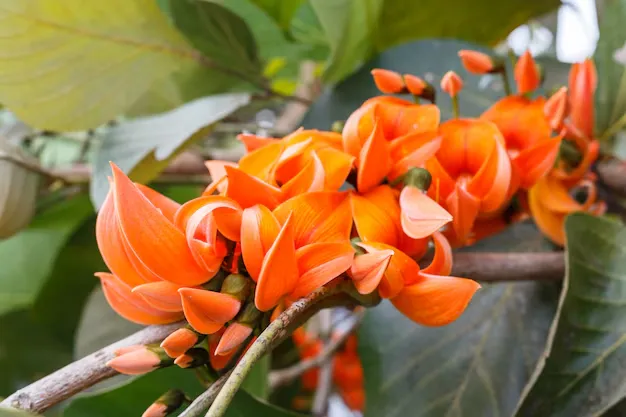
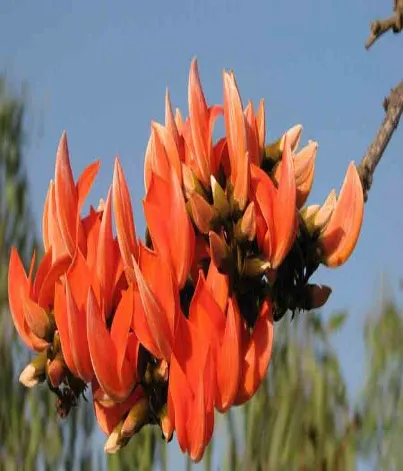
Fig:1
Butea monosperma (Lam.) Taub. is a slow-growing, deciduous tree with an erect habit, typically attaining a height of about 5–8 meters. The trunk is often irregular and somewhat crooked, with unevenly spreading branches. When fully mature, usually around 50 years of age, the tree develops a trunk diameter of approximately 20–40 cm (Kirtikar & Basu, 1999; Warrier et al., 1995). The leaves are large, trifoliate, and stipulate in nature. The leaflets are generally obtuse, smooth on the upper surface, and covered with fine silky hairs on the lower surface, which also shows prominent reticulate venation. The base of the leaflets ranges from cuneate to deltoid in shape (Nadkarni, 2009).
The flowers are conspicuous, large, and display a bright orange-red to crimson coloration, typically measuring about 2–4 cm in diameter. The flowering season generally occurs between February and April (Warrier et al., 1995). The fruit is a stalked, oblong pod measuring approximately 12.5–20 cm in length and 2.5–5 cm in width, characterized by thickened sutures and a reticulate surface. The seeds are flat and kidney-shaped, about 25–40 mm long, and are dark reddish-brown in color. They are thin, smooth, and glossy, with a faint Odor and a slightly bitter, acrid taste (Kirtikar & Basu, 1999; Nadkarni, 2009).
1.5 Ayurvedic Preparations
In Ayurvedic medicine, Butea monosperma is considered an important medicinal plant and is used as an ingredient in several classical formulations. It is included in preparations such as Kumkumadi Taila, Vanda Bhasma, Krimimudgara Rasa, Ayaskriti, and Palasha Arka, where it is valued for its therapeutic applications.
1.6 Macroscopic Characteristics of Butea monosperma
Table no.2
|
Sr.No. |
Feature |
Leaf |
Stem Bark |
Flower |
|
1 |
Colour |
Dark green to light green |
Greyish brown to dark brown |
Bright orange to crimson |
|
2 |
Odour |
Odourless |
Characteristic |
Slightly characteristic |
|
3 |
Surface |
Smooth with fine hairs |
Rough with cracks |
Smooth |
|
4 |
Texture |
Leathery |
Hard and fibrous |
Soft and fleshy |
|
5 |
Taste |
Astringent, slightly bitter |
Bitter |
Astringent, slightly sweet |
2.PHYTOCHEMISTRY
Butea monosperma contains a diverse range of phytochemical constituents, including imides, lactones, flavonoids, sterols, and alkaloids. Different parts of the plant possess unique bioactive compounds that contribute to its pharmacological activities.
Flowers
The flowers are rich in flavonoids, with major compounds including butrin, butein, and butin. Other phytoconstituents reported from the flowers include triterpenes, chalcones, aurones, steroidal compounds, and various glucosides such as coreopsin, isocoreopsin, monospermoside, and isomonospermoside (Burlia et al., 2007; Khare, 2007). Studies on the related species Butea frondosa have also documented flavonoids, free amino acids, and sugars, indicating considerable phytochemical diversity within the floral parts (Warrier et al., 1995).
Seeds
Seeds of Butea monosperma contain fixed oils, proteolytic and lipolytic enzymes, and plant proteinases. Nitrogenous acidic compounds such as palasonin are also present. Additionally, glucosides including monospermoside and somonospermoside, as well as allophanic acid in the seed coat, have been identified. The soft resin obtained from seeds mainly consists of characteristic acid esters that contribute to its chemical activity (Burlia et al., 2007; Nadkarni, 2009).
Leaves
Leaves of Butea monosperma contain glucosides and kino oil, which is rich in fatty acids such as oleic, linoleic, palmitic, and lignoceric acids. Phytochemical studies have also reported the presence of compounds such as 3,9-dimethoxypterocarpan from the ethyl acetate fraction and 3-α-hydroxyeuph-25-enylheptacosanoate from the hexane fraction of methanolic leaf extracts (Khare, 2007).
Bark
The bark contains kino-tannic acid, gallic acid, and pyrocatechin. Other identified constituents include palasitrin, major glycosides like butrin, and bioactive compounds such as allophanic acid, butolic acid, cyanidin, lupeol, lupenone, medicarpin, miroestrol, palasimide, and shellolic acid (Warrier et al., 1995; Nadkarni, 2009).
Stems
Stem extracts of Butea monosperma have yielded bioactive compounds such as 3-Z-hydroxyeuph-25-ene and a substituted oxo-octadecene derivative. Other isolated compounds include stigmasterol-β-D-glucopyranoside and nonacosanoic acid (Burlia et al., 2007; Khare, 2007).
Table no . 3
|
Plant Part |
Major Phytoconstituents |
|
Flowers |
Butrin, Butein, Butin, Triterpenes, Chalcones, Aurones, Flavonoids (Palasitrin, Prunetin), Steroids, Glucosides (Coreopsin, Isocoreopsin, Monospermoside, Isomonospermoside), Free amino acids, Sugars |
|
Seeds |
Fixed oil, Proteolytic and lipolytic enzymes, Palasonin, Nitrogenous acidic compounds, Glucosides (Monospermoside, Somonospermoside), Allophanic acid (seed coat), Acid esters (Jalaric ester-I & II, Laccijalaric ester-I & II) |
|
Leaves |
Glucosides, Kino-oil (Oleic, Linoleic, Palmitic, Lignoceric acids), 3,9-Dimethoxypterocarpan, 3-α-Hydroxyeuph-25-enylheptacosanoate |
|
Bark |
Kino-tannic acid, Gallic acid, Pyrocatechin, Palasitrin, Glycosides (Butrin, Alanind), Allophanic acid, Butolic acid, Cyanidin, Histidine, Lupenone, Lupeol, Medicarpin, Miroestrol, Palasimide, Shellolic acid |
|
Stems |
3-Z-Hydroxyeuph-25-ene, 2,14-Dihydroxy-11,12-dimethyl-8-oxo-octadec-11-enylcyclohexane, Stigmasterol-β-D-glucopyranoside, Nonacosanoic acid |
3.PHARMACOLOGICAL ACTIVITIES ON BUTEA MONOSPERMA
3.1 Antioxidant and Free Radical Scavenging Activity
Butea monosperma possesses considerable antioxidant potential. Extracts obtained from the stem bark, especially those prepared using acetone and methanol, demonstrate strong free radical scavenging ability, mainly due to their high phenolic content. The flowers, which contain bioactive compounds such as butein, also exhibit antioxidant and apoptosis-inducing properties. These findings suggest its possible role in managing oxidative stress–associated disorders. (Sehrawat & Kumar, 2012).
3.2 Antioxidant and Anticonvulsant Activities
Butea monosperma leaves are a rich source of flavonoids that demonstrate considerable antioxidant and anticonvulsant potential. Laboratory studies have shown that these extracts effectively neutralize free radicals and possess strong reducing capacity. In animal experiments, the flavonoid fraction has been found to decrease seizure severity and frequency, while also delaying the onset of seizures in chemically and electrically induced models. The protective effects increase with dosage and are likely linked to the extract’s antioxidant and neuroprotective properties. These observations highlight its possible value in managing epilepsy and other neurological conditions associated with oxidative stress. (Bala et.al., 2023)
3.3 Antimicrobial Activity
Butea monosperma leaves possess strong antimicrobial properties against various Gram-positive and Gram-negative bacteria as well as fungi. Extracts prepared with ethanol and methanol exhibit broad-spectrum, dose-dependent inhibition. This activity is largely due to bioactive compounds such as dodecane, phytol, squalene, and lup-20(29)-en-3-one. Aqueous and alcoholic extracts have also been shown to suppress the growth of multiple bacterial and fungal strains. The presence of diverse phytochemicals contributes to this antimicrobial effect. These results validate the traditional use of the leaves in combating infections. Overall, Butea monosperma leaves show significant promise as a natural antimicrobial agent (Goyal et al., 2019)
3.4 Hepatoprotective Activity
Butea monosperma bark demonstrates significant hepatoprotective effects in experimental models of liver injury induced by thioacetamide. The ethyl acetate fraction of the bark exhibits strong antioxidant activity, including superoxide radical scavenging and inhibition of lipid peroxidation. Pretreatment with the extract effectively normalized altered serum biochemical markers such as SGOT, SGPT, ALP, bilirubin, and albumin. Additionally, it restored the levels of key hepatic antioxidant enzymes, including SOD, CAT, GSH, and GR. Histopathological analyses confirmed protection of liver tissue and preservation of normal architecture. These results suggest that the hepatoprotective activity of Butea monosperma bark is primarily due to its antioxidant properties and support its traditional use in managing liver disorders. (Kaur et.al.,2017)
3.5 Antidiabetic Activity
Butea monosperma has shown notable antidiabetic potential in experimental studies. Its extracts, which are rich in flavonoids, polyphenols, and other bioactive compounds, have been reported to lower blood glucose levels, enhance insulin sensitivity, and improve antioxidant status in diabetic animal models. Additionally, the plant helps protect pancreatic β-cells and other tissues from oxidative stress–related damage, contributing to its overall antidiabetic effects. These findings indicate that Butea monosperma may serve as a valuable herbal adjunct for the prevention and management of diabetes. (Parween et al., 2021)
3.6 Antidepressant Activity
Butea monosperma has shown promising antidepressant potential in preclinical studies. Methanolic and ethanolic extracts of the plant demonstrate central nervous system–modulating effects, including mood enhancement and stress alleviation, in animal models of depression. These effects are likely attributed to the presence of flavonoids and chalcones, which may influence neurotransmitter activity. Overall, the findings indicate that Butea monosperma could be a valuable herbal option for the management of depressive disorders (Boya et al., 2025).
3.7Anti-Inflammatory exertion
Butea monosperma flower excerpts, particularly the methanolic bit( MEBM), parade significant-inflammatory goods in experimental models. In albino rats, oral administration of MEBM at boluses of 600 and 800 mg/ kg produced cure-dependent inhibition of carrageenan- convinced paw edema and significantly reduced granuloma conformation in the cotton bullet model. The excerpt also dropped situations of serum lysosomal enzymes similar as SGOT, SGPT, and peak, along with lipid peroxidation labels. These findings indicate that Butea monosperma flowers effectively suppress both acute and habitual seditious responses( Shahavi & Desai, 2007).
3.8 Anticancer exertion
Butea monosperma has demonstrated notable anticancer eventuality, particularly against bone cancer, in both in vitro and in vivo studies. Laboratory trials revealed that factory excerpts inhibit the proliferation of bone cancer cell lines and promote apoptosis. Beast studies further showed a significant reduction in tumour growth and volume, along with favourable modulation of biochemical labels linked to cancer progression. These anticancer goods are primarily attributed to bioactive phytochemicals similar as flavonoids, polyphenols, and other secondary metabolites, which retain antioxidant,pro-apoptotic, and cytotoxic parcels. Overall, the findings suggest that Butea monosperma could serve as a promising natural agent for bone cancer operation( Karia et.al., 2018).
3.9 Antidepressant Activity
Butea monosperma has shown promising antidepressant effects in preclinical studies. Methanolic and ethanolic extracts of the plant demonstrate central nervous system–modulating activity, including mood enhancement and reduction of stress-related behaviours in animal models of depression. These effects are likely linked to the presence of flavonoids and chalcones, which may regulate neurotransmitter function. Overall, the findings indicate that Butea monosperma could be a valuable herbal option for managing depressive disorders (Boya et al., 2025).
3.10 Anti-Hyperglycemic Activity
Butea monosperma leaves exhibit significant anti-hyperglycemic effects. Ethanolic extracts, administered at doses of 100–400 mg/kg, reduced blood glucose levels in adrenaline-induced and high-glucose–fed diabetic rabbits in a dose-dependent manner, with the 400 mg/kg dose showing the greatest effect. These actions are attributed to the presence of flavonoids, tannins, phenols, and saponins, which enhance insulin secretion, improve glucose utilization, and inhibit intestinal glucose absorption. These findings support the traditional use of Butea monosperma in the management of diabetes(Ray et al., 2017).
CONCLUSION
Butea monosperma (Lam.) Taub., commonly referred to as Palash or the “Flame of the Forest,” is an important medicinal plant that holds a significant place in traditional Indian systems of medicine, particularly Ayurveda. For centuries, different parts of this plant have been used in folk and classical herbal practices to treat a variety of ailments. Scientific investigations conducted in recent years have validated many of these traditional claims and revealed that the plant contains a wide range of biologically active phytochemicals. Major constituents such as flavonoids, chalcones, glycosides, tannins, sterols, and other secondary metabolites are present in its flowers, seeds, leaves, bark, and stems.
These phytochemicals are responsible for several pharmacological activities reported in experimental and preclinical studies. Research has demonstrated that extracts of Butea monosperma exhibit antioxidant, antimicrobial, anti-inflammatory, antidiabetic, hepatoprotective, anticonvulsant, antidepressant, and anticancer properties. Among these, the antioxidant activity plays a vital role in neutralizing free radicals and protecting biological systems from oxidative stress, which is associated with the development of many chronic diseases. The presence of diverse bioactive compounds also supports the plant’s traditional applications in managing infections, metabolic disorders, liver problems, and inflammatory conditions.
Despite the encouraging findings from laboratory and animal studies, comprehensive clinical trials in humans remain limited. Further research is necessary to establish standardized extraction methods, determine safe and effective dosage ranges, and evaluate long-term safety profiles. In conclusion, integrating traditional medicinal knowledge with modern pharmacological research highlights the considerable therapeutic potential of Butea monosperma. With continued scientific exploration, this plant may serve as a valuable source for the development of safe, effective, and globally accepted herbal medicines and nutraceutical products.
REFERENCES

Puyed Shivkanta, Wadulkar Raghunath, Satpute Kranti Karale Shital, Maid Sakshi, Comparative Review on Phytochemical and Pharmacological Potential of Butea Monosperma, Int. J. of Pharm. Sci., 2026, Vol 4, Issue 6, 6925-6932, https://doi.org/10.5281/zenodo.20957320
 10.5281/zenodo.20957320