

We use cookies to ensure our website works properly and to personalise your experience. Cookies policy
Surabhi Dayakar Rao College of Pharmacy, Gajwel, Siddipet, Telangana.
A simple, precise, and reliable reverse-phase high-performance liquid chromatography (RP-HPLC) method was successfully developed and optimized for the simultaneous estimation of Dolutegravir and Rilpivirine in bulk and pharmaceutical dosage forms. Chromatographic separation was achieved using a YMC ODS C18 column with a mobile phase of phosphate buffer and methanol (35:65 v/v) at pH 3.5, yielding well-resolved peaks with satisfactory retention times and system suitability parameters. The method was validated according to ICH guidelines, demonstrating excellent linearity (10–50 µg/ml, correlation coefficients >0.999), precision (%RSD within acceptable limits), and accuracy (recovery close to 100%). Sensitivity was confirmed through low LOD and LOQ values. Robustness studies further established the reliability of the method. Overall, the developed RP-HPLC method is accurate, precise, linear, robust, and sensitive, making it suitable for routine quality control analysis of Dolutegravir and Rilpivirine in combined dosage forms. Its economical and time-efficient nature enhances applicability in pharmaceutical industries and research laboratories
Pharmaceutical analysis is an essential discipline within pharmaceutical sciences that ensures the identity, purity, safety, and efficacy of drug substances and pharmaceutical formulations. It encompasses a wide range of analytical techniques used throughout drug development, manufacturing, and quality control processes. The primary objective of pharmaceutical analysis is to guarantee that drugs meet predefined specifications and regulatory requirements. (1,2,3,5,6)
Importance of High-Performance Liquid Chromatography (HPLC)
High-Performance Liquid Chromatography (HPLC) is one of the most widely used analytical techniques for the separation, identification, and quantification of components in complex mixtures. It is especially valuable in pharmaceutical analysis due to its ability to handle thermally unstable, non-volatile, and high molecular weight compounds. (4,11,13,14)
HPLC offers several advantages, including: (4,13,14)
INTRODUCTION TO HPLC
HPLC is an advanced form of column chromatography that operates under high pressure to increase the efficiency and speed of the separation process. It has become a standard method for analyzing complex mixtures in various industries, particularly pharmaceuticals. (4,13,14)
Principles of HPLC: The principle of HPLC is based on the partitioning of components between a stationary phase (usually packed inside a column) and a mobile phase (solvent that moves through the column). The different affinities of each component for the stationary and mobile phases cause them to elute at different times, known as retention times. (4,14)
Types of HPLC:
Applications of HPLC:
HPLC is valued for its accuracy, precision, and ability to analyze a wide range of compounds. Its versatility makes it an indispensable tool in scientific research and quality control laboratories worldwide. (4,5,11,13)
System Suitability:
According to the USP, system suitability tests are an integral part of chromatographic methods. These tests are used to verify that the resolution and reproducibility of the system are adequate for the analysis to be performed. System suitability tests are based on the concept that the equipment, electronics, analytical operations, and samples constitute an integral system that can be evaluated as a whole. The purpose of the system suitability test is to ensure that the complete testing system (including instrument, reagents, columns, analysts) is suitable for the intended application. (9)
Similar to the analytical method development, the system suitability test strategy should be revised as the analysts develop more experience with the assay. (3,9)
System suitability is the checking of a system to ensure system performance before or during the analysis of unknowns. Parameters such as plate count, tailing factors, resolution and reproducibility (%RSD retention time and area for six repetitions) are determined and compared against the specifications set for the method. These parameters are measured during the analysis of system suitability "sample" that is a mixture of main components and expected by-products. Below Table lists the terms to be measured and their recommended limits obtained from the analysis of the system suitability sample as per current FDA guidelines on "Validation of Chromatographic Methods". (3,9)
Table 4. System Suitability Parameters and Recommendations
|
Parameter |
Recommendation |
|
Capacity Factor (k’) |
The peak should be well-resolved from other peaks and the void volume, generally k’>2.0 |
|
Repeatability |
RSD < 1% for N > 5 is desirable. |
|
Relative retention |
Not essential as long as the resolution is stated. |
|
Resolution (Rs) |
Rs of > 2 between the peak of interest and the closest eluting potential interferent (impurity, excipient, degradation product, internal standard, etc. |
|
Tailing Factor (T) |
T of < 2 |
|
Theoretical Plates (N) |
N > 2000 |
Accuracy: Defined as the closeness of agreement between the actual (true) value and mean analytical value obtained by applying the test method a number of times. Accuracy is acceptable if the difference between the true value and mean measured value does not exceed the RSD values obtained for repeatability of the method. (1,12)
Precision: It is a measure of degree of repeatability of an analytical method under normal operation and it is normally expressed as % of relative standard deviation (% RSD). This involves (1,12)
% RSD = 100 S/X
Where, S = Standard deviation
X = Mean
It is determined at three levels.
Linearity: It is the ability of the method to elicit test result that is directly proportional to analytic concentration within a given range. It is generally reported as variance of slope of regression line. It is determined by series of three to six injections of five of more standards. (1,12)
Limit of Detection (LOD): It is defined as the lowest concentration of an analyte in a sample that can be detected but not quantified. LOD is expressed as a concentration at a specified signal to noise ratio. The LOD will not only depend on the procedure of analysis but also on the type of instrument. (1,12)
In chromatography, detection limit is the injected amount that results in a peak with a height at least twice or thrice as high as baseline noise level.
S/N = 2/1 or 3/1
LOQ is expressed as a concentration at a specified signal to noise ratio. In chromatography, limit of quantification is the injected amount that results in a peak with a height, ten times as high as base line noise level.
S/N = 10/1
Robustness: It is the measure of the capacity of the analytical method to remain unaffected by small but deliberate variation in procedure. It provides an indication about variability of the method during normal laboratory conditions. (1,12)
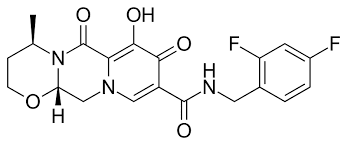
MOLECULAR STRUCTURE OF DOLUTEGRAVIR
|
Molecular Formula |
C20H19F2N3O5 (17,18) |
|
Molecular Weight |
419.45 g/mol (17) |
|
IUPAC Name |
(4R,12aS)-N-(2,4-difluorobenzyl)-7-hydroxy-4-methyl-6,8-dioxo-3,4,6,8,12,12a-hexahydro-2H-pyrido [1',2':4,5] pyrazino[2,1-b] [1,3] oxazine-9-carboxamide (17,18) |
|
ChemSpider ID |
25067956 (18) |
|
Density |
1.45 g/cm³ (18) |
|
Boiling Point |
998.8 °C (at 760 mmHg) (18) |
|
Vapour Pressure |
2.15 × 10^-9 Pa (at 25 °C) (18) |
|
Flash Point |
605.8 °C (18) |
|
Refractive Index |
1.63 (18) |
|
Polar Surface Area |
193.3 Ų (17) |
|
LogP (Octanol/Water) |
3.49 (17) |
|
Generic Name |
Dolutegravir (16) |
|
Brand Names |
Tivicay, Juluca (combination with rilpivirine) (20) |
|
Drug Category |
Antiretroviral, Integrase strand transfer inhibitor (INSTI) (16,19) |
|
Indications |
HIV-1 infection (treatment-naive and treatment-experienced adults and children) (19,20) |
|
Pharmacology |
Inhibits HIV-1 integrase, preventing viral DNA integration into host genome (16,19) |
|
Potency |
Highly potent, with IC50 values ranging from 0.05 to 0.5 nm (16) |
|
Tolerability |
Generally well-tolerated, with common adverse effects including insomnia, headache, and diarrhea (16,20) |
|
Contraindications |
Hypersensitivity to dolutegravir or any component of the formulation (20) |
|
Adverse Effects |
Common: insomnia, headache, diarrhea; Less common: hypersensitivity reactions, liver enzyme elevations (16,20) |
|
Availability |
Available in oral tablet and film-coated tablet formulations, as well as a powder for oral suspension (20) |
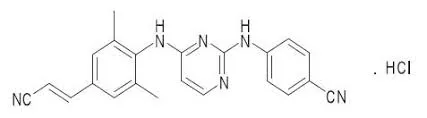
MOLECULAR STRUCTURE OF RILPIVIRINE
|
Molecular Formula |
C22H18N6 (22,23) |
|
Molecular Weight |
366.42 g/mol (22) |
|
IUPAC Name |
4-{[4-({4-[(E)-2-cyanoethenyl]-2,6-dimethylphenyl} amino) pyrimidin-2-yl] amino} benzonitrile (22,23) |
|
ChemSpider ID |
44457598 (23) |
|
Density |
1.23 g/cm3 (23) |
|
Boiling Point |
567.8 °C (1053.8 °F) (23) |
|
Vapour Pressure |
0.0 mmHg (20 °C) (23) |
|
Flash Point |
282.3 °C (540.1 °F) (23) |
|
Refractive Index |
1.65 (23) |
|
Polar Surface Area |
102.39 Å2 (22) |
|
LogP (Octanol/Water) |
4.45 (22) |
|
Generic Name |
Rilpivirine (21) |
|
Brand Names |
Edurant, Juluca (combination with dolutegravir) (24) |
|
Drug Category |
Antiretroviral, Non-nucleoside reverse transcriptase inhibitor (NNRTI) (21,25) |
|
Indications |
HIV-1 infection (treatment-naive and treatment-experienced adults and children) (24,25) |
|
Pharmacology |
Inhibits HIV-1 reverse transcriptase, preventing viral replication (21,25) |
|
Potency |
Highly potent, with IC50 values ranging from 0.27 to 0.34 Nm (21) |
|
Tolerability |
Generally well-tolerated, with common adverse effects including depression, insomnia, and rash (21,24) |
|
Contraindications |
Hypersensitivity to rilpivirine or any component of the formulation Co-administration with proton pump inhibitors, rifampicin, rifapentine, carbamazepine, oxcarbazepine, phenobarbital, phenytoin, St. John's Wort (24,25) |
|
Adverse Effects |
Common: depression, insomnia, rash Less common: severe skin and hypersensitivity reactions, liver enzyme elevations (21,24) |
|
Availability |
Available in oral tablet formulation, 25 mg (24) |
|
Mechanism of Action |
1. Binds to HIV-1 reverse transcriptase (21) 2. Inhibits reverse transcription, preventing viral replication (21,25) 3. Prevents integration of viral DNA into host genome (21,25)
|
MATERIALS AND METHODS:
List of Proposed Materials:
|
S. No. |
Chemicals/standards and reagents |
Grade |
Make |
Used for the estimation of drugs |
|
1 |
Phosphate buffer |
HPLC |
Qualigens |
1. Dolutegravir and Rilpivirine |
|
2 |
Acetic acid |
HPLC |
Qualigens |
1. Dolutegravir and Rilpivirine |
|
3 |
Water |
HPLC |
Qualigens |
For all drugs |
|
4 |
Acetonitrile |
HPLC |
Qualigens |
For all drugs |
|
5 |
Methanol |
HPLC |
Rankem |
For all drugs |
Equipment’s and instruments used in the study:
S.No.
|
Equipment |
Model/Type |
Manufacturer |
|
|
1 |
Electronic Balance |
SAB2032 |
SCALETEC |
|
2 |
Ultra-Sonicator |
SE60US |
LABMAN SCIENTIFIC INDIA |
|
3 |
Thermal Oven |
i-THERM A17782 |
DWARAKA SCIENTIFIC |
|
4 |
pH Meter |
ORION STAR A111 |
THERMOSCIENTIFIC |
|
5 |
Filter Paper |
0.45 microns |
MILLIPORE |
|
6 |
HPLC System |
WATERS 2690 SEPARATION MODULE |
WATERS |
Optimization of Column: YMC ODS (4.6*250mm, 5µm) was found to be ideal as it gave good peak shape and resolution at 1.0 ml/min flow.
OPTIMIZED CHROMATOGRAPHIC CONDITIONS
Equipment : High performance liquid chromatography equipped with Auto Sampler and PDA detector
Column : YMC ODS (4.6*250mm, 5µm)
Buffer : Phosphate buffer
PH : 3.5
Mobile phase : 35% buffer: 65% Methanol
Flow rate : 1.0 ml per min
Wavelength : 250 nm
Injection volume : 20 ml
Run time : 12 min.

|
S.No |
Name |
RT(min) |
Area (µV sec) |
Height (µV) |
Resolution |
USP tailing |
USP plate count |
|
1 |
Dolutegravir |
3.602 |
214546 |
8021578 |
4.57 |
1.06 |
4596 |
|
2 |
Rilpivirine |
5.148 |
34475 |
124577 |
1.2 |
3153 |
System Suitability: Tailing factor for the peaks due to Dolutegravir and Rilpivirine in Standard solution should not be more than 2.0. Theoretical plates for the Dolutegravir and Rilpivirine peaks in Standard solution should not be less than 2000
Calculation: (For Dolutegravir and Rilpivirine)

Where:
AT = average area counts of sample preparation.
AS = average area counts of standard preparation.
WS = Weight of working standard taken in mg.
P = Percentage purity of working standard
LC = Label Claim mg/ml.
Acceptance criteria of System Suitability:
RESULTS AND DISCUSSION
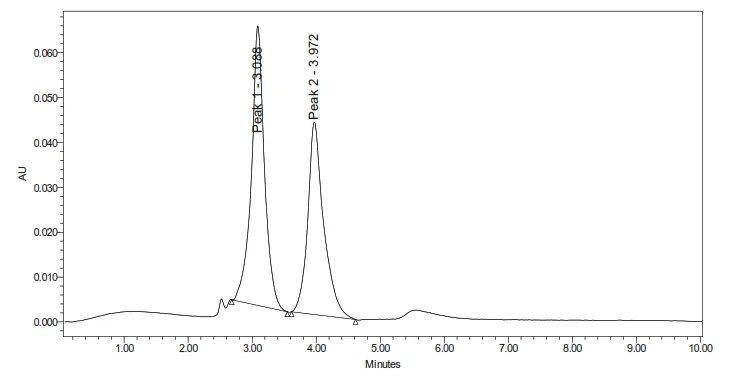
TRIAL - 1
Instrument used : High performance liquid chromatography equipped with Auto Sampler and PDA
Temperature : Ambient
Column : Platisil C18, (250×4.6mm, 5mm)
Mobile phase : 65% Methanol: 35% NaH2PO4 PH-4
Flow rate : 0.9 ml per min
Wavelength : 250 nm
Injection volume : 10 ml
Run time : 10 min.
TRAIL 2
Instrument used : High performance liquid chromatography equipped with Auto Sampler and PDA
Temperature : Ambient
Column : Spurcil C18, (250×4.6mm, 5mm)
Mobile phase : 65% Methanol: 35% NaH2PO4 PH-4.5
Flow rate : 0.8 ml per min
Wavelength : 250 nm
Injection volume : 10 ml
Run time : 10 min.

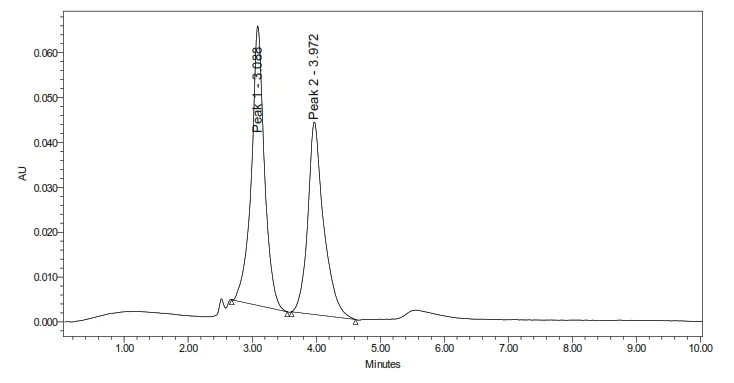
TRAIL 3
Instrument used : High performance liquid chromatography equipped with Auto Sampler and PDA
Temperature : Ambient
Column : Inertsil, (250×4.6mm, 5mm)
Mobile phase : 65% Methanol: 35% NaH2PO4 PH-4
Flow rate : 0.9 ml per min
Wavelength : 250 nm
Injection volume : 10 ml
Run time : 10 min.
1 VALIDATION PARAMETERS:
1.1 ASSAY:
Standard and sample solution injected as described under experimental work. The corresponding chromatograms and results are shown below.
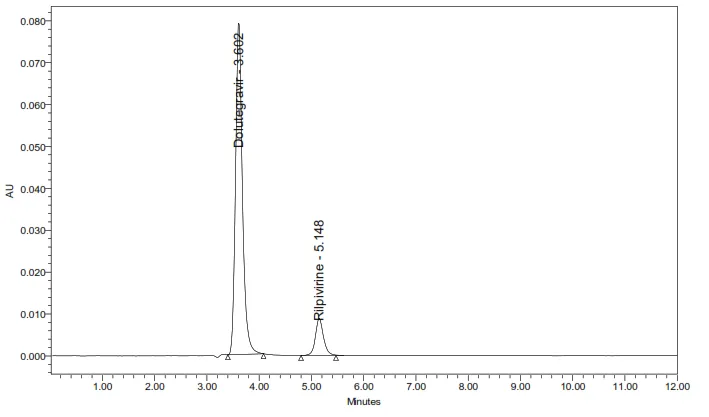
Figure 1: Chromatogram for Standard
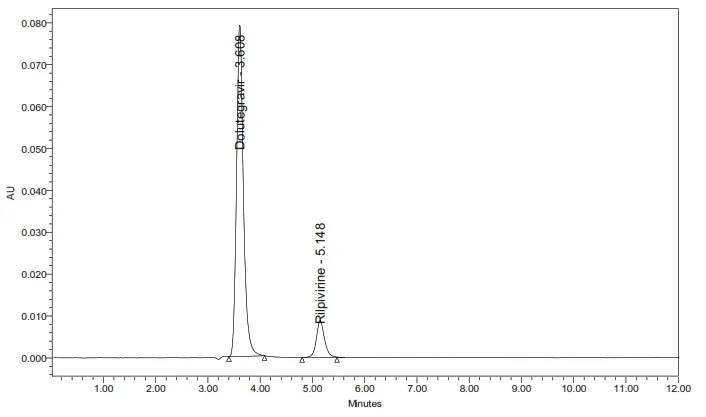
Figure 2: Chromatogram for Sample
Table 1: Results of Assay for Dolutegravir and Rilpivirine
|
S.No |
Name (STD) |
RT(min) |
Area (µV sec) |
Height (µV) |
Resolution |
USP tailing |
USP plate count |
|
1 |
Dolutegravir |
3.608 |
12867 |
8021578 |
4.7 |
1.06 |
3246 |
|
2 |
Rilpivirine |
5.148 |
34475 |
124577 |
1.08 |
68369 |
|
|
S.No |
Name (Sample) |
RT(min) |
Area (µV sec) |
Height (µV) |
5.01 |
USP tailing |
USP plate count |
|
1 |
Dolutegravir |
3.608 |
214258 |
8021578 |
1.25 |
3465 |
|
|
2 |
Rilpivirine
|
5.148 |
33983 |
124577 |
1.06 |
6942 |
|
|
Label Claim (mg) |
% Assay |
|
Dolutegravir |
50 mg |
99.6% |
|
Rilpivirine |
25mg |
98.0% |
2 LINEARITY:
The linearity range was found to lie from 10µg/ml to 50µg/ml of Dolutegravir and Rilpivirine and chromatograms are shown below.
Table 2: Area of different concentration of Dolutegravir and Rilpivirine
|
S. No |
Dolutegravir |
|
|
Concentration (µg/ml) |
Area |
|
|
1 |
20 |
71596 |
|
2 |
40 |
143965 |
|
3 |
60 |
213269 |
|
4 |
80 |
275985 |
|
5 |
100 |
347416 |
|
S. No |
Rilpivirine |
|
|
Concentration (µg/ml) |
Area |
|
|
1 |
10 |
10786 |
|
2 |
20 |
21469 |
|
3 |
30 |
32652 |
|
4 |
40 |
42586 |
|
5 |
50 |
53512 |
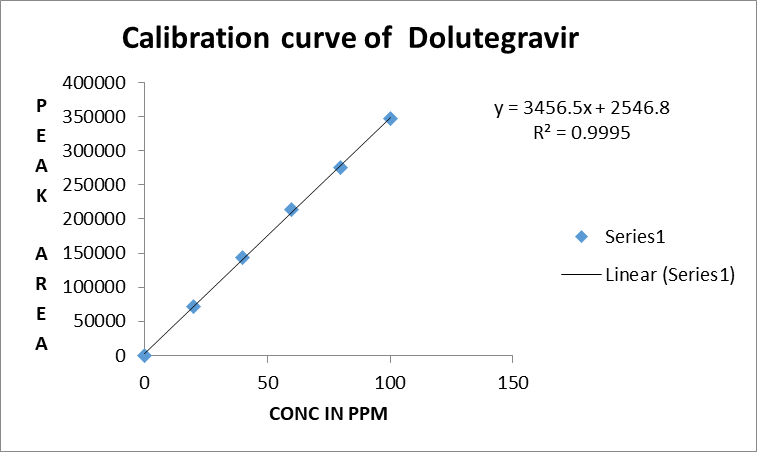
Figure 3: Calibration graph for Dolutegravir
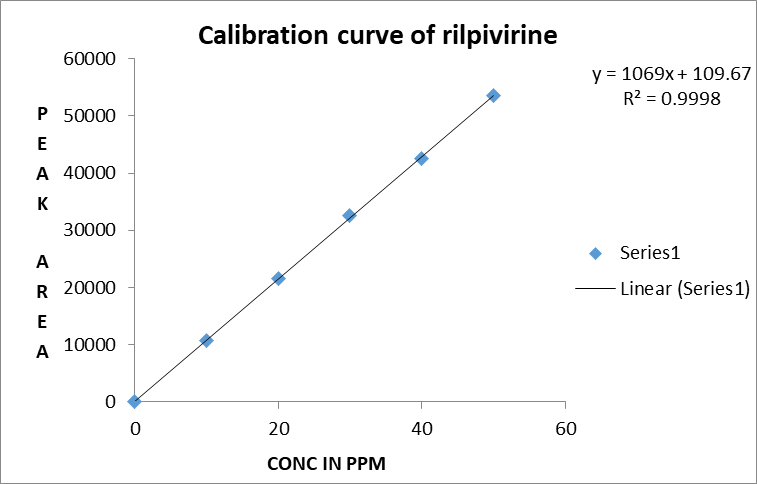
Figure 4: Calibration graph for Rilpivirine
Table 4: Analytical performance parameters of Dolutegravir and Rilpivirine
|
Parameters |
Dolutegravir |
Rilpivirine |
|
Slope (m) |
6913 |
534.49 |
|
Intercept (c) |
2546.8 |
109.67 |
|
Correlation coefficient (R2) |
0.9995 |
0.9998 |
Results of Precision for Dolutegravir and Rilpivirine
|
Injection |
Dolutegravir Area |
Rilpivirine Area |
|
Injection-1 |
214652 |
33321 |
|
Injection-2 |
214985 |
33658 |
|
Injection-3 |
214423 |
33756 |
|
Injection-4 |
214145 |
33249 |
|
Injection-5 |
214021 |
33943 |
|
Injection-6 |
214362 |
33145 |
|
Average |
214213 |
33397 |
|
Standard Deviation |
214400.1 |
33495.57 |
|
%RSD |
329.4786 |
293.9069 |
Table 5: Results for variation in mobile phase composition for Dolutegravir and
Rilpivirine
|
S. No |
Change in Organic Composition in the Mobile Phase |
System Suitability Results of Dolutegravir |
|
|
USP Plate Count |
USP Tailing |
||
|
1 |
10% less(54ml) |
3075 |
1.05 |
|
2 |
*Actual(60ml) |
3069 |
1.08 |
|
3 |
10% more(66ml) |
3053 |
1.02 |
|
S. No |
Change in Organic Composition in the Mobile Phase |
System Suitability Results of Rilpivirine |
|
|
USP Plate Count |
USP Tailing |
||
|
1 |
10% less(54ml) |
6947 |
1.04 |
|
2 |
*Actual(60ml) |
6991 |
1.07 |
|
3 |
10% more(66ml) |
6939 |
1.2 |
CONCLUSION
The developed RP-HPLC method is accurate, precise, linear, robust, and sensitive for the simultaneous determination of Dolutegravir and Rilpivirine. All validation parameters including system suitability, precision, accuracy, linearity, LOD, LOQ, and robustness were found to be within acceptable limits, confirming the suitability of the method for routine quality control analysis. The method is economical, time-efficient, and reproducible, making it highly suitable for regular laboratory use in pharmaceutical industries and research laboratories for the analysis of these drugs in combined dosage forms.
REFERENCES


Baswaraju Aruna, Macharla Rakesh, Jarupla Abhishek, Ulli Vaman Shiva, Durgam Shashank, Development and Validation of an HPLC Method for the Simultaneous Estimation of Dolutegravir and Rilpivirine in Bulk and Pharmaceutical Dosage Forms, Int. J. of Pharm. Sci., 2026, Vol 4, Issue 6, 1344-1355, https://doi.org/10.5281/zenodo.20556264
 10.5281/zenodo.20556264