

We use cookies to ensure our website works properly and to personalise your experience. Cookies policy
1Pioneer Pharmacy College, Ajwa-Nimeta Road, Vadodara, Gujarat, India -390019
The convergence of Artificial Intelligence (AI) and pharmaceutical three-dimensional (3D) printing is proving to be a promising strategy for creating more precise and adaptable oral drug delivery systems. The review investigates the potential of AI-driven 3D printing to address some of the drawbacks of traditional manufacturing, by offering enhanced control over formulation composition, dosage, product geometry and drug release behaviour. The various 3D printing technologies used for oral dosage forms, for example, fused deposition modelling, semi-solid extrusion, binder jetting, inkjet printing, stereolithography and selective laser sintering, are explained and discussed with respect to their pharmaceutical application. Special attention is paid to the application of machine learning and computational modeling in formulation optimization, predictability of printability, process parameter selection, drug release prediction and monitoring of quality. The review also highlights the potential of these technologies for patient-specific dosage forms, including customized tablets, oral films, chewable formulations and polypills. Recent developments indicate a growing transition of 3D printing systems from research towards practical applications as the systems become more viable and patient oriented. But issues concerning printable pharmaceutical materials, equipment expense, data quality, model validation, regulatory requirements, cybersecurity, and industrial scalability continue to be significant hurdles for broader implementation. Future innovations like digital twins, autonomous AI-driven printing, Internet of Things (IoT) and Explainable AI (XAI) can still redefine pharmaceutical production, offering the potential for more intelligent production and real-time process control. Overall, AI-integrated 3D printing represents a significant step towards flexible, data-driven and personalized manufacturing of oral dosage forms.
Artificial Intelligence (AI) is a general term encompassing computational methods that allow machines to learn, analyze data, identify patterns and make decisions. AI can be applied in different fields including the pharmacy. In pharmacy, AI is implemented to improve decision-making, data analysis and process optimization. It has been used across various pharmaceutical sectors, from drug discovery and development to manufacturing and patient care, due to its potential benefits, including greater accuracy, shorter development times and greater efficiency.1
3D Printing is another emerging technology currently receiving a lot of interest in the pharmaceutical manufacturing industry. Also known as Additive Manufacturing (AM), 3D Printing is the technology of manufacturing three-dimensional objects based on Computer-Aided Design (CAD) models by depositing or solidifying materials in layers. Compared with the conventional manufacturing techniques, 3D printing provides greater flexibility for the creation of complex and patient-specific dosage forms. Such dosage forms are flexible with regard to geometry, drug loading and drug release. In the pharmaceutical industry, tablets, capsules, granules and pellets are the forms that have been most studied for 3D printing applications and are called oral dosage forms. Oral delivery is one of the most popular routes of drug administration due to its convenience, patient acceptance and modest manufacturing cost. However, conventional oral dosage forms are usually produced with typical dosage levels and dosage forms that may not be ideal for each patient. Tablets may also be cut or broken to obtain the desired dose, which can result in incorrect dosing as well as alter the dose-release profile intended.2
One way that 3D printing is being used to help address some of these challenges is by the ability to create a custom and precise drug delivery system with controlled drug loading, geometry and release profile of an oral dosage form. This adaptability is very exciting for the future of the technology in the field of personalized pharmacotherapy, in which dosage forms can be customized to meet the needs of each individual patient. The formulation composition, material properties, printing parameters and product characteristics, however, are some of the variables involved in developing 3D-printed pharmaceutical products. It is challenging to control these variables effectively using conventional trial-and-error methods.3
AI and 3D printing can provide a solution to these issues. AI models can be utilized to assist in creating the formulation, predicting printability, optimizing printing parameters, and analyzing large datasets to improve product quality and process performance. By finding relationships between formulation and process factors, AI can help reduce the number of experimental trials, reduce the time taken to develop the formulation and ensure uniform drug-release properties. Thus, AI and 3D printing can improve drug dosage accuracy, manufacturing efficiency, the effectiveness of individualized drug delivery and personalized manufacturing with on-demand production, which in turn will help to minimize material waste and production costs.4
The current review highlights the status and applications of AI in oral dosage form 3D printing with emphasis on formulation design, optimization of the printing process, quality control, personalized medicine, current challenges, and future prospects.
2. 3D PRINTING TECHNOLOGIES FOR ORAL DOSAGE FORMS
In pharmaceuticals, there are a number of technologies that were tested, and their properties in terms of material composition, resolution, processing temperature, etc. have their own advantages. The most prominent technologies are fused deposition modelling (FDM), semi-solid extrusion (SSE), binder jetting (BJ), inkjet printing (IJP), stereolithography (SLA), selective laser sintering (SLS), direct powder extrusion (DPE), direct writing (DW), and digital light processing (DLP).
2.1 Fused Deposition Modelling (FDM)
The FDM process is an extrusion process in which a thermoplastic material with a drug in it is fed to the extruder, melted, passed through a nozzle and laid down in layers on a build platform. The deposited material is cooled and solidified to create the final dosage form. Hot-melt extrusion (HME) is one approach used to formulate drug loaded filaments and has the ability to deliver a relatively uniform distribution and loading level for the drug. Several polymers have been investigated for pharmaceutical FDM including PVA, PLA, PEG, PEO, HPMC, HPC, PVP and Eudragit®.
The benefits of FDM are that the dose can be customised very precisely, complex geometry can be created and immediate release and modified release products can be developed without a large amount of material wastage.
It has a relatively high processing temperature (typically 150-230°C), which may result in degradation of thermolabile drugs and excipients. Another drawback is the preparation of the filament is complex and the method may only work for materials that have suitable thermal and mechanical properties.5
2.2 Semi Solid Extrusion (SSE)
SSE is an extrusion process in which semi-solid material formulations such as gels, pastes, viscous suspensions, are extruded and layered through a syringe or a cartridge nozzle. Unlike FDM, it does not require preparation of a thermoplastic filament and drugs can be directly introduced into the formulation. It is also easily applicable to thermolabile drugs because it goes through a low-temperature processing.
The oral route of administration for SSE has been investigated in immediate and controlled release tablets, orodispersible tablets, gastro-retentive systems, paediatric formulations and solid lipid-based tablets. It can also be employed for personalized and demand-oriented medicine production. The formulation, however, should have the right rheological properties for the successful extrusion process. Low-viscosity formulations can spread after deposition, while highly viscous formulations can be extruded but can cause difficulties. Drying or cooling is also often necessary following the printing process and this can lead to shrinkage or deformation.6
2.3 Binder Jetting (BJ)
Binder jetting is one of the powder-bed processes, where a liquid binder is selectively deposited onto the successive layers of pharmaceutical powder. The powder particles are held together by the binder forming the desired structure and the unbound powder gives natural support. The process is normally carried out at room temperature and therefore is suitable for thermolabile drugs.
The BJ is especially significant for creating highly porous dosage forms having quick disintegration and dissolution. It also allows for customization of a dose, tablet geometry, porosity and drug loading. It is used in various pharmaceutical products, and the first 3D-printed drug to receive FDA approval, Spritam® (levetiracetam), was developed with the use of the ZipDose® binder-jetting technology.
The main drawbacks are relatively low mechanical strength, the need for the optimization of the binder concentration, drying conditions and powder flowability. Too much binder can cause longer drying time and also influence the dimensions, while too little binder can lead to weak tablets.7
2.4 Inkjet Printing (IJP)
The Inkjet printing method is a non-contact approach whereby small (microscopic) drops of liquid formulation containing the drug are printed onto a surface following a digital design. The API and other excipients are assembled into what's known as an “ink” that is manipulated for the correct surface tension and viscosity. There are two approaches to IJP – Continuous Inkjet Printing (CIJP) and Drop-on-Demand Inkjet Printing (DoD-IJP). The technique has low material consumption, high resolution, accurate deposition of drugs and is fast. Studies for orodispersible films, personalized oral dosage forms, paediatric and geriatric medicines and fixed dose combinations using IJP have already been carried out. However, the challenges such as nozzle blockage, concentration limit, formulation restrictions are yet to be overcome.
2.5 Stereolithography (SLA)
SLA is a vat-photopolymerization technology that selectively cures the photo-sensitive resin layer by layer with a focused UV laser. PEGDA, PEGDMA, GelMA and other biocompatible polymers, which can be light-cured, have been investigated for pharmaceutical and biomedical applications.
SLA is employed to produce Drug Delivery Systems (DDS) with complex structure and function, implants, controlled release drugs and micro structured formulations; with high resolution, excellent surface finish and dimensional accuracy. It is a process which generates little local heat and could be beneficial for thermolabile drugs. However, due to several drawbacks such as the absence of appropriate photocurable materials, the presence of residual monomer, photoinitiators and even toxicity of some resins in the pharmaceutical industry, their pharmaceutical use is currently limited.9
2.6 Selective Laser Sintering (SLS)
SLS is a powder-bed fusion method whereby a laser fuses the powdered material in a selective manner, layer by layer. The unsintered powder surrounding the part provides it with inherent support, which can be used to create complex structures without the need for extra support materials.
SLS offers good dimensional accuracy and can create personalized tablets, multi-layer systems and lattice dosage forms with optimized drug release profiles. It also eliminates filament preparation and overall, does not need to dry the products after printing. However, its pharmaceutical applications are limited by its potential for thermal degradation from the laser energy, powder-handling requirements and high equipment costs. The print quality and mechanical strength are also influenced by the powder flowability and the particle size.10
2.7 Direct Powder Extrusion (DPE)
The DPE process directly transforms a powder mixture of API and excipients into the dosage form, without any need for filament preparation or solvents. Heat and mechanical forces are applied to powder and it is extruded layer by layer through a nozzle. This makes the manufacturing process easier and can achieve a high drug loading.
DPE provides solvent-free processing, fewer manufacturing steps and can be used to manufacture immediate release, sustained release and pulsatile-release dosage forms. It has been explored for manufacturing of custom-made tablets and as needed pharmaceuticals. Drug distribution with DPE however, may be less uniform than with an HME system and the print quality will be highly dependent on the powder flow properties. Some APIs may be incompatible with the printing process too.11
2.8 Direct Writing (DW)
Direct writing is a process that extrudes a drug loaded formulation or bioink through a nozzle to create three-dimensional structures, one layer at a time. It can process a wide range of viscosities and is especially useful in pharmaceutical and biomedical applications. Hydrogels including alginate, gelatin, collagen, chitosan, PEG and GelMA can be utilized as printing materials.
DW could be used in customized drug-delivery systems, implants, tissue scaffolds and controlled release. It can be used to deposit biomaterials and even living cells which makes it useful in bioprinting and regenerative medicine. However, it usually has a lower resolution than SLA and DLP.12
2.9 Digital Light Processing (DLP)
Another vat-photopolymerization technique is DLP, which employs a digital micromirror device to focus light onto a photopolymer resin and selectively cure each layer. In contrast to SLA, in which a laser traces the pattern, the entire layer is cured simultaneously in DLP, resulting in faster fabrication, high resolution and excellent dimensional accuracy.
DLP has been studied for the creation of personalized drug-delivery systems, complex dosage forms and microneedles arrays. A significant benefit of DLP is that it has fast and accurate printing with a good surface finish. Like SLA, however, pharmaceutical applications of DLP are constrained by the availability of appropriate photocurable and biocompatible materials, as well as possible residual photoinitiators or uncured resin.13
In general, the choice of 3D printing technology will depend on the characteristics of the drug itself and the excipients, on the dosage form of the drug, on the desired resolution, on the required drug-release profile, on the processing temperature and on the level of personalization. Extrusion based approaches like FDM, SSE and DPE are especially effective in the production of customized oral dosage forms and BJ is suitable for tablets with high porosity rapidly disintegrating tablets. While IJP can deliver highly resolved small deposits of drug, SLA and DLP can deliver high resolution for complex structures. This means that it is not a single technology which is ideal, the selection will depend on formulation and therapeutic needs.
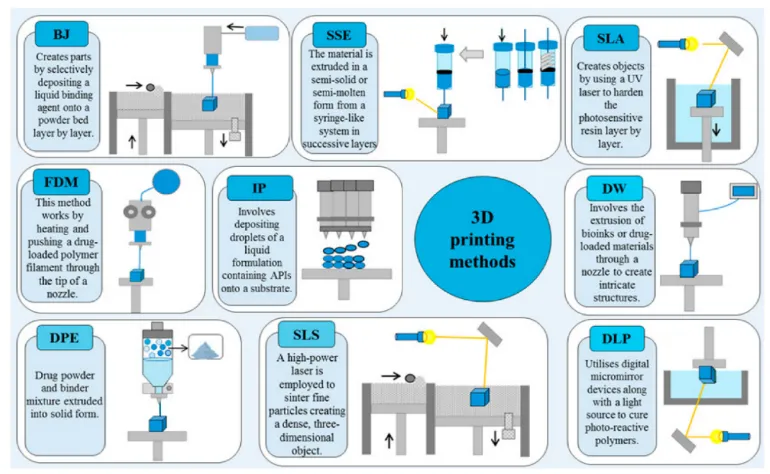
Figure 1: 3D Printing Technologies14
3. 3D PRINTED ORAL DOSAGE FORMS
The advent of three-dimensional (3D) printing has opened up new avenues in the field of oral drug delivery by allowing the precise control of a drug dose, geometry, loading, internal structure and release characteristics. In contrast to traditional manufacturing, it can also be used to prepare patient-specific drugs and complex dosage forms such as tablets, capsules, pellets, oral films, chewable and polypills. These key attributes are especially beneficial in personalised medicine and patient compliance.
3.1 Conventional Tablet
The conventional tablets are popular due to their precise dosage, stability and ease of administration. Conventional production techniques, however, are not well suited for creating an individual dose or more complex structures. The 3D printing technology eliminates these restrictions by permitting the design of the tablet size, shape, dose, internal geometry and the release profile of the drug depending on the patient's needs.
The production of tablets has been investigated with FDM, SSE, BJ, SLS, SLA, DLP and IJP. However, these benefits are offset by the fact that there are currently very few materials available for printable pharmaceuticals, high equipment cost, slow production speed and regulatory restrictions.15
3.2 Immediate-Release Tablets
Immediate-release (IR) tablets are designed to disintegrate quickly and deliver the drug quickly into the bloodstream without prolongation for immediate therapeutic action. They can be disintegrated and dissolved by controlling geometry, porosity, infill density, and surface-area-to-volume ratio of the 3D printed tablet.
FDM allows for tailored dose strength and size while binder jetting is especially advantageous for the manufacture of highly porous tablets that have a very rapid disintegration rate. SSE may be beneficial for drugs with a high drug loading and heat-sensitive drugs. But the rapid release of the drug along with the desirable mechanical strength is still very difficult.16
3.3 Extended-Release Tablets
Extended-release (ER) tablets release the drug slowly over a longer period of time to help maintain therapeutic drug levels and decrease the number of doses needed. The advantage of 3D printing is the ability to control drug release by altering the geometry, infill density, surface area and internal structure of the tablets.
The use of polymers, like HPMC, HPC, ethyl cellulose, PVA, PEO and Eudragit®, for controlled-release matrices is widely studied for the application of FDM. Multilayer, compartmentalized and core-shell structures can also be manufactured to enable specific release patterns. High processing temperatures, the narrow range of polymers that can be printed, slow product production and regulatory issues could limit the use.17
3.4 Orodispersible Tablets (ODTs)
The orodispersible tablets quickly disintegrate in the mouth without the necessity of water and are especially beneficial for dysphagic patients, geriatric patients and children. By using 3D printing the porosity as well as the internal structure of a tablet can be controlled, which means it can disintegrate quickly and still have a controlled dose.
Binder jetting has been found to be a good method for ODTs because of the highly porous structures that can be created. An important breakthrough was Spritam® (levetiracetam), the first FDA-approved 3D-printed medicine, which was able to create highly porous tablets that disintegrated rapidly.18
3.5 Chewable Tablets
Chewable tablets are chewed before they are swallowed, and are especially helpful when swallowing is difficult for children and patients. Other factors that contribute to patient acceptance are taste, texture and chewability, as well as accurate dosing.
Personalized dose and appealing shapes, even child friendly shapes, are achievable with 3D printing. SSE is a common research area as the capability to print formulations with a hydrogel can be directly utilized. Patient friendly dosage forms, such as 3D-printed medicated gummies and taste masking are still key issues. Careful consideration must be given to drying related shrinkage, taste optimization and the candy-like appearance of some formulations.19
3.6 Pellets
The advantages of pellets are that they are multiparticulate dosage forms and provide flexibility in the amount of the drug delivered, gastrointestinal distribution and minimize dose dumping. They are also very small, allowing them to be used in paediatrics and geriatrics.
Pellet size, shape, drug loading and release characteristics can be controlled using 3D printing. SSE has studied the possibility of developing custom pellets that will allow for various dosages or release rates within a capsule/sachet. However, it is difficult to get uniform pellet size, uniformity of prints and scalability of production.20
3.7 Polypills
Polypills are pills with two or more APIs in them and can make treatment simpler, fewer pills to take and better adherence. Manufacturing using traditional methods might be unable to cope with different doses and release schedules for the drugs.
The 3D printing technique allows for the exact positioning of more than one drug in different compartments of a single tablet. The three methods FDM, SSE and binder jetting, have been studied for the manufacture of multilayer and compartmentalized polypills where the immediate release, delayed release and sustained release drug components can be combined into a single dosage form. Yet formulation complexity, the compatibility of drugs, production speed and regulatory needs are challenges.21
3.8 Capsules
Capsules may be filled with powder, pellets, granules, liquids or semi-solid formulations and are very popular due to the ease of dosing and the ability to hide unpleasant flavours and odors. The size, shape of capsules, the thickness of the capsule shell and the internal structure of the capsules can all be customized using 3D printing.
The use of FDM and SSE to create custom-made capsule shells as well as the incorporation of multiparticulate systems with various release properties has been studied. This method can aid in individual multidrug therapy and decrease pill burden. Printable materials, manufacturing efficiency, reproducibility and regulatory approval however, are important limitations.22
3.9 Oral Film
Oral films are thin and flexible polymeric dosage forms that can dissolve quickly in the oral cavity or stick to the buccal mucosa for local or systemic drug delivery. They are especially appealing to children, geriatrics and dysphagic patients.
3D printing enables precise control of film thickness, dimensions, drug loading and internal structure. The use of SSE and IJP are especially applicable to individualized films, particularly if low doses of drugs are to be delivered accurately. While drug distribution, stability and production challenges exist, 3D-printed oral films have a huge potential to deliver personalized and on-demand drug delivery.23
Table 1: 3D Printed Oral Dosage Forms
|
Dosage Form |
3D-Printed example |
Drug/API |
Therapeutic effect |
Technology |
Materials/Polymers used |
Reference |
|
Immediate-Release Tablet |
Rapid release tablet |
Paracetamol |
Rapid analgesic effect |
FDM |
PVA-based filament |
24 |
|
Delayed-Release Tablet |
Enteric delayed-release tablet |
Diclofenac sodium |
Intestinal drug delivery |
FDM |
HPMCAS, PVA |
25 |
|
Extended-Release Tablet |
Floating sustained release printlet |
Propranolol HCl |
Gastro-retentive therapy |
FDM |
HPMC, PVA |
26 |
|
Orodispersible Tablet |
Porous ODT |
Ondansetron |
Antiemetic therapy |
SLS |
Ondansetron–β-cyclodextrin complex, Kollidon® VA64, mannitol, Candurin® Gold Sheen |
27 |
|
Polypill |
Multi-drug polypill |
Aspirin + Simvastatin |
Cardiovascular disease |
FDM |
Eudragit® L100-55 |
28 |
|
Oral Film |
Drug-loaded oral film |
Salbutamol sulfate |
Asthma |
Inkjet printing |
Potato starch |
29 |
4. APPLICATIONS OF AI IN PHARMACEUTICAL 3D PRINTING
With data-driven formulation design, prediction of printability, optimization, quality control, drug release prediction and personalized medicine development, Artificial Intelligence (AI) is reshaping pharmaceutical 3D printing. By analyzing the relationship among formulation composition, material properties, and printing parameters, AI can forecast the formulation performance and reduce the need for trial-error testing. This can improve the precision, repeatability and productivity of developing an oral dosage form via 3D printing.
4.1 Formulation Development And Optimization
Using a comprehensive database of formulations, AI can be used to help choose and optimize formulations involving APIs, polymers and excipients. Machine learning (ML) models such as artificial neural networks and other regression methods can be used to predict formulation and printing properties. AI can also help identify the excipient ratio, polymer concentration, plasticizer concentration and drug loading level to achieve desired dosage-form properties. Published work using 968 3D-printed formulations from 114 articles showed that ML could predict important processing and formulation variables and drug-release behaviour, showing the practical potential of data-driven formulation development.30
Generative AI may also be useful for generating new combinations of APIs, polymers and excipients beyond prediction of already known formulations. Conditional generative adversarial networks (cGANs) could potentially learn from previous printable formulations and generate candidate formulations with desirable properties. However, these approaches still require experimental validation before they can be considered reliable for pharmaceutical formulation development.31
4.2 Printability Prediction
Material characteristics and printing parameters are important for successful pharmaceutical 3D printing. Formulation characteristics and previous printing data can be used to predict the printability of a formulation before actual printing using AI models. Parameters like polymer type, drug loading, plasticizer content, thermal properties, etc., can be incorporated in these models to minimize problems like brittleness, deformation, nozzle clogging in fused deposition modelling (FDM).
AI can be used to model and simulate the flow and spreading of powder particles, which can be useful in powder-based processes like binder jetting and selective laser sintering (SLS), by taking into account factors like particle size, shape, density, moisture, and surface properties. In extrusion-based systems, AI can also be applied to analyze parameters like viscosity, temperature, pressure and printing speed to mitigate issues like cracking, warping, and delamination.32
4.3 Printing Process Optimization
Machine learning (ML) and artificial intelligence (AI) can be used to detect and fine-tune critical printing features like infill percentage, nozzle diameter, layer height, print speed, build orientation, and pressure while maintaining a constant temperature. By learning from previous printing data, models such as ML and Bayesian optimization can help identify suitable process parameters and improve print accuracy. Recent work using Gaussian Process Regression and Efficient Global Optimization predicted print parameters for batch and continuous FDM printing and experimentally confirmed zero-defect printlets, showing a direct application of ML to pharmaceutical 3D-printing process optimization.33
AI-based optimization can also help improve dimensional accuracy, mechanical properties, porosity and drug-release properties. For instance, one can use ML to correlate printing conditions with target product properties. However, closed-loop regulation of pharmaceutical printing parameters should be considered an emerging application unless it has been experimentally demonstrated in the specific printing system.34
4.4 Quality Control And Real-Time Monitoring
Automated inspection of pharmaceutical products produced by 3D printing using computer vision and machine learning with AI technology can be performed. These systems can pinpoint defects like incomplete layers, cracking, warping, delamination, and irregular material deposition. Image-based analysis can also be used to assess surface features, dosage-form shape and uniformity. Based on the findings from the 2023 study on machine vision for 3D printed medicines, it was concluded that the ML models were able to classify photorealistic images of SLA-printed capsules, tablets and films, indicating that AI can be used in quality control of medicine in the future.35
AI can also compare a printed product with its original digital design to detect dimensional and alignment issues. Recent work using OpenAI-based vision for SSE-printed products demonstrated image-based defect detection, colour analysis and comparison of printed geometry with the digital design. These methods can be used to assist in Quality by Design (QbD) and Process Analytical Technology (PAT) and may require additional validation for use in routine pharmaceutical quality control.36
4.5 Drug-Release Prediction And Control
The composition of the formulation, polymer properties, tablet geometry and printing parameters can affect the drug-release behaviour of a 3D-printed dosage form. These variables can be used as inputs to AI models to predict dissolution and release profiles and may reduce the amount of experimental testing.
AI may also help identify suitable drug loading, polymer type, excipient concentration and printing parameters for immediate-, sustained- and controlled-release formulations.37 Recent experimental work has also shown that ML can predict printing conditions for target tablet dimensions in 3D-printed chewable tablets, supporting the use of data-driven approaches in personalized oral dosage-form development.19
4.6 Evidence From Published AI/ML Studies
Published studies provide direct evidence that AI and ML can be applied at different stages of pharmaceutical 3D printing. Muñiz Castro et al. analysed 968 3D-printed formulations from 114 articles and reported ML prediction of processing variables, printability and drug-release behaviour, with the best artificial neural network predicting drug-release time with a mean error of ±24.29 min.30 Sun et al. demonstrated machine-vision classification of 3D-printed dosage-form images for quality control.[35] Chitnis et al. later used Gaussian Process Regression and Efficient Global Optimization to select printing parameters for batch and continuous FDM printing and experimentally confirmed zero-defect printlets.33 A recent study by Truong et al. combined rheology and a Gradient Boosting Regressor for chewable 3D-printed tablets, achieving R² = 0.94 and RMSE = 52 µm for strut-diameter prediction.19 These studies show that the strongest current evidence is for prediction, optimization and quality control, rather than fully autonomous pharmaceutical manufacturing.
4.7 Personalized Oral Dosage Forms
Personalized medicine is one of the promising areas for the intersection of AI and 3D printing. By integrating patient-specific information such as age, body weight, disease state, organ function and response to therapy with formulation and manufacturing data, AI may support dosage-form design and dose selection. However, clinical dose selection should remain under appropriate clinical and regulatory oversight rather than being treated as fully autonomous AI decision-making.
This is particularly relevant where there is a lack of adequate dosage strength, size or delivery for the paediatric and geriatric patient groups. Mini-tablets, chewable tablets and oral disintegrating tablets and 3D printed films are possible with a customized dose, size, shape, flavour and release characteristics.
Pharmaceutical 3D printing is a use case where customized dosage forms such as FabRx Printlets® can be developed. Customisation of dosage strength, size, shape, colour, flavour and drug-release profiles is possible by using different printing technologies such as FDM, stereolithography (SLA), SLS and semi-solid extrusion (SSE). It holds promise for combining automated 3D printing with patient-specific dosing, including paediatric formulations. AI can assist such systems with patient and formulation data analysis for recommendation of dosage-form and printing parameters.
AI-driven 3D printing provides the potential to help develop personalized polypills, as multiple drugs can be formulated in a spatially controlled manner and with distinct drug release profiles in a single dosage form. This could help to decrease the number of pills and improve adherence for those taking multiple drugs.38
4.8 Industrial And Commercial Manufacturing
Pharmaceutical applications of 3D Printing have moved from research to commercial manufacturing. The U.S. FDA approved the first prescription drug product produced with the 3D Printing Technology, SPRITAM® (levetiracetam), in 2015. It is formulated with Aprecia Pharmaceuticals' patented ZipDose® technology that produces a porous formulation that quickly breaks apart upon ingestion of liquid. SPRITAM® is available in 250, 500, 750 and 1000 mg strengths.
Spritam® was developed prior to the establishment of AI-assisted pharmaceutical 3D printing, but it showed that 3D printing might be able to create a commercialized oral dosage form under regulatory requirements. This success provides a basis for the next phase of its integration within the formulation optimization, quality control and personalized manufacturing.[18]
For pharmaceutical 3D printing at an industrial scale, another example is the Triastek's MED® (Melt Extrusion Deposition) platform. The technology can be directly applied for the formulation of pharmaceutical products into dosage forms and also used to control the micro-structure of the tablet and drug-release profile. Triastek's 3D Printing Formulation by Design (3DFbD®) platform leverages computational tools to guide formulation design and tablet design and manufacturing parameters. Real-time monitoring and PAT can be integrated to help maintain consistent production and process control.39
AI can contribute to pharmaceutical 3D printing's progression to a more predictive and automated manufacturing process, overall. Existing evidence indicates that these applications are being considered for formulation and process prediction, printability, drug-release modelling and image-based quality control, with fully autonomous and closed-loop manufacturing an emerging field.
5. ADVANTAGES OF AI IN 3D PRINTING
Pharmaceutical 3D printing, when combined with artificial intelligence (AI), can provide several benefits by significantly speeding up formulation development and manufacturing while being more consistent and resource-efficient. AI allows for decreased reliance on repeated experimentation, data-driven decision making and increased flexibility in oral dosage form manufacturing. The major advantages are discussed below.
5.1 Reduced Development Time
Based on past formulation and process data, AI can predict possible formulations with minimal trial and error experiments. This allows the researchers to formulate and optimize the printing process faster, thus accelerating the transition from the laboratory to the clinical and manufacturing stages of development.
5.2 Enhanced Consistency And Reproducibility
Difference in data formats can make datasets difficult to compare and standardize. AI-driven process monitoring can help identify process variations for the 3D printing process and maintain manufacturing uniformity. This adds uniformity from batch to batch for the parameters such as the tablet size, weight, drug content, mechanical properties and dissolution behaviour, which is crucial for the proper pharmaceutical production process.
5.3 Reduced Material Waste
AI can reduce wasted drug and excipient, and can anticipate the formulation that will not print, as well as potential printing issues, early in the print run. This helps to reduce the waste of materials and improve the effectiveness of the printing process.
5.4 Cost And Resource Efficiency
The total cost of pharmaceutical 3D printing may be reduced with fewer experiments, less material waste, and production failures. Manual monitoring and quality assessment can be further reduced and the manufacturing productivity enhanced by automation.
5.5 Personalized Drug Delivery
The use of AI and 3D printing offers more flexibility in the production of patient-specific medications. The selection of the proper dose and formulation properties can be aided by AI, and 3D printing can rapidly produce these. This can be very helpful when treating paediatric, geriatric and other patients who need personalised treatment.
5.6 Better Manufacturing Scalability
AI-powered process monitoring and control can help support the move of the pharmaceutical 3D printing process from the lab to larger scale production. AI can help make the production of 3D printed oral dosage forms more efficient and reliable by ensuring consistency in the process and minimizing reliance on manual steps.40
6. CHALLENGES AND LIMITATIONS
The challenges and opportunities of bringing pharmaceutical 3D printing and artificial intelligence (AI) together are numerous and include technical, financial and regulatory issues. Its implementation is limited by small datasets, high implementation costs, model-validation difficulties and regulatory concerns. Several of these are essential for the successful implementation of AI-driven 3D printing in the pharmaceutical sector, particularly with respect to safety, reliability, and scalability.
6.1 Limited And Non-Standardized Datasets
Large, diverse, and high-quality datasets are required for training AI models to make accurate predictions. Currently, however, the datasets for pharmaceutical 3D printing are rather small in size and only offer limited information concerning the composition of the formulations, the properties of the materials, the printing conditions and the product properties. The available information is generally provided by small research efforts that is not standardized. Proprietary industrial data that can be difficult to access may also limit the generalizability of AI models.
6.2 High Implementation Costs
Adopting 3D printing based on AI requires high computational power, software, sensors, automated monitoring systems, and advanced 3D printers. Other expenses include data collecting, model development, maintenance and staff training. While these upfront expenditures may save money in the long run, they may be difficult to manage, particularly for small-scale pharmaceutical firms such as university research laboratories.
6.3 Regulatory And Validation Challenges
The use of AI in pharmaceutical production creates regulatory, transparency and validation challenges. Some AI models are more complex, especially deep-learning models, which might be considered “black boxes” that make decisions that are hard to explain. Before being used in pharmaceutical production, AI models must be demonstrated to be accurate, reliable and reproducible. If models change or updates are made, they will also require revalidation to ensure accurate results.
6.4 Data Security And Privacy
Personalized medicine driven by AI could include sensitive patient or clinical and pharmacogenomic information, and industrial use could include proprietary formulation and manufacturing information. These data need to be safeguarded from unauthorized access and cyber threats. Secure data storage, cybersecurity, and data-governance protocols are thus essential for responsible implementation.
6.5 Industrial Scalability
Most of the AI-based solutions related to 3D-printing in the pharmaceutical sector have been demonstrated in a lab or small-scale environment. When scaled up to industrial production, variations in material properties, environment, equipment calibration and printing parameters can affect the model's performance. The adoption of AI systems within established pharmaceutical facilities and automation systems demands significant technological progress as well. Another aspect of this is the need for technological advancements to integrate AI systems with current pharmaceutical manufacturing and automation systems.
6.6 Multidisciplinary Skill Requirements
To leverage AI in Pharmaceutical 3D Printing, the fields of pharmaceutical sciences, materials science, additive manufacturing, AI, data science, and engineering and regulatory affairs must be integrated. Finding professionals with a skills mix may be challenging, causing a skills gap and delay in implementation. Therefore, interdisciplinary collaboration and specialized training are important for the successful development and implementation of these technologies.41
7. FUTURE PERSPECTIVES
Pharmaceutical 3D printing and artificial intelligence (AI) are poised to work together to enable smarter, more automated, and personalized drug manufacturing. The flexibility and efficiency of oral dosage-form manufacturing can be further enhanced with emerging technologies like digital twins, autonomous printing, Internet of Things (IoT), Explainable AI (XAI), smart hospitals and decentralized manufacturing.
7.1. Digital Twins
Digital twins can simulate formulations and manufacturing conditions before or during the manufacturing process, to create virtual representations of pharmaceutical 3D-printing processes. When leveraged by AI and real-time sensor data, they can be used to potentially predict product performance, detect process problems, and even predict maintenance needs. This may be a saving in development trials, production failures and loss of material.42
7.2 Autonomous AI-Guided 3D Printing
In the future, AI, robotics, computer vision and sensors will be incorporated into 3D-printing systems for formulation selection, parameter tuning and quality monitoring, all of which will require little or no human involvement. These independent systems can detect print defects during printing and might be employed to modify print process parameters based on such print defect detection. They may also be used to automatically produce patient-specific medications.43
7.3 Integration With IoT
The connected pharmaceutical manufacturing system could be achieved using AI in conjunction with IoT, with sensors constantly monitoring temperature, humidity and pressure, among other parameters. These data could be analysed using AI to detect abnormalities and optimize production. Systems may also be linked to enable predictive maintenance, inventory management and other more efficient manufacturing processes.44
7.4 Explainable AI (XAI)
The integration of AI into the pharmaceutical decision-making process has raised the demand for systems such as AI to be explainable. Unlike black box models, XAI can provide additional details with regards to the factors underlying predictions and recommendations. This may facilitate the acceptance of AI-supported formulation and process decisions and contribute to the assessment process and Quality by Design (QbD) strategies in the regulatory context.45
7.5 Smart Hospitals And On-Demand Drug Printing
AI-3D printing could enable hospital pharmacies to produce personalised medicines specifically tailored to each patient's requirements. Dosage and formulation properties could be determined by AI and dosage form could be manufactured by 3D printing when needed. Such systems may be particularly useful in the polypharmacy, geriatric and paediatric patient population, where individual care is required.46
7.6. Decentralized Pharmaceutical Manufacturing
AI aiding 3D printing of a medicine could enable the production of a medicine at the point of care in hospital, regional manufacturing centres or community pharmacies. AI could be utilized to forecast demand and also optimise small batch manufacturing, while 3D printing would be adaptable when it involves custom-made medicines. This can help to enhance medicine’s availability and supply chain’s resilience, especially in times of shortage or emergency.47
8. CONCLUSION
The combination of pharmaceutical 3D printing and artificial intelligence (AI) is showing great promise for the production of more intelligent and individualized oral dosage forms. In the world of 3D printing, AI can offer predictive and data-driven functions that can positively impact formulation development, printability, process optimization, quality control, and personalized drug delivery. Together these technologies can significantly reduce the amount of trial and error, material waste, development time, while improving manufacturing consistency and efficiency.
Finally, examples like the first commercialization of a 3D-printed drug (Spritam®), the development of 3D-printed dosage forms (personalized tablets, orodispersible tablets, polypills and 3D printed oral films) show that the potential of 3D printing of pharmaceuticals is constantly growing. These capabilities can be further advanced by the use of AI-aided techniques for better formulation, dosing and production. But the small amount of data available, high cost of implementation, regulatory and validation needs, data security issues, and the difficulties in scaling up to the industrial level are still significant hurdles to the broader adoption of this technology.
The use of AI in pharmaceutical 3D printing looks set to benefit from the development of digital twins, autonomous printing systems, IoT, and Explainable AI in the future. As technology advances, data standardization, and multidisciplinary cooperation, AI-driven 3D printing can revolutionize oral drug production from a process that currently relies heavily on trial-and-error to a more predictive, efficient and patient-centred process.
REFERENCES


Satyajit Sahoo, Anjali Patel*, Dhananjay Meshram, Smart Pills, Smarter Printing: AI In 3D Printing Of Oral Dosage Forms, Int. J. of Pharm. Sci., 2026, Vol 4, Issue 10, 435-452.https://doi.org/10.5281/zenodo.23153291
 10.5281/zenodo.23153291