

We use cookies to ensure our website works properly and to personalise your experience. Cookies policy
Malla Reddy Institute Of Pharmaceutical Sciences
Photodynamic therapy (PDT) is a modern and advanced treatment method that combines photochemistry, molecular biology and clinical medicine to treat diseased tissues in a selective way. In recent years, PDT has become popular as a minimal invasive and targeted treatment, especially in oncology, dermatology, ophthalmology and antimicrobial therapy. This therapy works by giving a photosensitizing drug that mainly collects in abnormal or diseased cells. These cells are exposed then to light of a particular wavelength in the presence of oxygen. This reaction produces Reactive Oxygen Species (ROS), which damage and destroy the diseased cells. PDT can also cause apoptosis, block blood supply to abnormal tissue and activate the immune system, while causing very little harm to nearby healthy tissue. Although photodynamic therapy (PDT) has many benefits such as lower overall body toxicity, less invasive treatment, repeatability, and better patient comfort, it still has some limitations. This includes poor light penetration into deep tissues, dependence on oxygen, and difficulty in improving the selectivity of photosensitizers. Current research is working to overcome these problems through advanced molecular engineering and targeted treatment methods. This explains the basic mechanisms, recent technological developments, clinical uses and future possibilities of photodynamic therapy, highlights its important role in the growth of precision medicine and modern healthcare. PDT is strong example of how combined scientific innovations from different fields can improve disease treatment by providing safer, smarter and more patient friendly therapies.
Photodynamic therapy (PDT) is becoming one of the most advanced and effective methods in modern medical science. It offers a special way to destroy diseased tissues while protecting nearby healthy tissues. Traditional treatment like surgery, chemotherapy, and radiotherapy often has problems such as invasiveness, toxic side effects, drug resistance, and lack of specific targeting. In contrast, PDT combines chemistry, physics, biology, and clinical medicine to provide a better treatment option. It works through the interaction of light-sensitive substances, oxygen, and carefully controlled light exposure, making PDT a minimally invasive therapy that can accurately destroy targeted cells with fewer side effects.
The basic idea of photodynamic therapy (PDT) is that some light-sensitive molecules can absorb light energy and use it to produce reactive oxygen pies (ROS), especially singlet oxygen, inside the body. These highly reactive substances damage cell structure and finally cause cell death, blood vessel blockage, and immune system destruction of diseased tissues. Unlike traditional treatments that affect both healthy and diseased cells, PDT works only where the light is applied, allowing doctors to target only the affected area. This selective action reduces damage to nearby healthy tissues and improves patient comfort, recovery, and treatment results.
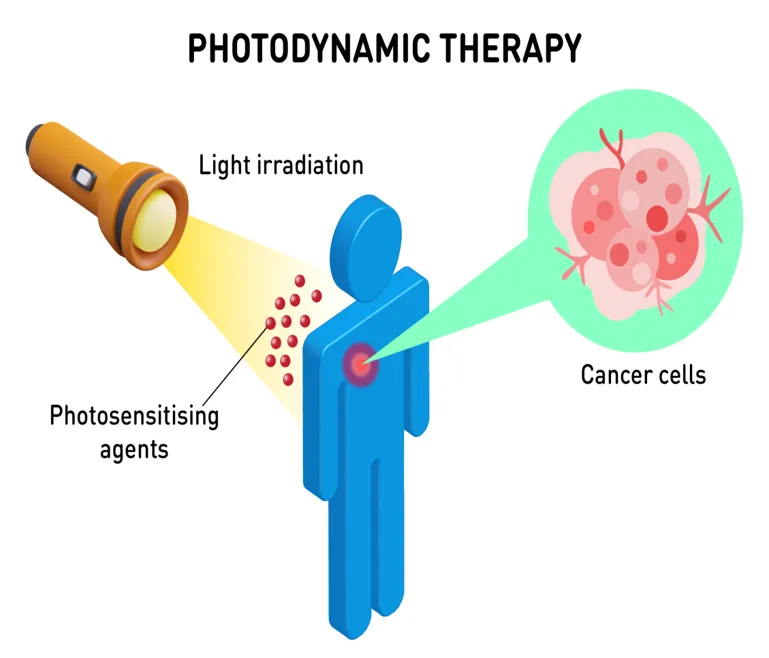
In the field of cancer treatment, photodynamic therapy has attracted immense attention due to its potential to overcome several challenges associated with standard therapeutic approaches. Malignant tumours often develop resistance to chemotherapeutic agents and may recur after surgical excision or radiation therapy. PDT offers a promising solution by attacking cancer cells through oxidative stress mechanisms that differ fundamentally from those of chemotherapy and radiation. Furthermore, PDT can stimulate antitumor immune responses, thereby contributing to systemic immune activation against malignant cells. This immunological dimension has opened new avenues for combining PDT with immunotherapy and nanotechnology, creating opportunities for more personalized and effective cancer treatments.
Beyond oncology, photodynamic therapy is also very useful in treating skin disease like acne, psoriasis, actinic keratosis, and non-melanoma skin cancer. In eye disease, PDT has greatly improved the treatment of age related macular degeneration by targeting abnormal blood vessels without damaging the retina. Moreover, the growing problem of antibiotic-resistant microorganisms has increased interest in antimicrobial photodynamic therapy, where PDT is used to destroy bacteria, , fungi, and viruses without causing microbial resistance. This wide-ranging uses show that PDT is a flexible and adaptable treatment method used in many medical fields.
Recent advances in nanomedicine and molecular engineering have further accelerated the evolution of photodynamic therapy. The incorporation of nanoparticles, liposomes, and targeted drug-delivery systems has significantly improved the bioavailability, selectivity, and photo stability of photosensitizers. Simultaneously, innovations in laser systems, fibre optics, and imaging technologies have enhanced light penetration and treatment monitoring, enabling clinicians to achieve greater therapeutic accuracy. These technological developments continue to expand the clinical potential of PDT, especially in the treatment of deep-seated tumours and complex pathological conditions that were previously considered difficult to manage.
BASIC PRINCIPLES OF PDT:
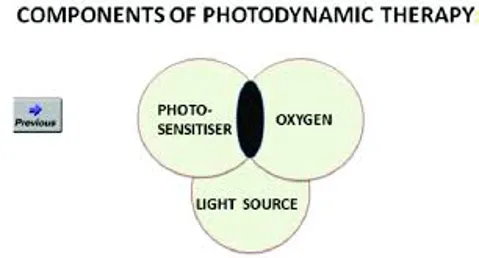
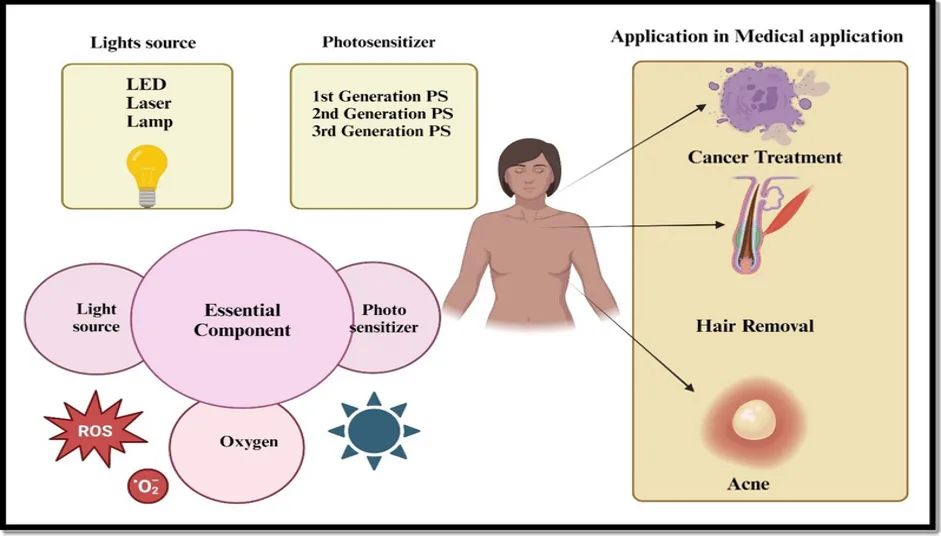
PDT works on main three components
• Photosensitizer drug
A drug that stays inactive in the body until light activates it
• Light Source
Laser, LED of a specific wavelength
• Oxygen
MECHANISM
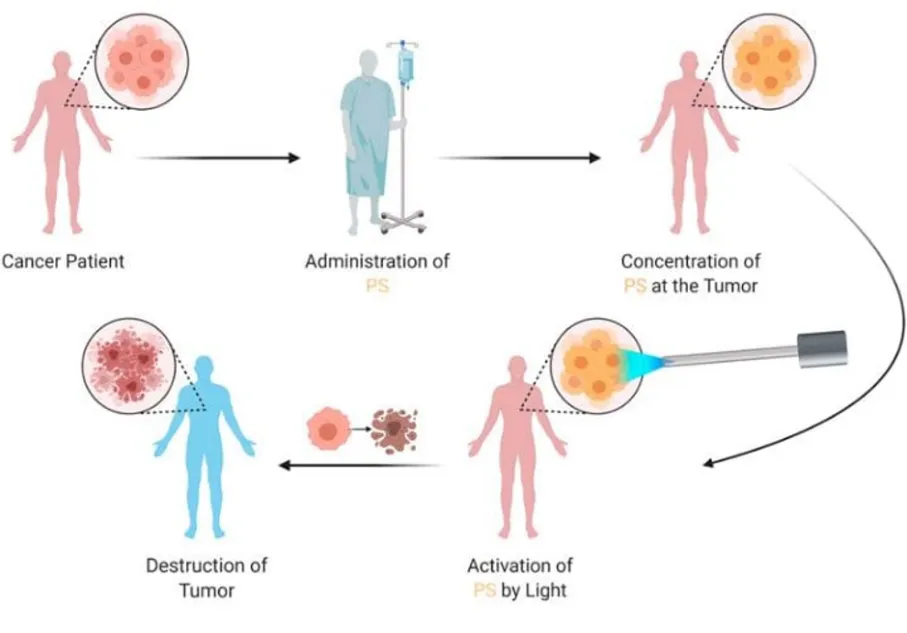
The following mechanism involves in photodynamic therapy
A person who diagnosed with cancer mainly receives a photosensitizer drug which remains inactive in body until light activate it. After 24 to 72 hours cancer cells absorb the photosensitizer drug. These cells after absorbing photosensitizer drug a specific wavelength of light will be exposed which activates the photosensitizer drug and make the formation of ROS (reactive oxygen species) which kills the cancer cells.
FLOWCHART
PHOTOSENSITIZER
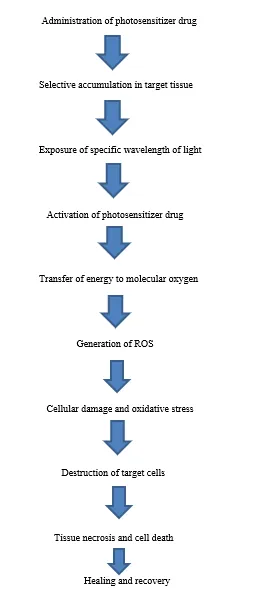
In Photodynamic Therapy (PDT), a photosensitizer is a chemical or light sensitive drug that becomes activated when exposed to a specific wavelength of light.
1. The photosensitizer drug is absorbed by abnormal cells (such as cancer cells).
2. A specific light source exposes on the area.
3. The activated photosensitizer produces reactive oxygen species {ROS} (mainly singlet oxygen).
4. These molecules destroy targeted cancerous cells
5. These molecules also minimizing damage to nearby healthy tissue.
The effectiveness of PDT is mainly depends on the photosensitizer which is used.
Ideal characteristics of a photosensitizer:
• Accumulate selectively in diseased tissue
• Be activated by deeply penetrating light
• Produce high amounts of singlet oxygen
• Have minimal toxicity in darkness
• Be rapidly cleared from the body
Classification of Photosensitizers
Photosensitizers are commonly divided into:
|
Generation |
Characteristics |
|
First generation
|
Early compounds with prolonged Photosensitivity |
|
Second generation |
Better selectivity and light absorption |
|
Third generation |
Targeted and nanoparticle based system |
EXAMPLE:
1. Photofrin (Porfimer Sodium)
It is a First-generation photosensitizer, derived from hematoporphyrin derivatives. Whose activation wavelength is 630nm (red light).
Mechanism of Action
After intravenous administration:
Photofrin accumulates in tumours due to increased vascular permeability.
Red light activates the porphyrin ring.
Excited Photofrin transfers energy to oxygen.
Large quantities of singlet oxygen are generated.
This causes: Tumour cell apoptosis, Mitochondrial damage, Vascular shutdown and Local inflammatory response
Unique Features:
One of the earliest FDA-approved PDT agents
Effective for oesophageal and lung cancers
Deep tissue penetration due to red-light activation
Limitations
Long-lasting skin photosensitivity (weeks)
Poor selectivity
Relatively shallow penetration compared with newer agents
2. 5-Aminolevulinic Acid (ALA)
It is a Second-generation precursor photosensitizer whose activation wavelength is typically 635nm. It’s unique property is that ALA itself is not directly photosensitive, it acts as a precursor in heme biosynthesis.
Mechanism of Action
Intracellular Conversion
ALA enters cells
Tumour cells accumulate excessive PpIX
Light Activation
ROS Production
Cellular Effects
Unique Features
Excellent selectivity
Shorter photosensitivity duration
Modern Advances in Photosensitizers
Third-Generation Photosensitizers
Modern PDT research focuses on targeted delivery systems:
Antibody-linked photosensitizers, Liposomal formulations, Nanoparticles,Stimuli-responsive systems
These improve: Tumor specificity, Drug stability, Tissue penetration, Reduced side effects
Light
Among three components, the light source plays a decisive role because it determines:
1. Depth of penetration
2. Precision of treatment
3. Amount of reactive oxygen species formed
4. Degree of tissue destruction
5. Selectivity of therapy
Without appropriate light activation, even the most powerful photosensitizer remains biologically inactive.
Why Light is Important in PDT?
The photosensitizer absorbs light at a specific wavelength known as its: Absorption peak
When illuminated:
1. Electrons in the photosensitizer become excited.
2. Energy transfer reactions occur.
3. Reactive oxygen species (ROS) are produced.
4. Cytotoxic damage destroys abnormal cells.
Therefore, selecting the correct light source is essential
Ideal Characteristics of PDT Light Sources
1. Appropriate Wavelength
The emitted wavelength must match the absorption spectrum of the photosensitizer.
Examples: Photofrin ,Verteporfin
2. Adequate Tissue Penetration
Longer wavelengths penetrate deeper into tissues.
|
Colour |
Approximate Penetration |
|
Blue light |
Superficial |
|
Green light |
Moderate |
|
Red light |
Deep |
|
Near infrared |
Deepest |
The “therapeutic window” in PDT is approximately 600–800 nm
3. Controlled Energy Delivery
The source should provide: Accurate fluence , Controlled intensity, Uniform irradiation
This prevents:
Thermal burns
Uneven treatment
Photo bleaching
4. Minimal Heat Production
PDT is primarily a photochemical therapy, not a thermal therapy.
Hence, ideal light sources: Produce minimal heat, Avoid thermal necrosis, Preserve surrounding healthy tissue
Types of Light Sources Used in PDT
Light sources are classified according to:
1.Coherence
2.Wavelength
3.Energy output
4. Clinical application
1. Lasers
Lasers are the most commonly used and highly precise PDT light sources.
LASER stands for: Light Amplification by Stimulated Emission of Radiation
They emit Monochromatic light, Coherent beams, High-intensity focused energy
Mechanism in PDT
Laser photons:
- Match the absorption wavelength of the photosensitizer.
- Excite electrons into higher energy states.
- Initiate ROS generation.
Types of Lasers Used
A. Argon Laser
B. Dye Lasers
C. Diode Lasers
D. Nd:YAG Laser
Advantages of Lasers in PDT
High precision
Controlled irradiation
Deep targeting capability
Excellent energy control
Fibre-optic compatibility
Disadvantages
Expensive
Complex equipment
Requires trained personnel
2. Light Emitting Diodes (LEDs)
LEDs are increasingly replacing lasers in many PDT applications.
They emit: Non-coherent light, Broad wavelength bands, Low-cost illumination
Mechanism in PDT
LED light activates photosensitizers similarly to lasers, though less precisely. The emitted photons:
Excite the photosensitizer
Produce ROS
Cause oxidative damage
Common LED Colours in PDT
|
LED Colour |
Wavelength |
Application |
|
Blue |
405–420 nm |
Acne, superficial lesions |
|
Red |
630–635 nm |
Skin cancer, deeper lesions |
Advantages of LEDs
Inexpensive
Portable
Safer
Uniform illumination
Minimal heat generation
Limitations
Lower intensity
Less focused
Longer treatment times
3. Daylight PDT
Natural sunlight acts as the activating light source.
Used mainly with: 5-Aminolevulinic Acid, Methyl Aminolevulinate
Mechanism
Sunlight continuously activates PpIX gradually. Which leads to slow ROS generation, less pain and uniform treatment.
Advantages
Convenient
Low cost
Comfortable
Excellent for large skin fields
Limitations
Weather dependent
Less controllable
Variable intensity
4. Near-Infrared (NIR) Light Sources
Near-Infrared Light wavelength is 700 to 900nm
Significance in Modern PDT
NIR light: Penetrates tissues deeply
Reduces scattering
Improves deep tumor targeting
Uses
|
Factor |
Importance |
|
Photosensitizer absorption |
Determines wavelength |
|
Lesion depth |
Determines penetration needs |
|
Tissue type |
Influences scattering |
|
Accessibility |
External vs internal lesions |
Oxygen
Oxygen is a vital component of Photodynamic Therapy. During PDT, oxygen present in the tissues interacts with the activated photosensitizer to form reactive oxygen species, especially singlet oxygen. These reactive molecules are responsible for destroying abnormal or cancerous cells.
The activated oxygen damages cell membranes, proteins, mitochondria, and DNA, resulting in cell death. The efficiency of PDT largely depends on the availability of oxygen in the tissue. If oxygen levels are low, the production of reactive oxygen species decreases, reducing the effectiveness of the therapy. Oxygen also contributes to vascular damage and immune responses during treatment. Therefore, oxygen is considered indispensable for the success of photodynamic therapy.
Clinical Features of Photodynamic Therapy (PDT)
The clinical response to photodynamic therapy (PDT) is generally predictable and depends on the type of lesion being treated, the photosensitizer used, and the treatment protocol. During light irradiation, some patients may experience mild discomfort, such as a burning or stinging sensation, which usually subsides soon after the procedure. In the hours or days following treatment, localized redness, swelling, and inflammation are commonly observed as part of the normal therapeutic response. In certain cases, superficial blistering, crust formation, or temporary tissue necrosis may develop before the treated area gradually heals.
One of the characteristic features of PDT is its ability to selectively destroy diseased tissue while preserving the surrounding healthy structures, resulting in satisfactory healing with minimal scarring. Patients treated with systemic photosensitizers may also develop temporary photosensitivity and are therefore advised to avoid direct exposure to sunlight and bright indoor light until the photosensitizer has been adequately cleared from the body. The severity of these reactions varies among individuals and is influenced by factors such as the treatment site, light dose, and photosensitizer administered. Overall, most adverse effects associated with PDT are mild and self-limiting, and the treatment is generally well tolerated with favorable clinical outcomes.
Clinical Applications
Dermatologic Conditions
Acne vulgaris
Actinic keratosis
Superficial skin cancers
Cancer Therapy
Early lung tumours
Oesophageal lesions
Bladder neoplasms
Ophthalmic Use
Age-related macular degeneration
Dental Applications
Periodontal infections
Oral premalignant disorders
Root canal disinfection
Advantages of Photodynamic Therapy (PDT)
Photodynamic therapy (PDT) has emerged as an effective treatment option because of its several clinical advantages. One of its major benefits is its ability to selectively destroy abnormal cells while causing minimal damage to the surrounding healthy tissues. Since PDT is a minimally invasive procedure, it often avoids the need for surgery, reducing the risk of complications associated with more invasive treatments. In addition, the treated area usually heals with little or no scarring, which is especially beneficial for lesions located in cosmetically sensitive regions. Patients also tend to recover more quickly after PDT, allowing an earlier return to their daily activities. Another important advantage is that the treatment can be repeated when required, making it a suitable option for patients with recurrent or multiple lesions. These features make PDT a valuable and patient-friendly approach for the management of various diseases.
Limitations of Photodynamic Therapy (PDT)
Although photodynamic therapy (PDT) has shown considerable promise in the treatment of various diseases, it is associated with several limitations. A major challenge is the limited depth of light penetration, which reduces its effectiveness in treating deep-seated tumors or lesions located beneath the tissue surface. In addition, PDT relies on the presence of adequate oxygen within the target tissue to generate reactive oxygen species, making its therapeutic efficacy dependent on tissue oxygenation. Patients may also experience temporary photosensitivity after treatment and are often advised to avoid direct exposure to sunlight or bright indoor light for a certain period. Mild adverse effects, including pain, redness, and swelling at the treatment site, may occur but are generally self-limiting. In some cases, repeated treatment sessions are required to achieve satisfactory clinical outcomes. The need for specialized light sources, photosensitizers, and trained healthcare professionals can also increase the overall cost of treatment and limit its availability in many healthcare settings. Furthermore, the clinical response to PDT is not uniform and may vary depending on factors such as the type and stage of the disease, tissue characteristics, and individual patient differences.
Future Prospects of Photodynamic Therapy (PDT)
Photodynamic therapy (PDT) continues to evolve, and ongoing research is expected to expand its role in the treatment of a wide range of diseases. Considerable efforts are being made to develop next-generation photosensitizers that are safer, more selective, and capable of producing improved therapeutic outcomes. The integration of nanotechnology into PDT has also gained significant attention, as nanoparticle-based delivery systems can enhance the targeted transport of photosensitizers and reduce unwanted effects on healthy tissues. Furthermore, combining PDT with conventional treatment approaches, such as chemotherapy and immunotherapy, is being explored to improve treatment efficacy and reduce the likelihood of disease recurrence. Advances in light delivery technologies may help overcome the current limitation of shallow light penetration, making PDT more effective for deeper-seated lesions. Beyond oncology, the use of PDT is steadily increasing in dentistry for the management of oral infections and periodontal disorders. It is also being investigated as a promising strategy against drug-resistant microorganisms, offering an alternative approach to antimicrobial therapy. In addition, the application of artificial intelligence and modern imaging techniques is expected to improve treatment planning, and real-time monitoring, leading to greater precision during therapy. As these innovations continue to develop, personalized PDT based on the patient's clinical condition and disease characteristics is likely to become an important direction for future clinical practice.
CONCLUSION
Photodynamic therapy (PDT) is an advanced treatment method that combines a photosensitizing agent, light, and oxygen to destroy abnormal or diseased cells. It is considered a minimally invasive procedure because it causes less damage to normal tissues when compared with conventional surgical methods. The treatment is widely used in different branches of medicine and dentistry due to its selective action and good clinical results.
One of the major advantages of PDT is its ability to target diseased tissues while preserving healthy surrounding structures. This makes the treatment safer and more effective for many superficial lesions and early-stage diseases. PDT also provides good cosmetic healing with minimal scarring, which is especially important in visible areas such as the face and oral cavity. In addition, the procedure is usually simple, requires less recovery time, and canoften be performed in outpatient settings.
PDT has shown valuable applications in dermatology, oncology, ophthalmology, and dentistry. In dentistry, it is increasingly used for periodontal therapy, root canal disinfection, and management of oral lesions. The antimicrobial effect of PDT also makes it useful in controlling infections and reducing resistant microorganisms.
Despite its benefits, PDT has certain limitations. Light penetration into tissues is limited, so deep lesions may not respond effectively. Some patients may experience pain, redness, swelling, or temporary sensitivity to light after treatment. The cost of specialized equipment and photosensitizing agents may also restrict its availability in some healthcare centers.
Continuous research and technological developments are improving the effectiveness of PDT. New photosensitizers, advanced light delivery systems, and nanotechnology-based approaches are expanding its future applications. Combination therapy with chemotherapy, immunotherapy, and other treatment methods may further improve clinical outcomes.
Overall, photodynamic therapy is a safe, selective, and promising treatment modality. Because of its minimally invasive nature, good healing response, and expanding clinical applications, PDT is expected to play an important role in the future of medicine and dentistry.
REFERENCES

Saniya Firdous, Photodynamic Therapy, Int. J. of Pharm. Sci., 2026, Vol 4, Issue 10, 321-331, https://doi.org/10.5281/zenodo.23120212
 10.5281/zenodo.23120212