

We use cookies to ensure our website works properly and to personalise your experience. Cookies policy
P. R. Patil Institute of Pharmacy, Talegaon (S.P), Maharashtra, India
The present study focuses on the development and evaluation of a cosmeceutical for the treatment of vascular periorbital hyperpigmentation (POH) using caffeine as the active ingredient. The aim of the study was to formulate a safe, effective, and economical serum capable of improving microcirculation and reducing vascular hyperpigmentation around the periorbital area. The serum was prepared using suitable base formulations and nano emulsion techniques to enhance the effectiveness of the active ingredients. Base formulations and nano emulsions were developed and compared for their physicochemical and stability characteristics. The prepared formulation was evaluated for various parameters including viscosity, pH, colour, odour, and skin irritation by patch test method. The results indicated that the formulation was stable, smooth in texture, non-irritant, and suitable for topical application. The presence of caffeine and other ingredients contributed to improved microcirculation and showed promising potential in the treatment of vascular periorbital hyperpigmentation. Thus, the developed cosmeceutical serum can be considered a promising alternative for the management of vascular POH.
Periorbital hyperpigmentation is defined as bilateral, homogeneous hyperchromic macules and patches primarily involving the lower eyelids but also sometimes extending towards the upper eyelids, eyebrows, malar regions, temporal regions and lateral nasal root. The age of onset is usually after puberty or in early adulthood (16-25 years). It is more pronounced in certain ethnic groups and is also frequently seen in multiple members of the same family.[1]
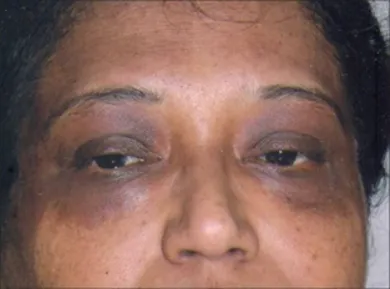
Fig. No. 1 Vascular periorbital hyperpigmentation
TYPES OF POH
Recently, Huang et al. performed the clinical analysis and proposed classification on the basis of clinical pattern of pigmentation and vasculature.[2]
Periorbital hyperpigmentation was classified into
1. Pigmented (brown colour),
2. Vascular (blue/pink/purple colour),
3. Structural (skin colour)
4. Mixed type - Based on the clinical appearance assessed by the physician. The mixed type of dark eye circle included the following four subtypes:
a) Pigmented-vascular (PV),
b) Pigmented-structural (PS),
c) Vascular-structural (VS),
d) Combination of the three.
Pigmented type (P) appears as infraorbital brown hue. Vascular (V) type appears as infraorbital blue, pink, or purple hue with or without periorbital puffiness. Structural type (S) appears as structural shadows formed by facial anatomic surface contours. It can be associated with infraorbital palpebral bags, blepharoptosis, and loss of fat with bony prominence. Mixed type (M) combines two or three of the above appearances. This classification can help in introducing the therapeutic modalities on the basis of POH type, as different types of POH respond to different types of treatment.[3]
NANO-EMULSIONS:
Nano-emulsions consist of fine oil-in-water dispersions, having droplets covering the size range of 100–600 nm. Nano-emulsions, usually spherical, are a group of dispersed particles used for pharmaceuticals biomedical aids and vehicles that show great promise for the future of cosmetics, diagnostics, drug therapies and biotechnologies. [4] It is a heterogeneous mixture of lipid and aqueous phase and stability is achieved by using a suitable material known as emulsifying agents. Nano-emulsion is a translucent system compared to ordinary emulsion or sometimes microemulsion. It has been demonstrated that with the help of nano-emulsion as a delivery system retention time of a drug in the body can be increased, so low amount of drug is required for the therapeutic action.[5] Nano-emulsions are somewhat stable and have a surface that is so smooth that it can be splashed on. They also have excellent hydration and skin penetrating properties.[6]
EPIDEMIOLOGY OF POH
Most commonly POH develops with respect to two major components: hemodynamic congestion (possible post inflammatory) and dermal melanin deposition.[7] Dermal melanin deposition may be primary (congenital) or secondary to environmental factors such as excessive exposure to sun, exogenous or even unbalanced endogenous estrogen, pregnancy, and breast-feeding practices among the females.[8] Clinically, POH is characterized by light- to dark-colored, brownish-black pigmentation surrounding the eyelids giving a tired look to the patient. Diagnosis is mainly based on clinical examination. It is always important to differentiate the dark eyelid skin with shadowing effect due to tear trough. Manual stretching of the lower eyelid skin will help to differentiate between true pigmentation and shadowing effect, true pigmentation retains its appearance whereas if it was due to shadowing effect it resolves entirely while stretching.[9] Wood’s lamp examination can be done to differentiate between the epidermal and dermal pigmentation.[10] The other non-invasive tool which was used to diagnose POH is dermoscopy (also known as epiluminescence microscopy, skin surface microscopy, incident-light microscopy, or dermatoscopy), it allows the in-vivo evaluation of colors and microstructures of the epidermis, the dermoepidermal junction and the papillary dermis which are not visible to the naked eye. These structures are specifically correlated to histologic features.[11] There are a number of treatment options available for POH. The available treatment options for POH include topical depigmenting agents, such as hydroquinone, kojic acid, azelaic acid, topical retinoic acid and physical therapies, including chemical peels, surgical corrections, and laser therapy, most of which were already tried scientifically for melisma and found to be successful .[12,13]There is a scarcity of data regarding the incidence and prevalence of periorbital melanosis due to its transitory nature and lack of reasonable etiological explanation. In a recent Indian study, it was found that POH was most prevalent in the age group of 16 to 25 years and it is more common among females .[14]
AIM AND OBJECTIVES:
Aim: Development of cosmeceutical for vascular periorbital hyperpigmentation (POH)
Objectives:
MATERIALS AND METHODS
Materials
Caffeine Anhydrous 98%, Tween® 80, Polyethylene glycol 400, Carbopol 940, 2-Phenoxyethanol 99% were purchased from Dange trading company (Maharashtra, India), Span 80, Isopropyl myristate, Sodium Benzoate, Triethanolamine, Orange oil, Glycerine and Distilled water were obtained from laboratory. All chemicals used were of pharmaceutical grade.
BASE SERUM FORMULATION
Table No. 1: Quantity wise batch formulated:
|
Component |
F1 |
F2 |
F3 |
F4 |
Role |
|
Carbopol 940 |
0.1 g |
0.2 g |
0.3 g |
0.25 g |
Gelling agent |
|
Triethanolamine |
0.3 ml |
0.3 ml |
0.3 ml |
0.3 ml |
Neutralizing agent |
|
Tween 80 |
2 ml |
2 ml |
2 ml |
2 ml |
Solubilizer |
|
Orange oil |
0.3 ml |
0.3 ml |
0.3 ml |
0.3 ml |
Fragrance agent |
|
Glycerin |
0.1 ml |
0.1 ml |
0.1 ml |
0.1 ml |
Moisturizing agent |
|
Sodium Benzoate |
7 g |
7 g |
7 g |
7 g |
Preservative |
|
2-Phenoxyethanol 99% |
1.2 ml |
1.2 ml |
1.2 ml |
1.2 ml |
Preservative |
NANO-EMULSION FORMULATION
Table No. 2: Quantity wise batch formulated:
|
Component |
F1 |
F2 |
F3 |
F4 |
Role |
|
Caffeine |
0.5 g |
0.5 g |
0.5 g |
0.5 g |
Skin brightening agent |
|
Isopropyl myristate |
2.5 ml |
5 ml |
7 ml |
2.5 ml |
Penetration enhancer |
|
Span 80 |
1.5 ml |
1.5 ml |
1.5 ml |
2.0 ml |
Emulsifier |
|
Tween 80 |
0.5 ml |
0.5 ml |
0.5 ml |
0.5 ml |
Solubilizer |
|
Polyethylene glycol |
16.5 ml |
16.5 ml |
16.5 ml |
16.5 ml |
Humectant |
|
Distilled water |
25 ml |
22.5 ml |
20 ml |
25 ml |
Provides stability |
PROCEDURE FOR PREPARATION OF NANO-EMULSION:
Firstly, a clean beaker was taken,
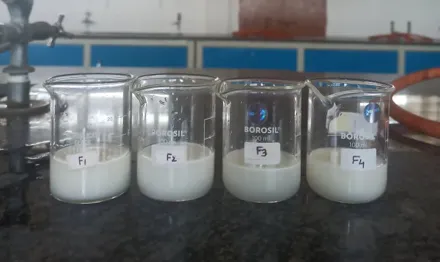
Fig No. 5 Nano emulsions
Mixed thoroughly until a uniform oil phase was formed.
Slowly the oil phase was added into the aqueous phase at a speed of 100 rpm for 15 minutes using a magnetic stirrer followed by sonication. Thus, nano-emulsion was formed.
BASE SERUM FORMULATION:
Carbopol was added into distilled water and kept overnight. Later Triethanolamine, Tween 80, orange oil, glycerine, Sodium Benzoate and 2-Phenoxyethanol 99% were added and stirred homogeneously.
LIST OF INSTRUMENTS:
Probe sonicator:
Sonication is the act of applying sound energy to agitate particles in a sample, for various purposes.
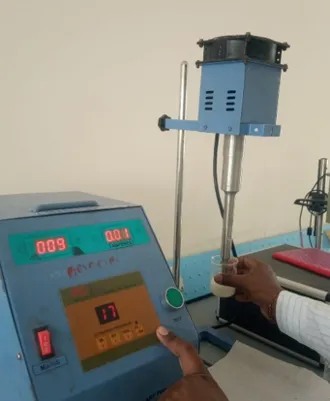
Fig. No. 2 Probe sonicator
Brookfield Viscometer:
A Brookfield viscometer is a rotational viscometer manufactured by Brookfield Engineering (now AMETEK Brookfield) that measures fluid viscosity by determining the torque required to rotate a spindle in a sample at a specified speed. It's widely recognized as the industry standard for viscosity measurement.[16]
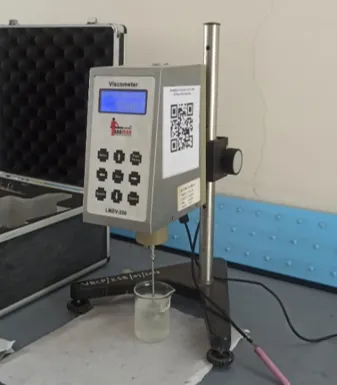
Fig. No. 3 Brookfield Viscometer
Zetasizer:
Instruments in the Zetasizer family are used to measure the particle size of dispersed systems from sub-nanometer to several micrometers in diameter, using the technique of Dynamic Light Scattering (DLS). Zetasizer systems are also used to analyze particle mobility and charge (Zeta potential) using the technique of Electrophoretic Light Scattering (ELS), and the molecular weight of particles in solution using Static Light Scattering (SLS). [17]
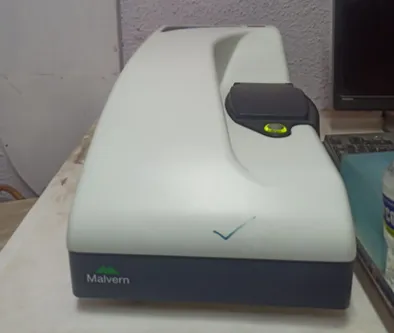
Fig. No. 4 Zeta sizer
OBSERVATION TABLE 1: Base serum formulation
Instrument Details: LMDV 200 Labman, Mumbai | Spindle Used: Spindle-4
This test measured the viscosity of Sample-01 at various rotational speeds (rpm). The results include viscosity (mPas) and the corresponding torque percentage (%).
Sample 01: (F4)
|
Speed (RPM) |
Viscosity (mPas) |
% Torque |
|
10 |
8064.0 |
13.2 |
|
20 |
6311.9 |
20.6 |
|
30 |
5207.9 |
25.5 |
|
40 |
4227.1 |
28.2 |
|
50 |
3090.6 |
25.8 |
|
100 |
1910.6 |
31.7 |
|
50 |
2699.8 |
21.8 |
|
40 |
3506.5 |
23.2 |
|
30 |
3730.2 |
18.7 |
|
20 |
3401.0 |
11.3 |
|
10 |
2398.5 |
4.8 |
A. Flow Behavior (Shear-Thinning)
The sample exhibits significant pseudoplastic (shear-thinning) behavior. As the rotational speed increased from 10 to 100 rpm, the viscosity dropped by approximately 76% (from 8064.0 mPas to 1910.6 mPas). This indicates that the material's internal structure breaks down or aligns under flow, making it easier to move.
B. Time-Dependent Recovery (Thixotropy)
There is a clear hysteresis loop present. When comparing the upward and downward readings at the same speeds, the viscosity is significantly lower during the recovery phase:
This confirms the sample is thixotropic. The material does not instantly regain its original thickness once the agitation stops; it requires a "rest period" to rebuild its network.
C. Torque Measurement Quality
The torque values remained between 4.8% and 31.7%. While the peak readings are very reliable, the low torque (4.8%) at the final 10 rpm measurement is near the lower limit of most viscometers, which may introduce a slight margin of error in the final recovery data point.
Conclusion:
Sample-01 is a highly structured, non-Newtonian fluid. It provides high resistance at rest (good for preventing sedimentation) but thins out effectively under work. However, because of its strong thixotropic nature, its "thickness" in a production line or during use will depend heavily on how long and how fast it has been stirred.
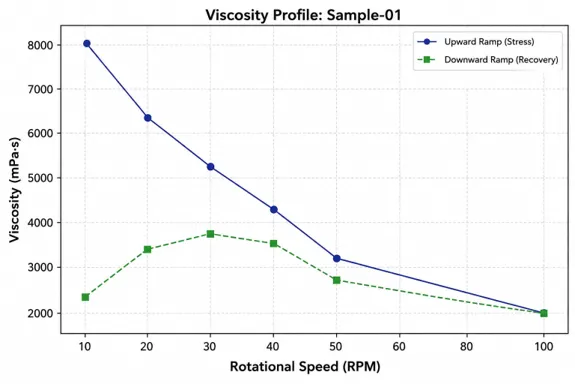
Fig. No. 6 Viscosity profile of sample 01
Sample 02: (F2)
|
Speed (RPM) |
Viscosity (mPas) |
% Torque |
|
10 |
2561.9 |
4.3 |
|
20 |
2732.7 |
9.1 |
|
30 |
3334.0 |
14.2 |
|
40 |
3332.3 |
22.2 |
|
50 |
1678.2 |
14 |
|
100 |
1213.4 |
20.2 |
|
50 |
1774.8 |
14.8 |
|
40 |
3365.7 |
22.4 |
|
30 |
2745.2 |
13.7 |
|
20 |
2602.7 |
8.7 |
|
10 |
1826.7 |
3.0 |
Rheological Behavior: Overall, the sample shows a shear-thinning trend at higher speeds (above 40 rpm), where viscosity significantly drops. However, an unusual increase is noted between 10 and 30 rpm.
Hysteresis/Thixotropy: There is a visible gap (hysteresis) between the upward and downward curves. Specifically at 10 and 20 rpm, the viscosity is lower on the way down than on the way up, suggesting the sample has thixotropic properties (it becomes less viscous over time when under stress).
Average Viscosity: The overall mean of all recorded points is approximately 2509.19 mPas. Sample-02 is a non-Newtonian fluid exhibiting both shear-thinning and thixotropic properties. Its flow behavior is highly dependent on its "shear history," meaning its viscosity will decrease the longer it is agitated or pumped.
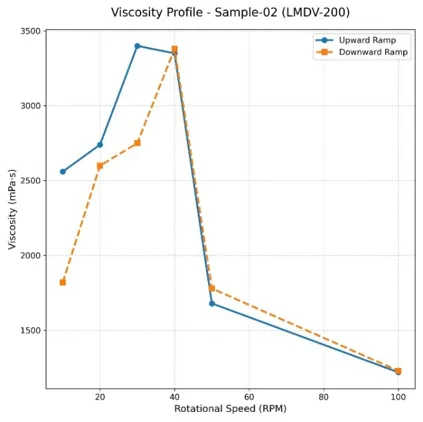
Fig. No. 7 Viscosity profile of sample 02
Comparison of sample:
|
Speed (RPM) |
Sample 01 Viscosity (mPas) |
Sample 02 Viscosity (mPas) |
|
10 (up) |
8064.2 |
2561.9 |
|
30 (up) |
5207.9 |
3394.0 |
|
100 (peak) |
1910.6 |
1213.4 |
|
30 (down) |
3730.2 |
2745.2 |
|
10 (down) |
2398.5 |
1826.7 |
Flow Profile (Pseudoplasticity)
Sample-01 is a highly shear-thinning material. It offers high resistance at low shear (providing excellent storage stability) but thins out significantly under work, making it highly spreadable.
Sample-02 is moderately shear-thinning. Its viscosity is more consistent across different speeds, which may make it easier to control in high-speed manufacturing processes.
Structural Integrity (Thixotropy)
Sample-01 exhibits strong thixotropy. After high-speed shearing, it loses over 70% of its initial "body" and remains thin for a long period. This is ideal for products like adhesives or coatings that need to stay fluid after application.
Sample-02 exhibits weak thixotropy. It recovers over 71% of its original structure almost immediately after stress is removed. This makes it more "stable" if the goal is for the product to maintain its thickness throughout use.
Conclusion:
Sample-01 is the superior choice if you need a high-viscosity product that thins out drastically for application (like a heavy gel).
Sample-02 is better if you need a more consistent, lower-viscosity fluid that retains its properties better after being stirred.
Probe sonicator:
|
Sample ID |
Amplitude (Amp) |
Time |
Cycle rate |
|
F1 |
0.41-100 |
4 min |
25/min |
|
F2 |
0.42-100 |
2 min |
60/min |
|
F3 |
0.12-100 |
2 min |
60/min |
|
F4 |
0.12-100 |
2 min |
60/min |
Observation: Samples F3 and F4 shared identical parameters. Sample F1 used a significantly lower cycle rate but a longer duration compared to the others.
OBSERVATION TABLE 2: Nano-emulsion formulation
Zeta sizer: Comparison of samples
|
Components |
F1 |
F2 |
F3 |
F4 |
|
Size distribution |
64.30 r.nm |
3.213 r.nm |
6.267 r.nm |
74.72 r.nm |
|
Zeta potential |
0.267 mV |
-0.0441 mV |
0.232 mV |
-0.00313 mV |
|
PDI |
0.326 |
0.288 |
0.311 |
0.597 |
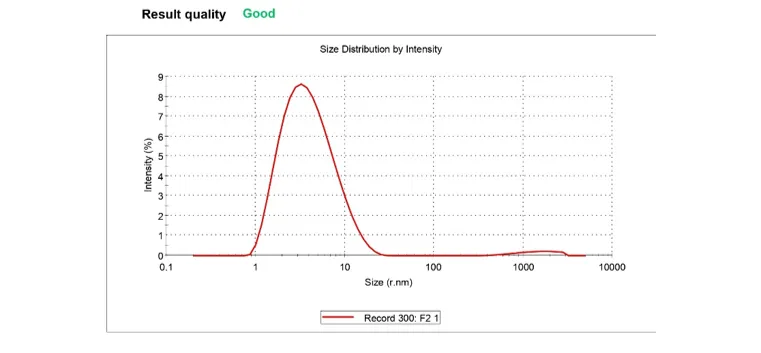
Fig. No. 8: Size distribution analysis of nano-emulsion (F2)
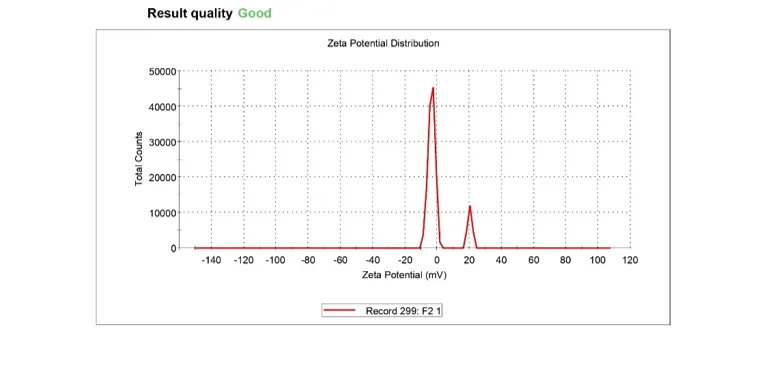
Fig. No. 9: Zeta potential analysis of nano-emulsion (F2)
SERUM FORMULATION:
An amount of 0.66 g caffeine nano-emulsion (F2) was dispersed slowly into the serum base (Sample 01/F4) mixture by using a magnetic stirrer at 100 rpm for 30 min.
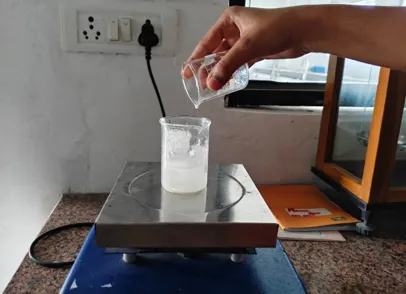
Fig. No. 10 Magnetic stirrer
EVALUATION OF SERUM FORMULATION:
Parameters:
Orange oil odour; clear and colourless appearance.
The viscosity of serum was found to be 1910.6 mPas
To check the pH of an under-eye serum, first calibrate your pH meter, then dilute the serum with distilled water in a 1:9 ratio. Place the electrode in the sample, wait for the reading to settle, and note the result. Since this product is used near the delicate eye area, the pH should remain around 6.5 to 7.0 to help reduce the chance of stinging.
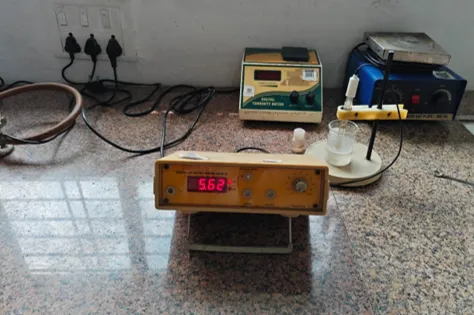
Fig. No. 11 PH Test of F2
The formulated under-eye serum was evaluated for skin irritation by performing a patch test on multiple volunteers. The formulation was applied on the inner aspect of the arm and observed for any signs of irritation such as redness, itching, burning, swelling, or discomfort. No irritation or adverse effects were observed in any of the volunteers, indicating that the formulation was safe and non-irritant for topical application.
Observation: No redness, itching, burning sensation, swelling, or irritation was observed at the site of application. The formulation was found to be safe and skin-friendly.

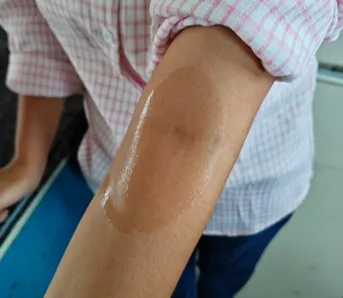
Fig. No. 12 Skin irritation test on volunteers
RESULT AND DISCUSSION:
The formulated cosmeceutical serum for vascular periorbital hyperpigmentation (POH) exhibited satisfactory physicochemical properties, including acceptable colour, characteristic odour, smooth texture, and good homogeneity, indicating proper formulation and uniform mixing. The developed serum showed suitable viscosity and pH, making it appropriate for topical application in the periorbital region.
Different base formulations and nano-emulsions were prepared and compared to obtain a stable and effective formulation. Among the developed formulations, the optimized formulation showed better stability, consistency, and desirable application properties. The nano emulsion system enhanced the uniform distribution of caffeine and improved the overall formulation characteristics. Skin irritation studies performed by patch test method showed no signs of irritation or adverse effects, indicating that the formulation was safe for topical use. The presence of caffeine and other ingredients contributed to improved microcirculation, which may help in reducing vascular periorbital hyperpigmentation.
Overall, the final formulation successfully passed the evaluation tests including viscosity, pH, texture, colour, odour, and skin irritation assessment, demonstrating its suitability as a cosmeceutical preparation for vascular POH treatment.
CONCLUSION
The study concluded that the caffeine-based cosmeceutical serum for vascular periorbital hyperpigmentation was successfully formulated and evaluated. The developed formulation showed good stability, acceptable physicochemical properties and safety for topical application. Among the prepared formulations, the optimized nano emulsion-based serum demonstrated better performance and desirable characteristics. The presence of caffeine contributed to improved microcirculation and showed promising potential in the treatment of vascular POH. Thus, the developed serum can be considered a scientifically acceptable, economical, safe, and effective formulation for the management of vascular periorbital hyperpigmentation.
REFERENCES





Aditya Zade, Akansha Nandagawali, Amisha Kokate, Anisha Bure, Dr. Koshish Gabhane, Development of Cosmeceutical for Vascular Periorbital Hyperpigmentation (POH), Int. J. of Pharm. Sci., 2026, Vol 4, Issue 6, 1694-1704. https://doi.org/10.5281/zenodo.20573493
Severity: 8192
Message: substr(): Passing null to parameter #1 ($string) of type string is deprecated
Filename: frontend/article.php
Line Number: 706
Severity: 8192
Message: substr(): Passing null to parameter #1 ($string) of type string is deprecated
Filename: frontend/article.php
Line Number: 706
Severity: 8192
Message: substr(): Passing null to parameter #1 ($string) of type string is deprecated
Filename: frontend/article.php
Line Number: 741
Severity: 8192
Message: substr(): Passing null to parameter #1 ($string) of type string is deprecated
Filename: frontend/article.php
Line Number: 741
 10.5281/zenodo.20573493
Severity: 8192
Message: substr(): Passing null to parameter #1 ($string) of type string is deprecated
Filename: frontend/article.php
Line Number: 890
Severity: 8192
Message: substr(): Passing null to parameter #1 ($string) of type string is deprecated
Filename: frontend/article.php
Line Number: 925
Severity: 8192
Message: substr(): Passing null to parameter #1 ($string) of type string is deprecated
Filename: frontend/article.php
Line Number: 925
Severity: 8192
Message: substr(): Passing null to parameter #1 ($string) of type string is deprecated
Filename: frontend/article.php
Line Number: 957
Severity: 8192
Message: substr(): Passing null to parameter #1 ($string) of type string is deprecated
Filename: frontend/article.php
Line Number: 957