

We use cookies to ensure our website works properly and to personalise your experience. Cookies policy
SIMS College Of Pharmacy.
Digital Twin (DT) technology is an emerging digital technogy that is gaining importance in modern pharmaceutical manufacturing. It creates a virtual representation of a physical machine, process, product, or manufacturing facility and connects it with real-time information from the actual system. In pharmaceutical manufacturing, data from sensors, manufacturing equipment, and Process Analytical Technology (PAT) can be combined with mathematical, statistical, mechan istic, and data-driven models to understand how a process behaves. This helps manufacturers monitor processes continuously, identify changes at an early stage, and maintain consistent product quality. Digital Twin technology can be used in different pharmaceutical operations such as mixing, granulation, drying, tablet compression, coating, filling, and packaging. It also has potential applications in biopharmaceutical processes such as cell culture, fermentation, filtration, and purification. One of the major benefits of a digital twin is that it allows manufacturers to observe and analyze a process without depending only on physical testing. It can also be used to study different process conditions virtually before making changes to the actual manufacturing process. This may help in process optimization and reduce unnecessary experiments. Digital twins can support Quality by Design (QbD) by improving the understanding of the relationship between raw materials, process parameters, and critical quality attributes. They are also useful in continuous manufacturing, where large amounts of real-time process data are generated. Another important application is predictive maintenance, where equipment data can be analyzed to identify unusual changes and possible equipment failures before they occur. When digital twins are combined with PAT, artificial intelligence, machine learning, Internet of Things (IoT), and cloud computing, they can provide more detailed information about pharmaceutical processes and support the development of Pharma 4.0.
Pharmaceutical manufacturing is becoming increasingly digital as the industry looks for better ways to improve product quality, process efficiency, and manufacturing control. Traditional pharmaceutical manufacturing mainly depends on laboratory testing, in-process checks, batch records, and quality-control testing. Although these methods are important, they may not always provide a complete real-time picture of what is happening during production. The development of Industry 4.0 technologies, such as the Internet of Things (IoT), artificial intelligence, cloud computing, advanced process control, and data analytics, is creating new opportunities for more connected and intelligent pharmaceutical manufacturing systems.
One of the important technologies emerging from this digital transformation is the Digital Twin (DT). A digital twin can be described as a digital representation of a physical object, machine, process, or manufacturing system that is connected with information from its real-world counterpart. A complete digital twin generally includes a physical component, a virtual component, and communication between the two. The virtual component can use process models, historical data, and real-time data to represent and predict the behavior of the physical manufacturing system. [6,9,10]
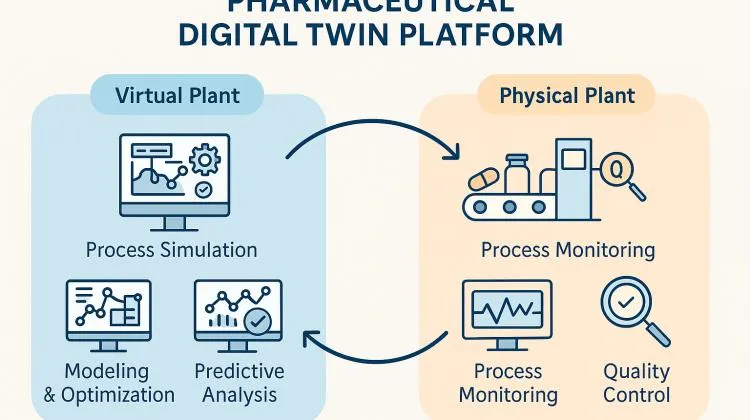
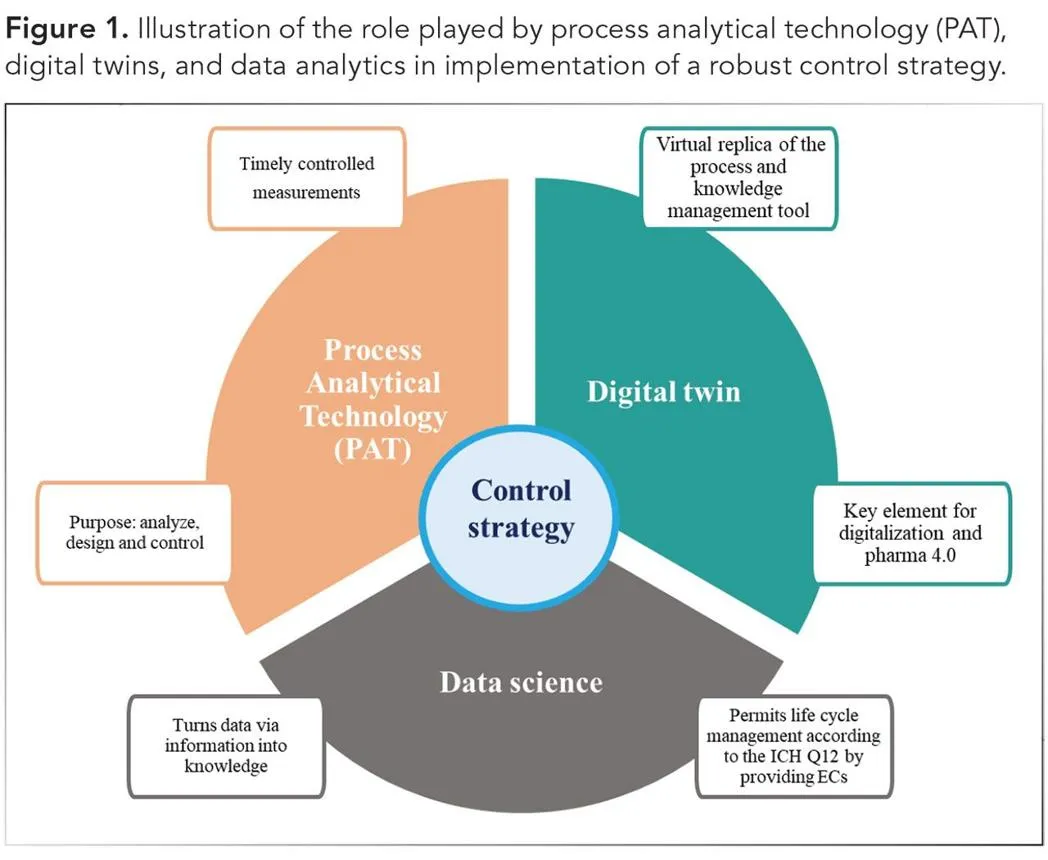
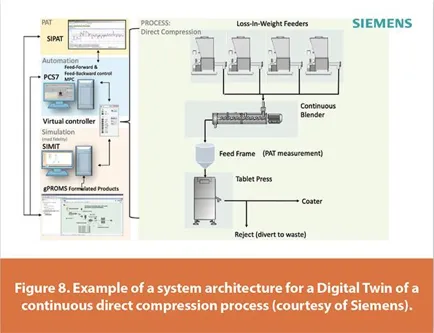
Figure 1: Concept of Digital Twin in Pharmaceutical Manufacturing. The digital twin connects the physical manufacturing system with a virtual model through continuous data communication, allowing monitoring, analysis, prediction, and process optimization.
In pharmaceutical manufacturing, the digital twin can receive information from manufacturing equipment, sensors, and Process Analytical Technology (PAT) instruments. PAT is important because it can provide timely information about process conditions and product characteristics. Techniques such as near-infrared spectroscopy, Raman spectroscopy, ultraviolet spectroscopy, and other analytical methods can be used to obtain information during manufacturing. These data can then be used by the digital twin to monitor the process and improve the understanding of critical process parameters and critical quality attributes.
The concept is closely related to Quality by Design (QbD) and Pharma 4.0. QbD focuses on understanding the relationship between materials, manufacturing processes, and product quality. Digital twins can support this approach by allowing manufacturers to study process behavior and evaluate different operating conditions using virtual models. Pharma 4.0, meanwhile, aims to use connected digital technologies to make pharmaceutical manufacturing more integrated, intelligent, and data-driven. [13]
Table 1: Role of Digital Twin Technology in Pharmaceutical Manufacturing
| Component | Role in pharmaceutical manufacturing |
|---|---|
| Physical system | Actual manufacturing equipment and processes |
| Sensors | Collect temperature, pressure, flow, vibration, and other process data |
| PAT | Provides timely information about process and product quality |
| Data platform | Stores and manages process, historical, and model data |
| Virtual model | Represents and simulates the physical manufacturing process |
| Artificial intelligence/ML | Helps identify patterns and predict process behavior |
| Digital Twin | Connects physical and virtual systems |
| Dashboard | Provides visualization of real-time process information |
| Process control | Uses analysis and predictions to support manufacturing decisions |
A pharmaceutical digital twin can be used at different stages of manufacturing. During process development, it can help researchers study different manufacturing conditions and reduce dependence on repeated physical experiments. During production, it can provide real-time process monitoring and help identify abnormal process behavior. Digital twins can also support process optimization, predictive maintenance, operator training, quality assurance, and decision-making.
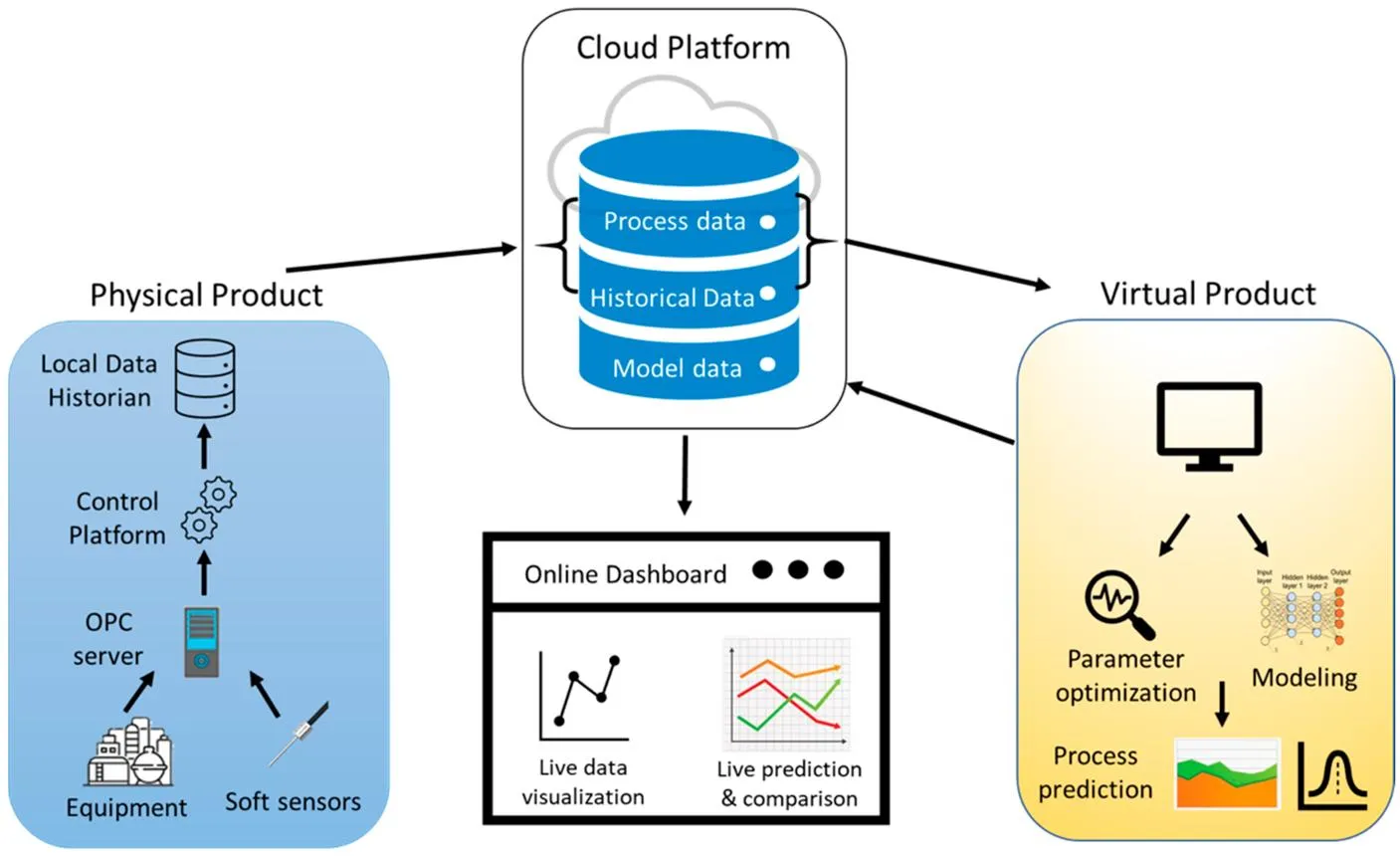
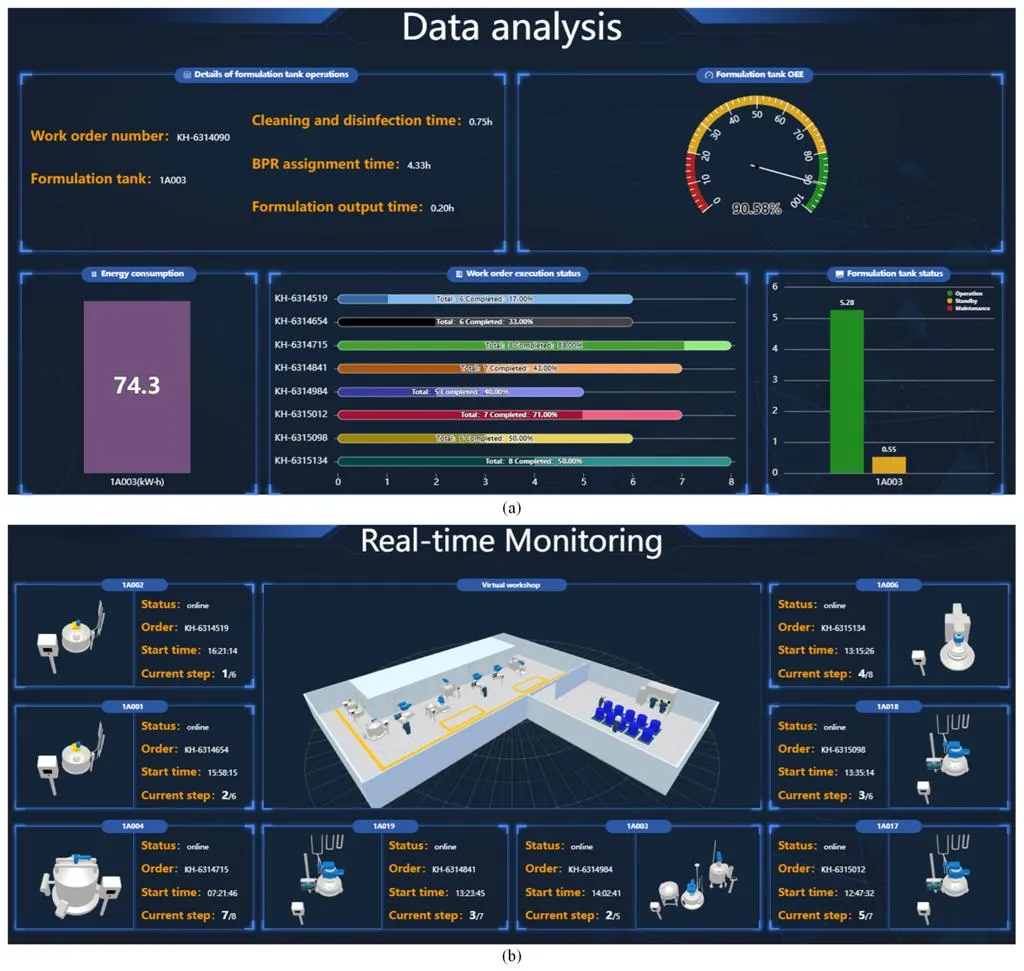
Figure 2: Digital Twin Framework for Pharmaceutical Manufacturing. Process and historical data are collected from the physical manufacturing system, stored and analyzed through a digital platform, and used by virtual models for prediction and optimization.
Another important area is continuous manufacturing. Unlike traditional batch manufacturing, continuous manufacturing produces material continuously and can generate large amounts of process information. A digital twin can help integrate these data with process models to continuously monitor the manufacturing system. The resulting information can be used to understand process changes and support optimization and control. [15]
Table 2: Major Applications of Digital Twins
| Application | Possible use |
|---|---|
| Process monitoring | Continuous observation of manufacturing conditions |
| Process optimization | Evaluation of different operating conditions |
| Predictive maintenance | Early identification of possible equipment problems |
| Quality monitoring | Linking process conditions with product quality |
| Continuous manufacturing | Monitoring and optimization of continuous processes |
| QbD support | Understanding process parameters and quality attributes |
| Real-time analysis | Combining PAT data with process models |
| Virtual experimentation | Testing process conditions without immediately changing the physical system |
| Operator training | Simulating manufacturing situations for training |
| Decision support | Providing information for manufacturing decisions |
Despite its potential, digital twin technology is still developing in pharmaceutical manufacturing. Important challenges include data quality, real-time data communication, model accuracy, interoperability, cybersecurity, data integrity, model maintenance, and regulatory requirements. A fully integrated digital twin requires reliable communication between the physical manufacturing system and the virtual environment. Existing pharmaceutical applications have demonstrated several individual components, but complete two-way integration remains an area of ongoing development.
3. Applications of Digital Twin Technology in Pharmaceutical Manufacturing
Digital Twin technology has several applications in pharmaceutical manufacturing. It provides a digital representation of manufacturing equipment and processes and allows real-time data to be used for monitoring, prediction, simulation, and optimization. It can be applied from the development stage to commercial production and equipment maintenance.[4,5,10]
3.1 Process Monitoring
Digital Twins can continuously monitor important manufacturing parameters such as temperature, pressure, humidity, mixing speed, flow rate, moisture content, and particle size. Sensors installed on manufacturing equipment collect real-time information and transfer it to the digital model. The Digital Twin compares current process conditions with expected operating conditions and can identify unusual changes or deviations. Early detection of deviations can help operators take corrective action before product quality is affected.[11,12,15]
3.2 Predictive Maintenance
Pharmaceutical manufacturing depends on the reliable operation of equipment such as mixers, granulators, dryers, tablet presses, filling machines, and packaging systems. Digital Twins can collect equipment information such as vibration, temperature, operating hours, energy consumption, and machine performance. By analysing these data, the system can identify patterns associated with equipment deterioration or possible failure. This supports predictive maintenance and can reduce unexpected equipment breakdowns and production interruptions.[4]
3.3 Quality Control
Maintaining consistent product quality is an important requirement in pharmaceutical manufacturing. Digital Twins can connect manufacturing-process information with quality-related data such as assay, dissolution, tablet hardness, weight variation, moisture content, and content uniformity. This connection helps manufacturers understand the relationship between critical process parameters and critical quality attributes. It can also support the early identification of conditions that may result in poor-quality batches.[1,4]
3.4 Process Optimization
Digital Twins can be used to simulate different manufacturing conditions without repeatedly changing the actual production process. For example, different mixing speeds, drying temperatures, processing times, or feed rates can be evaluated using the digital model. This allows manufacturers to study possible outcomes before implementing changes in the real process. Process optimization can help improve production efficiency while maintaining the required quality standards.[1,4,10]
3.5 Scale-Up and Technology Transfer
Moving a pharmaceutical process from laboratory or pilot scale to commercial production can present several challenges. Digital Twins can help compare process behaviour at different scales by using process data and mathematical models. They can identify differences in parameters such as mixing, heat transfer, drying behaviour, and material flow. This information can support technology transfer and help manufacturers understand how process conditions may change during scale-up.
3.6 Continuous Manufacturing
Digital Twin technology can be particularly useful in continuous pharmaceutical manufacturing, where materials move continuously through different processing units. The Digital Twin can monitor the process in real time and identify changes in material or equipment behaviour. It can also help predict how a change in one part of the process may affect downstream operations. This supports stable and consistent manufacturing.
3.7 Energy and Resource Management
Pharmaceutical manufacturing requires considerable amounts of electricity, water, raw materials, compressed air, and other resources. Digital Twins can monitor resource consumption throughout the manufacturing process. By analysing these data, manufacturers can identify areas where resources are being unnecessarily consumed. This can support improved energy efficiency, waste reduction, and more sustainable manufacturing practices.
3.8 Manufacturing Process Simulation
Digital Twins allow pharmaceutical companies to create virtual simulations of manufacturing processes. Different operating conditions can be tested in the virtual environment before being introduced into the actual manufacturing process. This can help manufacturers understand possible risks and evaluate the effect of process changes without interrupting production.
3.9 Batch Production Management
Digital Twins can support the monitoring of individual pharmaceutical batches. Information from raw-material handling, processing, testing, and equipment operation can be connected to the digital model. This provides a more complete view of batch performance and can help identify differences between batches.
4310 Support for Process Analytical Technology
Digital Twins can work together with Process Analytical Technology (PAT) systems to improve real-time understanding of pharmaceutical processes. PAT tools can provide information about material and product characteristics during manufacturing. When this information is incorporated into the Digital Twin, the manufacturer can obtain a more detailed picture of the process and its relationship with product quality.
4. Benefits of Digital Twin Technology
Digital Twin technology offers several potential benefits to pharmaceutical manufacturers when it is properly implemented and validated.[10,17]
4.1 Real-Time Process Monitoring
Digital Twins provide continuous access to manufacturing information. Operators can observe important process parameters and identify changes while production is taking place[4].
4.2 Early Detection of Process Deviations
The system can compare actual process conditions with expected conditions. Deviations can therefore be identified at an early stage, allowing appropriate investigation and corrective action.[15]
4.3 Improved Product Quality
By connecting process data with product-quality information, Digital Twins can help manufacturers understand the factors that influence product quality and maintain more consistent manufacturing conditions.[16,7]
4.4 Predictive Maintenance
Continuous analysis of equipment data can help identify possible equipment problems before they result in major failures. This can reduce unexpected downtime and support better maintenance planning.[6,8]
4.5 Reduced Manufacturing Downtime
Early identification of equipment or process problems can reduce interruptions to production. Better planning of maintenance activities can also improve equipment availability.[7,2]
4.6 Better Process Understanding
Digital Twins bring together data from different sources and provide a more complete view of the manufacturing process. This can improve understanding of how process parameters influence product performance.[8,5]
4.7 Process Optimization
Virtual simulations can be used to investigate different operating conditions. This can help manufacturers identify suitable process settings and improve production efficiency.[5,9]
4.8 Reduction of Material Waste
Better process monitoring and prediction can help reduce the number of batches affected by avoidable process deviations. This may reduce the wastage of raw materials and finished products.
4.9 Improved Resource Utilization
Digital Twins can help monitor the use of energy, water, raw materials, and equipment capacity. This information can support more efficient resource management.
4.10 Data-Driven Decision-Making
Digital Twins provide manufacturers with information that can support decisions related to process control, maintenance, quality, and production planning.
5. Challenges and Limitations
Although Digital Twin technology provides many opportunities, its implementation in pharmaceutical manufacturing also involves several challenges.
5.1 Data Quality
Digital Twins depend heavily on accurate and reliable data. Incorrect, incomplete, inconsistent, or poorly calibrated sensor data can affect the performance of the digital model.
5.2 Integration with Existing Systems
Pharmaceutical manufacturing facilities often use different types of equipment and software systems. Connecting these systems and allowing them to exchange data can be technically challenging.
5.3 High Implementation Cost
Developing a Digital Twin may require investment in sensors, data infrastructure, software, computing systems, cybersecurity, and skilled personnel. The initial cost can therefore be significant.
5.4 Model Validation
Digital Twin models used in pharmaceutical manufacturing need to be appropriately developed, tested, and validated for their intended purpose. The model must provide sufficiently reliable results for the decisions it supports.
5.5 Data Integrity
Pharmaceutical manufacturing requires reliable and traceable data. Data generated and processed by Digital Twin systems must be managed in a way that maintains accuracy, consistency, and traceability.
5.6 Cybersecurity
Because Digital Twins depend on connected digital systems and networks, they may introduce cybersecurity concerns. Appropriate security measures are needed to protect manufacturing and product-related information.
5.7 Regulatory Considerations
Pharmaceutical manufacturing is highly regulated. Digital Twin applications must therefore be implemented in accordance with applicable quality, validation, data-integrity, and regulatory requirements.
5.8 Requirement for Skilled Personnel
Successful implementation requires professionals who understand pharmaceutical manufacturing as well as areas such as data science, modelling, artificial intelligence, automation, software systems, and process engineering.
5.9 Maintenance of the Digital Model
A Digital Twin cannot remain accurate if the physical manufacturing system changes but the digital model is not updated. Continuous maintenance and periodic review of the model may therefore be necessary.
CONCLUSION
Digital Twin technology has significant potential for the future of pharmaceutical manufacturing. As manufacturing facilities become more connected and automated, Digital Twins may become an important part of smart pharmaceutical factories and Industry 4.0 systems.
Future Digital Twin systems may combine artificial intelligence (AI), machine learning (ML), Internet of Things (IoT), cloud computing, advanced sensors, robotics, and Process Analytical Technology (PAT). These technologies can provide more detailed information about manufacturing processes and equipment.
Digital Twins may increasingly be used for real-time process prediction, automated process optimization, predictive maintenance, quality monitoring, and manufacturing simulation. Instead of responding only after a problem occurs, manufacturers may use Digital Twins to predict potential problems and take preventive action.
The technology may also support the development of more flexible manufacturing systems. For example, a digital model could be used to evaluate the effect of changes in raw materials, equipment settings, or production conditions before implementing them in the physical facility.
In the future, Digital Twins could also contribute to continuous manufacturing, personalized medicine, sustainable production, and reduced manufacturing waste. Integration with advanced analytics may allow manufacturers to understand complex relationships between process parameters and product quality more effectively.
However, wider adoption will depend on improvements in data quality, model accuracy, interoperability, cybersecurity, regulatory acceptance, and workforce skills. Therefore, successful implementation will require cooperation between pharmaceutical scientists, engineers, data scientists, IT professionals, quality teams, and regulatory experts.
Overall, Digital Twin technology represents a promising approach for creating more data-driven, connected, predictive, and efficient pharmaceutical manufacturing systems. It can support better process understanding and decision-making while helping manufacturers maintain consistent product quality and improve operational performance.[4,6,10,12]
REFERENCES

Sudarsanam Nagarjuna, Dr. B. Thangabalan, K. Pravallika, M. Beula, Sk. Naziya, J. Dwaraka, K. Sravani, Leishangthem Dibiya Devi, S. Mohan, Digital Twin Technology in Pharmaceutical Manufacturing , Int. J. of Pharm. Sci., 2026, Vol 4, Issue 10, 4977-4986. https://doi.org/10.5281/zenodo.23830921
 10.5281/zenodo.23830921