

We use cookies to ensure our website works properly and to personalise your experience. Cookies policy
School of Pharmacy, Anjaneya University, Raipur.
Ethnoveterinary medicine (EVM) represents a rich tradition of indigenous knowledge that has been traditionally adopted by rural and tribal communities for the prevention and treatment of livestock diseases. This review examines India's rich dual tradition; the cow science and the orally transmitted folk knowledge across various parts of the country. Relevant published research articles and books were examined to identify commonly used plant species, usable plant parts, and their use in treating an ailment in ethnoveterinary knowledge. The review highlights a diversity of role of very common medicinal plants in treating different livestock health conditions. Despite their widespread use and potential therapeutic value, many traditional remedies remain scientifically underexplored and are increasingly threatened by the erosion of indigenous knowledge. The review emphasizes the need for pharmacological standardization, conservation of medicinal plant resources, and documentation of traditional knowledge to facilitate the integration of validated ethnoveterinary practices into sustainable animal healthcare systems also known as "the One Health Integration". Strengthening research and conservation efforts can contribute to improved livestock health, reduced dependence on synthetic drugs, and the preservation of India's valuable ethnoveterinary heritage.
1.1 Definition and Scope:
Ethnoveterinary medicine refer to the indigenous knowledge and methods used by communities to care for livestock, by utilizing herbal remedies. It is based on availability of local herbs and plants that are readily available in the area, are inexpensive to use, have minimal side-effects, and are environmentally sustainable in comparison to modern medicines. (1)
Ethnomedicine is a traditional medical practice that concerns the cultural interpretation of health, disease, and illness. It includes people's understanding, expertise, approach, way of application, and faith. (2) Documentation of this age-old, non-codified traditional knowledge for its larger prospects and academic interest has revolved around the wheel of research in ethnobotany that deals with the multidisciplinary approach of people-plant interactions. It has existed since the domestication of livestock in various forms across different cultures. It is developed by gradual trial and error by farmers, when the modern medicines did not exist. (3)Ethnoveterinary medicinal practices comprises local knowledge on methods of preparation and administration of herbal medicinal formulations for caring, healing and managing of livestock. (4)According to World Health Organization, about 80% of the population in developed countries is dependent in their traditional methods of control and treatment of various ailments affecting both humans and animals. These practices are called Ethnoveterinary medicines. (5)In India, the tradition of livestock rearing is prehistoric and for a farmer, livestock is a source of cash income as cropping is seasonal while livestock can provide a regular source of income. Therefore, they must be protected from diseases. Hence these practices are cost effective, easily accessible and easy to administer for a farmer that lives in a remote village. (6) So, these are often cheap, safe, time tested and based on local resources and strengths. Ethnoveterinary medicines differ not only from region to region but also among different communities as there are different believes of people living in distinct areas. Also, due to variations in climatic conditions, precipitation, sunlight, humidity, temperature etc. the medicinal properties of different plants change. (7)Phytotherapeutic knowledge of veterinary importance, traditional practitioners of veterinary medicine and their role in primary healthcare for veterinary diseases and ailments have been overlooked initially. The documentation of ethnoveterinary medicines started much later, resulting in scanty knowledge documentation. (8)Ethnoveterinary practices have been used in India from ancient times. The Atharva Veda is recognised as a reservoir of traditional medicine, including prescriptions for animal treatment, in several ancient scriptures. Other ancient texts include, the Agni Purana, Devi Purana, Garud Purana, Skand Purana, Matsya Purana, and Linga Purana which offer knowledge on the use of medicinal plants to treat the animal ailments. Traditional ethnoveterinary practices , deeply rooted in indigenous knowledge, have long relied on natural remedies to address livestock health and production challenges. (9)These practices offer a sustainable and culturally acceptable alternative to synthetic drugs aligning with the global emphasis on organic and sustainable livestock management.
1.2 Historical origins:
Ethnoveterinary medicine (EVM) is a scientific term for traditional animal healthcare as it encompasses the knowledge, skills and methods found among community members for preserving the health and welfare of animals. (10)
• Human evolutionary history: Ethnoveterinary knowledge has existed alongside human history since the domestication of livestock, taking various forms across different cultures.
• Ancient legal records: one of the earliest legal records of the practice dates back to 1800 B.C. in Babylon, where king Hammurabi formulated laws regarding veterinary fees for treating donkeys and cattle. (11)
• Regional centres of knowledge: During the early Middle Ages, Arabia was a world centre for veterinary knowledge, which later spread into Africa. Classic systems like Ayurveda in India and acupuncture in China were developed both for humans and animals.
• Ancient Indian contributions: India possesses one of the world's most extensive and diverse EVM traditions. (12)
India has a rich history of "cow science" dating back to the Rigvedic period (1500-1000 B.C.) where cows were adored as "best wealth".Shalihotra was the world's first known veterinarian. He documented various texts on horse husbandry and medicine. (13)
Traditional Indian practices can be categorised into two main streams;
• Codified traditions: India has documented history of veterinary science spanning 5000 years. Key ancient texts include the Rigveda, the Arthashastra and specialised treatises like Haya Ayurveda(horse medicine by Shalihotra), Gaja Ayurveda(elephant medicine by Palakapya). (14)
• Folk medicine: This undocumented knowledge exists in rural villages and is transmitted orally through generations. It relies on locally available natural products such as the Panchgavya; five products obtained from cow- milk, curd, ghee, urine, dung- which are used for their remedial and immune enhancing properties. (15)
• Modern revival: Interest in documenting these practices surged in the early 1980s as researchers realised this indigenous knowledge was rapidly disappearing due to death of elderly practitioners and the introduction of western culture. (16)
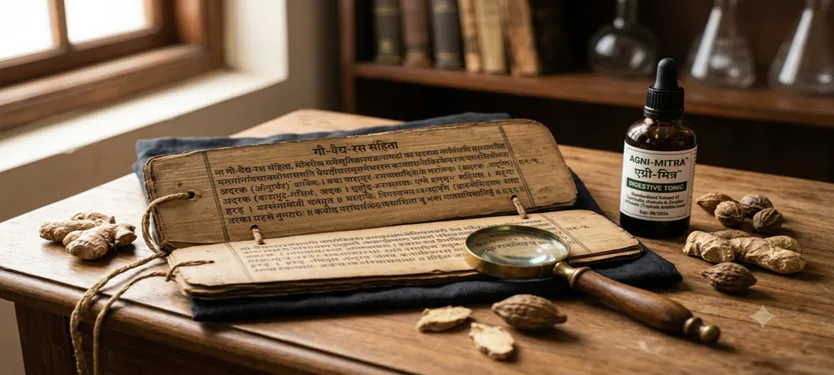
Fig. 1.1 - The script and the sample.
1.3 Common Methodologies:
This rich tradition of India has been mentioned in various religious texts of our country, but it is mostly passed on to generations orally through folklores. Ethnoveterinary practices have three types of methods: (17)
a) Pharmacotherapy-It involves the use of medicinal plants. Around 35,000 plants known globally have healing properties.
Commonly used substances in this method are:
Phytotherapy- This is the most prevalent practice, utilizing India's diverse flora. Common examples include Neem (Azadirechta indica) for skin and wounds, Arjuna (Terminalia arjuna) for various ailments, and Ashoka (Saraca asoca), other than these, garlic, aloe and hot pepper are also used for different problems. (18)
Animal and Mineral products- Remedies often incorporate minerals, honey, vegetable oils, butter, salt and even snake venom. In ancient times, formulations used cobra venom as a powerful stimulant for conditions like fever or plague.
Preparation and delivery- Drugs are typically prepared as liquids, powders or ointments through crushing , boiling or soaking raw materials. The most common routes of administration are oral (drenching), and topical (skin application). (19)
Table 1.1: Common medicinal plants and their uses.
|
Botanical name |
Family |
Native name |
Parts used |
Ailment |
Reference |
|
Ferula asefotida H. Karst |
Apiaceae |
Hing, Asefotida |
Olea- gum- resin |
Digestive aid, antispasmodic, antihelminthic, antimicrobial. |
(20) |
|
Coriandrum sativum L. |
Apiaceae |
Coriander |
Seed |
Respiratory aiments, stress related mood/nervous disorders and pain. |
(21) |
|
Moringa oleifera Lam. |
Moringaceae |
Sahjan, munga |
Leaves |
Cure skin rash or major wound. |
(22) |
|
Asparagus racemosus Will. |
Asparagaceae |
Shatavari, satamuli |
Root |
Get more energy during ploughing. |
(23) |
|
Mangifera indica L. |
Anacardiaceae |
Mango, Aam |
Cotyledon |
Used on injured organs to stop bleeding. |
(24) |
|
Curcuma longa L. |
Zingiberaceae |
Turmeric, haldi |
Rhizome |
Prevent worm infection and joint pain. |
(25) |
|
Artocarpus heterophyllus Lamk. |
Moraceae |
Jackfruit, kathal |
Leaves |
Stop loose watery stool. |
(25) |
|
Helianthus annus L. |
Asteraceae |
Sunflower, suraj mukhi |
Seed |
Curing general weakness cold and respiratory disorders. |
(26) |
|
Aloe vera(L.) Burm. f. |
Asphodelaceae |
Aloevera, Ghritkumari |
Leaves |
Applied on burn wounds as ointment. |
(26) |
|
Musa pardisica L. |
Musaceae |
Banana, kela |
Leaf base |
Cure of dysentery as blood. |
(26) |
Fig. 1.2- Seed and the capsule.
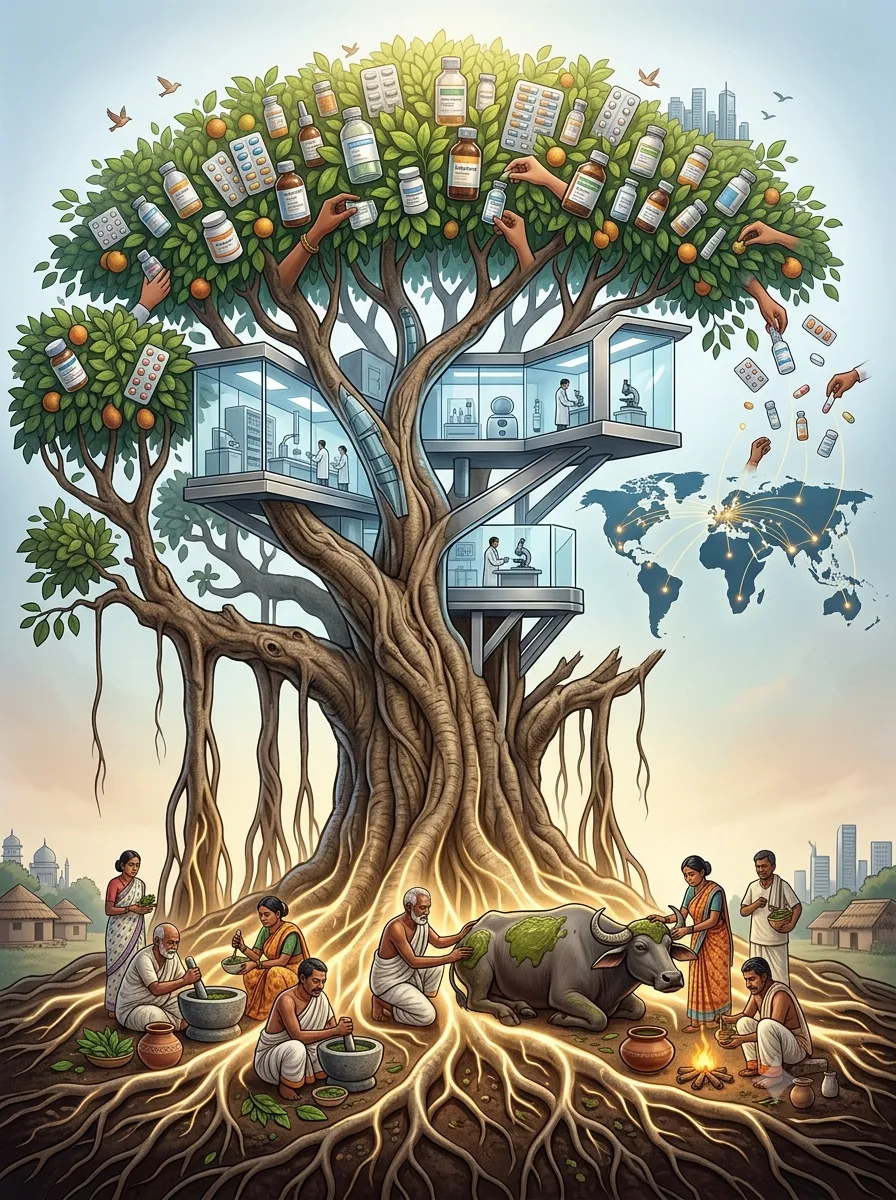
Fig.1.3- Roots of strength.
b) Spiritual practices- Ancient spiritual practices:
This spiritual knowledge is predominantly unscripted and passed from elder to younger generations through stories and ceremonies because it is often viewed with suspiction by Western trained practitioners, it remains a rapidly disappearing 'grey literature'. (28)
Table- 1.2: Traditional concepts and their remedies. (29)
|
Concept |
Believed cause(s) |
Corresponding remedies/ practices |
|
Demonic theory |
Spirits of the dead, 'evil eye' or sorcery |
Sacrifices (placations), hymns, prayers and protective amulets hung in animal quarters. |
|
Divine wrath |
Punishment from a displeased deity or supreme being. |
Special rituals, propitatory rites, and communal lifestyle changes. |
|
Universe of Natural law |
Imbalance of humors (Doshas: kapha, vata, pitta) or elements (air, water, fire). |
Dietary alterations, acupuncture or relocating animals to areas with "better air". |
|
Contagion/ vector theory |
Transmission via contact, air-borne seeds, or parasitic vectors like ticks and flies. |
Physical isolation of sick stock, manual removal of parasites, and plant based washes (e.g.- tobacco decoction) |
|
Magico- religious |
Supernatural mechanisms such as animals being "magically" attracted to toxic plants. |
Exorcism, recitation of incantations and use of holy water for purification. |
c) Physical manipulations-
Physical manipulation in Indian EVM is a highly developed field with roots in ancient surgical documentations like the Susruta Samhita and specialised veterinary texts like Gaja Ayurveda and Haya Ayurveda , these practies blend manual skils and traditional tools to treat structural and physiologial issues. (30)
1.4 Limitations, Risks and Challenges:
While traditional methods are useful, they cannot rapidly control epidemic infectious diseases or acute, life threatening bacterial infections.
1.5 One Health Integration:
One health is a collaborative approach recognizing that human health is interwined with the health of animals and the environment. Key objectives of this integration are:
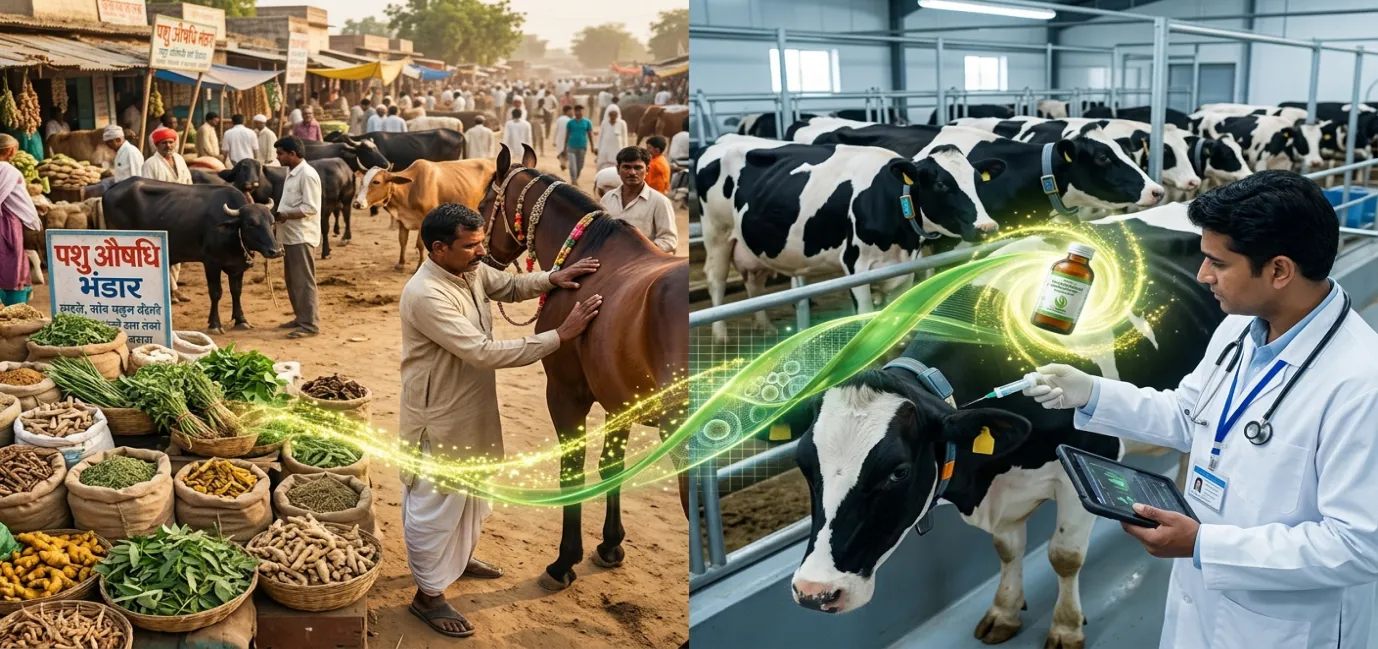
Fig. 1.4 - The market and the lab.
CONCLUSION
Ethnoveterinary Medicine (EVM) in India represents a unique dual legacy, merging 5,000 years of codefied ancient texts like the Vedas and Arthashastra with a rich, orally transmitted folk tradition. This holistic system remains vital socio-economic pillar for rural livestock holders, providing accessible and culturally acceptable alternatives to expensive modern treatments. (34)
While methodologies such as phytotherapy, physical manipulation and Panchgavya therapy continue to demonstrate practical efficacy, the field faces critical challenges including lack of standardisation and rapid erosion of knowledge. Addressing these risks requires a strong effort towards formal documentation, scientific validation of dosages and protection of indigenous intellectual property. (35)
The future of EVM in India lies in its integration to the global "One health" paradigm. By bridging the gap between traditional wisdom and biomedical science, EVM can offer sustainable solutions for managing zoonotic diseases and reducing antimicrobial resistance. (36)
REFERENCES


Eshita Bhave, Prerana Sahu, Harish Sharma, Ethnoveterinary Practices in India: Traditional Knowledge, Medicinal Plants, and Future Perspectives, Int. J. of Pharm. Sci., 2026, Vol 4, Issue 7, 6130-6138, https://doi.org/10.5281/zenodo.21721911
 10.5281/zenodo.21721911