

We use cookies to ensure our website works properly and to personalise your experience. Cookies policy
Department of Pharmaceutics, JKK Munirajah Institute of Health Sciences College of Pharmacy, T.N Palayam, Erode (DT), Tamil Nadu.
Film-forming drug delivery systems (FFDS) are topical or transdermal formulations applied as liquids or semisolids that form a thin polymeric film after the volatile components evaporate or the formulation changes upon contact with the skin. The final film can stay in contact with the application area, increase the time it remains in place, form a protective barrier, and control the release of the drug that is included within it. These systems are being explored as alternatives to conventional creams, ointments and patches, which may be removed by clothing, feel greasy, be difficult to apply over curved surfaces or cause discomfort during removal. This review summarises the concept and mechanism of film formation, formulation components, major types, manufacturing approaches, evaluation parameters, applications, benefits and limitations of FFDS. The choice of polymer and its concentration, the amount of plasticizer used, the speed at which the solvent evaporates, how well the drug dissolves, and the use of permeation enhancers can all affect the flexibility of the film, how well it sticks to the skin, how long it takes to dry, the rate at which the drug is released, and how easily the drug passes through the skin.Film-forming gels are a related platform in which a gel-like vehicle dries to leave a drug-containing film. Published studies report promising results for sustained dermal delivery and selected wound-care applications, but performance depends on the particular drug and formulation. Standardised testing, stability assessment, skin-safety evaluation and quality-by-design development remain important for translating laboratory formulations into reliable products.
The skin is a convenient route for local treatment and, for suitable medicines, systemic delivery. However, the stratum corneum forms a substantial barrier to drug transport. Traditional topical treatments like creams, ointments, and gels are simple to use but can be removed easily, need to be reapplied frequently, and often result in a greasy or sticky feeling. Patches can provide prolonged contact, yet may be inconvenient on curved body areas and can cause discomfort during removal. These practical limitations have encouraged the development of film-forming drug delivery systems [1–4].
A film-forming system is generally a non-solid preparation containing a drug, a film-forming polymer and a suitable vehicle. Following application, evaporation of a volatile solvent or another formulation-triggered transition leaves a coherent film on the skin. The film can act as a drug reservoir, improve persistence at the application site and, depending on its composition, support local delivery or transdermal absorption [1,2].
This review brings together the uploaded review articles and research papers on topical film-forming systems, film-forming gels, polymeric films and solvent casting. It emphasises formulation principles and evaluation rather than claiming that every formulation improves clinical outcomes.
CONCEPT AND MECHANISM OF FILM FORMATION
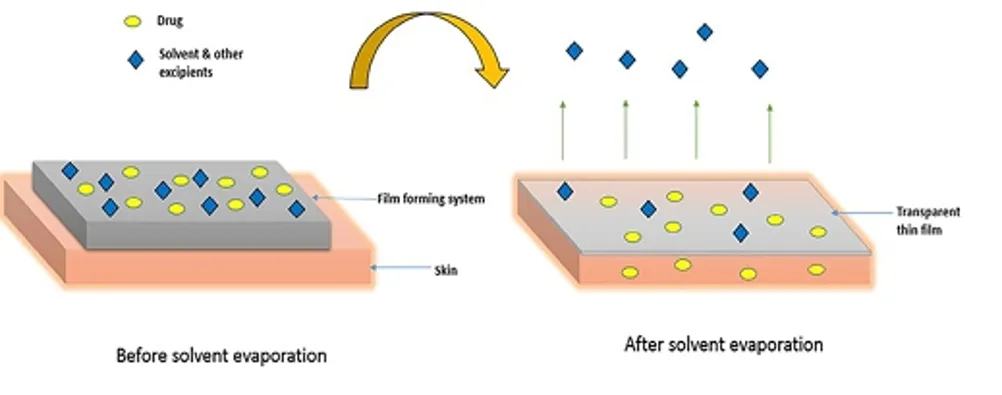
In a typical solvent-based formulation, the drug and polymer are dispersed or dissolved in a vehicle that spreads over the skin. After application, volatile components evaporate, and the polymer chains become concentrated, associate and form a continuous or semi-continuous layer. The drug remains within or on the film and is subsequently released by diffusion, partitioning into the skin, dissolution in skin moisture or a combination of these processes [1,2,4].
Solvent evaporation is a key process variable. If evaporation is too slow, the applied area may remain wet for an extended period. If it is too rapid, the formulation may not spread evenly and may produce an irregular film. Temperature, humidity, airflow, solvent composition, polymer concentration and application thickness can all affect drying and film quality [1,3].
After volatile solvent loss, the drug concentration in the residual film can rise and may approach or exceed saturation. In some formulations, this increases thermodynamic activity and can improve the driving force for skin permeation. However, supersaturation may also lead to drug crystallisation, so the formulation must balance drug activity with physical stability [1,2].
FORMULATION COMPONENTS
Active pharmaceutical ingredient
The drug should be compatible with the selected polymer and vehicle and remain sufficiently stable during preparation, drying and storage. Solubility, molecular size, dose, partitioning behaviour and intended site of action influence whether a drug is suitable for local dermal or transdermal delivery. A drug suitable for one film-forming system may not perform similarly in another formulation [1,2].
Film-forming polymers
Polymers form the structural matrix that remains after the vehicle evaporates. Selection affects viscosity, spreading, drying, film continuity, adhesion, flexibility, water resistance and drug release. Polymers described in topical film-forming literature include cellulose derivatives, polyvinylpyrrolidone (PVP), polyvinyl alcohol (PVA), acrylate/methacrylate polymers, chitosan and other natural or synthetic film formers. The polymer must be compatible with the drug and excipients and produce a film with acceptable mechanical and skin-contact properties [1,2,5].
Solvents and vehicles
Water, alcohols and mixed solvent systems may be used according to polymer solubility, drug properties and intended drying profile. The vehicle should allow adequate spreading and application while supporting formation of a uniform film. Solvent choice also affects drying time, residual solvent risk, skin tolerability and manufacturing safety. The use of volatile or flammable solvents requires suitable handling and process controls [3,5].
Plasticizers
Plasticisers such as glycerol, propylene glycol or other compatible agents may be incorporated to reduce brittleness and improve flexibility. Their concentration must be optimised: too little may produce a rigid or cracked film, whereas excessive plasticiser can make the film tacky, alter drying, affect drug diffusion or reduce mechanical strength. The final effect depends on the polymer–plasticiser combination [1,2,6].
Permeation enhancers and other excipients
Permeation enhancers may be included when increased transport across the skin is needed. Examples investigated in the literature include fatty acids such as oleic acid and other chemical enhancers. Humectants, pH adjusters, preservatives, antioxidants and solubilisers may also be required, depending on the formulation. Each additive should be justified by its effect on product performance and its safety for the intended site and duration of application [1,7].
TYPES OF FILM-FORMING SYSTEMS
Film-forming solutions and sprays
These are liquid preparations applied by spreading, brushing or spraying. The solvent evaporates and leaves a polymeric film. Sprays may be convenient for larger or difficult-to-reach areas and can permit relatively uniform application, although spray pattern, dose reproducibility and inhalation exposure need consideration [1,2].
Film-forming gels
Film-forming gels are semisolid or gel-like systems that form a film after application. They combine the handling properties of a gel with the persistence of a film. The 2026 systematic review supplied for this manuscript describes polymer and plasticiser selection as important determinants of drying time, mechanical properties, flexibility and bioadhesion. Across the studies included in that review, drug release commonly extended over several hours, although results varied by formulation and study design [8].
Film-forming emulsions
Emulsion-based systems can incorporate ingredients with different solubility characteristics and may form a film as volatile components evaporate. The composition of the emulsion and the nature of the residual polymer layer affect drug retention and release. These formulations require assessment of emulsion stability in addition to film characteristics [1,2].
Polymeric films prepared before application
Preformed films are manufactured separately and then placed on the skin or wound. They differ from in-situ film-forming systems, which create the film directly on the application site. Polymeric wound films can provide a protective barrier, allow gas exchange and serve as carriers for active agents. Solvent casting is a commonly used method for producing such films [9].
METHODS OF PREPARATION
Solvent evaporation / in-situ film formation
A common approach is to dissolve or disperse the polymer and drug in a suitable vehicle, add excipients under controlled mixing, remove entrapped air where necessary, and package the formulation. A measured amount is applied to the skin and allowed to dry. Development should define mixing order, temperature, viscosity, application amount and drying conditions to support reproducibility [1,2].
Solvent casting
In solvent casting, polymer and other ingredients are dissolved or dispersed in a suitable solvent, the mixture is cast onto a level surface, and the solvent is removed under controlled conditions. The resulting sheet is peeled off and cut to the required dimensions. The method is relatively straightforward and can produce films with useful uniformity, but film thickness and properties depend on solution composition, casting volume, substrate, drying rate and residual solvent [3,9].
Spraying and coating
Spraying can be used to deposit a formulation onto a surface or directly onto the skin. Coating approaches are useful when controlled film thickness or large-area manufacture is required. Process variables include spray pressure, nozzle characteristics, distance, feed rate, viscosity and drying conditions. Scale-up should assess whether the same film properties are retained at larger batch sizes [2,3].
EVALUATION OF FILM-FORMING FORMULATIONS
Appearance and film formation
Observe colour, clarity, homogeneity, visible particles, spreading, drying behaviour, film continuity and ease of removal where relevant. The formulation should form a consistent layer without unacceptable cracking, flaking, pilling or tackiness. For wound films, transparency and barrier properties may also be important [2,9].
Drying time and film thickness
Drying time is the interval required for the applied formulation to form a non-transferable or sufficiently dry film under specified conditions. It should be measured using a defined application quantity, area, temperature and humidity. Film thickness can be measured at multiple locations for preformed films; for in-situ films, a suitable validated method is needed. Variability should be reported rather than relying on a single measurement [1,8].
Mechanical properties
Flexibility, tensile strength, elongation, folding endurance and resistance to cracking can help characterise the film. The most relevant tests depend on whether the product must stretch with skin, remain intact during movement or be removed after a defined period. Mechanical results should be interpreted alongside tack, adhesion and comfort rather than in isolation [2,6].
Adhesion and resistance
Adhesion or residence time measures whether the film remains at the application site. Water resistance, abrasion resistance and wipe-off resistance can be relevant for products exposed to clothing, sweat or washing. Test methods should represent intended use and should avoid overstating performance beyond the conditions tested [1,2].
Drug content, uniformity and release
Drug content and content uniformity assess whether the active ingredient is distributed consistently. In vitro release testing can compare formulations and help identify the effect of polymer concentration, plasticiser, drug loading and other excipients. The test medium, apparatus, membrane and sampling procedure should be justified and reported. Release from the formulation is not identical to permeation through skin [1,2,8].
Skin permeation and retention
Franz diffusion cells and suitable skin models are commonly used to investigate drug permeation. Outcomes may include cumulative amount permeated, flux, lag time and drug retained in skin. Skin source, its integrity, temperature, the receptor medium, and sink conditions can all affect the results.Ex-vivo or in-vitro findings support formulation comparison but do not alone establish clinical effectiveness or safety [2,7,8].
Stability and safety
Stability studies need to observe changes in the physical characteristics, active ingredient levels, breakdown of the drug, consistency, effectiveness of the film, and how well the packaging holds up when stored under appropriate conditions.Skin irritation, sensitisation and other local tolerability assessments are essential for the intended use. Residual solvent, microbial quality and preservative effectiveness should be considered when applicable. Testing should follow relevant institutional and regulatory requirements [1,2,8].
APPLICATIONS
ADVANTAGES
LIMITATIONS AND CHALLENGES
RECENT ADVANCES AND FUTURE PROSPECTS
Recent work has focused on clarifying how formulation variables control film performance, release and skin permeation. The supplied 2026 systematic review included 27 studies of topical film-forming gels and highlighted the importance of polymer and plasticiser selection, with solvent evaporation being the predominant preparation approach in the included literature [8]. The authors also identified a need for broader use of quality-by-design principles and more consistent evaluation methods.
Future studies should establish a clear quality target product profile, identify critical material attributes and process parameters, and examine their relationship with critical quality attributes such as drying time, film strength, adhesion, drug release and permeation. Improved models of skin performance, reproducible application methods, long-term stability testing and well-designed human studies will be important. Sustainability and solvent safety, scalable manufacturing, packaging compatibility and patient acceptability should also be considered early in development [2,3,8,9].
CONCLUSION
Film-forming drug delivery systems are a versatile platform for topical and transdermal formulation development. Their defining feature is the formation of a polymeric film after application, which can improve residence at the site and provide a matrix for drug release. The final performance depends on the drug, polymer, solvent, plasticiser, permeation enhancer and manufacturing conditions. Evaluation should include film formation, drying time, mechanical behaviour, adhesion, drug content, release, skin permeation, stability and local safety. Although published findings are promising for selected applications, benefits must be demonstrated for each drug and formulation through reproducible testing and suitable clinical evidence.
REFERENCES

Kavin M, Agalya A, Poornamirtha P, Vijay N, Perumal T, Film-Forming Drug Delivery Systems: Formulation, Mechanism, Evaluation and Recent Advances, Int. J. of Pharm. Sci., 2026, Vol 4, Issue 10, 3031-3038. https://doi.org/10.5281/zenodo.23476212
 10.5281/zenodo.23476212