

We use cookies to ensure our website works properly and to personalise your experience. Cookies policy
Shree Sainath College of Pharmacy, Dawalameti, Nagpur, 440023
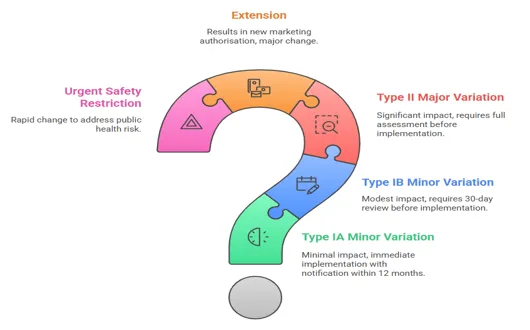
The European Medicines Agency is the central medical authority of the European Union, responsible for the evaluation, supervision, and safety monitoring of medicines for both humans and animals across Europe. Established in 1995, the EMA ensures that all medicines circulating in the EU are effective, safe, and of high quality. Its creation helped harmonize medicine regulations among European countries that share similar health conditions and environments, promoting scientific cooperation and public health protection. Since its founding, the EMA has actively involved patients and consumers in its decision-making process. Beginning in 2000, patients joined the Orphan Committee, followed by the formation of the Patients’ and Consumers’ Working Party in 2006. Today, patients are full members in four of the EMA’s seven key committees — the Orphan, Paediatric, Advanced Therapy, and Pharmacovigilance committees — ensuring their voices help shape healthcare innovation. The EMA also manages updates to marketing authorisations through the Variations Regulation. Type IA (Do and Tell): Minor changes implemented first and reported within 12 months. Type IB (Tell, Wait, and Do): Moderate changes that require notification and 30-day approval. Type II (Major Variations): Significant modifications affecting safety or efficacy, requiring prior approval. Extensions: Major changes leading to a new or modified authorisation. Through these procedures, the EMA maintains consistent medicine quality, safety, and effectiveness across Europe, supporting innovation and trust in healthcare for both people and animals.
European Medicines Agency
The European Medicines Agency is one of the most important regulators of the medical field in the European Union. They ensure that every medicine that goes into the market in Europe undergoes testing, evaluation, and discount[1]. Every medicine that comes into use should be safe, effective, and of high quality, and this only happens after thorough evaluation in the European Medicines Agency. There is cooperation between the agency and many countries across Europe, along with the exchange of research articles, data from their modern laboratories and other findings[2]. This helps bring about the creation of new medicines for the benefit of all. All clinical trials as well as trading of non-prescription medicines in Europe are under the purview of the agency. The agency is beneficial to both human beings as well as animals, where the veterinary committee provides guidance from the manufacture to the marketing of the medicines[3].
The phrase "Member States concerned" describes all member states of the European Union that have authorised the specific medication[4]. This phrase, thus, represents all member states of the European Union that have permitted the distribution and use of a particular drug. The term "Concerned Member States" implies all countries included in the former definition with the exclusion of the Reference Member State (RMS). The RMS is defined as the lead member state that coordinates the evaluation of a given medication. Concerned member states support the RMS throughout the procedure[5].
The definition of these phrases is aimed at establishing the responsibilities of different countries and their authorities related to the process of authorising medications in the European Union[6]. It should be noted that Agency refers to European Medicines Agency.
1.1 Interaction with patience
The history of the European Medicines Agency (EMA) started way back in 1995, at the inception of the agency. Just a few years later, in the year 2000, the patients scored another milestone by becoming part of a scientific committee of the EMA for the very first time; it is known as the Orphan Committee[7].
Three years after this milestone, the EMA launched its first group with patients; thus, this was a whole new level of collaboration. These collaborative efforts became more organized in 2005 when the framework of interaction with patient organizations was put in place. The Patients and Consumers Working Party came into existence in 2006; hence, from then on, there was a forum for the patients and consumers to contribute in deliberations[8]. As can be seen, the EMA has made sure to create elaborate mechanisms that involve patients in the entire process of medicine assessment. It is after more than two decades of fruitful collaboration that the agency continues its commitment towards building on this partnership.
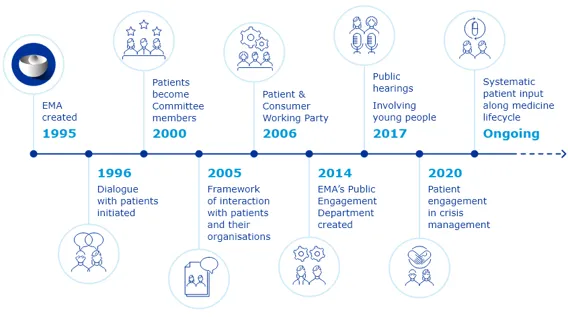
Figure 1: Showing interaction of EU with patients
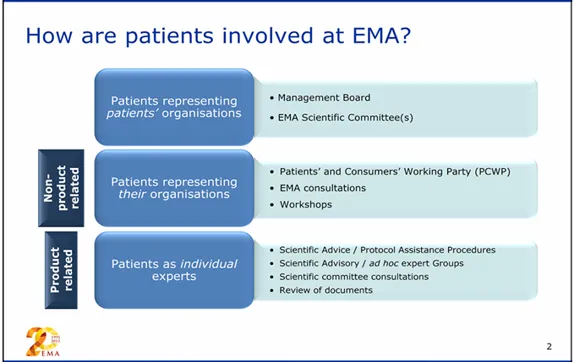
Figure 2: Showing how patients involved at EMA
1.2. EMA Scientific committee’s
There are the several committee which are helps to create the European Medicinal Agency.
Of the 7 committees that evaluate medicines at the EMA.6 are for human medicines and one is for veterinary, Patients are full members of four of these committees.
These are the, Orphan committee, Paediatric committee, Advanced therapy committee & Pharmacovigilance committee[9].
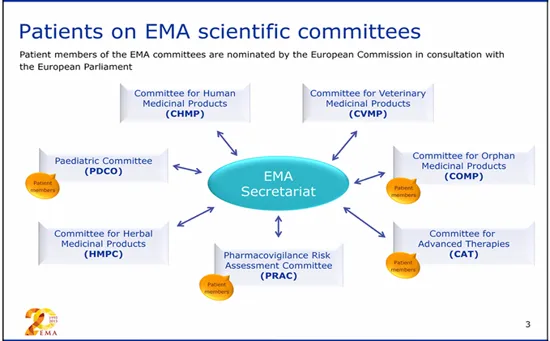
Figure 3: Showing Committees of EMA
Out of the seven committees that assess medicines within EMA: Six focus on human medicines, and One focuses on veterinary medicines.
Patients are active members of four important committees:
2. VARIATIONS
Marketing authorization refers to the official approval required before a medicinal product is placed on the market for sale within the European Union. It encompasses all the essential aspects related to a medicinal product, which include its mode of administration, proper dosage, any potential hazards associated with its use, indications, storage requirements, and labeling instructions[10]. In some cases, however, these aspects may require modification after a product has been granted approval by the regulatory authority. This may be necessitated by the results of new research carried out, manufacturing process changes, and the emergence of new safety information regarding the product in question[11].
So, let's suppose that you are a pharmaceutical company planning to submit certain variations for your product. In advance, you are not alone anymore because reference Member State, national competent authority or European Medicines Agency (EMA) may provide consultation, resolve certain ambiguities for you or arrange a discussion prior to submission if you request it. Imagine it as a situation when you are checking your assignment for possible errors before submitting it[12].
Another point that should be mentioned here is that it is possible to submit several variations in one package. However, the rules say that all variations will be considered depending on their "highest" type. It means that if one of variations requires more complicated procedures than other variations, all variations will be evaluated based on these procedures[13]. If your submission contains both extension application and significant Type II variation, your submission will be considered as extension application submission. Otherwise, if all your variations are of types IB and IA, your submission will be treated as Type IB notification.
Whereas with regards to submitting the applications, there are certain considerations to be made in relation to the particular pathway being followed. Where the centralized procedure is followed, then the EMA shall give instructions as regards the number of copies of the application and where to deliver them[14]. In the case where a company opts for mutual recognition procedure (MRP), it is the coordination groups established by Articles 31 of Directive 2001/82/EC in case of veterinary medicines and by Article 27 of Directive 2001/83/EC in case of human medicines that determine how it will be done[15]. Otherwise, where a strictly national procedure is followed, then this depends on the national authority.
2.1 Minor variations of Type IA
This is a small change that will not influence the quality, safety, and performance of the medicine. The company can perform this action first and inform the authority later within twelve months. It is called the "Do and Tell" procedure. In certain instances, the change needs to be reported immediately after being performed, particularly when dealing with safety issues related to medicines[16].
Place and Method for Reporting: The company has three options for submitting the notification. It may send its notice either to the national authority, to Member States, or to the EMA depending on the category of the product.Merging of Type IA changes: When several Type IA changes are performed on the same product or when the same change impacts several products, the company can merge these notices into one single report, provided that it is sent to the relevant body at the same time.Merging annually: The company can report all of its Type IA changes in one report yearly[17].
2.1.1 Type IA variations review for mutual recognition procedure
For example, a company makes a very slight change in one of its medicines; although the change does not impact the nature of the medicine, it needs to be notified. This is known as Type IA Variation. After receiving a notification from the company for the reference Member State (which is basically the Member State responsible for coordinating the marketing authorization of the medicine throughout the European Union), a countdown begins[18]. In the next 30 days, this Member State evaluates the information provided by the company; this includes checking the details and documents and determining if it is indeed a "minor" variation.
It should be noted that if a company fails to provide all documents or makes even a minor omission, it is not a critical issue. In fact, the authority can demand that the company provide whatever is needed, and it will be sufficient if it does so immediately. Otherwise, the approval can simply be denied due to the significance of missing information or a delay in the process. In such an unfortunate situation, the company would be required to cease applying the approved changes immediately[19]. However, on the other hand, it is strict enough to guarantee the quality of all medications that appear on the market despite minor modifications.
2.2Minor variations of Type IB
Type IB variations are small but slightly more important changes compared to Type IA. These changes do not usually affect the overall safety or effectiveness of the medicine, but they could have some impact on how the product is manufactured, packaged, or labelled. Because of this, health authorities must review them before the company can go ahead with the update[20]. The process for Type IB variations is often called “Tell, Wait and Do.” Here’s what that means:
Where to Report
The Type IB notification must reach all parties at the same time – depending on how the medicine was approved, it might be the national competent authorities, the reference Member State, or the European Medicines Agency. This will make sure that all the authorities have identical information to consider.
Grouping of Changes
Companies can make the process more efficient through grouping, which means submitting several related variations together in one application instead of multiple separate ones.
Here’s how grouping works for Type IB variations[22]:
Worksharing
In some instances, the company could hold several MA(s), such as for the same drug but under different names or marketed in different EU member states, which are all impacted by the same Type IB modification. Rather than submitting individual variation applications to cover each one, the firm may employ a work-sharing process[23]. Work sharing entails the submission and joint assessment of just one application on behalf of all the affected MA(s).
2.2.1 Type IB variations review for mutual recognition procedure
Once a company makes its application through the Type IB variation process, the first step for the RMS is to validate the application to see whether the information provided is complete and whether the variation is indeed a minor variation[24]. The validation procedure needs to be completed within seven days of receipt of the notification.
However, if the RMS concludes from this assessment that the suggested change can have a significant impact on the quality, safety, and efficacy of the product, then it can be concluded that the change does not fall into the category of Type IB variation. The RMS must notify all the relevant Member States and the marketing authorization holder (MAH) about this situation[25]. If no objection is made by another Member State during the next seven days, the application will be required to be amended and re-submitted as a major variation (Type II). On the contrary, if there is an objection from another Member State, the RMS takes it into account and decides whether the change should be classified as a major variation or Type IB minor change. After the assessment has been done and it is concluded that the change can be qualified as a Type IB variation, then the RMS must notify the company about the acceptance of the notification, and also, start evaluating the change[26]. Thirty days after notification of receipt of a validated notification, the RMS examines the change and informs the company of the outcome of this examination.
2.3.1 Major variations of Type II
They are significant modifications which could potentially affect directly the quality, efficacy, or safety of the medicine concerned. These modifications require prior approval from the competent authority before implementation.Some examples are change in the manufacturing process, active substance, or information about clinical use of the medicine[27]. The list of such variations is provided under the Variations Regulation along with its Annex.
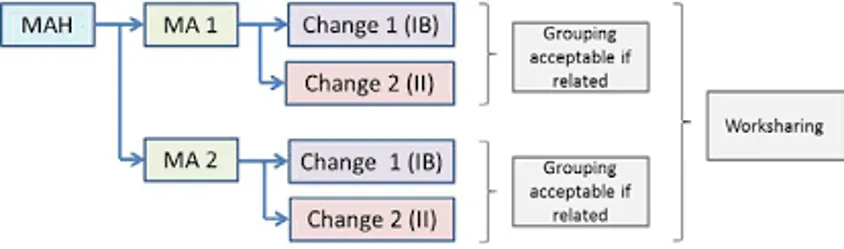
Figure 4: Showing Worksharing
2.3.2 Submission of Type II applications
If the firm intends to perform a major change in its products, called Type II variation, then it must submit the notification simultaneously to all interested Member States, national authority, or European Medicines Agency, according to their responsibility concerning the particular marketing authorization holder. There is an option to submit more than one Type II variation in one application if all of them are related to the same marketing authorization[28]. Furthermore, it may incorporate the major change along with the smaller variations as long as it complies with the Variations Regulation or prior agreement with the authorities.
Where only the national procedure for the marketing authorisation is used, an application may be submitted by the manufacturer covering a group of changes to marketing authorisations which involve the same change or several similar changes for various marketing authorisations[29]. It is possible to do this only when the changes in all the marketing authorisations mentioned above are identical, the application is submitted at the same time, and the national authority has approved such a procedure. Where the same modification of significant importance or a number of similar modifications of significant importance occur to various marketing authorisations, then it is work sharing.
All applications should contain all of the details specified in Annex IV of the Variations Regulation. The information should be presented in accordance with the sequence set out in the EU Common Technical Document template[30]. In the case of veterinary medicinal products, the Notice to Applicants Volume 6B template may be applied in place of the EU-CTD template.
2.3.3 Type II variations assessment for mutual recognition procedure
Where an applicant submits a Type II variation application, which is considered a major variation to the already authorized medicinal product, it is the Reference Member State (RMS) that is responsible for conducting the evaluation[31].
The RMS may be seen as the "leader" of the team that works on the project, communicating and coordinating the work of all the Member States where the medicinal product is authorized. Upon receipt of the application and upon determination of its completeness, the RMS declares the application as valid, thus launching the procedure of review[32]. After that, the clock starts ticking.Usually, the period of review lasts no more than 60 days. However, in some cases, this term may be shortened. For example, if there are grounds to believe that the authorization of the variation poses an immediate risk to health and safety, then the period is shortened to 15 days. Alternatively, if there is a bundle of variations associated with each other, the time limit increases to 90 days. For certain types of veterinary medicinal products, the standard term of 90 days applies automatically.
Should additional data be requested by the reviewers, the company will receive a formal demand for additional information. In effect, this is equivalent to the RMS putting their "finger" on the clock, suspending the clock and asking the company to provide the relevant data, which the latter would have roughly one month to provide. Should it require additional time to provide the additional information, the company may seek extensions, provided, however, that there are convincing reasons behind such an intention[33]. Once the data are provided, the assessment resumes, taking as long as required by the complexity of the data; this second assessment is likely to take between 30 and 60 days.In summary, following the examination of the response made by the company, the RMS will conclude its evaluation, update the document with any changes and make the new document available to all interested Member States, as well as the company itself[34].
Simply put, the Type II assessment process is a systematic European assessment procedure that allows for sufficient flexibility without sacrificing accuracy.
2.3.4 Summary of Variation Types
Table 1 :Showing Summary of Variation Types
|
Type |
Description |
Process |
Approval needed |
|
Type IA |
Very small change |
Do first, then inform (“Do and Tell”) |
No approval before change |
|
Type IB |
Minor but important change |
Tell first, wait 30 days, then do (“Tell, wait and Do”) |
Implicit approval after 30 days |
|
Type II |
Major change affecting safety or efficacy |
Submit and wait for formal approval |
Yes, before change |
2.4.1 Extensions
Certain modifications to the medicinal product are of such significance that it is considered an extension. An extension is defined in Annex I, which contains a list of all kinds of extensions and specifies that all extensions have to undergo the same assessment procedure as any other newly marketed product[35]. The extension may be granted separately or appended to the original authorization.
2.4.2 Submission of Extensions applications
In the situation where a company wishes to make changes, for instance, to include another strength or dosage form or new route of administration, then information must be sent to all concerned authorities.
In this case, sometimes as an effort to be more efficient, a company may combine various extensions into one application. The company can also combine extensions with other kinds of variations for the same medicinal product where such case falls under any of those provided for in the Annex III to the Variations Regulation or when prior agreement has been reached with the concerned authority[36]. One thing that should be pointed out is the fact that work sharing is not allowed under the procedure as compared with others.
In the case of submission, it is not simply about submitting some documents; there are steps to be followed, and it can almost be compared to putting together a dossier. The first step will be a cover letter detailing what is requested. Following this is the official application form of the EU, and then all the supporting information required to substantiate the extension. This could range from study reports, details of safety and efficacy, among others[37].
The data should meet EU-CTD requirements in case of human medicinal products. Concerning veterinary products, if the former are not applicable, the Volume 6B structure is used. The application should contain Module 1 or Part 1, together with the rationale for excluding some documents, if needed. Updated quality, non-clinical or clinical summaries as well as updated expert review should be provided in case it is necessary[38]. In case a clinical or non-clinical study summary appears in Module 2, a new one should also appear here if only one study was newly included. Moreover, the product information such as the SPC, labeling, or leaflet should be updated, and the revised versions of these documents should be submitted in appropriate formats. As concerns mutual recognition procedures, a list of all countries where applications were sent together with dates should be submitted by the reference member state[39]. What is more, the payment confirmation of all fees should be provided. However, for national procedures, only confirmation of national fees' payment should be provided.
In brief, extending the authorization procedure is quite complicated since many documents are to be submitted properly.
2.4.3 Extension assessment for national procedure
Where there is an application for an extension on the basis of either the national or mutual recognition routes, the application does not simply receive a cursory glance but is instead treated almost as though it were a completely new marketing authorization application. In other words, the same process is followed that would normally apply where a first-time application is submitted, subject to the guidelines stipulated in Directive 2001/82/EC or 2001/83/EC respectively[40].
2.4.4 Extension assessment for centralised procedure
With the centralized route, everything is scaled up. The EMA gets involved and treats the application in a way as if it were for an original marketing authorization. This means that everything is done in accordance with the procedures described in the Regulation (EC) No 726/2004, so the product in question is analyzed in the same manner as during the initial process[41]. So, no matter what route was used, an extension is far from being a fast-track procedure – rather, it is about reopening a case and reassessing if the product deserves its place on the market, only this time perhaps with some changes, such as a new dosage form.
2.5 Urgent Safety Restrictions
In short, such emergency safety restrictions can be considered akin to an emergency brake that is pulled on a train, which should not necessarily halt a trip but merely ensure that no harm is done before the situation can be sorted out[42]. The regulation allows for a certain amount of leeway for businesses and authorities alike to act quickly in case of an unforeseen event, all in pursuit of one aim – safety.
CONCLUSION
The European Medicines Agency (EMA) plays a vital role in protecting public health across the European Union. It makes sure that medicines are safe, effective, and of good quality even after they are approved. The EMA carefully reviews any changes made to medicines through post-authorisation procedures such as variations, extensions, and urgent safety updates. Its committees work together with national authorities to keep medicine regulation consistent and reliable across all Member States. By continuing to assess and monitor medicines after approval, the EMA helps build public trust and ensures that treatments remain safe and up to date with the latest scientific knowledge and healthcare needs.
ACKNOWLEDGMENT
The author Mr Sahil Dhabale, would like to thank Dr. Yogita Charde Mam for giving me right path in my Graduation phase at Shree Sainath College of Pharmacy, Nagpur and also support me and I also would like to thank my friends Parimal Khedkar, Sameer Sheikh and Harshal Usendi for helping me in Project, Parimal Khedkar for helping me in the Project, Sameer Sheikh for helping me in improving the manuscript, Harshal Usendi for helping me in the Editing Portion. I would also like to thank Mr. Dhananjay R. Tidke Sir for helping me in referencing portion. We wish to gratefully acknowledge all the staff of Shree Sainath College of Pharmacy, Nagpur.
REFERENCES

Sahil Dhabale, Parimal Khedkar, Sameer Sheikh, Harshal Usendi, Yogita Charade, Sumit Mhaske, European Medicines Agency (EMA): Regulatory Framework, Patient Involvement, and Post-Authorisation Variations in the European Union, Int. J. of Pharm. Sci., 2026, Vol 4, Issue 10, 2655-2667. https://doi.org/10.5281/zenodo.23424252
 10.5281/zenodo.23424252