

We use cookies to ensure our website works properly and to personalise your experience. Cookies policy
Srinivas College of Pharmacy, Farangipete Post, Valachil, Mangalore-574143.
Gastroretentive drug delivery systems (GRDDS) are designed to prolong gastric residence time and improve the bioavailability of drugs with narrow absorption windows. Among various approaches, floating alginate beads have emerged as an effective multiparticulate system for sustained and site-specific drug delivery. These systems remain buoyant in gastric fluid, allowing prolonged retention in the stomach without affecting normal gastric emptying. Sodium alginate, a natural polymer obtained from brown seaweed, is widely used because of its biocompatibility, non-toxicity, and easy gel-forming ability in the presence of calcium ions. Floating alginate beads are commonly prepared by ionotropic gelation and emulsion gelation methods. The incorporation of gas-generating agents such as sodium bicarbonate imparts buoyancy to the beads. These formulations offer several advantages, including improved bioavailability, reduced dosing frequency, controlled drug release, and enhanced patient compliance. Evaluation parameters such as percentage yield, particle size, drug entrapment efficiency, buoyancy, swelling index, and in-vitro drug release play an important role in assessing formulation performance. Floating alginate beads have shown significant applications in delivering drugs for gastric ulcers, Helicobacter pylori eradication, and drugs absorbed mainly in the upper gastrointestinal tract. Recent advances in polymer science and formulation strategies have further improved their effectiveness. However, challenges such as variability in gastric emptying and stability issues still remain. Overall, floating alginate beads represent a promising and innovative gastroretentive system for achieving controlled, sustained, and targeted oral drug delivery
The oral route is the main method used to develop and administer controlled release drug delivery systems (CRDDS). Medication is released by these drug delivery systems at a steady pace. However, they are not suitable for drugs with low bioavailability owing to stability issues. Modern strategies, such as gastroretentive drug delivery systems (GRDDS), which are intended to extend the residence time by retaining the dosage in the stomach and regulating its release, can solve these issues.1,2 Numerous pharmaceutical, physiological, and patient-related factors affect GRDDS's effectiveness.3Recent trends in pharmaceutical research focus on floating drug delivery systems (FDDS), which are designed to float on gastric contents and stay in the stomach for a longer time without disturbing the normal gastric emptying rate.4,5 thereby prolonging gastric residence time and enhancing drug bioavailability.6Floating beads are micro-sized, free-flowing particles provide more uniform drug distribution in the gastrointestinal tract and ensure controlled and predictable drug release. 7
BENEFITS : 1,8
DISADVANTAGES: 9
APPROACHES FOR GRDDS : 10,11
HIGH DENSITY :
These systems, which have a density of 3 g/cm3, are retained in the rugae of the stomach and can withstand its peristatlic movements. Commonly used excipients include barium sulfate, zinc oxide, titanium dioxide and iron powder. These materials increase the density by up to1.5–2.4g/cm3. Above a threshold density of 2.4–2.8 g/cm3, these systems can be retained in the lower part of the stomach.
BIOADHESIVE OR MUCOADHESIVE SYSTEM
Bioadhesive systems attach to the gastric epithelial cells or mucosa, enhancing gastric retention by increasing the closeness and duration of contact between gastro-retentive drug delivery systems (GRDDS) and the biological membrane. The term 'mucoadhesion' is commonly used to describe the interaction between the mucin layer that lines the entire GIT and a bioadhesive polymer. Some of the most promising excipients that have been commonly used in these systems include polycarbophil, carbopol, lectins, chitosan, gliadin, and alginate.
SWELLABLE AND EXPANDABLE :
Swelling and expanding systems are dosage forms that swell after swallowing and exit the pylorus. As a result, this type of dosage form is retained in the stomach for a long time. A balance between the extent and duration of swelling is maintained by the degree of crosslinking between the polymeric chains. A high degree of crosslinking retards the swelling ability of the system, maintaining its physical integrity for a prolonged period.
FLOATING SYSTEM :
Most often, people choose floating dosage forms. Since these are lighter than stomach fluids, they stay afloat inside the stomach for quite some time without changing how fast things move out. This kind of drug setup works well because once it reaches the stomach, it meets the gastric liquid and begins to float right away. As soon as it floats, the medicine starts to leave the structure slowly, exactly where and when it should. The release happens bit by bit, just as planned.
FACTORS AFFECTING GASTRIC RETENTION :12
What stays in the stomach longer depends on how the body works along with details about the dosage form formulation.
Floating happens when a dose is lighter than stomach fluid - this keeps it around longer. Heavy ones drop fast, leaving the stomach without delay. What stays up sticks around; what goes down exits quick.
When something is bigger than about 9.5 millimeters across, it tends to stay longer in the stomach because it struggles to squeeze past the valve leading out. That delay happens mainly when digestion is active.
Shape matters when it comes to staying in the stomach. Odd forms like rings or pyramids stick around longer than round pills.
When the body has nothing to digest, a pattern of electrical signals moves through the stomach, pushing leftover bits along. Eating often interrupts this signal cycle, leaving contents sitting longer where they are.
Stomach movement isn’t quite the same between men and women. For most females, food stays in the stomach longer than it does for males. This difference shows up even when comparing people of similar size.
Prolonged gastric retention often appears in older adults, especially past age seventy. Because aging slows stomach movement, food stays longer.
How you sit or lie changes how your stomach empties. Differences in gastric residence time show up when comparing lying down to sitting up.
FLOATING SYSTEM MAINLY CLASSIFIED INTO 2 TYPES : 13,14
Effervescent floating systems achieve buoyancy through the generation of gas, primarily carbon dioxide (CO₂), which becomes entrapped within the dosage form. The generated gas reduces the density of the system, allowing it to float on gastric contents.
Inside these setups are two separate chambers. One holds the medicine, while the second carries a quick-evaporating fluid like ether or cyclopentane. When warmed by the body, that fluid turns into vapor, filling its compartment and creating flotation. Certain versions use a slowly melting barrier built from substances such as polyvinyl alcohol or polyethylene. Over time, this barrier breaks down in a predictable way. As it fades, gas escapes, pressure drops, the device deflates, then leaves the stomach once the medicine has been delivered.
Gas forms inside certain systems when carbonate or bicarbonate meets stomach acid or added acids like citric or tartaric. A mix of 0.76 parts citric acid to one part sodium bicarbonate works best for releasing gas.
Non-effervescent systems do not rely on gas generation but instead utilize the swelling and gel-forming properties of polymers. These systems typically contain high concentrations (20–75% w/w) of hydrophilic polymers such as hydroxypropyl methylcellulose (HPMC), hydroxyethyl cellulose, hydroxypropyl cellulose, sodium carboxymethyl cellulose, alginates, and other matrix-forming polymers.
The main types of non-effervescent floating systems include:
A mix of medicine plus a water-loving material often HPMC forms tiny floating units in the stomach. Once swallowed, the capsule breaks open fast in stomach fluids. Polymer hydration results in swelling and formation of a floating gel mass. Drug release occurs mainly through diffusion and erosion mechanisms. The performance of these systems largely depends on polymer concentration, drug loading, and formulation composition.
In microporous compartment systems, the drug reservoir is enclosed within a compartment having microporous top and bottom walls, while the peripheral walls remain impermeable. This design prevents direct contact between the undissolved drug and the gastric mucosa. Gastric fluid enters through the pores, dissolves the drug, and allows controlled drug release, while trapped air within the system provides buoyancy. These systems minimize gastric irritation and ensure sustained drug delivery.
Alginate beads are prepared by dropping sodium alginate solution into calcium chloride solution, resulting in calcium alginate bead formation. The beads are subsequently freeze-dried to create a porous structure capable of floating for extended periods. These multi-unit systems have demonstrated buoyancy for over 12 hours and prolonged gastric residence times, offering improved safety, reproducibility, and reduced risk of dose dumping.
Tiny bubbles made of round shells form when liquids escape into air or spread out in water. Materials like seaweed gel, apple fiber, plastic sheets, wood wrap, chalk gloop, and clear lab film often shape these tiny pods.
EXCIPIENTS USED IN FLOATING DRUG DELIVERY SYSTEMS (FDDS) 15,16
During the formulation of floating drug delivery systems, a variety of excipients are incorporated to achieve buoyancy, controlled drug release, and formulation stability. The commonly employed excipients include:
Natural polymers: Chitosan, sodium alginate, Xanthan gum, guar gum, carrageen, gelan gum
Semi-synthetic polymer: Ethyl cellulose, HPMC, eudragit, polyvinyl pyrrolidone. Synthetic polymers: acrylic acid derivative, Carbopol etc
ALGINATE AS A POLYMER FOR FLOATING BEADS:
Floating beads are multiparticulate drug delivery systems developed for the sustained release of drugs, ensuring uniform distribution throughout the gastrointestinal tract while minimizing local irritation. They are small, solid, free-flowing particulate carriers in which drug molecules are dispersed either in solution or crystalline form. Floating/1can be prepared using various techniques, and a wide range of natural and synthetic polymers have been explored for their application in drug delivery. Among these, alginate beads prepared from sodium alginate have gained considerable attention due to their biocompatibility, safety, non-toxicity, and cost-effectiveness. Sodium alginate, a natural polymer derived from brown seaweed, forms stable hydrogel matrices in the presence of calcium ions, imparting gastroretentive and bioadhesive properties. Alginate beads are easy to prepare, protect sensitive drug molecules, and support controlled and sustained drug release. Additionally, they are capable of encapsulating both hydrophilic and hydrophobic drugs while offering a protective effect on the gastrointestinal mucosa, making them suitable carriers for targeted and prolonged gastric drug delivery. 17,18
When sodium alginate comes in contact with calcium ions, it naturally locks together to form a soft but stable gel that holds the drug inside. In the acidic environment of the stomach, this gel swells without breaking down, making the beads light enough to float. As the gel slowly absorbs fluid, the drug gently seeps out over time, providing sustained release while shielding the drug from harsh stomach acid. 19
METHOD OF PREPARATION OF FLOATING ALGINATE BEADS:
· Ionotropic gelation Method20
In this method, sodium alginate is dissolved in distilled water, and the drug is dispersed uniformly in the polymer solution. This mixture is then extruded dropwise using a syringe into a gently stirred solution of calcium chloride (CaCl₂), which served as the cross-linking agent. To impart floating ability, sodium bicarbonate is incorporated into the formulation. Upon contact with calcium ions, alginate undergoes ionic crosslinking, forming beads that is allowed to harden in the calcium chloride solution for a specific period, filtered, washed with distilled water, and dried.
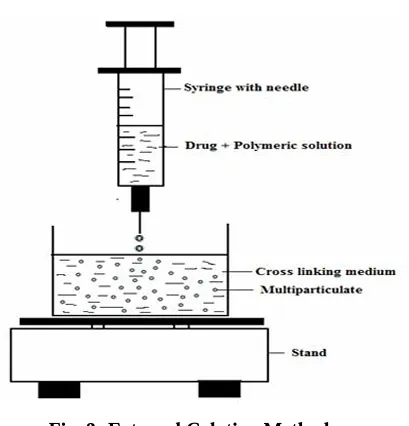
Figure 1: Ionotropic gelation Method
· Emulsion gelation Method 21
Floating beads is prepared by the emulsion gelation technique, where drug is dispersed in a sodium alginate solution. This drug-polymer solution is then added dropwise into light liquid paraffin containing a surfactant under continuous stirring to form a stable water-in-oil (w/o) emulsion. To initiate gelation, a calcium chloride solution is added dropwise, leading to cross-linking of alginate and formation of beads within the emulsion. Stirring is continued for a specific time to allow complete gelation, after which the beads are filtered, washed with n-hexane to remove oil residues, and dried.
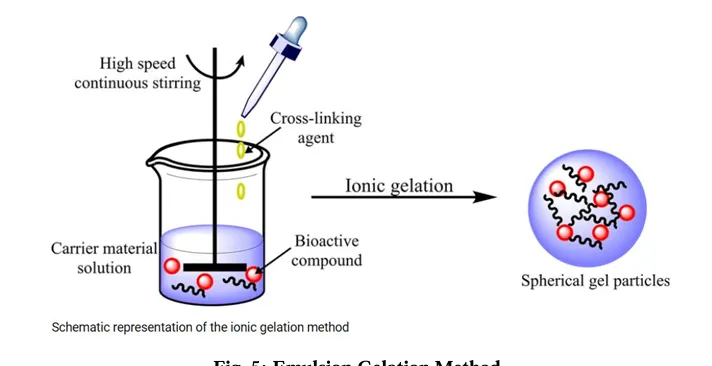
Figure 2: Emulsion gelation Method
EVALUATION PARAMETERS OF FLOATING ALGINATE BEADS
1. Percentage Yield 22
Percentage yield indicates the efficiency of the ionotropic gelation process and reflects material loss during bead preparation, curing, washing, and drying. The dried beads are weighed and compared with the total theoretical weight of the drug and polymers used during formulation. The percentage yield indicates the amount of beads successfully obtained after the preparation process.
Weight of beads obtained
Percentage yield= ×100
Total weight of drug and polymer
2. Particle Size and Size Distribution 23
The particle size of the floating beads was determined using an optical microscopy method. Initially, the eyepiece micrometer was calibrated with a stage micrometer to ensure accurate measurement. A small number of beads were then placed on a glass slide and observed under the microscope. The diameter of 100 beads was measured, and the average value was calculated to obtain the mean particle size.
3. Surface Morphology 24
Scanning electron microscopy provides insight into bead shape, surface texture, and internal porosity. The surface and internal structure of floating beads are usually examined using scanning electron microscopy (SEM). The beads are carefully cut open and coated with a thin conductive layer before observation.
4. Drug Entrapment Efficiency 25
Drug entrapment efficiency represents the ability of the alginate matrix to retain the drug during bead formation. High entrapment is desirable for dose uniformity and sustained drug release. Drug entrapment efficiency is determined by dissolving a known quantity of alginate beads in methanol using sonication, followed by suitable dilution with distilled water. The absorbance of the resulting solution was measured spectrophotometrically. Entrapment efficiency was calculated from the measured drug content using the standard formula and expressed as percentage.
Amount of drug actually present
% Drug entrapment efficiency= ×100
Theoretical drug loaded expected
5. In-vitro Buoyancy Study 26
Buoyancy is a defining characteristic of floating alginate beads and determines their gastroretentive potential. In vitro buoyancy of floating beads is evaluated in simulated gastric fluid (0.1 N HCl, pH 1.2) using a USP type II dissolution apparatus at 37 ± 0.5 °C and 50 rpm. The percentage buoyancy is calculated from the ratio of floating beads to the total number of beads.
Floating lag time indicates how quickly the beads rise to the surface after being placed in the medium.
Total floating duration represents how long the beads continue to float steadily on the surface of the medium.
6. Swelling Index 27
Swelling behaviour reflects the hydration capacity of the alginate matrix in gastric conditions. Upon contact with acidic media, alginate beads absorb fluid and swell, forming a gel barrier that controls drug diffusion. A known weight of dried beads was immersed in the medium and removed at regular intervals.The beads were filtered and reweighed to determine the extent of swelling.
Wt -W0
Swelling index = ×100
W0
Where, Wt = Final weight of beads
W0= initial wt of the beads
7. In-vitro Drug Release Study 28
Drug release studies evaluate the release profile and mechanism of drug diffusion from alginate beads. In-vitro drug release from the floating beads was evaluated using a USP type II dissolution apparatus maintained at 37 ± 2 °C. A known quantity of beads was placed in the dissolution medium, and samples were withdrawn at regular time intervals to maintain sink conditions. The collected samples were filtered and analyzed spectrophotometrically at an appropriate wavelength to determine the amount of drug released over time.
8. Drug Release Kinetics 29
Mathematical modelling using zero-order, first-order, Higuchi, and Korsmeyer–Peppas equations helps explain the drug release mechanism. Floating alginate beads commonly exhibit diffusion-controlled or anomalous transport due to combined polymer swelling and matrix erosion.
9. Stability Studies 30
Stability studies assess the ability of floating alginate beads to retain their physical integrity, buoyancy, drug content, and release characteristics during storage. Stability studies of the optimized floating bead formulation were conducted according to ICH guidelines under accelerated conditions. The formulation was packed in aluminum foil and stored at 40 °C and 75% relative humidity for three months. After the storage period, the beads were evaluated to check for any changes in their floating behavior, drug content, and drug release profile, ensuring the formulation remained stable over time.
APPLICATION OF FLOATING BEADS 31
Floating beads are ideal for drugs that are mainly absorbed in the stomach or upper intestine, such as riboflavin and furosemide. Their ability to stay in the gastric region for a longer time improves drug availability at the absorption site.
For drugs with limited absorption in the upper gastrointestinal tract, floating beads help prolong gastric residence and improve drug uptake. This results in better bioavailability compared to conventional oral dosage forms.
By retaining the dosage form in the stomach, floating beads reduce the amount of drug reaching the colon, which helps prevent unwanted colonic irritation. This makes them suitable for drugs that are unstable or harmful in the colonic environment.
Floating beads release the drug gradually, maintaining more stable plasma drug levels over time. This reduces sudden peaks and drops in concentration and lowers the risk of dose-related side effects.
CURRENT SCENARIO AND FUTURE PROSPECTS: 32
At present, gastroretentive floating beads are recognized as a promising approach for enhancing the bioavailability of drugs that are mainly absorbed in the stomach or upper part of the intestine. Current research focuses on improving buoyancy, drug entrapment efficiency, and controlled drug release using polymers such as alginate and chitosan. Floating beads have shown useful applications in the treatment of gastric disorders and in drugs requiring prolonged gastric residence time. However, challenges such as variability in gastric emptying and formulation stability still limit their widespread clinical use. In the future, the use of novel polymers, advanced fabrication techniques, and better understanding of gastric physiology may help overcome these limitations. These developments are expected to expand the therapeutic applications of floating beads and improve patient compliance.
CONCLUSION
A promising gastroretentive drug delivery method for increasing drug bioavailability and maintaining drug release in the stomach is the use of floating alginate beads. Because of their multiparticulate nature, there is less chance of dose dumping and uniform drug distribution. Benefits of alginate include controlled drug release behavior, biocompatibility, and ease of gelation. Recent developments in polymer science and fabrication methods have enhanced system performance despite formulation difficulties pertaining to gastric variability and stability. All things considered, floating alginate beads have a great deal of promise for the creation of patient-friendly and targeted oral medication delivery systems in the future.
REFERENCES



Nagaveni, Vindhya V. S., A. R. Shabaraya, Floating Alginate Beads In Gastroretentive Drug Delivery Systems: A Comprehensive Review, Int. J. of Pharm. Sci., 2026, Vol 4, Issue 7, 99-108, https://doi.org/10.5281/zenodo.21103568
 10.5281/zenodo.21103568