

We use cookies to ensure our website works properly and to personalise your experience. Cookies policy
Department of Pharmaceutics, Lamrin Tech Skills University, Ropar, Punjab-India
Allergic rhinitis is frequently managed with a combination of an antihistamine and an intranasal corticosteroid because the two drug classes act on complementary pathways of the inflammatory cascade. The present work describes the formulation and evaluation of a dual-action aqueous nasal spray containing azelastine hydrochloride (0.1% w/v) and fluticasone propionate (0.0365% w/v) intended for onceor twicedaily intranasal administration. Five formulations (F1–F5) were prepared by varying the ratio of microcrystalline cellulose/sodium carboxymethylcellulose (MCC/CMC) used as a suspending and viscositymodifying system, together with polysorbate 80 as a wetting agent and benzalkonium chloride as a preservative. The formulations were evaluated for pH, viscosity, osmolality, spray content uniformity, droplet size distribution, and spray pattern/plume geometry, in vitro drug release, and shortterm accelerated stability. Formulation F3 (MCC:CMC, 1:3) showed the most favourable overall profile with pH 5.2 ± 0.1, viscosity 148 ± 6 cP at 100 s?¹, Dv50 of 38 ± 3 ?m, and cumulative in vitro release of 97.4 ± 1.2% (azelastine) and 74.1 ± 1.8% (fluticasone) at 6 h and was selected as the optimized batch. F3 remained within specification for pH, drug content, and viscosity after 90 days of storage at 40 °C/75% RH. The results indicate that a single aqueous suspension nasal spray combining azelastine hydrochloride and fluticasone propionate can be formulated with acceptable physicochemical and release characteristics for further pharmacokinetic and clinical evaluation.
Allergic rhinitis (AR) is a chronic inflammatory condition of the nasal mucosa mediated by IgE-dependent release of histamine and other inflammatory mediators following allergen exposure. Monotherapy with either an intranasal antihistamine or an intranasal corticosteroid provides only partial symptom control in a substantial proportion of patients, since the two drug class’s act at different points of the inflammatory pathway[1]. Azelastine hydrochloride is a secondgeneration H1-receptor antagonist that also exhibits mastcellstabilizing and anti-inflammatory activity, providing rapid onset of action, while fluticasone propionate is a potent trifluorinated glucocorticoid that suppresses the broader inflammatory cascade but has a comparatively delayed onset[2]. Combining the two actives in a single delivery device allows rapid symptom relief together with sustained anti-inflammatory control, improves patient adherence by reducing the number of actuations required, and has been shown in clinical studies of the reference fixeddose combination product to produce a significantly greater reduction in the total nasal symptom score than either agent alone[1,3].From a formulation standpoint, combining a watersoluble antihistamine salt with a poorly watersoluble corticosteroid ester in a single aqueous suspension presents challenges in achieving physical stability, uniform dose delivery, an appropriate droplet size for nasal deposition, and comparable release/dissolution behaviour for both actives. Spray droplet size, plume geometry, and formulation viscosity are known to influence nasal deposition pattern and, in turn, the local and systemic bioavailability of the corticosteroid component [4,5]. The objective of the present study was therefore to develop and characterize a dual-action azelastine hydrochloride/fluticasone propionate aqueous nasal spray, to optimize the suspending/viscositymodifying polymer ratio across five trial formulations (F1–F5), and to evaluate the optimized formulation for in vitro release and shortterm accelerated stability [6-10].
Materials and Methods
Materials
Azelastine hydrochloride and fluticasone propionate (micronized, d90 < 10 μm) were obtained as gift samples from a pharmaceutical excipient/API supplier. Microcrystalline cellulose and sodium carboxymethylcellulose (Avicel RC-591-type co-processed blend), polysorbate 80, benzalkonium chloride, disodium edetate, dextrose, and phenylethyl alcohol were of pharmaceutical grade. Hydrochloric acid and sodium hydroxide were used for pH adjustment. Purified water (freshly prepared, USP grade) was used throughout. All other reagents used for analysis (methanol, acetonitrile, potassium dihydrogen phosphate) were of HPLC grade.
Formulation development (F1–F5)
Aqueous suspension nasal sprays were prepared by dispersing the micronized drugs in a pre-hydrated dispersion of MCC/CMC in purified water under highshear homogenization (5000 rpm, 15 min), followed by incorporation of polysorbate 80, benzalkonium chloride, disodium edetate, and dextrose with continuous stirring. The pH of each batch was adjusted to 4.8–5.5 with dilute HCl/NaOH, and the volume was made up with purified water. Batches were passed through a colloid mill to reduce particle agglomerates and equilibrated for 24 h before evaluation [11]. The five trial formulations differed only in the MCC:CMC ratio, which was varied to optimize suspension viscosity, sedimentation resistance, and consequently spray and release characteristics and composition is summarized in Table 1.
Table 1 Qualitative and quantitative composition of formulations F1–F5 (quantities per mL of finished product)
|
Ingredient (mg/mL unless stated) |
F1 |
F2 |
F3 |
F4 |
F5 |
Function |
|
Azelastine hydrochloride |
1.37 |
1.37 |
1.37 |
1.37 |
1.37 |
Antihistamine (active) |
|
Fluticasone propionate |
0.365 |
0.365 |
0.365 |
0.365 |
0.365 |
Corticosteroid (active) |
|
Microcrystalline cellulose |
5.0 |
4.0 |
3.0 |
6.0 |
6.5 |
Suspending agent |
|
Sodium CMC |
5.0 |
8.0 |
9.0 |
3.0 |
2.5 |
Viscosity modifier |
|
MCC:CMC ratio |
1:1 |
1:2 |
1:3 |
2:1 |
2.6:1 |
— |
|
Polysorbate 80 |
0.20 |
0.20 |
0.20 |
0.20 |
0.20 |
Wetting agent |
|
Benzalkonium chloride |
0.20 |
0.20 |
0.20 |
0.20 |
0.20 |
Preservative |
|
Disodium edetate |
0.10 |
0.10 |
0.10 |
0.10 |
0.10 |
Chelating agent |
|
Dextrose |
25.0 |
25.0 |
25.0 |
25.0 |
25.0 |
Tonicity agent |
|
Phenylethyl alcohol |
2.5 |
2.5 |
2.5 |
2.5 |
2.5 |
Co-preservative |
|
HCl / NaOH |
q.s. |
q.s. |
q.s. |
q.s. |
q.s. |
pH adjustment (4.8–5.5) |
|
Purified water |
q.s. to 1 mL |
q.s. to 1 mL |
q.s. to 1 mL |
q.s. to 1 mL |
q.s. to 1 mL |
Vehicle |
Evaluation of physicochemical properties
Results and Discussion
Physicochemical evaluation
All five formulations were homogeneous, off white suspensions with no visible aggregation immediately after preparation. pH values for all batches fell within the target range of 4.8–5.5, close to the physiological pH of nasal secretions, minimizing the likelihood of nasal irritation. Viscosity increased with increasing proportion of sodium CMC relative to MCC, consistent with the higher intrinsic viscosity of the carboxymethylcellulose component.All formulations exhibited shearthinning (pseudoplastic) behaviour, which is desirable for a nasal spray as it permits easy actuation under the high shear generated by the pump mechanism while maintaining sufficient viscosity at rest to limit sedimentation. Osmolality of all batches ranged between 295 and 318 mOsm/kg, within the physiologically acceptable range for nasal administration. Summarised evaluation data is presented in Table 2.
Table 2 Physicochemical evaluation of formulations F1–F5 (mean ± SD, n = 3)
|
Parameter |
F1 |
F2 |
F3 |
F4 |
F5 |
|
pH |
5.4 ± 0.1 |
5.3 ± 0.1 |
5.2 ± 0.1 |
5.5 ± 0.1 |
5.4 ± 0.1 |
|
Viscosity at 100 s⁻¹ (cP) |
165 ± 8 |
210 ± 7 |
148 ± 6 |
255 ± 9 |
270 ± 10 |
|
Osmolality (mOsm/kg) |
301 ± 4 |
308 ± 3 |
310 ± 5 |
295 ± 4 |
318 ± 6 |
|
Dv50 droplet size (μm) |
52 ± 4 |
47 ± 3 |
38 ± 3 |
58 ± 5 |
44 ± 4 |
|
Ovality ratio (spray pattern) |
1.32 |
1.24 |
1.11 |
1.41 |
1.28 |
|
Drug content – azelastine (%) |
99.1 ± 0.6 |
99.4 ± 0.5 |
99.8 ± 0.4 |
98.7 ± 0.7 |
99.0 ± 0.5 |
|
Drug content – fluticasone (%) |
98.6 ± 0.8 |
99.0 ± 0.6 |
99.5 ± 0.5 |
98.1 ± 0.9 |
98.8 ± 0.6 |
Droplet size distribution
Droplet size decreased progressively as the sodium CMC content increased up to F3, likely reflecting improved dispersion homogeneity and reduced particle agglomeration at the intermediate MCC:CMC ratio; a further increase in CMC content (F4, F5) resulted in higher viscosity that hindered efficient atomization and produced larger droplets. F3 produced the narrowest and finest droplet size distribution (Dv50 = 38 ± 3 μm), which falls within the 30–80 μm range generally considered optimal for deposition on the nasal mucosa while minimizing pharyngeal deposition and postnasal drip.
Rheological behaviour
The rheogram of the optimized formulation F3 showed a progressive decrease in apparent viscosity with increasing shear rate, confirming pseudoplastic (shearthinning) flow. This behaviour is advantageous for a suspension nasal spray: high viscosity at low shear supports uniform re-suspension and prevents settling of the micronized drug particles during storage, whereas the marked drop in viscosity at the high shear rates generated during pump actuation (>200 s⁻¹) facilitates consistent atomization and delivery of a reproducible dose.
In vitro drug release
In vitro release profiles for azelastine hydrochloride and fluticasone propionate from formulations F1–F5 are shown Table 3. For both actives, cumulative release followed the order F3 > F2 > F5 > F1 > F4, mirroring the trend observed for droplet size and viscosity: the lowerviscosity, finerdroplet formulations offered a larger effective surface area for drug dissolution/diffusion across the membrane. Azelastine hydrochloride, being freely watersoluble, showed markedly faster and more complete release (84–97% at 6 h across batches) than fluticasone propionate (46–74% at 6 h), consistent with the substantially lower aqueous solubility of the corticosteroid ester. Formulation F3 gave the highest cumulative release for both actives (97.4 ± 1.2% azelastine; 74.1 ± 1.8% fluticasone at 6 h) and was therefore selected as the optimized batch for further stability evaluation.
Table 3 Cumulative in vitro drug release (%) of azelastine hydrochloride and fluticasone propionate from optimized formulation F3 (mean ± SD, n = 3)
|
Time (h) |
0 |
0.5 |
1 |
2 |
3 |
4 |
5 |
6 |
|
AzelastineHCl (%) |
0 |
26.1±1.1 |
44.3±1.3 |
62.0±1.5 |
74.2±1.4 |
84.1±1.6 |
92.0±1.2 |
97.4±1.2 |
|
Fluticasone propionate (%) |
0 |
13.2±0.9 |
23.8±1.0 |
36.1±1.2 |
46.9±1.3 |
57.0±1.4 |
65.8±1.5 |
74.1±1.8 |
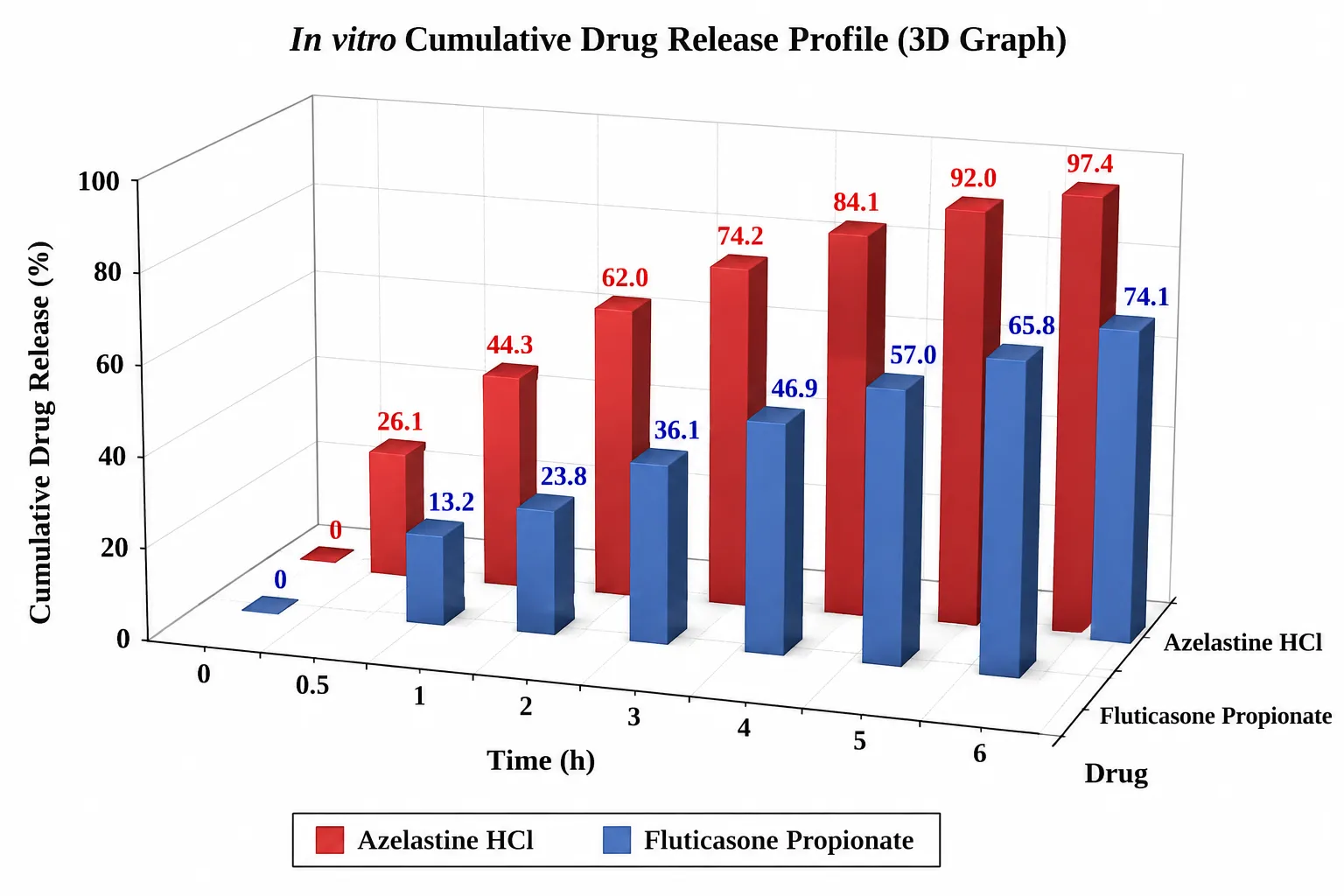
Figure 1 In vitro cumulative drug release profiles of Azelastine HCl and Fluticasone Propionate over 6 h.
Accelerated stability of optimized formulation (F3)
The optimized formulation F3 remained a homogeneous, easily re-dispersible suspension throughout the 90day accelerated stability study, with no evidence of caking, discoloration, or crystal growth. pH drifted marginally from 5.2 to 5.0, and viscosity remained within ±10% of the initial value. Drug content for both actives remained above 97% of label claim through 90 days at 40 °C/75% RH (Figure 5), indicating adequate chemical stability of both azelastine hydrochloride and fluticasone propionate in the developed suspension base.
Table 4 Accelerated stability data for optimized formulation F3 (40 ± 2 °C / 75 ± 5% RH)
|
Time (days) |
pH |
Viscosity (cP) |
Azelastine content (%) |
Fluticasone content (%) |
|
0 |
5.2 ± 0.1 |
148 ± 6 |
100.0 |
100.0 |
|
15 |
5.2 ± 0.1 |
150 ± 5 |
99.6 ± 0.3 |
99.3 ± 0.4 |
|
30 |
5.1 ± 0.1 |
152 ± 6 |
99.1 ± 0.4 |
98.8 ± 0.4 |
|
45 |
5.1 ± 0.1 |
155 ± 7 |
98.7 ± 0.5 |
98.2 ± 0.5 |
|
60 |
5.0 ± 0.1 |
157 ± 6 |
98.3 ± 0.5 |
97.6 ± 0.5 |
|
90 |
5.0 ± 0.1 |
160 ± 7 |
97.9 ± 0.6 |
97.0 ± 0.6 |
Selection of optimized formulation
Considering pH, viscosity/rheological profile, droplet size distribution, spray pattern uniformity, drug content, and in vitro release performance collectively, formulation F3 (MCC:CMC, 1:3) was identified as the optimized batch. It combined the lowest viscosity and finest, most uniform droplet size with the highest cumulative in vitro release of both actives, while retaining acceptable physical and chemical stability over the 90-day accelerated study.
CONCLUSION
A dual-action aqueous suspension nasal spray combining azelastine hydrochloride and fluticasone propionate was successfully formulated and evaluated across five trial batches (F1–F5) differing in suspending/viscosity-modifying polymer ratio. Formulation F3, prepared with an MCC:CMC ratio of 1:3, demonstrated the most favourable combination of physicochemical properties, the finest droplet size distribution, and the highest in vitro drug release for both actives, and retained acceptable stability on short-term accelerated storage. These findings support the feasibility of delivering a fixeddose combination of an antihistamine and a corticosteroid from a single aqueous nasal spray formulation and provide a rational basis for further pharmacokinetic, nasal deposition, and clinical studies of the optimized formulation.
REFERENCES

Kanupriya Choudhary, Dr. Naresh Singh Gill, Komal*, Formulation And Evaluation Of A Dualaction Nasal Spray Of Azelastine Hydrochloride And Fluticasone Propionate, Int. J. of Pharm. Sci., 2026, Vol 4, Issue 8, 1925-1931. https://doi.org/10.5281/zenodo.21892711
 10.5281/zenodo.21892711