We use cookies to ensure our website works properly and to personalise your experience. Cookies policy
1,2,3,4,5,6 D.S.T.S Mandal’s College of Pharmacy, Solapur, Maharashtra, India
7Government College of Pharmacy, Karad, Maharashtra, India.
The periorbital skin is thinner and contains less subcutaneous fat than skin elsewhere on the face, making it particularly susceptible to hyperpigmentation, puffiness and premature ageing. This has driven demand for cosmeceutical formulations that combine natural antioxidant actives with well-tolerated synthetic excipients. The present study describes the formulation and evaluation of an under-eye gel incorporating coffee (Coffea arabica) bean extract and liquorice (Glycyrrhiza glabra) root extract, together with aloe vera and almond oil, for the management of dark circles, puffiness and hyperpigmentation. Coffee and liquorice extracts were obtained by decoction and hydro-alcoholic maceration–ultrasonication, respectively, and incorporated into a Carbopol 940 gel base at four different gelling-agent concentrations (F1-F4), with triethanolamine as the pH-adjusting/neutralising agent and glycerine and polyethylene glycol as humectants. The formulations were evaluated for physical appearance, pH, viscosity, spreadability, extrudability, washability, greasiness, skin irritancy and in vitro antioxidant activity (H2O2 radical-scavenging assay). All four formulations were light brown, smooth, semi-solid, non-greasy, easily washable and non-irritant, with pH values of 5.5-6.1 and spreadability of 5.4-6.0 cm. Viscosity decreased with increasing shear (5304-2080 cP across 10–40 rpm), consistent with the expected pseudoplastic behaviour of a Carbopol gel. Antioxidant activity, assessed as percentage H2O2 scavenging, ranged from 33.8% to 43.3%, with formulation F4 (containing the highest Carbopol 940 concentration) showing the greatest activity. These findings indicate that the coffee–liquorice under-eye gel is a stable, skin-compatible, non-irritant formulation with measurable antioxidant activity, supporting its potential as a herbal cosmeceutical for periorbital hyperpigmentation
Cosmetics are defined under the Drugs and Cosmetics Act, 1940 and Rules, 1945 as articles intended to be applied to the human body for cleansing, beautifying or altering appearance [1]. Cosmeceuticals, a term introduced by Albert Kligman, occupy the space between conventional cosmetics and pharmaceuticals, offering measurable dermatological benefit in addition to cosmetic effect, and represent one of the fastest-growing segments of the personal-care industry [1,2].
The skin surrounding the eyes is thinner and contains comparatively less subcutaneous fat than skin elsewhere on the face, which makes the underlying vasculature more visible and predisposes this region to a bluish or brownish discolouration commonly termed “dark circles” or periorbital hyperpigmentation. Periorbital hyperpigmentation is multifactorial, arising from dermal vascular congestion, post-inflammatory pigmentation, infra-orbital fat herniation, tear-trough deformity, skin laxity and thinning, and is aggravated by ageing, stress, sun exposure, allergic dermatitis, genetics and lifestyle factors such as poor sleep and eye rubbing [3,4]. Tyrosinase is the rate-limiting enzyme in melanogenesis, and compounds that inhibit tyrosinase activity or scavenge the reactive oxygen species that up-regulate it are of particular interest for skin-brightening formulations [4].
Herbal actives are increasingly preferred over purely synthetic agents in cosmeceutical formulations because of their comparatively favourable safety profile and consumer acceptance [1,4,5]. Coffee (Coffea arabica) is a rich source of caffeine, chlorogenic acid, diterpenes and polyphenols, which together provide vasoconstrictive, antioxidant and anti-inflammatory activity and are reported to reduce periorbital puffiness [6]. Liquorice (Glycyrrhiza glabra) contains glycyrrhizin, liquiritin and glabridin, constituents associated with skin-brightening, anti-inflammatory and tyrosinase-inhibitory activity, and has been used effectively in herbal formulations for hyperpigmentation and dark circles [4,7,8]. Aloe vera contributes hydrating, soothing and antioxidant properties through its polysaccharide and glycoprotein content, while almond oil, rich in vitamin E, essential fatty acids and antioxidants, moisturises and helps repair the skin barrier [5,9]. Related herbal under-eye formulations incorporating actives such as caffeine, niacinamide, turmeric, Terminalia chebula, and Crepe Jasmine/mango-leaf extracts have similarly demonstrated reductions in puffiness, fine lines and pigmentation, supporting the rationale for a combination herbal approach [10,11].
Building on this evidence base, the present study was undertaken to formulate an under-eye gel combining coffee and liquorice extracts with aloe vera and almond oil in a Carbopol 940 gel base, and to evaluate its physicochemical properties, skin compatibility and in vitro antioxidant activity.
1.1 Aim
To formulate and evaluate an under-eye gel using natural and synthetic ingredients for the management of periorbital dark circles.
1.2 Objectives
(i) To formulate an under-eye gel incorporating coffee and liquorice extracts;
(ii) to evaluate the physicochemical properties of the formulations, including pH, viscosity and spreadability;
(iii) to assess the in vitro antioxidant activity of the formulated gel; and
(iv) to confirm that the formulated gel is safe (non-irritant) and effective for topical application.
Need of Research:
The delicate skin under the eyes is highly susceptible to signs of aging, stress, and environmental damage, often resulting in puffiness, dark circles, fine lines, and dryness. Conventional under-eye products may contain synthetic ingredients that could cause irritation or long-term side effects, especially for sensitive skin.
There is an increasing demand for herbal cosmetic products due to their safety and skin-friendly benefits. Ingredients like coffee bean extract, liquorice, aloe vera, and almond oil help reduce puffiness, hydrate skin, and lighten dark circles, making them ideal for under-eye gel formulations.
2. MATERIALS AND METHODS
2.1 Materials
Coffee beans were collected from a farm in Shimoga village, Karnataka. Liquorice and almond oil were procured from a local herbal supplier (Balu Gote, Solapur). Aloe vera was obtained from the medicinal-plant garden of the college. Carbopol 940, sodium benzoate, glycerine, polyethylene glycol (PEG), triethanolamine and rose water (all of laboratory grade) were used as received. Details of the ingredients, their functional category and source are summarised in Table 1.
Table 1. Ingredients used in the formulation
|
Sr. No. |
Ingredient |
Category |
|
1 |
Coffee bean extract |
Antioxidant, vasoconstrictor |
|
2 |
Liquorice extract |
Skin lightening, anti-inflammatory |
|
3 |
Aloe vera |
Moisturising, soothing |
|
4 |
Almond oil |
Emollient, anti-ageing |
|
5 |
Carbopol 940 |
Gelling agent |
|
6 |
Sodium benzoate |
Antimicrobial, preservative |
|
7 |
Glycerine |
Humectant |
|
8 |
Polyethylene glycol (PEG) |
Solvent, penetration enhancer |
|
9 |
Triethanolamine |
pH adjuster |
|
10 |
Rose water |
Natural fragrance, vehicle |
2.2 Extraction Method Plant material:
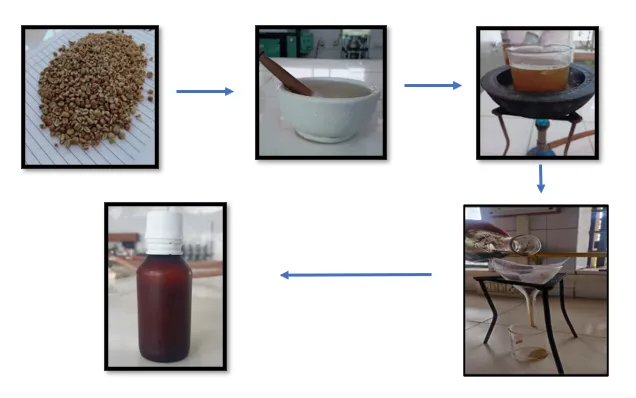
2.2.1 Decoction Method of Coffee Bean Extract:
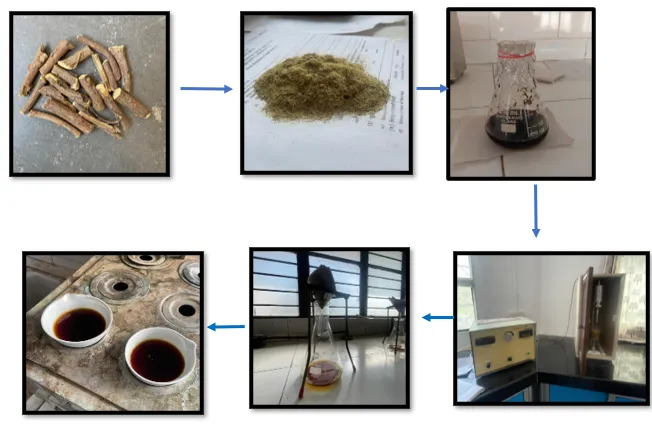
2.2.2 Maceration and Ultrasonication method of liquorice extract:
2.4 Formulation of Under-Eye Gel
Carbopol 940 was dispersed slowly in rose water with gentle stirring and allowed to hydrate for 1-2 h to form the aqueous phase. The herbal actives (coffee extract, liquorice extract, aloe vera and almond oil) were mixed separately to obtain a uniform extract blend, to which glycerine, PEG and sodium benzoate were added with stirring. This extract blend was then incorporated into the hydrated Carbopol dispersion under continuous stirring. Triethanolamine was added dropwise to neutralise the Carbopol and form the gel, with the pH adjusted to 5.0-7.0. The final volume was made up to 50 mL with rose water and stirred to ensure uniform consistency. Four formulations (F1-F4) were prepared, varying only the concentration of Carbopol 940, as shown in Table 2.
Table 2. Composition of the formulated under-eye gel
|
Sr. No. |
Ingredient |
F1 |
F2 |
F3 |
F4 |
|
1 |
Coffee extract |
3 |
3 |
3 |
3 |
|
2 |
Liquorice extract |
1.5 |
1.5 |
1.5 |
1.5 |
|
3 |
Aloe vera |
2 |
2 |
2 |
2 |
|
4 |
Almond oil |
0.4 |
0.4 |
0.4 |
0.4 |
|
5 |
Carbopol 940 |
0.4 |
0.6 |
0.8 |
1 |
|
6 |
Sodium benzoate |
0.2 |
0.2 |
0.2 |
0.2 |
|
7 |
Glycerine |
3 |
3 |
3 |
3 |
|
8 |
PEG |
1.3 |
1.3 |
1.3 |
1.3 |
|
9 |
Triethanolamine |
0.5 |
0.5 |
0.5 |
0.5 |
|
10 |
Rose water |
Q.S. |
Q.S. |
Q.S. |
Q.S. |
2.5 Evaluation of the Formulated Gel
2.5.1 Physical evaluation: Colour, odour, texture and consistency of each formulation were assessed by visual and organoleptic examination.
2.5.2 pH: One gram of gel was dissolved in 10 mL of distilled water and the pH measured with a digital pH meter by fully immersing the glass electrode in the dispersion. The acceptable pH range for skin compatibility was taken as 5.0-7.5.
2.5.3 Irritancy: A small quantity of gel was applied to the skin and the site observed for redness or irritation over a 10-min period.
2.5.4 Viscosity: Viscosity was measured with a digital Brookfield viscometer (spindle no. 64) at 10, 20, 30 and 40 rpm.
2.5.5 Spreadability: One gram of gel was placed between two glass slides fitted to a laboratory-fabricated spreadability apparatus; a fixed weight was applied to the upper slide and the time taken for the slides to separate was recorded with a stopwatch and converted to a spread distance (cm).
2.5.6 Washability: Gel was applied to the skin, left for 5 min, and then rinsed under running tap water to assess ease of removal.
2.5.7 Greasiness: Gel was smeared on the skin surface and the residue examined for an oily or greasy feel.
2.5.8 Extrudability: Gel was filled into a collapsible aluminium tube sealed at one end; light pressure was applied at the closed end and the quantity extruded and time taken were recorded.
2.5.9 In vitro antioxidant activity (H2O2 scavenging assay): Antioxidant activity was determined by the hydrogen-peroxide-scavenging method. To 0.1 mL of sample, 3.4 mL of 0.1 M phosphate buffer and 0.6 mL of 40 mM H2O2 were added, and the mixture incubated for 10 min at room temperature. Absorbance was measured at λmax 230 nm against a blank using a UV-Vis spectrophotometer, with ascorbic acid as the standard, at a test concentration of 1000 µg/mL of gel extract. Percentage scavenging of H2O2 was calculated as: % scavenging = (A0 − A1)/A0 × 100, where A0 is the absorbance of the control and A1 is the absorbance of the sample.
3. RESULTS AND DISCUSSION
3.1 Physical evaluation
All four formulations (F1–F4) were light brown in colour, with a pleasant odour, smooth texture and semi-solid consistency (Table 3), indicating uniform incorporation of the herbal extracts across formulations.
Table 3: Physical evaluation of the formulated gel
|
Sr. No. |
Parameter |
F1 |
F2 |
F3 |
F4 |
|
1 |
Colour |
Light brown |
Light brown |
Light brown |
Light brown |
|
2 |
Odour |
Pleasant |
Pleasant |
Pleasant |
Pleasant |
|
3 |
Texture |
Smooth |
Smooth |
Smooth |
Smooth |
|
4 |
State |
Semi-solid |
Semi-solid |
Semi-solid |
Semi-solid |
3.2 Washability
All formulations were easily washable with running water (Table 4), a desirable characteristic for a cosmetic gel intended for daily use around the delicate periorbital area.
Table 4. Washability of the formulated gels
|
Sr. No. |
Formulation |
Washability |
|
1 |
F1 |
Easily washable |
|
2 |
F2 |
Easily washable |
|
3 |
F3 |
Easily washable |
|
4 |
F4 |
Easily washable |
3.3 Irritancy
No erythema, oedema or irritation was observed at the application site for any formulation over the 10-min observation period; all formulations were classed as non-irritant (Table 5), supporting suitability for use on sensitive periorbital skin.
Table 5. Skin irritancy of the formulated gel
|
Sr. No. |
Formulation |
Irritancy |
|
1 |
F1 |
Non-irritant |
|
2 |
F2 |
Non-irritant |
|
3 |
F3 |
Non-irritant |
|
4 |
F4 |
Non-irritant |
3.4 Spreadability
Spreadability values ranged from 5.4 cm (F1) to 6.0 cm (F4) (Table 6). Spreadability increased slightly with increasing Carbopol 940 concentration, indicating that the formulations retained good spreading characteristics important for uniform, patient-compliant application even as gel strength increased.
Table 6: Spreadability of the formulated gel
|
Sr. No. |
Formulation |
Spreadability (cm) |
|
1 |
F1 |
5.4 |
|
2 |
F2 |
5.9 |
|
3 |
F3 |
5.8 |
|
4 |
F4 |
6.0 |
3.5 pH
The pH of the formulations ranged from 5.5 to 6.1 (Table 7), within the acceptable range for topical application and close to the physiological pH of the skin, indicating a low likelihood of pH-related irritation.
Table 7: pH of the formulated gels
|
Sr. No. |
Formulation |
pH |
|
1 |
F1 |
5.5 |
|
2 |
F2 |
5.8 |
|
3 |
F3 |
6.0 |
|
4 |
F4 |
6.1 |
3.6 Viscosity
Viscosity was recorded across increasing rotational speed (10-40 rpm), with values of 5304 cP (F1, 10 rpm), 3760 cP (F2, 20 rpm), 2560 cP (F3, 30 rpm) and 2080 cP (F4, 40 rpm) (Table 8). The decrease in apparent viscosity with increasing shear rate is consistent with the pseudoplastic (shear-thinning) flow behaviour typical of Carbopol gels, which favours ease of application while maintaining adequate consistency at rest.
Table 8: Viscosity of the formulated gel
|
Sr. No. |
Formulation |
Viscosity (cP) |
Speed (rpm) |
|
1 |
F1 |
5304 |
10 |
|
2 |
F2 |
3760 |
20 |
|
3 |
F3 |
2560 |
30 |
|
4 |
F4 |
2080 |
40 |
3.7 Greasiness
All formulations were assessed as non-greasy on application (Table 9), consistent with the light, aqueous-gel character of the base and suitable for use in the periorbital region, where a heavy or occlusive residue is undesirable.
Table 9: Greasiness of the formulated gel
|
Sr. No. |
Formulation |
Greasiness |
|
1 |
F1 |
Non-greasy |
|
2 |
F2 |
Non-greasy |
|
3 |
F3 |
Non-greasy |
|
4 |
F4 |
Non-greasy |
3.8 In vitro antioxidant activity
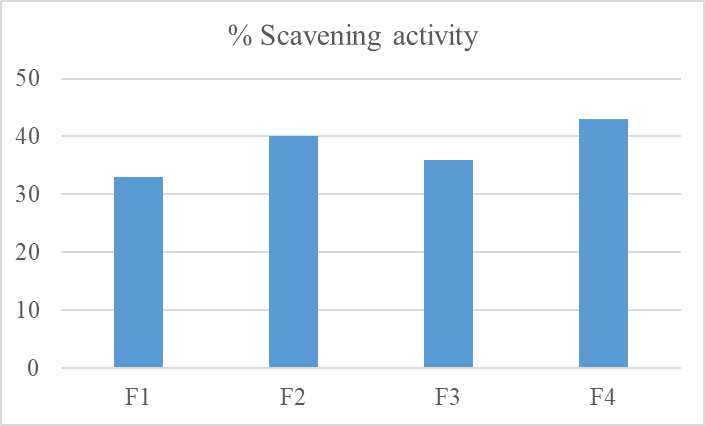
Antioxidant activity, measured as percentage H2O2-scavenging relative to a control absorbance of 0.127, ranged from 33.8% (F1) to 43.3% (F4) (Table 10). Scavenging activity increased with increasing Carbopol 940 concentration across the series (F1: 33.8% < F3: 36% < F2: 40% < F4: 43.3%), with F4 showing the highest activity. This antioxidant activity is attributable to the phenolic and polyphenolic constituents of the coffee and liquorice extracts (chlorogenic acid, diterpenes and glycyrrhizin/glabridin), which are capable of neutralising reactive oxygen species and are consistent with the free-radical-scavenging mechanism reported for related plant-derived phenolics [4,6,7].
Table 10: In vitro antioxidant (H2O2-scavenging) activity of the formulated gels
|
Formulation |
Absorbance of control |
Absorbance of sample |
% Scavenging activity |
|
F1 |
0.127 |
0.084 |
33.8% |
|
F2 |
0.127 |
0.075 |
40% |
|
F3 |
0.127 |
0.081 |
36% |
|
F4 |
0.127 |
0.072 |
43.30% |
Taken together, all four formulations met the physicochemical and safety criteria expected of a topical under-eye gel. F4, formulated with the highest Carbopol 940 concentration (1%), showed the best overall performance, combining the highest antioxidant activity (43.3%), a favourable pH (6.1), good spreadability (6.0 cm) and non-irritant, non-greasy characteristics, and is therefore considered the optimised formulation from this series.
CONCLUSION
An under-eye gel combining coffee (Coffea arabica) and liquorice (Glycyrrhiza glabra) extracts with aloe vera and almond oil was successfully formulated using Carbopol 940 as the gelling agent. All formulations (F1–F4) were light brown, smooth, semi-solid, non-greasy, easily washable and non-irritant, with pH (5.5–6.1) and spreadability (5.4–6.0 cm) within acceptable ranges for topical use, and viscosity that decreased with increasing shear, consistent with pseudoplastic gel behaviour. In vitro H2O2-scavenging activity ranged from 33.8% to 43.3%, with formulation F4 exhibiting the highest antioxidant activity together with optimal physicochemical properties and excellent skin compatibility. These results support the potential of this coffee–liquorice gel as a safe, effective, non-greasy herbal cosmeceutical for reducing under-eye dryness, puffiness, dark circles and hyperpigmentation. Further work, including long-term stability studies, dermal-penetration/permeation studies and clinical evaluation of efficacy in human subjects, is warranted before commercial development.
ACKNOWLEDGEMENTS
The authors thank the Principal and management of D.S.T.S. Mandal's College of Pharmacy, Solapur, for providing the facilities used in this work, and the laboratory staff for their technical assistance.
CONFLICT OF INTEREST
The authors declare no conflict of interest.
REFERENCES


Laxmi Kawade, Y.S. Thorat, Sakshi Bhanap, Sandhya Khyamgonde, Vaishnavi Salunke, Ganesh Sarsambe, Avinash Hosmani. Formulation and Evaluation of Antioxidant Gel Containing Extracts of Coffee and Liquorice for Treatment of Under Eye Hyperpigmentation, Int. J. of Pharm. Sci., 2026, Vol 4, Issue 8, 3493-3502, https://doi.org/10.5281/zenodo.22053713
 10.5281/zenodo.22053713