

We use cookies to ensure our website works properly and to personalise your experience. Cookies policy
Smt. Tarawati Institute of Bio-Medical & Allied Sciences, Roorkee, Uttarakhand 247667
Introduction : Fast dissolving tablets dissolves and split very fast in our mouth in a very less time and it does not need any liquid for consumption. The Fast dissolving tablet splits very fast into the saliva of our mouth and gives the pharmacological action of the API. Objective : The main objective of this study was to use a natural and synthetic super disintegrants for formulation of the fast dissolving table of Diltiazem with low substitute hydroxypropyl of cellulose (synthetic super disintegrants) and chia seed mucilage ( natural superdisintegrants) as a superdisintegrants. Identification test of Diltiazem, tablet manufacturing, disintegration and dissolution time assessment, physical and chemical property and drug release assessment. Method : Using the Direct Compression technique The mix of all formulations was found to be satisfactory after being evaluated for several precompression parameters, including as Hausner's ratio, bulk density, tapped density, compressibility index, and angle of repose. The tablets were evaluated for a number of attributes, such as weight variation, thickness, hardness, friability, wetting time, water absorption ratio, disintegration time, content homogeneity, and in vitro drug release. Result: The four API formulations in the study, designated F1, F2, F3, and F4, were created utilizing various super disintegration agents. low substitute hydroxypropyl of cellulose 6% in F1 and 9% in F2, Salvia hispanica L. 6 % in F3 and 9% in F4 . Among F1 (97.98%), F3 (96.86%), and F4 (96.46%), F2 demonstrated 98.66% drug release at 30 minutes .The hardness of the tablet varied from 2.6 to 3.4 kg/cm2, Thickness is 2.22 to 2.26 mm and friability is 0.48 to 0.62%according to the results. Conclusion: The goal of the study was to create Fast dissolving tablets for Diltiazem using natural and synthetic polymers, such as low substitute hydroxypropyl of cellulose or Salvia hispanica L., to enhance the API's drug release.
Fast dissolving tablet
Fast dissolving tablets dissolves and split very fast in our mouth in a very less time and it does not need any liquid for consumption. The Fast dissolving tablet splits very fast into the saliva of our mouth and gives the pharmacological action of the API. In comparison with normal tablets, oral dispersible Tablet have good compliance with patients, improved drug plasma concentration
We use oral route over other routes of administration because of easy administration of dosage form, no pain during administration and nil patient incompliance. Tablets and capsules are the most widely used dosage form. But one of the major disadvantages of tablet dosage forms is that they are tough to swallow. To overcome this type of hurdle in swallowing, Formulation department has developed a system which is fast dissolving i.e. Fast dissolving tablet
They offer advantages over swallowed tablet. To swallow the tablet is very tough especially for small children and old age patients. The different methods that are being used for the formulation of FDT are lyophilization, blow drying, molding, sublimation and direct compression.[1,2]
Need of fast dissolving drug delivery system
The oral route is the most popular because of ease of ingestion, avoidance of pain, versatility to accommodate different types of drug candidates and most importantly, patient compliance. In addition, solid oral delivery systems do not require sterile conditions and are therefore less costly to manufacture. Many pharmaceutical dosages are taken by mouth as pills, such as tablets and capsules. Recently, many novel technologies for oral delivery have become available to address the physicochemical and pharmacokinetic characteristics of drugs and to improve patient compliance.[3]
All age groups frequently have dysphagia, or difficulty swallowing. found that approximately 35% of the general population, 30–40% of elderly institutionalized patients, and 8–22% of all individuals in long-term care facilities have dysphagia. Tablet size, surface, form, and taste are the most frequently complained about aspects of tablet swallowing problems.
Among all the dosage forms that are currently accessible, tablets are the most commonly utilized due to their ease of administration, affordability, and elegance. Tablets are oral, single-dose preparations meant for administration. Among the excipients utilized it he tablet manufacturing process are lubricants, disintegrants, binder, glidants, etc. Certain tablets are chewed or consumed whole, while others dissolve or disperse in water before delivery, and yet others are placed in the mouth to release the active ingredient. Oral administration is the most common route of drug delivery, with advantages including high patient compliance, low risk of infection and minimal sterility constraints, which simplifies the production process and reduces costs.
Worldwide, hypertension is a major cause of disease and mortality. It is one of the leading causes of chronic renal disease, overall mortality rates, and cardiovascular issues such ischemic heart disease, stroke, and heart failure. As the population ages, it is expected that the number of people with hypertension would increase. Resistant hypertension affects between 10% and 15% of people undergoing hypertension medication.[4,5]
In the absence of confirmatory testing, resistant hypertension is defined as blood pressure readings that stay above the target even when the patient takes three or more antihypertensive drugs—typically a diuretic—or requires four or more drugs to effectively control blood pressure.
Improving treatments for resistant hypertension is crucial since multiple studies show that people with this illness are more likely to have negative consequences. Heart attacks, ischemic heart disease, heart failure, strokes, Chronic Kidney Disease (CKD) or end-stage renal disease, and mortality were almost twice as common among patients with resistant hypertension in large retrospective studies with 200,000–400,000 participants.
Additionally, patients with particular comorbidities, such as CKD, ischemic heart disease, obesity, diabetes, and obstructive sleep apnea, have worse results when they have resistant hypertension.[6,7]
Diltiazem hydrochloride
Diltiazem is a calcium channel blocker that blocks calcium channels in the heart and blood vessels. By relaxing the blood arteries, reducing blood pressure, and boosting the heart's blood and oxygen flow, this decreases the strain on the heart.
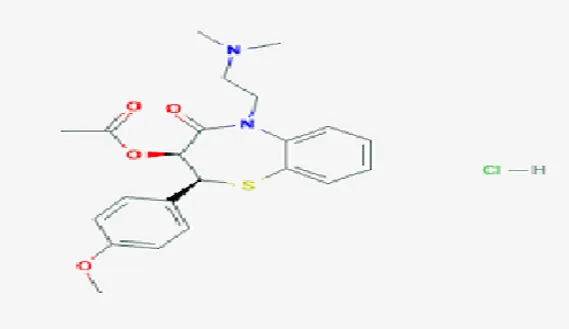
Figure: 1 Diltiazem
Diltiazem has the longest half-life, lasting between 30 and 50 hours. This extended half-life makes it possible to take the medication once daily, which is beneficial. The FDA first approved amlodipine in 1987, and it is currently sold under the brand name Diltiazem. Diltiazem a calcium antagonist dihydropyridine, inhibits the entrance of calcium ions into cardiac and vascular smooth muscle. Diltiazem is used to treat hypertension in both young and elderly people. When an instant release formulation is taken orally, it takes six to eight hours for the therapeutic action to manifest.[8,9]
Diltiazem bind on the L-shape calcium binding site and stop the intake of calcium ion in smooth muscle. Dihydropyridine more potent action on blood vessels than heart muscle and prevent hypertension. Non-dihydropyridine more potent action on heart muscle then blood vessels and treat hypertension. Diltiazem is use also alone and combination with other medicine such as hydrochlorothiazide to treat HTN.
MATERIAL AND METHOD
Diltiazem hydrochloride is given as gift sample by Acme generics Pharma from Baddi microcrystalline cellulose Acme generics Pharma from Baddi. Natural Superdisintegrants by Local market, Talc and magnesium stearate were Acme generics Pharma from Baddi.
Extraction
Salvia hispanica
Salvia Hispanic seeds were steeped in water for a whole night (the seed-solvent ratio was 1:20), mixed on a magnetic stirrer for an hour, and then heated for 30 minutes to completely release the mucilage into the water. Centrifuging the liquid for 50 minutes at 5000 rpm produced three separate layers. Dry the gel layer at 50°C in a hot air oven. The product was stored at room temperature in desiccators for subsequent use after being powdered and passing through sieve no. 80.[10]

Figure: 2 Salvia Hiaspanica
Table:1 Evaluation of Salvia hispanica
|
Sr. No |
Consistent |
Name of test |
Observation |
Result |
|
1 |
Molisch’s test |
Carbohydrate Test |
Violet or purple ring confirms |
+ve |
|
2 |
Mayer’s reagent |
Alkaloid Test |
opalescence or yellowish precipitate |
-ve |
|
3 |
Ferric chloride |
Tannins Test |
blackish blue color precipitate |
-ve |
|
4 |
Keller-Kilani test |
Glycosides Test |
formed Reddish brown layer |
+ve |
|
5 |
Ninhydrin Test |
Protein Test |
Appearance blue colour |
-ve |
Table 2: Composition of Experimental Batches of Tablets
|
Ingredients |
F1 |
F2 |
F3 |
F4 |
|
Diltiazem |
60 |
60 |
60 |
60 |
|
low substitute hydroxypropyl of cellulose |
6 |
9 |
- |
- |
|
Salvia Hispanic |
- |
- |
6 |
9 |
|
Mannitol |
50 |
50 |
50 |
50 |
|
Microcrystalline cellulose |
20 |
20 |
20 |
20 |
|
Aspartame |
10 |
10 |
10 |
10 |
|
Magnesium stearate |
34 |
31 |
34 |
31 |
|
Talc |
20 |
20 |
21 |
21 |
|
Total |
200 |
200 |
200 |
200 |
Precompression study
Determination of melting point determining the melting point The medication Diltiazem is to be placed into a fused capillary tube with one end and placed within a digital melting point instrument (Perfit India, Model No. REC2802582). The melting point of a medicine is the temperature at which it begins to melt.[11]
Determination of λ max of Diltiazem Using a UV-visible spectrometer (UV-2450, Shimadzu), the UV spectra of Diltiazem was produced. The medication was introduced to a 100 ml volumetric flask with an accurate weight of 10 mg. Using 100 μg/ml of water, the volume was increased to 100 ml. This was a stock solution that was applied. This solution (100 μg/ml) was used to generate appropriate working solutions at various concentrations (10, 20, 30, 40, and 50 μg/ml). After scanning the resulting solution from 400 to 200 nm, the maximum wavelength in each of the solvents was determined by recording the spectra. A spectrophotometer was used to measure each standard solution's absorbance. [12,13]
Bulk density powder's bulk density varies with powder consolidation and is influenced by particle packing. The bulk powder was poured into a graduated cylinder using a large funnel, and the weight and volume were measured to determine the apparent bulk density. The formula for calculating bulk density is as follows:.[14]
Bulk Density = Weight of powder
Bulk Volume
Angle of repose (θ) The maximum angle that can exist between a powder pile's surface and a horizontal plane is known as the angle of repose. By measuring the angle of repose, one can determine the frictional force in loose powder or grains[14]
θ = tan-1 h/r
Hausner’s ratio One measure of powder flow easiness that is not direct is Hausner's ratio Here's the formula that calculates it: [15,16]
H = Tapped density
Bulk density
Compressibility Index (Carr’s Index) Carr's devised a second indirect technique for determining powder flow from bulk densities. Powder arch or bridge strength and stability can be directly determined by calculating the % compressibility of the powder. Equation following is used to compute it.[17,18]
Compressibility Index =
100 × (Tapped Density – Bulk Density)
Tapped density
POST COMPRESSION STUDIES
Weight variation test: Twenty tablets of the formulation type were weighed individually using an electronic scale, the average weight was determined, and the weights of each tablet were compared to the average to find weight differences. [19,20]
%𝐰𝐞𝐢𝐠𝐡𝐭 𝐯𝐚𝐫𝐢𝐚𝐭𝐢𝐨𝐧 =
I𝐧𝐝𝐢𝐯𝐢𝐝𝐮𝐚𝐥 𝐰𝐞𝐢𝐠𝐡𝐭 − 𝐚𝐯𝐞𝐫𝐚𝐠𝐞 𝐰𝐞𝐢𝐠𝐡𝐭
𝐢𝐧𝐝𝐢𝐯𝐢𝐝𝐮𝐚𝐥 𝐰𝐞𝐢𝐠𝐡𝐭 × 𝟏𝟎0
Thickness and diameter Physical dimensions are the regulated parameter used in formulation preparation. In the marketplace and for regularity of tablet formulations, thickness and diameter are important factors. measurements were verified in millimeters using a "Digital vernier caliper." The thickness of the tablets was measured using a Vernier calipers. Average values were calculated using thirty of the formulation's pills.[21,22,23]
Hardness Before being utilized, a tablet's hardness dictates how resilient it is to shipping, handling, storage, and transit conditions. Six tablets per formulation were tested for hardness using the Monsanto hardness tester. The tablet was held along its oblong axis between the tester's two jaws. Right now, the reading should be 0 kg/cm2.[24,25]
Friability Friability is a measure of tablet strength. The following procedure was used to assess friability using a Roche Friabilator: In this test, tablets are subjected to the combined effects of impact abrasion by being dropped from a distance of six inches with each rotation of a plastic container rotating at a speed of 25 rpm. [26,27]
%𝑭𝑹𝑰𝑨𝑩𝑰𝑳𝑰𝑻𝒀 =
𝑰𝑵𝑰𝑻𝑰𝑨𝑳 𝑾𝑬𝑰𝑮𝑯𝑻−𝑭𝑰𝑵𝑨𝑳 𝑾𝑬𝑰𝑮𝑯𝑻 x100
𝑰𝑵𝑰𝑻𝑨𝑰𝑳 𝑾𝑬𝑰𝑮𝑯𝑻
Disintegration test A USP disintegration device utilizing phosphate buffer at pH 6.8 was used to measure time it took for mouth-dispersing pills to dissolve. medium had a capacity of 900 milliliters and a temperature of 37 °C±2 °C. amount of time (measured in seconds) required for tablet to completely dissolve and leave no discernible mass on the mesh was recorded. [28,29]
In vitro dissolution test The USP type II (paddle) instrument was used to study how the medication was released from the tablet. In this method, 900 milliliters of pH 6.8 phosphate buffer served as the dissolve media, and the paddle was rotated at a steady 500 revolutions per minute. The medium's temperature was kept at 37°C±0.5 °C. For seven minutes, a five-milliliter sample was taken out one minute at a time.[30,31]
RESULT AND DISCUSSION
Finding the melting point The drug Diltiazem will be put into a one-end fused capillary tube and kept in a digital melting point device. The melting point of drug is 166±1ºC
Calibration Curve of Diltiazem In 6.8 pH Phosphate Buffer Solution at 236 Λ max
Method is the standard plot of Diltiazem in Solution of 6.8 pH Phosphate Buffer, as explained in section shows that the Diltiazem standard curve complied with Beer's law. The R2 value and linearity between 1-10 µg/ml were determined to be at nm 0.9987, 239 nm 0.9981, and 236 nm 0.9986.
Table: 3 calibration curve data of diltiazem
|
Conc. of Drug in Phosphate Buffer Sulotion (µg/ml) |
Λ max 236 |
|
3 |
0.085±0.036 |
|
6 |
0.185±0.066 |
|
9 |
0.365±0.034 |
|
12 |
0.458±0.012 |
|
15 |
0.632±0.015 |
|
18 |
0.762±0.0048 |
|
21 |
0.826±0.042 |
|
24 |
0.954±0.046 |

Figure:3 calibration cure of Diltiazem
Table: 4 Precompression parameters for fast dissolving tablets of F1 to F4 Formulation code
|
Formulation |
Angle of repose (g/ml) |
Bulk density |
Tapped density (g/ml) |
Compressibility index (%) |
Hausner’s ratio |
|
F1 |
27.41±0.014 |
0.345±0.0036 |
0.430±0.0048 |
14.16±1.14 |
1.058 |
|
F2 |
26.42±0.017 |
0.353±0.0034 |
0.422±0.0054 |
13.18±1.56 |
1.136 |
|
F3 |
28.12±0.018 |
0.372±0.0056 |
0.388±0.0044 |
16.16±2.56 |
1.204 |
|
F4 |
30.46±0.026 |
0.376±0.0046 |
0.412±0.0058 |
15.24±2.22 |
1.126 |
Table:5 Precompression parameters for fast dissolving tablets of F1 to F4 Formulation code
|
Formulation code |
Thickness (mm) (mean±SD) |
Hardness at* Kg/cm2 +-S-D |
Friability Percentage |
Time in secs +-S.D |
(F1) Wt. mgs |
|
F1 |
2.22±0.012 |
3.32±0.022 |
0.51±0.04% |
32±1.56 |
198±0.12 |
|
F2 |
2.26±0.008 |
3.42±0.136 |
0.48±0.02% |
24±1.26 |
196±0.04 |
|
F3 |
2.24±0.024 |
3.48±0.036 |
0.62±0.04% |
42±1.24 |
204±0.16 |
|
F4 |
2.26±0.012 |
2.66±0.025 |
0.56±0.05% |
38±1.66 |
198±0.08 |
Table:6 Drug releasing of Diltiazem
|
Time |
%Drug Release (F1) |
%Drug Release (F2) |
%Drug Release (F3) |
%Drug Release (F4) |
|
0 |
0 |
0 |
0 |
0 |
|
5 |
74.26 |
76.44 |
74.48 |
68.56 |
|
10 |
80.22 |
79.92 |
79.54 |
71.46 |
|
15 |
92.21 |
86.45 |
82.23 |
85.56 |
|
20 |
93.12 |
92.40 |
84.86 |
89.86 |
|
25 |
97.26 |
96.68 |
89.72 |
92.65 |
|
30 |
97.98 |
98.66 |
96.86 |
96.46 |
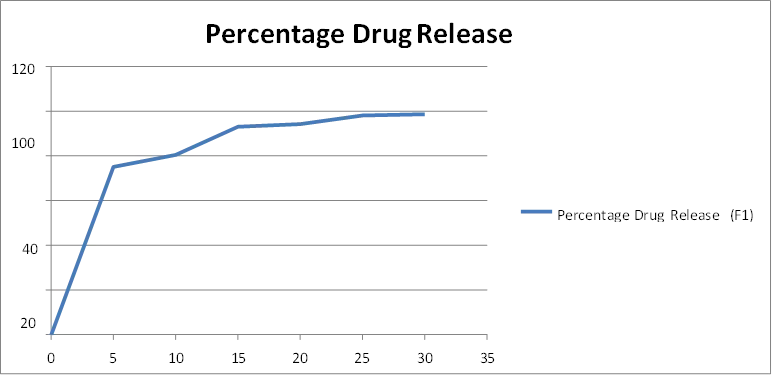
Figure:4 Drug releasing of Diltiazem

Figure:5 Drug releasing of Diltiazem

Figure:6 Drug releasing of Diltiazem
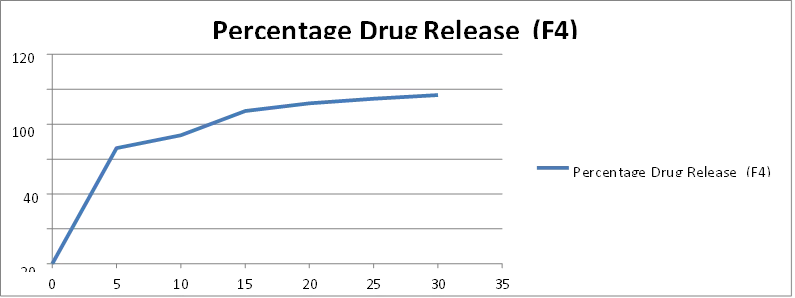
Figure:7 Drug releasing of Diltiazem
CONCLUSION
The four API formulations in the study, F1, F2, F3, and F4, were created utilizing various super disintegration agents. Low replacement hydroxypropyl of cellulose: 6% in F1 and 9% in F2; mucilage from chai seeds: 6% in F3 and 9% in F4. Among F1 (97.98%), F3 (96.86%), and F4 (96.46%), F2 demonstrated 98.66% drug release at 30 minutes in the research. The hardness of the tabs varied from 2.6 to 3.4 kg/cm2, Thickness is 2.22 to 2.26 mm and friability is 0.48 to 0.62%according to the results. The tablet's formulation may lead to a rise in patient complaints and medical issues. However, research is required to determine the disintegration agent's ideal concentration and stability. The study's use of super disintegrating agents improved the API mod peen's drug release, leading to a notable and possible improvement in therapeutic effects.
REFERENCES



Prince Chauhan, Deepak Saini, Chitra Gupta, Formulation and Evaluation of Fast Dissolving Tablet of Diltiazem by using Natural & Synthetic Superdisintegrants, Int. J. of Pharm. Sci., 2026, Vol 4, Issue 6, 6503-6512. https://doi.org/10.5281/zenodo.20848210
 10.5281/zenodo.20848210