

We use cookies to ensure our website works properly and to personalise your experience. Cookies policy
Mahadev Kanchan College of Pharmaceutical Education and Research.
Herbal hair oils are among the most widely used traditional and modern cosmetic preparations for maintaining scalp health, promoting hair growth, preventing hair fall, and managing conditions such as dandruff and premature greying. They are typically formulated by infusing bioactive plant parts into suitable carrier oils, followed by systematic physicochemical and biological evaluation to ensure quality, safety, and efficacy.This review paper summarizes the objectives, formulation approaches, commonly used herbal ingredients, and evaluation parameters for herbal hair oil, based on recent experimental and review literature. Particular emphasis is placed on polyherbal oil systems containing herbs such as Eclipta alba (Bhringraj), Murraya koenigii (curry leaf), Hibiscus rosa?sinensis, Nigella sativa, Trigonella foenum?graecum, amla, brahmi, methi, and neem, which have documented hair growth?promoting, antioxidant, antimicrobial and anti?inflammatory activities. Key physicochemical tests (pH, viscosity, specific gravity, acid value, saponification value), stability studies and in vivo hair growth or hair fall reduction studies are discussed to highlight how standardized evaluation supports product development. Overall, the review underlines that well?designed herbal hair oils can provide safe, effective and consumer?acceptable alternatives to synthetic hair care products when properly formulated and scientifically evaluated.
Hair and scalp health have significant cosmetic, social and psychological importance, leading to high demand for safe and effective hair care products. Conventional hair oils and lotions often contain synthetic fragrances, preservatives and mineral oil bases that may cause irritation or long‑term safety concerns, which has motivated a shift towards herbal and natural formulations.
Herbal hair oils are defined as preparations containing one or more herbal extracts or powdered drugs dispersed or infused in a suitable base oil such as coconut, sesame (til), almond or mineral oil, intended for application on scalp and hair. These oils aim to nourish hair roots, improve hair growth, reduce hair fall, prevent dandruff and delay greying by delivering phytoconstituents with antioxidant, anti‑inflammatory, antimicrobial and nutritive actions. Multiple recent experimental studies have shown that properly formulated herbal hair oils can achieve acceptable physicochemical properties, remain stable over storage, and exhibit measurable hair growth‑promoting effects in animal or human studies.
4) MATERIALS AND METHODS
4.1 Common herbal ingredients and bases
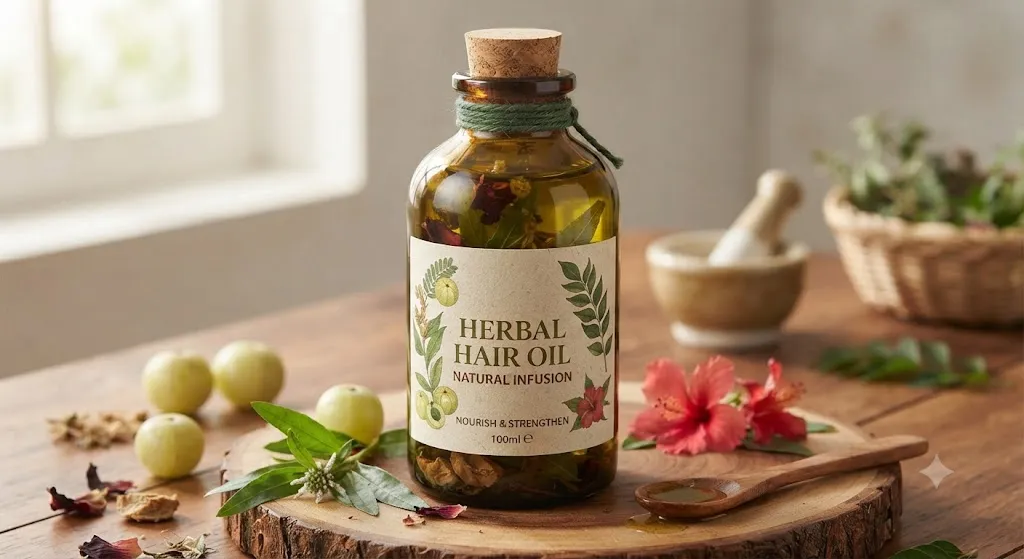
Review of experimental and review articles indicates that most herbal hair oils use vegetable oils such as coconut oil, sesame oil, castor oil, or almond oil as the primary base. These oils act as emollients, provide occlusion, improve spreadability, and serve as solvents for lipophilic phytoconstituents extracted from herbal drugs. Frequently used herbs include Eclipta alba (Bhringraj), amla (Emblica officinalis), hibiscus, brahmi (Bacopa monnieri), methi (Trigonella foenum‑graecum), curry leaves (Murraya koenigii), Nigella sativa, neem, tulsi and others, selected for their traditional and experimentally supported benefits in hair care.
Bhringraj‑based oils are especially popular in Ayurveda and have been shown to promote hair growth by accelerating the transition of follicles from telogen to anagen phase and stimulating follicular proliferation in preclinical models. Amla and hibiscus provide vitamin C, flavonoids and mucilage that condition hair shafts, while methi and curry leaves contain proteins, saponins and antioxidants that strengthen hair and reduce hair fall. Many formulations also incorporate essential oils or perfuming agents for improved patient acceptability, provided they do not irritate the scalp.
Across studies, three basic techniques are consistently described for preparing herbal hair oil: direct boiling, cold infusion and maceration. In the direct boiling method, coarsely powdered herbs are mixed with water and base oil and gently heated until the water evaporates and the active constituents transfer into the oil, which is then filtered to obtain the finished product. Cold infusion methods involve soaking herbs in oil under sunlight or at room temperature for several days, allowing diffusion of constituents without significant heat exposure, after which the oil is filtered.
Maceration techniques typically use crushed herbs soaked in oil with mild heating or agitation to improve extraction efficiency. Some recent formulations combine ethanolic or hydroalcoholic extracts of herbs with base oils, instead of crude powders, to improve standardization and reduce microbial load. In all cases, attention is given to avoiding excessive heating that could degrade sensitive phytoconstituents and to ensuring removal of moisture to minimize rancidity and microbial growth.
5)Evaluation parameters
|
Evaluation category |
Parameter/Test |
Purpose or observation |
Typical method/instrument |
Typical conditions or outcomes |
|
Organoleptic evaluation |
Color |
Evaluates visual appearance and batch uniformity |
Visual examination under suitable lighting |
Color should be uniform and acceptable |
|
Organoleptic evaluation |
Odor |
Assesses fragrance, freshness, and possible rancidity |
Sensory evaluation |
Odor should be pleasant and free from rancid smell |
|
Organoleptic evaluation |
Clarity |
Detects turbidity, suspended matter, or impurities |
Visual inspection |
Oil should be clear, unless a naturally cloudy herbal formulation is intended |
|
Organoleptic evaluation |
Texture |
Determines feel, smoothness, and ease of application |
Sensory examination by rubbing between fingers |
Should be smooth, non-sticky, and cosmetically acceptable |
|
Organoleptic evaluation |
Grittiness |
Detects coarse herbal particles or sediment |
Visual and tactile examination |
Grittiness should be absent |
|
Organoleptic evaluation |
Overall aesthetic appeal |
Determines consumer acceptability based on appearance, fragrance, and feel |
Sensory evaluation |
Should provide a pleasant overall user experience |
|
Physicochemical evaluation |
pH |
Ensures compatibility with scalp and hair |
Digital pH meter |
Commonly maintained within 4.5 

|
|
Physicochemical evaluation |
Viscosity |
Measures resistance to flow and ease of spreading on scalp and hair |
Viscometer |
Should be suitable for easy pouring and application |
6.1 Physicochemical performance of herbal hair oils
Multiple experimental studies report that well‑designed herbal hair oil formulations achieve pH values in the range of approximately 5.4–7.3, which are compatible with scalp and skin, thereby minimizing the risk of irritation or dryness. For example, one formulation containing Murraya koenigii, Hibiscus rosa‑sinensis, Nigella sativa and Trigonella foenum‑graecum showed pH 7.3 with Newtonian flow behavior and remained stable for 30 days, while another polyherbal oil exhibited pH 6.1 with no significant change over storage. Viscosity values are typically optimized to provide smooth flow and spreadability without excessive greasiness, with reported values ranging from around 30–150 cP or similar units, depending on measurement conditions.
Specific gravity of herbal hair oils is usually close to that of their base oils (around 0.84–0.89 g/cm³), while acid and saponification values are maintained within limits that indicate low levels of free fatty acids and acceptable fatty acid composition, thus supporting stability. Organoleptic evaluations consistently report clear or slightly colored oils with characteristic herbal odor, smooth texture, absence of grittiness and good washability, all of which are crucial for consumer preference. Stability studies generally show no phase separation, no significant changes in color or odor and no visible microbial growth over 30–90 days or more, indicating that properly processed herbal hair oils can achieve satisfactory shelf life.
6.2 Hair growth and therapeutic benefits
Beyond physicochemical suitability, many herbal hair oils demonstrate promising hair growth‑promoting and hair fall‑reducing activity in preclinical or small human studies. Eclipta alba‑based oils, for instance, have been reported to accelerate transition of hair follicles into the anagen phase, increase hair length and hair weight, and modulate signaling pathways such as Wnt/β‑catenin and VEGF that regulate follicular regeneration. Polyherbal oils combining amla, hibiscus, brahmi and methi have shown increased hair growth and improved hair density compared to control groups in experimental models, supporting the synergistic action of multiple herbs.
Several formulations specifically developed for hair fall control or anti‑dandruff effects have also undergone evaluation, showing reduced hair fall, improved scalp condition and absence of irritation in volunteer studies. These therapeutic benefits are attributed to the presence of phytoconstituents such as flavonoids, polyphenols, saponins, alkaloids and essential oils that provide antioxidant, antimicrobial, anti‑inflammatory and nutritive actions at the hair follicle level. However, most studies are limited to short‑term or small‑scale evaluations, indicating a need for more rigorous, long‑term clinical trials to fully validate efficacy.
6.3Advantages and limitations of herbal hair oils
Herbal hair oils offer several advantages, including use of renewable plant‑based ingredients, potential for multiple pharmacological actions (hair growth promotion, anti‑dandruff, scalp soothing), and better cultural acceptability, especially in Ayurvedic and traditional medicine systems. Properly formulated herbal oils with pH close to scalp, moderate viscosity, good spreadability and stable physicochemical properties can provide effective and user‑friendly hair care options. Moreover, they can be tailored by varying herbs and base oils to target specific indications such as hair fall, dryness or dandruff.
At the same time, herbal hair oils face challenges related to standardization of raw materials, batch‑to‑batch variability in phytoconstituent content, potential for contamination or adulteration, and limited high‑quality clinical evidence. Stability issues such as oxidation of unsaturated fatty acids, development of rancid odor or microbial growth must be carefully controlled through proper processing, packaging and storage. Additionally, some individuals may still experience sensitivity or allergic reactions to certain essential oils or herbal components, underscoring the importance of patch testing and clear labeling.

Priya Chavan, Formulation and Evaluation of Herbal Hair Oil, Int. J. of Pharm. Sci., 2026, Vol 4, Issue 9, 674-678, https://doi.org/10.5281/zenodo.22333223
 10.5281/zenodo.22333223