
View Article

Abstract

Adverse drug reactions (ADRs) are a major concern for patients, physicians and regulatory agencies worldwide. Pharmacovigilance requires a standardized approach for coding and sharing safety data for effective risk monitoring. This international standard is the Medical Dictionary for Regulatory Activities (MedDRA). This review describes the structure, regulatory mandate, signal detection capabilities, and coding challenges of MedDRA within the framework of pharmacovigilance. MedDRA is organized hierarchically in five levels from the most specific Lowest Level Terms (LLTs) to the most general System Organ Classes (SOCs). This is required by major regulators such as the European Medicines Agency (EMA) and the US Food and Drug Administration (FDA). The World Health Organization (WHO) also uses it globally to code millions of safety reports. The role of MedDRA during signal detection is important with the help of tools such as Standardized MedDRA Queries (SMQs) which facilitate rapid identification of new side effects. But the system has its own problems. Inconsistent coding, changing terminology and the need for constant training may compromise data quality. Still, MedDRA is an important basis for global safety surveillance. The future is bright for MedDRA with increased use of automation and artificial intelligence to accelerate and improve pharmacovigilance.

Keywords

Adverse Drug Reactions, Artificial Intelligence, Coding Quality, MedDRA, Pharmacovigilance, Signal detection

Introduction

× Popup Image

Adverse drug reactions (ADRs) are of great concern to patients, doctors, and regulatory agencies. Only when ADRs are severe enough to cause significant harm or death do they trigger strict actions like mandatory Phase IV trials, black box warnings, or even removal from the market. Stakeholders are now using real-world data from routine clinical practice to make better decisions throughout the life cycle of a drug. Pharmacovigilance is the ongoing surveillance of the safety of a drug after its approval helping to monitor these risks.

This becomes really important for catching ADRs that are rare, affect only specific groups, or show up after long-term use. (1)

The safety risks of some drugs only become apparent after approval. Thalidomide is a classic example, it was only after it reached the market that its severe teratogenic effects in pregnant women were discovered.

To overcome this challenge, standardized medical terminologies such as Medical Dictionary for Regulatory Activities (MedDRA) are used to code and classify adverse events consistently.

MedDRA is an international medical terminology developed under the auspices of International Council for Harmonisation (ICH) to facilitate the sharing of regulatory information on medical products.

It is used for registration, documentation and safety monitoring of medical products before and after a product has been authorised for use. Products covered by the scope of MedDRA include pharmaceuticals, vaccines and drug-device combination products.

However, despite its global adoption, recent studies have highlighted varying levels of coding inconsistency in MedDRA-based platforms. (2)

Therefore, this review aims to discuss the structure, regulatory mandate, signal detection role, and coding challenges of MedDRA.

MEDDRA STRUCTURE & HIERARCHY

Because the number of ADR reports kept increasing, MedDRA developed several hierarchy levels to code and report these events. (3)

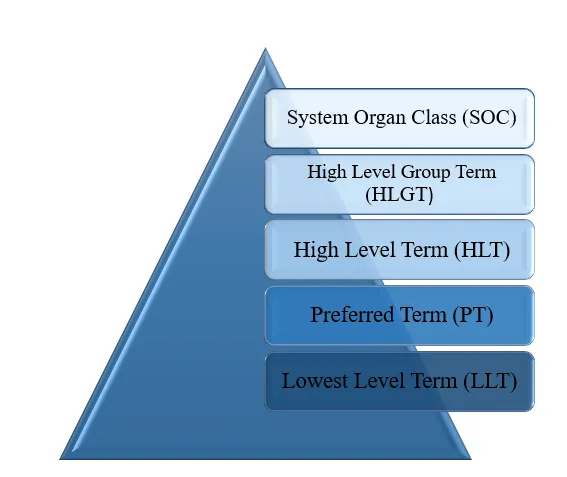
There are total five levels, ranging from the broadest to most specific as follows:

1. System Organ Class (SOC) : The broadest level, which groups conditions by major body system (eg. Cardiac disorder).

2. High Level Group Term (HLGT) : Groups related high level terms.

3. High Level Term (HLT) : Groups related to preferred terms.

4. Preferred Terms (PT) : The standard levels used for data analysis and reporting.

5. Lowest Level Term (LLT) : The most specific level, which records the reporter’s exact words. Each LLT maps directly to a PT.

In practice, data is entered at the LLT level but analysed at the PT level. This hierarchical grouping allows related terms to be combined, which is effective in signal detection. (4)
figure

Figure 1: The Five Level Hierarchical Structure of Med’DRA. (4)

The five-level hierarchy allows data to be aggregated at different levels, from specific LLTs to broad SOCs, which is essential for signal detection. (5)

"MedDRA's hierarchical structure is not just for coding, it is also essential for advanced statistical analysis. For example, a Bayesian hierarchical model has been developed to detect MedDRA-coded adverse events in clinical trials, showing how the five-level framework supports complex data mining. (6)

REGULATORY MANDATE & GLOBAL ADOPTION

For over two decades, the adverse events have been reported to the Eudravigilance database by using MedDRA, which is mandated by the European Medicines Agency (EMA).

The Eudravigilance database contains over 9.6 million reports, making it one of the largest safety databases. Most of these reports came from outside of Europe, mainly the USA (36.9%), followed by France (10%), which shows its global reach. (7)

In the United States, the Food and Drug Administration (FDA) uses MedDRA in its Adverse Event Reporting System (FAERS). A study analyzing FAERS data from 2004 to 2020 identified 488,470 medication error reports using MedDRA’s Standardized MedDRA Queries (SMQs). (8)

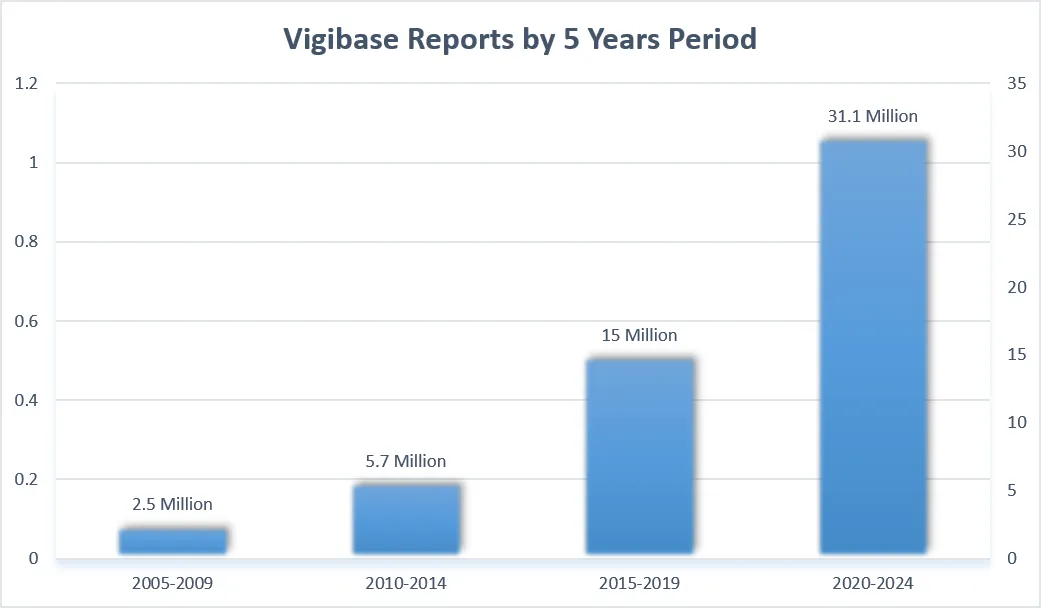
MedDRA is used globally by the World Health Organization (WHO) to code reports in its database. This database, which has over 40 million reports from over 160 nations as of 2024, demonstrates how MedDRA facilitates the global exchange of safety data. (9)
figure

Figure 2: Growth of Vigibase Reports by 5 Years Period.(9)

Japan has also mandated electronic reporting using MedDRA since 2003, achieving near complete compliance. A recent study using the Japanese Adverse Drug Event reporting (JADER) database, which uses MedDRA coding, shows how actively this system is used in real world pharmacovigilance.(10)

International harmonisation of pharmacovigilance practices helps to ensure consistency of drug safety monitoring across countries. MedDRA is a standardised medical terminology used to code adverse drug reactions and allows analysis and comparison of safety information. Harmonised reporting and coding practices can contribute to signal detection and to the monitoring of the benefit–risk profile of medicines.(11)

ROLE IN SIGNAL DETECTION

Regulators are unable to manually review all of the millions of reports that are submitted from all over the world. Signal detection is useful in this situation. For this vast amount of data, it is the process of identifying novel or uncommon side effects. In this case, MedDRA plays a significant role by offering structured tools for the retrieval and analysis of this data.(3)

One of the main tools that MedDRA provides for this is Standardized MedDRA Queries (SMQs). These are pre-defined search filters that combine related terms together to quickly identify cases for a particular medical condition. For example, a recent study used the SMQ ‘Pregnancy and neonatal topics’ to identify pregnancy-related ADRs in EudraVigilance. But this query could only correctly identify 54% of cases, as it also picked up unrelated events. To make this better, researchers created a new algorithm that got 90% accuracy and retrieved over 202,000 instances.(12)

However the accuracy of these queries very much depends on the way they are designed. A recent analysis of VigiBase cases of interstitial lung disease (ILD) demonstrated that the Preferred Term 'ILD' accounted for less than 40% of all terms within the broad SMQ for ILD. This makes it possible that researchers could miss a large number of relevant cases by searching only for one specific term. Therefore, careful design of the queries is crucial for robust signal detection.(13)

A great example of this in the real world was during the COVID-19 pandemic. With the global rollout of vaccines and treatments, safety reports started to include a huge number of new side effects. To address this, MedDRA rapidly made new terms and Standardized MedDRA Queries available outside the normal cycle of updates. The rapidity of the response meant that regulators and companies were able to view and examine safety signals as they arose, while the situation was still developing. It demonstrated how a standardized coding system can respond quickly when the world needs it most.(14)

CHALLENGES AND CODING QUALITY

MedDRA is a powerful tool but only as good as the people using it. One of the biggest issues is inconsistency in coding. Different coders looking at the same adverse event report may select different terms. A recent study found that when the information is not clear, pharmacovigilance officers tend to make mistakes such as failing to recognize a relevant term or selecting the wrong one.(2)

Another challenge is that the MedDRA terminology keeps evolving. The dictionary is updated twice a year. So, terms that existed a few years ago may be split, renamed, or replaced today. For example, a study of interstitial lung disease (ILD) found that different countries and different time periods use different Preferred Terms for the same condition. This makes it harder to do consistent searches over long periods of time.(13)

Bad code can really hurt your ability to detect signals. Badly coded reports may miss true safety signals. You saw that in the rollout of the Covid-19 vaccine. A recent study revealed that many medication error reports were either missing important information or were inconsistent. That makes it very hard for regulators to recognize patterns. This is where ongoing coder training, periodic quality audits and careful query development come into play. These steps are important for a good system to work well.(15)

FUTURE DIRECTIONS

AI is slowly changing the way MedDRA coding is done. One recent study looked at how AI can be used in clinical data management. Instead of manually reading every single report, automated systems can now suggest the correct MedDRA terms. The researchers found that using AI cuts down on the time spent on manual coding and speeds up the whole process.

Recent advancements in Large Language Models show promising results in automating the coding process with high accuracy.(16)

Another interesting direction is using social media and web content for safety monitoring. A recent study built a language model tool to scan social media posts during the COVID-19 pandemic. It pulled out possible vaccine side effects from these posts and mapped them to MedDRA terms. This approach lets regulators hear from everyday people, not just doctors, and it happens in real time.

Natural Language Processing (NLP) tools are also being developed to automatically extract adverse events from clinical narratives and map them to MedDRA terms.(17)

CONCLUSION

MedDRA is an integral part of pharmacovigilance. It provides a common language for regulators, doctors and companies to share safety data. MedDRA has a five-level structure that allows for quick detection of new side effects. However the system only works if the coding is done correctly. This is why constant training is so important for coders. With the increased use of AI and automation, MedDRA has a very bright future. It will remain a crucial tool to help guarantee the safety of medicines across the globe.

REFERENCES

  1. Lavertu A, Vora B, Giacomini KM, Altman R, Rensi S. A New Era in Pharmacovigilance: Toward Real‐World Data and Digital Monitoring. Clin Pharmacol Ther. 2021;109 (5):1197-1202. doi:10.1002/cpt.2172.
  2. Garmann T, Samdal H, Sartori D, Jahanlu D, Andersen F, Rocca E. Strategies and Challenges in Coding Ambiguous Information Using MedDRA®: An Exploration Among Norwegian Pharmacovigilance Officers. Drug Saf. 2025 Nov;48 (11):1253-1269. doi: 10.1007/s40264-025-01573-2. Epub 2025 Jul 1. PMID: 40593291; PMCID: PMC12515201.
  3. Zink RC, Lyzinski R, Mann G. Aggregation of Adverse Event Terms for Signal Detection and Labeling in Clinical Trials. Drug Saf. 2025 Jun;48 (6):595-606. doi: 10.1007/s40264-025-01518-9. Epub 2025 Feb 14. PMID: 39953273.
  4. Carragher R, Robertson C. c212: An R package for the detection of safety signals in clinical trials using body-systems (system organ classes). Journal of Open Source Software. 2020 Dec 4;5 (56). doi: https://doi.org/10.21105/joss.02706.
  5. Zhang Y, Yuan SS, Eagel BA, Li H, Lin LA, Wang WWB. Bayesian hierarchical model for safety signal detection in multiple clinical trials. Contemp Clin Trials. 2020 Dec;99:106183. doi: 10.1016/j.cct.2020.106183. Epub 2020 Oct 20. PMID: 33091588.
  6. Revers A, Hof MH, Zwinderman AH. BAHAMA: A Bayesian Hierarchical Model for the Detection of MedDRA®-Coded Adverse Events in Randomized Controlled Trials. Drug Saf. 2022 Sep;45 (9):961-970. doi: 10.1007/s40264-022-01208-w. Epub 2022 Jul 15. PMID: 35840802; PMCID: PMC9402776.
  7. Pera V, Kors JA, van Mulligen EM, de Wilde M, Rijnbeek PR, Verhamme KMC. Disproportionality Analysis and Characterisation of Medication Errors in EudraVigilance: Exploring Findings on Sexes and Age Groups. Drug Saf. 2025 Jan;48 (1):59-74. doi: 10.1007/s40264-024-01478-6. Epub 2024 Sep 19. PMID: 39300043; PMCID: PMC11711134.
  8. Pera V, van Vaerenbergh F, Kors JA, van Mulligen EM, Parry R, de Wilde M, Lahousse L, van der Lei J, Rijnbeek PR, Verhamme KMC. Descriptive analysis on disproportionate medication errors and associated patient characteristics in the Food and Drug Administration's Adverse Event Reporting System. Pharmacoepidemiol Drug Saf. 2024 Jan;33 (1):e5743. doi: 10.1002/pds.5743. Epub 2023 Dec 29. PMID: 38158381.
  9. Brand JS, Gauffin O, Sartori D, Fusaroli M, Sköld H, Bergvall T, Sandberg L, Wallberg M, Hjelmström P, Norén GN. VigiBase: Resource Profile Update with a Summary of Global Patterns and Trends in Adverse Event Reports for Medicines and Vaccines. Drug Saf. 2026 Jun;49 (6):613-629. doi: 10.1007/s40264-025-01642-6. Epub 2026 Jan 30. PMID: 41618069; PMCID: PMC13160990.
  10. Koga K, Tasaka Y, Nawa H. Cross-Cancer Type Evaluation of Potential Interstitial Lung Disease Complications of Immune Checkpoint Inhibitors Using JADER. Biol Pharm Bull. 2024;47 (7):1296-1300. doi: 10.1248/bpb.b24-00130. PMID: 39010215.
  11. Lomeli-Silva A, Contreras-Salinas H, Barajas-Virgen MY, Romero-Lopez MS, Rodríguez-Herrera LY. Harmonization of individual case safety reports transmission requirements among PAHO reference authorities: a review of their current regulation. Ther Adv Drug Saf. 2024 Feb 4;15:20420986241228119. doi: 10.1177/20420986241228119. PMID: 38323190; PMCID: PMC10846002.
  12. Zaccaria C, Piccolo L, Gordillo-Marañón M, Touraille G, de Vries C. Identification of Pregnancy Adverse Drug Reactions in Pharmacovigilance Reporting Systems: A Novel Algorithm Developed in EudraVigilance. Drug Saf. 2024 Nov;47 (11):1127-1136. doi: 10.1007/s40264-024-01448-y. Epub 2024 Jun 19. PMID: 38896215; PMCID: PMC11485138.
  13. Freppel R, Benis A, Bonniaud P, Faillie JL, Grandvuillemin A. Analysis of interstitial lung disease in pharmacovigilance databases: Coding challenges and interpretation biases-An update. Br J Clin Pharmacol. 2026 Jul;92 (7):2147-2161. doi: 10.1002/bcp.70483. Epub 2026 Feb 15. PMID: 41693128; PMCID: PMC13304250.
  14. O’Hare B, Ibrahim H and Revelle P (2025) The role of MedDRA in global pharmacovigilance and public health during COVID-19: pandemic preparedness and response. Front. Drug Saf. Regul. 5:1607642. doi: 10.3389/fdsfr.2025.1607642.
  15. Kralova K, Wilson CA, Richebourg N, D'souza J. Quality of MedDRA® Coding in a Sample of COVID-19 Vaccine Medication Error Data. Drug Saf. 2023 May;46 (5):501-507. doi: 10.1007/s40264-023-01294-4. Epub 2023 Apr 23. PMID: 37087705; PMCID: PMC10122720.
  16. Yan C, Yang R, Yan H, Wei X, Zhou E, Zhao S, Zhuang Y. Application of Artificial Intelligence in MedDRA Coding: A Practical Exploration from Clinical Data Management Perspective. Ther Innov Regul Sci. 2026 Jul;60 (4):1059-1067. doi: 10.1007/s43441-026-00953-9. Epub 2026 Mar 21. PMID: 41865154.
  17. Daluwatte C, Khromava A, Chen Y, Serradell L, Chabanon AL, Chan-Ou-Teung A, Molony C, Juhaeri J. Application of a Language Model Tool for COVID-19 Vaccine Adverse Event Monitoring Using Web and Social Media Content: Algorithm Development and Validation Study. JMIR Infodemiology. 2024 Dec 20;4:e53424. doi: 10.2196/53424. PMID: 39705077; PMCID: PMC11699502.

Reference

  1. Lavertu A, Vora B, Giacomini KM, Altman R, Rensi S. A New Era in Pharmacovigilance: Toward Real?World Data and Digital Monitoring. Clin Pharmacol Ther. 2021;109 (5):1197-1202. doi:10.1002/cpt.2172.
  2. Garmann T, Samdal H, Sartori D, Jahanlu D, Andersen F, Rocca E. Strategies and Challenges in Coding Ambiguous Information Using MedDRA®: An Exploration Among Norwegian Pharmacovigilance Officers. Drug Saf. 2025 Nov;48 (11):1253-1269. doi: 10.1007/s40264-025-01573-2. Epub 2025 Jul 1. PMID: 40593291; PMCID: PMC12515201.
  3. Zink RC, Lyzinski R, Mann G. Aggregation of Adverse Event Terms for Signal Detection and Labeling in Clinical Trials. Drug Saf. 2025 Jun;48 (6):595-606. doi: 10.1007/s40264-025-01518-9. Epub 2025 Feb 14. PMID: 39953273.
  4. Carragher R, Robertson C. c212: An R package for the detection of safety signals in clinical trials using body-systems (system organ classes). Journal of Open Source Software. 2020 Dec 4;5 (56). doi: https://doi.org/10.21105/joss.02706.
  5. Zhang Y, Yuan SS, Eagel BA, Li H, Lin LA, Wang WWB. Bayesian hierarchical model for safety signal detection in multiple clinical trials. Contemp Clin Trials. 2020 Dec;99:106183. doi: 10.1016/j.cct.2020.106183. Epub 2020 Oct 20. PMID: 33091588.
  6. Revers A, Hof MH, Zwinderman AH. BAHAMA: A Bayesian Hierarchical Model for the Detection of MedDRA®-Coded Adverse Events in Randomized Controlled Trials. Drug Saf. 2022 Sep;45 (9):961-970. doi: 10.1007/s40264-022-01208-w. Epub 2022 Jul 15. PMID: 35840802; PMCID: PMC9402776.
  7. Pera V, Kors JA, van Mulligen EM, de Wilde M, Rijnbeek PR, Verhamme KMC. Disproportionality Analysis and Characterisation of Medication Errors in EudraVigilance: Exploring Findings on Sexes and Age Groups. Drug Saf. 2025 Jan;48 (1):59-74. doi: 10.1007/s40264-024-01478-6. Epub 2024 Sep 19. PMID: 39300043; PMCID: PMC11711134.
  8. Pera V, van Vaerenbergh F, Kors JA, van Mulligen EM, Parry R, de Wilde M, Lahousse L, van der Lei J, Rijnbeek PR, Verhamme KMC. Descriptive analysis on disproportionate medication errors and associated patient characteristics in the Food and Drug Administration's Adverse Event Reporting System. Pharmacoepidemiol Drug Saf. 2024 Jan;33 (1):e5743. doi: 10.1002/pds.5743. Epub 2023 Dec 29. PMID: 38158381.
  9. Brand JS, Gauffin O, Sartori D, Fusaroli M, Sköld H, Bergvall T, Sandberg L, Wallberg M, Hjelmström P, Norén GN. VigiBase: Resource Profile Update with a Summary of Global Patterns and Trends in Adverse Event Reports for Medicines and Vaccines. Drug Saf. 2026 Jun;49 (6):613-629. doi: 10.1007/s40264-025-01642-6. Epub 2026 Jan 30. PMID: 41618069; PMCID: PMC13160990.
  10. Koga K, Tasaka Y, Nawa H. Cross-Cancer Type Evaluation of Potential Interstitial Lung Disease Complications of Immune Checkpoint Inhibitors Using JADER. Biol Pharm Bull. 2024;47 (7):1296-1300. doi: 10.1248/bpb.b24-00130. PMID: 39010215.
  11. Lomeli-Silva A, Contreras-Salinas H, Barajas-Virgen MY, Romero-Lopez MS, Rodríguez-Herrera LY. Harmonization of individual case safety reports transmission requirements among PAHO reference authorities: a review of their current regulation. Ther Adv Drug Saf. 2024 Feb 4;15:20420986241228119. doi: 10.1177/20420986241228119. PMID: 38323190; PMCID: PMC10846002.
  12. Zaccaria C, Piccolo L, Gordillo-Marañón M, Touraille G, de Vries C. Identification of Pregnancy Adverse Drug Reactions in Pharmacovigilance Reporting Systems: A Novel Algorithm Developed in EudraVigilance. Drug Saf. 2024 Nov;47 (11):1127-1136. doi: 10.1007/s40264-024-01448-y. Epub 2024 Jun 19. PMID: 38896215; PMCID: PMC11485138.
  13. Freppel R, Benis A, Bonniaud P, Faillie JL, Grandvuillemin A. Analysis of interstitial lung disease in pharmacovigilance databases: Coding challenges and interpretation biases-An update. Br J Clin Pharmacol. 2026 Jul;92 (7):2147-2161. doi: 10.1002/bcp.70483. Epub 2026 Feb 15. PMID: 41693128; PMCID: PMC13304250.
  14. O’Hare B, Ibrahim H and Revelle P (2025) The role of MedDRA in global pharmacovigilance and public health during COVID-19: pandemic preparedness and response. Front. Drug Saf. Regul. 5:1607642. doi: 10.3389/fdsfr.2025.1607642.
  15. Kralova K, Wilson CA, Richebourg N, D'souza J. Quality of MedDRA® Coding in a Sample of COVID-19 Vaccine Medication Error Data. Drug Saf. 2023 May;46 (5):501-507. doi: 10.1007/s40264-023-01294-4. Epub 2023 Apr 23. PMID: 37087705; PMCID: PMC10122720.
  16. Yan C, Yang R, Yan H, Wei X, Zhou E, Zhao S, Zhuang Y. Application of Artificial Intelligence in MedDRA Coding: A Practical Exploration from Clinical Data Management Perspective. Ther Innov Regul Sci. 2026 Jul;60 (4):1059-1067. doi: 10.1007/s43441-026-00953-9. Epub 2026 Mar 21. PMID: 41865154.
  17. Daluwatte C, Khromava A, Chen Y, Serradell L, Chabanon AL, Chan-Ou-Teung A, Molony C, Juhaeri J. Application of a Language Model Tool for COVID-19 Vaccine Adverse Event Monitoring Using Web and Social Media Content: Algorithm Development and Validation Study. JMIR Infodemiology. 2024 Dec 20;4:e53424. doi: 10.2196/53424. PMID: 39705077; PMCID: PMC11699502.

Photo
Ainul Shafeeque Shaikh
Corresponding author

Department of Pharmacology, M.S College of Pharmacy, Wada, Maharashtra.

Photo
Choudhary Rehan
Co-author

Department of Pharmacology, M.S College of Pharmacy, Wada, Maharashtra.

Photo
Mohammad Hashim Mansoori
Co-author

Department of Pharmacology, M.S College of Pharmacy, Wada, Maharashtra.

Choudhary Rehan, Ainul Shafeeque Shaikh, Mohammad Hashim Mansoori, Role of MedDRA in Pharmacovigilance: Standardized Coding for Adverse Drug Reactions, Int. J. of Pharm. Sci., 2026, Vol 4, Issue 11, 1441-1446. https://doi.org/10.5281/zenodo.24007549

More related articles
A Review Article on Nanotechnology in Drug Deliver...
Sudarsanam Nagarjuna, S. Mohan, M. Beula, L. Dibiya devi, K. Srav...
Eczema: An Updated Review of Epidemiology, Pathoge...
Vaishnavi Borate, Komal Adsure, Shruti Rokade...
Comprehensive Evaluation of Anti Inflammatory Pote...
Prakash Tigari, H. K. Yashvantha, K. Firdos, Nisha H. M....
Related Articles
A Review on the Safety of Two Single-Inhaler Triple Therapy Regimens: Fluticason...
Jerin. M., Sam Jeeva Kumar, Dr. Shaiju Dharan, Dr. Chintha Chandran, Krishna B....
Detection and Analysis of Microplastics in Pharmaceutical Products...
K. Suvarna, P. Uma Devi, R. Siri Chandan, S. Syama Laxmi, T. Likitha, K. Chandra Sekhar, K. Mythili...
A Review Article on Nanotechnology in Drug Delivery Systems: Current Advances, A...
Sudarsanam Nagarjuna, S. Mohan, M. Beula, L. Dibiya devi, K. Sravani, K. Pravallika, J. Dwaraka, Dr....
More related articles
A Review Article on Nanotechnology in Drug Delivery Systems: Current Advances, A...
Sudarsanam Nagarjuna, S. Mohan, M. Beula, L. Dibiya devi, K. Sravani, K. Pravallika, J. Dwaraka, Dr....
Comprehensive Evaluation of Anti Inflammatory Potential Through in Vitro Screeni...
Prakash Tigari, H. K. Yashvantha, K. Firdos, Nisha H. M....
A Review Article on Nanotechnology in Drug Delivery Systems: Current Advances, A...
Sudarsanam Nagarjuna, S. Mohan, M. Beula, L. Dibiya devi, K. Sravani, K. Pravallika, J. Dwaraka, Dr....
Comprehensive Evaluation of Anti Inflammatory Potential Through in Vitro Screeni...
Prakash Tigari, H. K. Yashvantha, K. Firdos, Nisha H. M....
