

We use cookies to ensure our website works properly and to personalise your experience. Cookies policy
Ashokrao Mane Institute of Pharmacy, Ambap, Maharashtra, India.
Transdermal drug delivery systems (TDDS) are gaining increasing importance due to their ability to deliver drugs through the skin in a controlled manner. [1,2] These systems provide several advantages such as avoidance of first-pass metabolism, improved bioavailability, and enhanced patient compliance. [1,2] Punarnava (Boerhavia diffusa) is a traditional medicinal plant widely known for its anti-inflammatory, diuretic, and antioxidant properties. [1,2] The present study focuses on the formulation and evaluation of Punarnava-based transdermal patches. The patches were prepared using the solvent casting method with polymers such as HPMC and PVA. .[3] Plasticizers like glycerin were used to improve flexibility.[3] The prepared patches were evaluated for physicochemical parameters such as thickness, weight variation, folding endurance, drug content, moisture content, and in-vitro drug release.[3] The results indicated that the formulated patches showed good mechanical strength, uniform drug distribution, and sustained drug release. [3,9] The study concludes that Punarnava transdermal patches are a promising alternative for anti-inflammatory therapy. [3,9] Punarnava is a running condiment which is used all throughout India and is botanically related to Boerhaavia diffusa Linn. [3,9] (Nyctaginaceae). Punarnava was first administered both internally and externally during the Vedic era. [3,9] A renewer of body is what the name Punarnava itself denotes. [3,9] The Rasayan branch of Ayurveda focusses on Rasa yan sauces and phrasings that give the stoner age stability and prolonged youth. [3,9]
A complicated biological reaction of bodily tissues to damaging stimuli like pathogens, damaged cells, or irritants is called inflammation.[1] It acts as a defense mechanism to eliminate harmful stimuli and start the healing process.On the other hand, a number of illnesses, such as diabetes, cancer, cardiovascular disease, and arthritis, can be brought on by persistent or chronic inflammation [1].
Inflammatory diseases are frequently treated with conventional anti-inflammatory medications, especially non-steroidal anti-inflammatory medicines (NSAIDs).[2] Despite its effectiveness, prolonged usage is linked to a number of negative consequences, including increased cardiovascular risks, gastrointestinal irritation, ulceration, and renal toxicity [2]. These restrictions have led to the hunt for safer and more potent substitutes, particularly those derived from natural sources.[2]
Traditional medical systems like Ayurveda have long used medicinal herbs to treat inflammation and related conditions. One such plant, Boerhavia diffusa (Punarnava), is wellknown for its important pharmacological qualities, which include immunomodulatory, analgesic, anti-inflammatory, and antioxidant effects. [3,4] Punarnava's phytoconstituents, including flavonoids, alkaloids, and phenolic compounds, which aid in blocking inflammatory mediators, are primarily responsible for its anti-inflammatory actions [3,4].
Transdermal drug delivery systems (TDDS) have become a viable substitute for traditional drug delivery techniques in recent years.[6] Transdermal patches improve bioavailability and lower the frequency of doses by enabling the controlled and prolonged delivery of medications through the skin into the systemic circulation.[6] They also reduce gastrointestinal adverse effects and avoid first-pass metabolism [6].
The creation and assessment of a transdermal patch with punarnava extract's anti-inflammatory properties are the main objectives of this study.[28] A unique strategy to increase treatment efficacy, improve patient compliance, and lessen side effects related to conventional medications is to combine herbal medicine with cutting-edge drug delivery technologies. [28] Phytoconstituents found in medicinal plants are what give them their therapeutic properties. [28] Because herbal formulations have fewer adverse effects and are more patient-acceptable, they are employed extensively. [29]
Transdermal Drug Delivery Systems (TDDS)
A cutting-edge technique for delivering medications through the skin and into the bloodstream is transdermal drug delivery systems (TDDS).[6] These systems offer a sustained and regulated release of therapeutic drugs, guaranteeing a steady plasma drug concentration for a long time.[6] TDDS's capacity to increase patient compliance and lower dose frequency has drawn a lot of interest.[6]The stratum corneum, the skin's outermost layer, acts as a natural barrier by preventing most medications from penetrating.[6] and reach systemic circulation [7]. The success of transdermal delivery depends on factors such as molecular weight, lipophilicity, and drug solubility. [7]
Compared to traditional dosing forms, transdermal patches provide a number of advantages.[9] These include reduced gastrointestinal adverse effects, enhanced bioavailability, avoidance of first-pass metabolism, and the option to stop medication therapy by just taking off the patch. [9] They also offer a non-invasive administration method, which improves patient comfort and treatment compliance.[9]
Transdermal patches come in a variety of forms, such as matrix systems, reservoir systems, adhesive dispersion systems, and microreservoir systems.[9] Among these, matrix-type patches are frequently utilized because of their ease of manufacture, stability, and simplicity [9].
Despite their benefits, TDDS have some drawbacks, including restricted drug permeability, the inability to deliver medications with large molecular weights, and the possibility of skin irritation. .[10] The goal of ongoing research is to overcome these obstacles using cutting-edge methods including iontophoresis, microneedles, and nano-carrier systems.[10] Transdermal medication administration offers better patient compliance and regulated release [5].
ADVANTAGES OF TRANSDERMAL DRUG DELIVERY SYSTEMS (TDDS)
DISADVANTAGES OF TRANSDERMAL DRUG DELIVERY SYSTEMS (TDDS)
LITERATURE REVIEW
AIM AND OBJECTIVE
AIM
OBJECTIVES
PLANT PROFILE
Plant profile of Punarnava
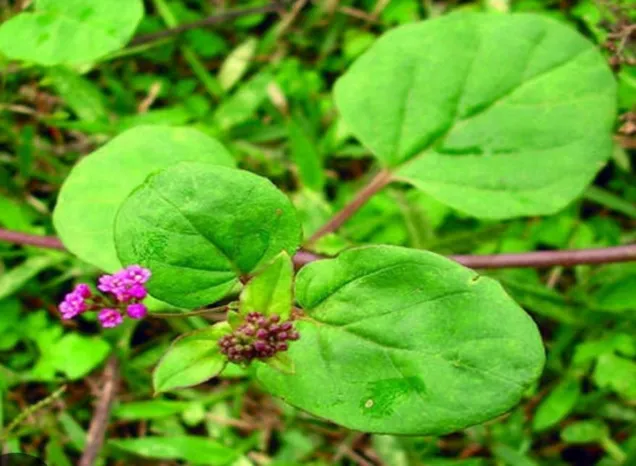
(Figure .1)
Common Names
Synonyms
Boerhavia repens
Boerhavia procumbens
Biological Source
Punarnava consists of the dried whole plant or roots of Boerhavia diffusa Linn., belonging to family Nyctaginaceae.[30]
Geographical Source
Punarnava is widely distributed throughout India, especially in Maharashtra, Gujarat, Rajasthan, Uttar Pradesh, and tropical regions of Asia, Africa, and America.[30]
Morphological Characteristics
Leaves: green, opposite, thick, simple, hairy, fleshy, grouped in uneven pairs, and glabrous. The morphology of the leaves varies greatly; they might be oval, with whole edges, smooth above, white beneath, and pointed or obtuse tips. At the base, they are round-oblong, subcordate or suborbicular. The leaves undersides are hairy and pinkish-white, while their top surfaces are smooth, green, and glabrous (Figure1). [30]
Roots: Big, robust, long, fusiform stalks that might be cylindrical, thin, cigar-shaped, tapering, or cone-shaped. These herbaceous perennials have an elongated, fusiform, or tapering tap root that ranges in colour from yellowish brown to brown. They are low spreading or creeping and have varying diffusely branching. Their surface is rough due to small longitudinal striations and root scars, even though it feels smooth to the touch (Figure 2). [30]
Flowers: They are hermaphrodite, pedicellate, and white, pink, or pinkish-red in colour. They grow in panicles of umbels with bracteoles. Bracts are deciduous and involucrate. The tubular perianth, which is constricted above the ovary and has a funnel-shaped top and a short, narrow base, replaces the calyx and corolla. The structure consists of five small, sharp lobes. There are two or three stamens that are partially expanded, and the stigma is peltate. The flowers bloom during the winter (Figure 1). [30]
Fruits: Small, single-seeded, round, clavate, blunt, broad, five-ribbed, extremely glandular and viscid, and contained in the longer bottom part of the perianth. Clinging glandular hairs that easily stick to passing animals and clothing cover the perianth. Fruits grow quickly and easily. [30]
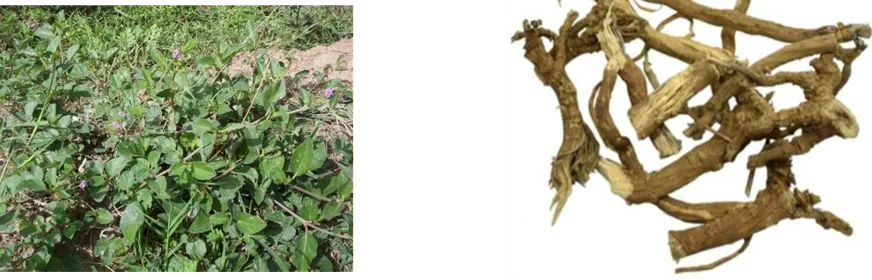
(Figure.2) (Figure.3)
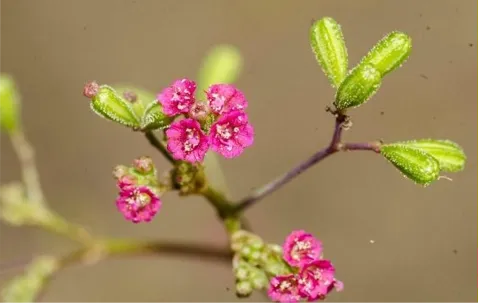
( Figure.4)
Chemical Constituents
Punarnava contains several active phytoconstituents such as:
1. Alkaloids
Punarnavine is the principal active alkaloid present in Punarnava. It is mainly responsible for anti-inflammatory, analgesic, and diuretic activities. Alkaloids also contribute to smooth muscle relaxation and reduction of swelling.[30]
2. Rotenoids (Boeravinones)
These are unique compounds found in Punarnava. Boeravinones exhibit antiinflammatory, immunomodulatory, hepatoprotective, and anticancer activities. They play a major role in reducing inflammation and improving liver function.[30]
3. Flavonoids
Flavonoids are powerful antioxidants that protect cells from oxidative damage. They also show anti-inflammatory, antimicrobial, and wound healing properties, making them important for skin-related formulations.[30]
4. Lignans
Lignans possess antioxidant and antimicrobial properties. They help in protecting tissues and promoting healing processes.[30]
5. Glycosides
Glycosides contribute to anti-inflammatory and cardioprotective effects. They enhance the overall pharmacological activity of the plant.[30]
6. Steroids and Phytosterols
These compounds provide anti-inflammatory and membrane-stabilizing effect. They help reduce irritation and support tissue repair.[30]
7. Saponins
Saponins show anti-inflammatory and antimicrobial activities. They also improve drug absorption through the skin, which is beneficial in transdermal drug delivery systems.[30]
8. Tannins
Tannins have astringent, antimicrobial, and wound healing properties. They help in tightening tissues and preventing infection.[30]
9. Carbohydrates and Proteins
These contribute to the nutritive value and support tissue repair and regeneration.
10. Essential Oils & Other Compounds
Punarnava contains alkaloids, rotenoids, flavonoids, lignans, saponins, tannins, and steroids, which collectively provide anti-inflammatory, antioxidant, antimicrobial, and wound-healing properties, making it highly suitable for transdermal patch formulation.[30]
Common Names
Medical use –
1. Anti-inflammatory Activity
Punarnava exhibits strong anti-inflammatory properties. It helps reduce inflammation, swelli5ng, and redness by inhibiting inflammatory mediators. This makes it highly useful in conditions like arthritis, joint pain, and skin inflammation. It is particularly beneficial in topical and transdermal formulations.[30]
2. Analgesic (Pain-Relieving) Activity
The plant shows significant analgesic effects by reducing pain sensation. It is used in the management of muscular pain, joint pain, and inflammatory pain conditions.[30]
3. Diuretic Activity
Punarnava is a potent natural diuretic. It increases urine output and helps in the removal of excess fluids from the body. This property is useful in treating edema, kidney disorders, and urinary tract infections.[30]
4. Hepatoprotective Action
Punarnava shields the liver against poisons, medications, and infections. It is frequently used to treat jaundice and other liver problems since it enhances liver function.[30]
5. Activity of Antioxidants
Punarnava has potent antioxidant qualities because the presence of flavonoids and phenolic substances. [30] It protects cells from oxidative stress and damage by aiding in the neutralization of free radicals.[30]
6. Activity Against Microbes
Punarnava has antifungal and antibacterial properties against a range of diseases. It promotes the treatment of wounds and skin infections and aids in the prevention of infections.[30]
7. Activity for Healing Wounds
By increasing tissue regeneration and lowering infection, punarnava accelerates the healing of wounds. It is helpful in topical treatments since it also lessens inflammation at the location of the wound.[30]
8. Activity Against Arthritis
Punarnava is useful in treating arthritis because of its analgesic and anti-inflammatory qualities.
It lessens pain, stiffness, and swelling in the joints.[30]
9. Activity of Immunomodulation
By controlling immunological reactions, punarnava aids in strengthening the immune system.
It strengthens the body's defenses against illnesses and infections.[30]
10. Adaptogenic and Anti-stress Activities
Punarnava aids the body in managing stress, both mental and physical. It enhances general health and fosters wellbeing. [30]
11. Skin Disorders
Punarnava is used in the treatment of various skin conditions such as:
Punarnava is widely used in traditional medicine for:
Uses in Formulation
Punarnava is used in topical and transdermal formulations because of its:
MATERIAL AND INSTRUMENTS
Table no.1: List of instruments used for work
|
Sr. No |
Name of Instrument |
|
1 |
Electronic weighing balance |
|
2 |
Soxhlet apparatus |
|
3 |
Hot plate / Heating mantle |
|
4 |
Beaker |
|
7 |
Measuring cylinder |
|
8 |
Round Bottum flask (RBF) |
|
9 |
Sonicator |
Table no. 2: List of chemicals used for work
|
Sr. No |
Chemicals |
|
1 |
Distilled water |
|
2 |
HPMC |
|
3 |
Carbopol |
|
4 |
Sodium alginate |
|
5 |
Glycerin |
|
6 |
Citric acid |
|
7 |
Ethanol |
EXPERIMENTAL METHODOLOGY
1. Collection and Authentication of Plant Material
Fresh plant material of Boerhavia diffusa (Punarnava) was collected from a local area and washed thoroughly to remove dirt and impurities.[21] The material was shade-dried for 5–7 days and coarsely powdered using a mechanical grinder.[21] The powdered drug was stored in an airtight container. The plant was authenticated by a qualified botanist. [21]
2. Preparation of Extract
Method: Soxhlet Extraction (Ethanolic Extract)
Accurately weighed 50 g of dried powdered Punarnava was placed in a thimble and loaded into a Soxhlet apparatus, 500 mL of ethanol was taken in a round-bottom flask as solvent[21,22]
The apparatus was heated using a heating mantle, allowing the solvent to reflux continuously. The extraction was carried out for 6–8 hours (approximately 10–15 cycles) until the solvent in the siphon tube became nearly colorless, indicating complete extraction. [21,22]
After completion, the extract was collected and concentrated on a water bath at 40– 50°C to remove excess solvent and obtain a semisolid extract. The extract was stored in an airtight container at low temperature for further use. [21,22]
Percentage Yield Calculation
Percentage yield = (weight of dried extract /weight of crude drug) *100
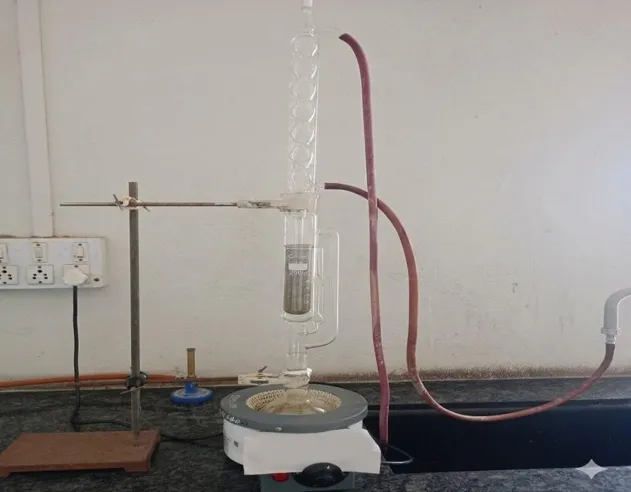
(figure .5)
3. Formulation of Transdermal Patch
Materials Required
Punarnava extract
Polymer (HPMC / PVA / Ethyl cellulose)
Plasticizer (Glycerin / PEG)
Penetration enhancer (Propylene glycol)
Solvent (Distilled water / Ethanol)
Formulation table
Table.3
|
Ingredients |
Quantity |
Role of Ingredient |
|
HPMC |
80 mg |
Film forming agent |
|
Carbopol |
25mg |
Gelling agent |
|
Punarnava extract |
10 mg |
Active drug (herbal extract) |
|
ethanol |
0.5 to 0.6 ml |
Solvent skin penetration |
|
Glycerin |
0.15-0.2 ml |
plasticiser |
|
Citric acid |
2-3 mg |
Ph Adjuster |
|
Distilled water |
1-1.5mg |
Main solvant |
|
Sodium alginate |
20 mg |
Polymer (optional) |
Procedure (Solvent Casting Method)
4. Evaluation of Transdermal Patch
a) Physical Appearance
Patches were visually inspected for color, smoothness, flexibility, and uniformity. [23]
b) Thickness
Measured at different points using a micrometer screw gauge and average thickness was calculated. [24]
c) Weight Variation
Individual patches were weighed and average weight was calculated. [23]
d) Folding Endurance
Patch was folded repeatedly at the same place until it broke. The number of folds was recorded. [24]
e) Surface pH
Patch was moistened with distilled water and pH was measured using a digital pH meter (acceptable range: 5–7). [23]
f) Skin Irritation Test
Patch was applied to the skin and observed for any signs of irritation such as redness or itching. [23]
g) Stability Studies
Prepared patches were stored at room temperature and accelerated conditions (40°C). They were evaluated periodically for changes in appearance, drug content, and stability. [26]
h) storage of patch
Transdermal patches should be stored in a cool and dry place away from moisture and direct sunlight.[25]
RESULT
Table.4
|
Sr. No. |
Evaluation Test |
Observation/ Result |
|
1 |
Physical Appearance |
Smooth, transparent, flexible, and uniform patches without air bubbles or cracks |
|
2 |
Thickness |
0.22 mm |
|
3 |
Weight Variation |
147.6 mg |
|
4 |
Folding Endurance |
285 folds |
|
5 |
Surface pH |
6.13 |
|
6 |
Skin Irritation Test |
No redness, edema, or irritation observed |
|
7 |
Stability Studies |
Stable at 38°C and 75% RH with no significant changes |
|
8 |
Storage Condition |
Stored in airtight container at cool and dry place away from sunlight |
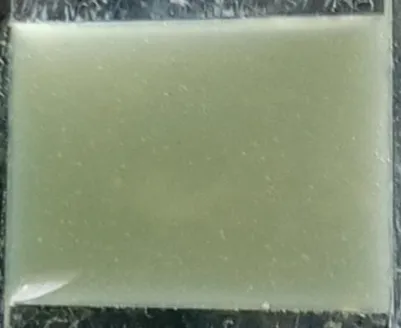
(Figure.6 transdermal patch)
ANTI-INFLAMMATORY
ACTIVITY OF FORMULATION
Table 5: Anti-inflammatory activity of test samples by PDA
|
|
|
|
Protein Denaturation Assay |
|
|
|||
|
Sr. No |
Sample code |
Concentrations (µg/mL) |
Absorbance at 660 nm |
|
|
|||
|
|
|
|
Test 1 |
Test 2 |
Test 3 |
Mean |
% of Inhibition |
IC50 (µg/mL) |
|
1 |
Control |
|
1.54 |
1.54 |
1.54 |
1.54 |
- |
70.89
|
|
2 |
Standard (Diclofenac Sodium) |
20 |
1.40 |
1.37 |
1.39 |
1.32 |
16.98% |
|
|
40 |
1.20 |
1.20 |
1.22 |
1.20 |
24.52% |
|||
|
60 |
0.91 |
0.89 |
0.93 |
0.91 |
42.76% |
|||
|
80 |
0.67 |
0.65 |
0.63 |
0.65 |
59.11% |
|||
|
100 |
0.21 |
0.18 |
0.23 |
0.21 |
86.79% |
|||
|
3 |
Punarnava (Boerhavia diffusa) |
20 |
1.36 |
1.37 |
1.38 |
1.37 |
11.04% |
99.35 |
|
40 |
1.25 |
1.28 |
1.31 |
1.28 |
16.88% |
|||
|
60 |
1.02 |
1.06 |
1.07 |
1.05 |
31.82% |
|||
|
80 |
0.84 |
0.85 |
0.89 |
0.86 |
44.16% |
|||
|
100 |
0.73 |
0.76 |
0.79 |
0.76 |
50.65% |
|||
*NE-Not Evaluable
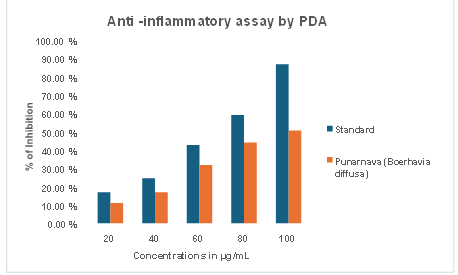
Graphical Data:
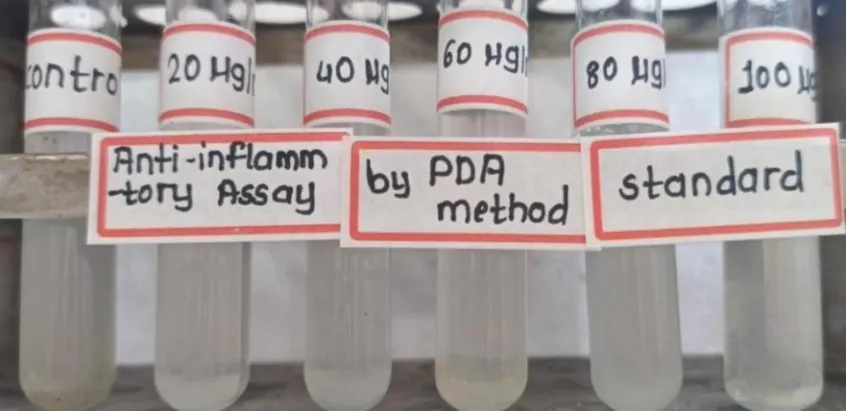
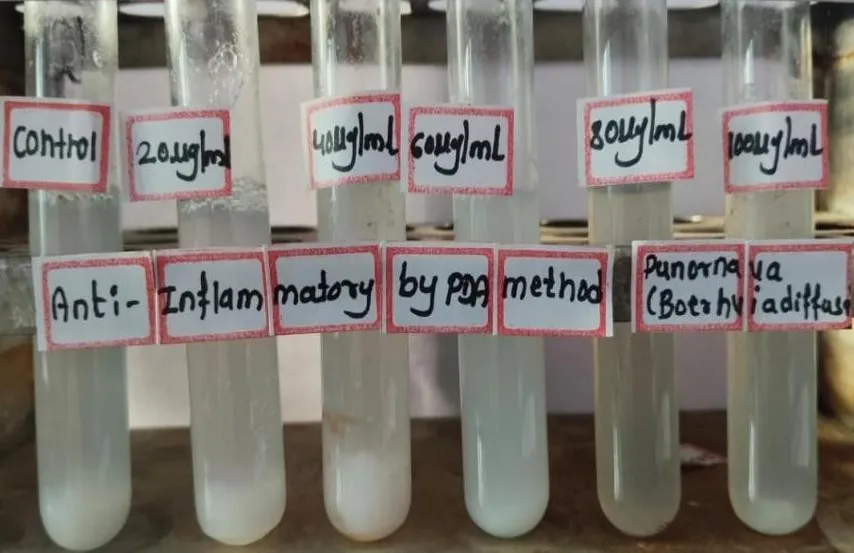
Images of the Activity:
CONCLUSION
The protein denaturation assay results demonstrate a clear concentration-dependent antiinflammatory effect for both the standard and Punarnava (Boerhavia diffusa) extract. As the concentration increases from 20 to 100 µg/mL, the percentage inhibition of protein denaturation rises steadily in both groups, indicating enhanced protein stabilization and antiinflammatory activity. The standard shows superior inhibition at all concentrations, reaching close to ~85–90% at 100 µg/mL, confirming its strong efficacy. The Punarnava extract also exhibits notable activity, with inhibition increasing from low levels at 20 µg/mL to approximately ~50% at 100 µg/mL. Although its activity is lower than that of the standard, the consistent dose-dependent response suggests significant anti-inflammatory potential. Overall, the findings indicate that Boerhavia diffusa possesses moderate but effective anti-inflammatory properties, supporting its potential use as a natural therapeutic agent.
REFERENCES


Mukesh Balate, Viraj Mahajan, Dr. N. B. Chougule, Formulation and Evaluation of Herbal Transdermal Patch Containing Punarnava (Boerhavia diffusa) Extract for Anti-inflammatory Activity, Int. J. of Pharm. Sci., 2026, Vol 4, Issue 7, 4317-4331. https://doi.org/10.5281/zenodo.21483334
 10.5281/zenodo.21483334