

We use cookies to ensure our website works properly and to personalise your experience. Cookies policy
1,2,3,4,5Research Student, Mount Zion College of Pharmaceutical Sciences and.
6Associated Professor, Mount Zion College of Pharmaceutical Sciences and.
The present study was undertaken to formulate and evaluate melatonin emulgel for antimicrobial activity containing melatonin as the active ingredient. An emulgel formulation was developed using suitable excipients to provide desirable physicochemical properties and topical application. Four formulations (F1–F4) were prepared using gelling agents, carbopol 940, xanthan gum, hydroxypropyl methylcellulose (HPMC), and sodium CMC. The prepared formulations were tested for physical appearance, homogeneity, pH, spreadability, viscosity, grittiness, drug content, and dilution stability. Among the formulations F1 showed a texture, uniform distribution of melatonin, acceptable pH and good spreadability. Based on the overall evaluation F1 was selected as the optimized formulation. The developed formulation exhibited physicochemical properties and stability indicating its potential as a cosmetically acceptable emulgel for antimicrobial activity.
Topical drug delivery is frequently utilized and allows drugs to be applied to a specific area. Ideally it can also reduce the extent to which drugs are absorbed into the body.
Skin is the largest organ in the body consisting of multiple layers each characterized by distinct cell types and biological components covering its entire external surface. It consists of 3 layers; epidermis, dermis, and hypodermis, which have different anatomical structures and functions. It acts as a barrier against pathogens, ultraviolet (UV) light, chemicals, and mechanical injury. It also regulates temperature and the amount of water released into the environment. Skin is basically acidic, ranges from 4 to 6, but the internal body environment have a near-neutral pH of 7 to 9. The acidic nature of the skin act as a defense against pathogen.
Melatonin (N-acetyl-5-methoxytryptamine) is an endogenously produced indole amine involved mainly in controlling circadian rhythms. Alongside its biological roles, melatonin also has antioxidant effects and has been studied to assess its possible importance in promoting skin health and defending against skin cell oxidative stress. Studies has also been conducted to determine its antimicrobial activity against Staphylococcus aureus. Due to the interesting properties of melatonin there it has been used in topical drug products. Furthermore, melatonin is poorly water soluble so the choice of a suitable formulation is essential.
An emulgel is a semi-solid product where an emulsion is dispersed within a polymeric gel. Emulgel HAS the advantage of both emulsions and gels. It can successfully encapsulate drugs and has good texture, applicability and spreadability. Being biphasic enables it to encapsulate both water and oil soluble components thereby, the gel component ensures sufficient product adhesion. Overall then, an emulgel is a favorable vehicle for designing effective topical drug products.
On the basis of these benefits, an investigation was conducted to prepare and assess a melatonin emulgel for topical use. Likewise, the antimicrobial activity of this melatonin emulgel was analysed. Four different polymer gelling materials (carbopol 940, xanthan gum, sodium carboxymethyl cellulose and hydroxypropyl methylcellulose) were used to produce the melatonin emulgels. Physical product attributes together with pH, spreadability and viscosity were analysed. In addition, grittiness and drug loading together with diluent stability were assessed. The antimicrobial activity of the melatonin emulgel was analysed to determine its antimicrobial ability. An ideal formulation was discovered having favorable physical attributes and potentially displayed antimicrobial activity.
3.KEYWORDS
Melatonin, Emulgel, Topical drug delivery, Antimicrobial activity, Staphylococcus aureus, Carbopol 940, Formulation and evaluation.
4.MATERIALS AND EXCIPIENTS
All materials and excipients used in the study were of analytical grade and were obtained from standard commercial suppliers. Tween 80, triethanolamine, methyl paraben, liquid paraffin, peppermint oil, propylene glycol, span 20 and gelling agents such as carbopol 940, xanthan gum, HPMC, sodium CMC were obtained from Isocheim Laboratories Angamaly, Kochi. Melatonin powder was obtained from Biovencer Health Care Pvt. Ltd, Greater Noida, Uttar Pradesh.
5.FORMULATION OF MELATONIN EMULGEL
The formulation of melatonin emulgel was prepared by incorporation method. Preparation of melatonin emulgel was further demonstrated.
Formulation design
Table 1: Composition of Melatonin Emulgel Formulation
| Ingredients | F1 | F2 | F3 | F4 |
|---|---|---|---|---|
| Melatonin (g) | 1 | 1 | 1 | 1 |
| Carbopol 940(g) | 1 | - | - | - |
| Xanthan gum (g) | -- | 1 | - | - |
| Sodium CMC(g) | - | - | 1 | - |
| HPMC(g) | - | - | - | 1 |
| Liquid paraffin (ml) | 7.5 | 7.5 | 7.5 | 7.5 |
| Tween 80 (ml) | 0.5 | 0.5 | 0.5 | 0.5 |
| Span 20 (ml) | 1 | 1 | 1 | 1 |
| Methyl paraben (g) | 0.03 | 0.03 | 0.03 | 0.03 |
| Propylene glycol(ml) | 5 | 5 | 5 | 5 |
| Triethanolamine | q.s | q.s | q.s | q.s |
| Water(ml) | q.s | q.s | q.s | q.s |
| Peppermint oil(ml) | q.s | q.s | q.s | q.s |
Four formulation were prepared using the incorporation method. Each contain 1% of melatonin and the same emulsion-phase excipients; the gelling agent was varied between formulations.
Preparation of melatonin emulsion
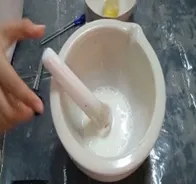
Span 20 was dissolved in liquid paraffin to prepare the oil phase. Tween 80 was dissolved in purified water to prepare the aqueous phase and to this melatonin and methyl paraben dissolved in propylene glycol was added. Peppermint oil was added to the oil phase. Both phases were separately heated to 70–80 °C. The oil phase was then added dropwise to the aqueous phase with continuous stirring using a mortar and pestle until the emulsion cooled to room temperature.
Preparation of gel and emulgel
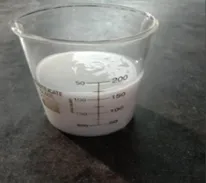
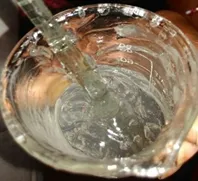
The selected gelling agent carbopol 940, sodium CMC, HPMC or xanthan gum was dispersed in purified water with continuous stirring and allowed to hydrate. To adjust the pH triethanolamine was added. The prepared emulsion was incorporated slowly into the gel base in a 1:1 ratio with gentle stirring. Purified water was added q.s. and mixing continued until a smooth, homogeneous emulgel was obtained. In a suitable containers preparations were transferred and stored in cool, dry place.
6.EVALUATION OF FORMULATIONS
1.Physical appearance and homogeneity: Consistency, colour, homogeneity and visible phase separation are verified visually.
2.Surface pH: One gram of formulation was dispersed in 100 mL distilled water, kept for two hours and measured using a calibrated digital pH meter.
3.Spreadability: The slip-and-drag method was used. The samples were placed between two glass slides and compressed under a 100 g weight for 5 minutes. Then upper slide was pulled using a 20 g load. Spreadability was calculated as
S = (W × L)/T
where,
W = pulling weight
L =distance travelled
T = time required.
4.Viscosity: A Brookfield viscometer with spindle No. 7 at 100 rpm was used. The reading after 10 minutes of shear was recorded in centipoise (cP).
5.Grittiness: Formulations were examined microscopically for appreciable particulate
matter.
6.Drug content: One gram of emulgel was extracted with methanol in a 100 mL volumetric flask, filtered, diluted and measured by UV–Visible spectrophotometry at 278 nm against methanol blank.
7.Dilution test: The emulgel was subjected to 50–100- fold aqueous dilution and visually examined for clarity and phase separation.
8.Antimicrobial assay: Mueller–Hinton agar plates were inoculated with the test organism. Four 8 mm wells were made. Sample volumes of 50 and 100 µL from a 10 mg/mL stock were added to test wells; gentamicin (40 µL from 4 mg/mL stock) and methanol were used as positive and negative controls, respectively. Plates were incubated for 24 hours at 36 ± 1 °C under aerobic conditions, after which inhibition zones were to be measured. The project document reports activity against S. aureus but does not include the numerical zone values.
RESULT AND DISCUSSION
Preformulation studies
Table 2: Preformulation Characteristics of Melatonin
| Parameter | Observation |
|---|---|
| Color | White to off -white |
| Odour | Odorless |
| Appearance | Crystalline powder |
| Melting point | 116-118℃ |
| Solubility in distilled water | Slightly soluble |
| Solubility in ethanol and methanol | Soluble |
Physicochemical evaluation
| Formulation | Surface pH | Spreadability | Viscosity(cP) | Drug content (%) |
|---|---|---|---|---|
| F1 | 5.33 | 12.00 | 8336 | 96 |
| F2 | 5.62 | 15.50 | 7200 | 94 |
| F3 | 5.78 | 10.71 | 6503 | 93 |
| F4 | 6.12 | 9.38 | 5800 | 91 |
Surface pH
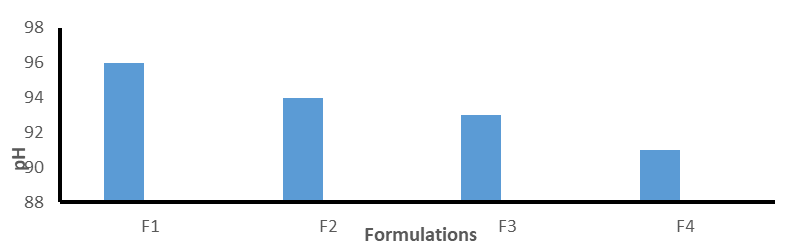
All measured pH values were between 5.33 and 6.12, within the skin-compatible range.
Spreadability
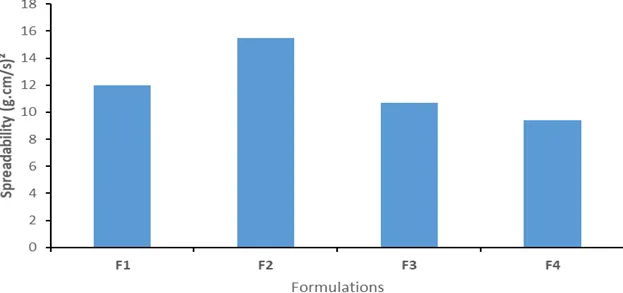
F2 showed the highest reported spreadability (15.50) while comparing with other formulations.
Viscosity
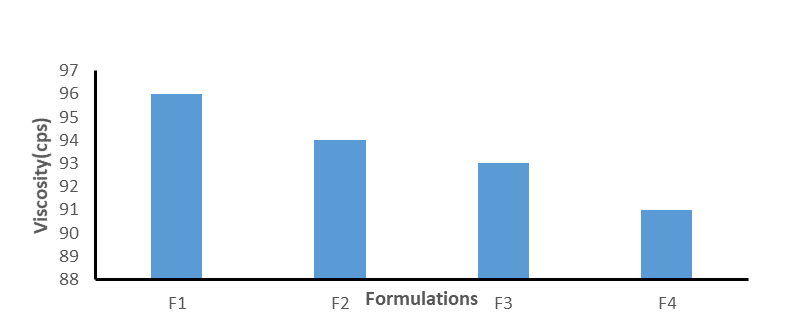
Within the formulations F1 had the highest viscosity (8336 cP).
Drug content
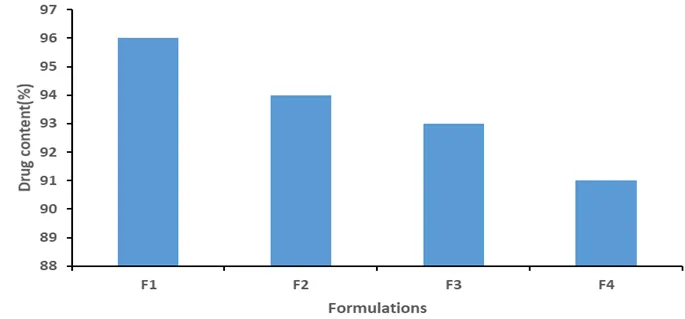
F1 had the highest tabulated drug content (96%), followed by F2 (94%), F3 (93%) and F4 (91%).
Calibration curve
The project report gives the calibration equation as y = 0.04532x + 0.004, with R² = 0.9985. This indicates a strong linear relationship over the reported concentration range. The drug-content procedure later describes measurement at 278 nm in methanol.
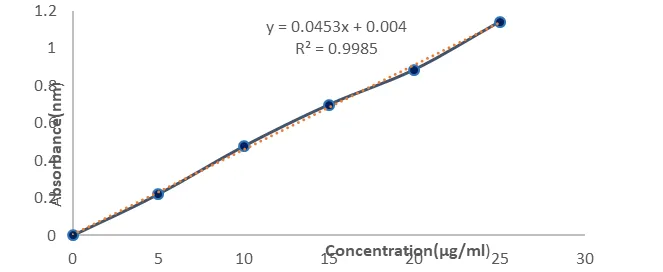
Table 3: Absorbance of Melatonin in Phosphate Buffer (pH 6.8) at 276.2 nm
Grittiness and dilution test
Microscopic analysis showed no significant particulate matter in the formulations. No phase separation was observed after 50–100-fold aqueous dilution, and the preparation was described as remaining clear and stable. These findings support acceptable preliminary physical characteristics under the tests reported.
Antimicrobial activity
The project report states that the Carbopol 940-based melatonin emulgel demonstrated antibacterial activity against Staphylococcus aureus. The assay design included two sample volumes, a gentamicin positive control and a methanol negative control. However, the source document does not provide the measured inhibition-zone diameters, replicate data or statistical analysis. Therefore, the antimicrobial finding should be interpreted as a qualitative preliminary observation and not as a quantified efficacy result.
CONCLUSION
The development and assessment of a topical melatonin emulgel have been finalized. Primary method of treatment is the application of topical treatment even for minor cases. Melatonin effectively exhibit antimicrobial activity into the deeper layers of skin. On the basis of the study, four melatonin emulgel formulations were prepared using Carbopol 940, xanthan gum, sodium CMC and HPMC. The formulations showed smooth appearance, homogeneity, no visible phase separation and surface pH values between 5.33 and 6.12. F2 exhibited the highest spreadability, F1 the highest viscosity and drug content. The project report identified F1 as the ideal formulation based on its overall physical characteristics. A preliminary antibacterial effect against Staphylococcus aureus was reported, although quantitative inhibition-zone data were not available in the supplied project document The work concluded the effectiveness of the formulation i.e. melatonin emulgel incorporated by particular gelling agent have antimicrobial property., Further studies can be conducted by designing the different formulation for different activities.
REFERENCES

Amjitha B., Rahul A., Sulthana Y., Bijin Biju, Gayathri A. R., Dr.: Bhageerathy A., Formulation and Evaluation of Melatonin Emulgel, Int. J. of Pharm. Sci., 2026, Vol 4, Issue 11, 5929-5935. https://doi.org/10.5281/zenodo.24645004
 10.5281/zenodo.24645004