
View Article

Abstract

Herbal cosmetics are preparations used to enhance the human appearance. Herbal formulations have significant Demand in the global market. It is more acceptable to believe that natural remedies are safer than synthetic ones with fewer side effects. The current research work focuses on the extraction of neem leaves (Azadirachta indica), Turmeric (Curcuma longa), aloe Vera, glycerin, lemon juice, rose water and xanthan gum they have anti-acne, anti-Inflammatory, and anti-oxidant properties, with the help of this herbal ingredient developed and evaluates as a herbal anti-Acne face wash. The face wash showed a multipurpose effect and all these herbal ingredients showed significant Different activities. The ingredient uses in herbal face wash have properties softening of skin, remove acne as well as Promote healing. The prepared formulation was evaluated based on number of criteria including consistency, pH test, spreadability, stability test, cleansing test, foamability and grittiness

Keywords

Acne vulgaris, Polyherbal face wash, Herbal cosmetics, Ayurvedic formulation, Neem, Aloe vera, Turmeric, Antimicrobial activity, Anti-inflammatory activity, Natural skincare

Introduction

× Popup Image

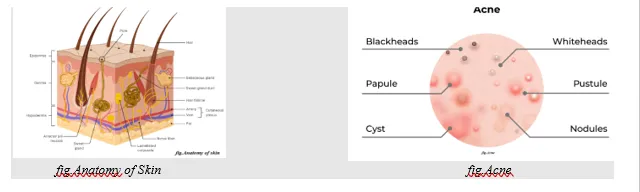
The skin is the largest organ in the body, covering its entire external surface. The skin has 3 layers—the epidermis, dermis, and hypodermis, which have different anatomical structures and functions (see Image. Cross Section, Layers of the Skin) The skin’s structure comprises an intricate network that serves as the body’s initial barrier against pathogens, ultraviolet (UV) light, chemicals, and mechanical injury. This organ also regulates temperature and the amount of water released into the environment.

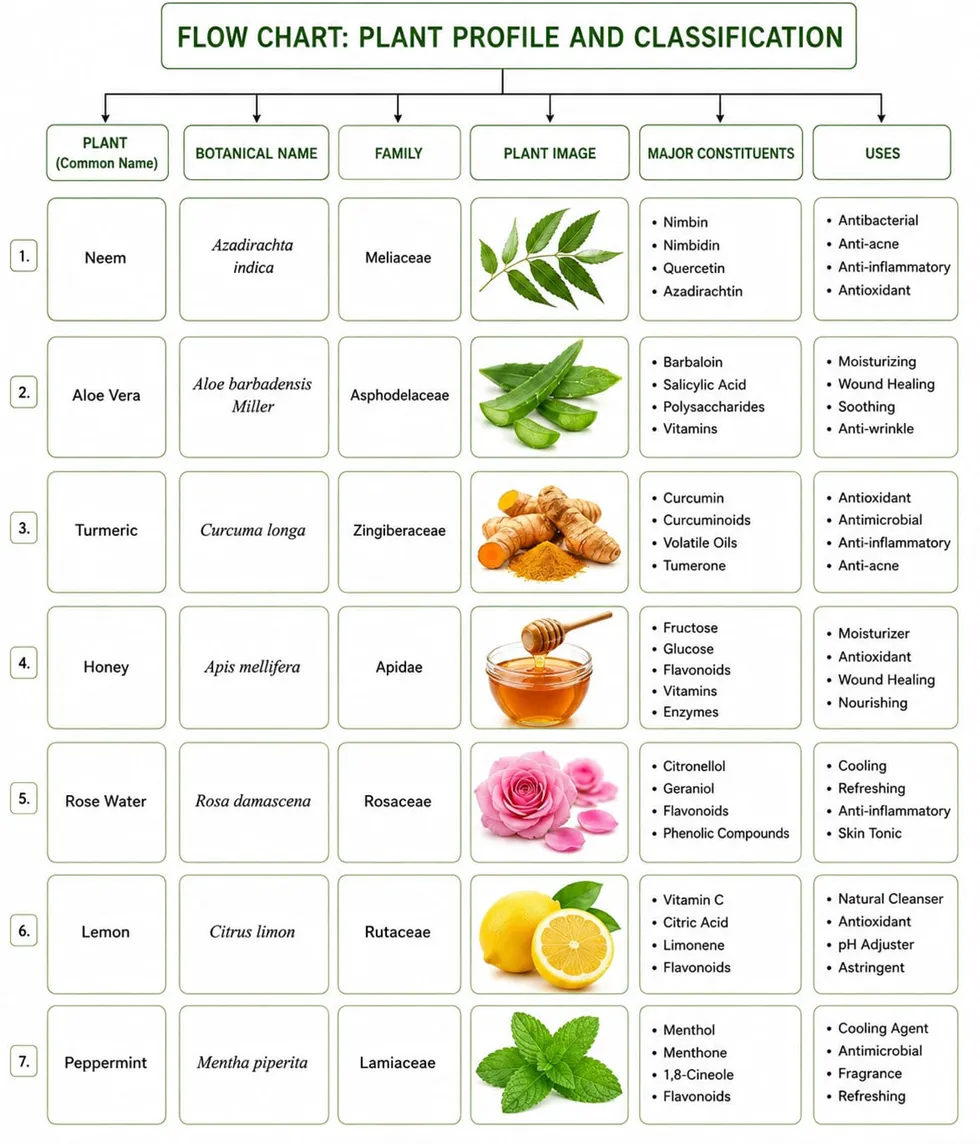
Herbal cosmetics have gained significant popularity because of their therapeutic benefits, biocompatibility, affordability, and minimal side effects. Medicinal plants such as Neem (Azadirachta indica), Aloe vera (Aloe barbadensis Miller), and Turmeric (Curcuma longa) have been traditionally used in Ayurvedic medicine for the treatment of various skin disorders. Neem possesses potent antibacterial and anti-inflammatory properties, Aloe vera provides moisturizing and wound-healing effects, while Turmeric exhibits strong antioxidant and antimicrobial activities. Additional ingredients such as honey, lemon juice, rose water, and peppermint oil contribute cleansing, soothing, moisturizing, and refreshing effects that support healthy skin. Polyherbal formulations combine the therapeutic benefits of multiple herbal ingredients to produce synergistic effects. Such formulations can effectively cleanse the skin, remove excess oil, reduce microbial growth, prevent acne formation, and promote skin regeneration. Herbal face wash preparations are particularly advantageous because they provide daily cleansing while delivering active phytoconstituents directly to the skin.The present study focuses on the formulation and evaluation of a Polyherbal Ayurvedic Face Wash for the management of Acne Vulgaris. The study aims to develop a safe, effective, and economical herbal formulation using natural ingredients and to evaluate its physicochemical properties, stability, and suitability for acne-prone skin.


2. MATERIALS AND METHODS

2.1 MATERIALS

The materials used for the formulation of Polyherbal Ayurvedic Face Wash included Neem leaves (Azadirachta indica), Aloe vera gel (Aloe barbadensis Miller), Turmeric oil (Curcuma longa), Honey, Lemon juice (Citrus limon), Rose water (Rosa damascena), and Peppermint oil (Mentha piperita). Xanthan gum was used as a thickening and stabilizing agent, Glycerin as a humectant and moisturizer, Sodium Lauryl Sulfate as a foaming agent, and Methyl Paraben as a preservative.


2.2 PREPARATION OF HERBAL EXTRACT

Aloe Vera Gel:

Take some aloe Vera leaves and wash with distilled water .then dissect the outer part of edges of the leaves using a sterile knife. Then remove the jelly part i.e. aloe-vera gel is collected. Then collect the pulp and blend with the help of a blender.

Extraction of Neem Leaves:

Azadirachta indica leaves were collected and washed under running tap water and rinsed with distilled water to remove dust and debris. The leaves were crushed In a mortar and pestle to a coarser particle size. The crushed leaves(50gm) added with 500ml of distilled water and boiled till the volume reduces to Half. Decoction was passed through muslin cloth and allowed to cool down at room temperature. The prepared decoction was passed through muslin cloth and filtrate used for further research study.

2.3 PREPRATION OF HERBAL FACE WASH

  1. First add required quantity of Xanthan gum put in rose water for overnight in a beaker.
  2. In second beaker, aloe vera gel, glycerin, honey and few drops of lemon juice mix it.
  3. Transfer second beaker mixture (aloe vera gel + glycerin +honey +few drops of lemon juice) into to rose water mixture (Xanthan gum +Rose water)
  4. Mix the two, mixtures are together.
  5. Then add the Neem extract and Turmeric extract to above mixture, Mix it properly, finally add sodium lauryl sulfate and Methyl Paraben to the above mixture. Mix it properly to make viscous Herbal Face wash.
  6. Add a few drops of peppermint oil at this stage and mix        gently but thoroughly.Peppermint oil is volatile and should   be added at the end to preserve its aroma and properties.

2.4 FORMULATION COMPOSITION


Name of Drug

F1

F2

F3

Neem Extract

4ml

4.5ml

3ml

Turmeric Oil

3 ml

2ml

2.5ml

Aloe vera gel

5gm

6gm

5gm

Honey

3ml

5ml

3ml

Lemon Oil

5 drops

6 drops

6 drops

Glycerine

5ml

5ml

4ml

Xanthan Gum

0.25gm

2gm

2gm

Rose Water

100ml

100ml

100ml

Methyl Paraben

0.02gm

0.02gm

0.02gm

Sodium Lauryl Sulphate

2gm

2gm

2gm

Peppermint Oil

0.2ml

0.2ml

0.2ml


2.5 EVALUATION PARAMETERS

The prepared Polyherbal Ayurvedic Face Wash formulations were evaluated using the following parameters:

1. Physical Appearance

The formulation was visually examined for color, odor, texture, consistency, and homogeneity. A good face wash should possess an attractive appearance, pleasant odor, and smooth texture without lumps.

2. pH Determination

The pH of the formulation was measured using a calibrated digital pH meter. The pH should be within the skin-friendly range (5.5–7.0) to avoid irritation and maintain normal skin physiology.

3. Washability

The face wash was applied to the skin and rinsed with water to evaluate the ease of removal. A good formulation should be easily washable without leaving any residue.

4. Foamability

Foamability was assessed by mixing the formulation with water and observing the amount and stability of foam produced. Adequate foam formation indicates good cleansing properties.

5. Grittiness Test

The formulation was rubbed between fingers to determine the presence of any coarse or gritty particles. The preparation should be free from grittiness to ensure smooth application.

6. Viscosity

Viscosity was determined using a Brookfield Viscometer. Appropriate viscosity is essential for easy application, spreadability, and product stability.

7. Spreadability

Spreadability was evaluated by measuring the ease with which the formulation spreads over the skin surface. Good spreadability ensures uniform application and consumer acceptability.

8. Cleansing Ability

The cleansing efficiency of the formulation was evaluated by assessing its ability to remove dirt, oil, and impurities from the skin surface.

9. Stability Study

The prepared formulations were subjected to stability testing under different temperature conditions. The formulations were observed for any changes in color, odor, pH, consistency, and phase separation during storage.

10. Skin Irritation Test

The formulation was applied to a small area of skin and observed for redness, itching, burning sensation, or irritation. The absence of adverse reactions indicates the safety of the formulation for topical use.

 RESULTS

Evaluation of formulation


Test

Formulation Fl

Formulation F2

Formulation F3

Color

Yellowish


Yellowish


Yellowish

Odor

Pleasant

Pleasant

Pleasant

Texture

Smooth

Smooth

Smooth

Spread-ability

Easily Spreadable

Easily Spreadable

Easily Spreadable

Wash-ability

Easily Washable

Easily Washable

Easily Washable

Foam-ability

2.4 ml

2 ml

3 ml

pH

6

7

6

Viscosity

1450

1560

1660

Grittiness

No Grittiness

No Grittiness

No Grittiness


DISCUSSION

Among the three formulations, F3 demonstrated superior performance. The formulation showed excellent foamability (3 mL), indicating better cleansing efficiency compared to F1 and F2. The pH value of F3 was found to be 6, which is within the normal skin pH range and suitable for topical application without causing irritation. The viscosity of F3 (1660 cps) was higher than the other formulations, providing better consistency and ease of application.

CONCLUSION

The Prepered formulations were evaluated for various physicochemical parameters, including appearance, pH, foamability, spreadability, washability, viscosity, grittiness, and stability. All formulations showed satisfactory results; however, formulation F3 exhibited the best overall performance. F3 demonstrated excellent foamability, suitable pH, better viscosity, easy spreadability, good washability, and no signs of skin irritation

By using Aloe Vera gel, Neem, turmeric, honey, peppermint oil and lemon juice the face wash showed a multipurpose effect and all these herbal ingredients showed significant different activities. Based on results and discussion, the formulation were stable at room temperature and can be safely used on the face. It is use to remove acne as well as promote healing, softening of skin .The extract of Azadirachta indica, Curcuma longa has anti-acne activity.   

REFERENCES

    1. Sehgal A, Banyal M, Gupta J, Joshi S. Formulation and evaluation of anti-acne herbal facewash. International Journal of Advance Research and Innovative Ideas in Education. 2023;9(2):1652-62.
    2. Formulation and Evaluation of Polyherbal Anti Acne Face Wash and Comparative Study with Marketed Product, *Parag Patle, Sneha Bhelave, Pooja Yede, Prachi  Munghate, Harshal Patle Manoharbhai Patel Institute of Bachelor of Pharmacy Kuwda, Gondia 441601 Maharashtra, India
    3. Yousef H, Alhajj M, Sharma S. Anatomy, skin (integument), epidermis..
    4. NHS. (n.d.). Acne – Causes. National Health Service (NHS). Retrieved February 21, 2025
    5. Kwan YJ. Skin Care Excellence: Increasing RN Skin Check Frequency to Prevent HAPIs.
    6. Waghmare PR, Kakade PG, Takdhat PL, Nagrale AM, Thakare SM, Parate MM. Turmeric as medicinal plant for the treatment of acne vulgaris. PharmaTutor. 2017 Apr 1;5(4):19-27.
    7. Pise S, Shaikh F, Vohra P. Formulation and evaluation of herbal anti-acne face scrub. Research Journal of Topical and Cosmetic Sciences. 2023 Jul 1;14(2):53-7.
    8. A Review on Extraction of Neem Leaves and Study the Antimicrobial Activity Vaishna V V*1 , Padmaja Devi M S2 ,Prasobh G R3
    9. Sehgal A, Banyal M, Gupta J, Joshi S. Formulation and evaluation of anti-acne herbal facewash. International Journal of Advance Research and Innovative Ideas in Education. 2023;9(2):1652-62.
    10. Gorantla NV, Das R, Mulani FA, Thulasiram HV, Chinnathambi S. Neem derivatives inhibits tau aggregation. Journal of Alzheimer's disease reports. 2019 Jun 14;3(1):169-78.
    11. Lavanya P, Ramaiah S, Anbarasu A. Computational analysis reveal inhibitory action of nimbin against dengue viral envelope protein. Virusdisease. 2015 Dec;26(4):243-54.
    12. Kaeding WW, Shulgin AT. Preparation of Salicylic Acids by the Hydroxylation of Benzoic Acids. The Journal of Organic Chemistry. 1962 Oct;27(10):3551-4.
    13.  Jurenka JS. Anti-inflammatory properties of curcumin, a major constituent of Curcuma longa: a review of preclinical and clinical research. Alternative medicine review. 2009 Jun 1;14(2).
    14. Aggarwal BB, Harikumar KB. Potential therapeutic effects of curcumin, the anti-inflammatory agent, against neurodegenerative, cardiovascular, pulmonary, metabolic, autoimmune and neoplastic diseases. The international journal of biochemistry & cell biology. 2009 Jan 1;41(1):40-59.
    15. Sikora, M., & Rakus, D. (2014). Curcumin: A therapeutic agent in cancer therapy. Current Pharmaceutical Design, 20(34), 5141–5152.
    16. Asase RV, Glukhareva TV. Production and application of xanthan gum—prospects in the dairy and plant-based milk food industry: a review. Food Science and Biotechnology. 2023 Nov 29;33(4):749.
    17. Williams PA, Phillips GO. Gum arabic. InHandbook of hydrocolloids 2009 Jan 1 (pp. 252-273). Woodhead Publishing.
    18. Bender, D. A. (2009). Xanthan gum. In Encyclopedia of Food Sciences and Nutrition (pp. 5943–5948). Elsevier.
    19. López, F., Rodríguez, C., & Jiménez, A. (2005). Essential oils as natural insect repellents: Chemical composition and biological activity of citronellol. Journal of Essential Oil Research, 17(6), 435-439. DOI: 10.1080/10412905.2005.9699353
    20. Wang Y, Kong L, Chen Y. Behavioural and biochemical effects of fractions prepared from Banxia Houpu decoction in depression models in mice. Phytotherapy Research. 2005 Jun;19(6):526-9.
    21. Gröger, D., & Riedel, F. (2011). Citronellol and its use in cosmetics: A comprehensive review of its biological and toxicological effects. Journal of Cosmetic Science, 62(3), 223-231.
    22. Sun J. D-Limonene: safety and clinical applications. Alternative medicine review. 2007 Sep 1;12(3):259.
    23. Bakkali F, Averbeck S, Averbeck D, Idaomar M. Biological effects of essential oils–A review. Food and Chemical Toxicology. 2008;46:446-75.
    24. Opdyke DL. Monographs on fragrance raw materials. Food and cosmetics toxicology. 1979 Oct 1;17(5):509-33
    25. Eccles R. Menthol and related cooling compounds. Journal of Pharmacy and Pharmacology. 1994 Aug;46(8):618-30.

Reference

    1. Sehgal A, Banyal M, Gupta J, Joshi S. Formulation and evaluation of anti-acne herbal facewash. International Journal of Advance Research and Innovative Ideas in Education. 2023;9(2):1652-62.
    2. Formulation and Evaluation of Polyherbal Anti Acne Face Wash and Comparative Study with Marketed Product, *Parag Patle, Sneha Bhelave, Pooja Yede, Prachi  Munghate, Harshal Patle Manoharbhai Patel Institute of Bachelor of Pharmacy Kuwda, Gondia 441601 Maharashtra, India
    3. Yousef H, Alhajj M, Sharma S. Anatomy, skin (integument), epidermis..
    4. NHS. (n.d.). Acne – Causes. National Health Service (NHS). Retrieved February 21, 2025
    5. Kwan YJ. Skin Care Excellence: Increasing RN Skin Check Frequency to Prevent HAPIs.
    6. Waghmare PR, Kakade PG, Takdhat PL, Nagrale AM, Thakare SM, Parate MM. Turmeric as medicinal plant for the treatment of acne vulgaris. PharmaTutor. 2017 Apr 1;5(4):19-27.
    7. Pise S, Shaikh F, Vohra P. Formulation and evaluation of herbal anti-acne face scrub. Research Journal of Topical and Cosmetic Sciences. 2023 Jul 1;14(2):53-7.
    8. A Review on Extraction of Neem Leaves and Study the Antimicrobial Activity Vaishna V V*1 , Padmaja Devi M S2 ,Prasobh G R3
    9. Sehgal A, Banyal M, Gupta J, Joshi S. Formulation and evaluation of anti-acne herbal facewash. International Journal of Advance Research and Innovative Ideas in Education. 2023;9(2):1652-62.
    10. Gorantla NV, Das R, Mulani FA, Thulasiram HV, Chinnathambi S. Neem derivatives inhibits tau aggregation. Journal of Alzheimer's disease reports. 2019 Jun 14;3(1):169-78.
    11. Lavanya P, Ramaiah S, Anbarasu A. Computational analysis reveal inhibitory action of nimbin against dengue viral envelope protein. Virusdisease. 2015 Dec;26(4):243-54.
    12. Kaeding WW, Shulgin AT. Preparation of Salicylic Acids by the Hydroxylation of Benzoic Acids. The Journal of Organic Chemistry. 1962 Oct;27(10):3551-4.
    13.  Jurenka JS. Anti-inflammatory properties of curcumin, a major constituent of Curcuma longa: a review of preclinical and clinical research. Alternative medicine review. 2009 Jun 1;14(2).
    14. Aggarwal BB, Harikumar KB. Potential therapeutic effects of curcumin, the anti-inflammatory agent, against neurodegenerative, cardiovascular, pulmonary, metabolic, autoimmune and neoplastic diseases. The international journal of biochemistry & cell biology. 2009 Jan 1;41(1):40-59.
    15. Sikora, M., & Rakus, D. (2014). Curcumin: A therapeutic agent in cancer therapy. Current Pharmaceutical Design, 20(34), 5141–5152.
    16. Asase RV, Glukhareva TV. Production and application of xanthan gum—prospects in the dairy and plant-based milk food industry: a review. Food Science and Biotechnology. 2023 Nov 29;33(4):749.
    17. Williams PA, Phillips GO. Gum arabic. InHandbook of hydrocolloids 2009 Jan 1 (pp. 252-273). Woodhead Publishing.
    18. Bender, D. A. (2009). Xanthan gum. In Encyclopedia of Food Sciences and Nutrition (pp. 5943–5948). Elsevier.
    19. López, F., Rodríguez, C., & Jiménez, A. (2005). Essential oils as natural insect repellents: Chemical composition and biological activity of citronellol. Journal of Essential Oil Research, 17(6), 435-439. DOI: 10.1080/10412905.2005.9699353
    20. Wang Y, Kong L, Chen Y. Behavioural and biochemical effects of fractions prepared from Banxia Houpu decoction in depression models in mice. Phytotherapy Research. 2005 Jun;19(6):526-9.
    21. Gröger, D., & Riedel, F. (2011). Citronellol and its use in cosmetics: A comprehensive review of its biological and toxicological effects. Journal of Cosmetic Science, 62(3), 223-231.
    22. Sun J. D-Limonene: safety and clinical applications. Alternative medicine review. 2007 Sep 1;12(3):259.
    23. Bakkali F, Averbeck S, Averbeck D, Idaomar M. Biological effects of essential oils–A review. Food and Chemical Toxicology. 2008;46:446-75.
    24. Opdyke DL. Monographs on fragrance raw materials. Food and cosmetics toxicology. 1979 Oct 1;17(5):509-33
    25. Eccles R. Menthol and related cooling compounds. Journal of Pharmacy and Pharmacology. 1994 Aug;46(8):618-30.

Photo
Phalke G.S
Corresponding author

Dharti janseva pratishthan college of pharmacy Pathri.

Photo
Golait S.S
Co-author

Dharti janseva pratishthan college of pharmacy Pathri

Photo
Sakhare D.S
Co-author

Dharti janseva pratishthan college of pharmacy Pathri

Photo
Hardas K. A
Co-author

Dharti janseva pratishthan college of pharmacy Pathri

Photo
Ingole R. D.
Co-author

Dharti janseva pratishthan college of pharmacy Pathri

Photo
Kasbe R. P.
Co-author

Dharti janseva pratishthan college of pharmacy Pathri

Phalke G.S, Golait S.S, Sakhare D.S, Hardas K. A, Ingole R. D, Kasbe R. P, Formulation And Evaluation of Polyherbal Ayurvedic Face Wash for the Management of Acne Vulgaris, Int. J. of Pharm. Sci., 2026, Vol 4, Issue 6, 4957-4963, https://doi.org/10.5281/zenodo.20758630

More related articles
Digital Transformation of Pharmaceutical Quality A...
Muskan Shaikh, O. G. Bhusnure, Prashant Chavan , Swapnil Kamble ,...
Polymeric Biomaterials in Modern Therapeutics: Eme...
Milind Thosar, Vaishnavi Deshmukh, Shivani Gandhi...
Marine-Derived Bioactive Compounds and Their Pharm...
Prajwal Tupe, Vilasini Pandav, Shruti Sonavane , Manav Watane...
Drug Repurposing: The Cost-Effective Approach to drug Development...
Sanika Nalande, Aarti More, Snehal Nage, Pranjali Narawade, Tanaya Markande, Sumeet Bhilwade...
3D Printed Tablets for Oral Dosage Forms: Based on Types, Technologies, Applicat...
Harshal Borse, Sagar Dhongade , Sanket Gabhale , Uma Patil, Sakshi Bandgar, Radhika shinde, Shravani...
Messenger RNA Vaccine Platforms in COVID-19: Architecture, Immunological Mechani...
Afra Shaireen Mohamed Bakkar, Shivprasad Sanjay Dhage2...
Related Articles
Nanoemulsions As Drug Delivery Systems: Formulation Strategies, Characterization...
Suchitra Thorat, Rini Punathil, Aakanksha Gaikwad, Dr. Sanket Dharashivkar...
Role of Quality Management System (QMS) for Effective Regulatory Compliance...
Mayuri Janakwade, Nikita Delmade, Rohit Muneshwar, Dr. Jadhav S. B., Dr. Vijay Navghare...
Digital Transformation of Pharmaceutical Quality Assurance through Industry 4.0:...
Muskan Shaikh, O. G. Bhusnure, Prashant Chavan , Swapnil Kamble , Omkar Rankhamb ...
More related articles
Digital Transformation of Pharmaceutical Quality Assurance through Industry 4.0:...
Muskan Shaikh, O. G. Bhusnure, Prashant Chavan , Swapnil Kamble , Omkar Rankhamb ...
Marine-Derived Bioactive Compounds and Their Pharmaceutical Applications: A Revi...
Prajwal Tupe, Vilasini Pandav, Shruti Sonavane , Manav Watane...
Digital Transformation of Pharmaceutical Quality Assurance through Industry 4.0:...
Muskan Shaikh, O. G. Bhusnure, Prashant Chavan , Swapnil Kamble , Omkar Rankhamb ...
Marine-Derived Bioactive Compounds and Their Pharmaceutical Applications: A Revi...
Prajwal Tupe, Vilasini Pandav, Shruti Sonavane , Manav Watane...