

We use cookies to ensure our website works properly and to personalise your experience. Cookies policy
Department of Pharmacognosy, College of Pharmacy, Madras Medical College, Chennai, Tamil Nadu, India.
A member of the Asteraceae family, Wedelia chinensis (Osbeck) Merr. is a medicinal herb that has been used extensively in traditional medical systems to treat wounds, skin conditions, diabetes, inflammation, liver problems, and neurological conditions. This review highlights the botanical traits, taxonomy, ethnomedicinal uses, phytochemical constituents, Pharmacognostic aspects, and Pharmacological actions of the plant. The medicinal qualities of the plant are attributed to a number of bioactive substances, such as Wedelolactone, Norwedelolactone, flavonoids, alkaloids, saponins, tannins, phenolic compounds, and terpenoids. Pharmacological studies have showed considerable invitro antioxidant, anticancer, and anticholinesterase properties and invivo anticonvulsant, nephroprotective, analgesic, central nervous system depressant, wound healing, and antidiabetic actions. These findings scientifically confirm the traditional medicinal applications of Wedelia chinensis and show its potential as a valuable source of natural therapeutic ingredients. However, further investigations, including extensive toxicity studies, standardization, and well-designed clinical trials, are required to establish its safety, efficacy, and therapeutic applications in modern medicine
Plants continue to be a significant source of medicinal agents and are essential for nation’s healthcare systems. The World Health Organization (WHO) has advised assessing the safety and effectiveness of medicinal plants, especially in situations when access to safe and effective synthetic medications is restricted or non-existent. Ayurveda, Siddha, and Unani are just a few of the traditional medical systems that have made extensive use of Wedelia chinensis (Osbeck) Merr ., a medicinal herb from the Asteraceae family. Additionally, the plant has been widely used in many traditional medical practices to treat fever, liver problems, skin conditions, cough, inflammation, wounds, and conditions related to the hair. Wedelia chinensis has drawn a lot of interest as a prospective herbal remedy for pharmacological research because of its wide range of traditional medicinal applications and the presence of several bioactive phytoconstituents.
HABITAT, TAXONOMY, SYNONYMS, VERNACULAR NAMES AND BOTANICAL DESCRIPTION OF Wedelia chinensis (Osbeck) MERR. [3-14]
HABITAT
Wedelia chinensis (Osbeck) Merr. is a perennial medicinal herb widely distributed throughout tropical and subtropical regions of Asia, including India, China, and Japan. In India, it is commonly found in the plains of the former Madras Presidency and occurs naturally in the states of Uttar Pradesh, Assam, Andhra Pradesh, and other coastal regions. The plant grows abundantly in moist, marshy, and wet places such as riverbanks, canals, paddy fields, and grasslands.
TAXONOMY [5, 6]
SYNONYM
VERNACULAR NAMES [7,8]
BOTANICAL DESCRIPTION
Wedelia chinensis (Osbeck) Merr. is a procumbent, perennial, herb belonging to the family Asteraceae. The plant is characterized by a pleasant camphor-like odour and luxuriant growth, attaining a height of approximately 0.3–0.9 m. The stem is procumbent at the base, rooting at the lower nodes, and is covered with rough hairs (scabrous).
The leaves are arranged oppositely, subsessile, lanceolate to oblong in shape, measuring about 2.5–7.5 cm in length and 1–2.8 cm in width. They are entire or irregularly crenate-serrate along the margins, scabrous due to short white hairs, and taper towards the base.
The flower heads are solitary, bright yellow, and measure approximately 2–3.2 cm in diameter. They are borne on erect, slender peduncles ranging from 2.5–15 cm in length, which are slightly thickened just below the flower head.
The whole plant is traditionally used for medicinal purposes, although the leaves and stems are the most commonly utilized plant parts.
Parts Used: Leaves, stem, and whole plant.
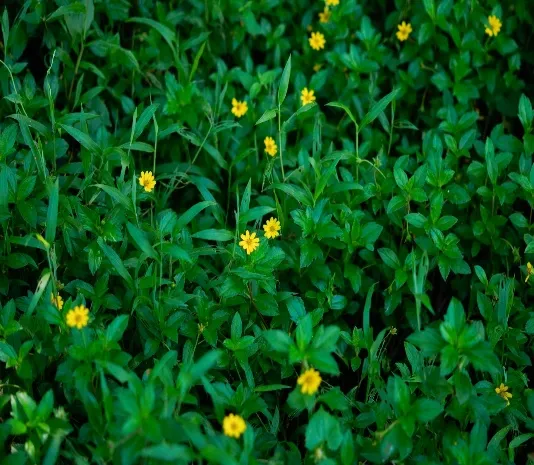
FIGURE 1: WEDELIA CHINENSIS
TABLE1: ETHNOMEDICINAL USES [3, 13, 14]
|
Plant Part |
Traditional Uses |
|
Whole plant |
Used as a folklorie medicine for hepatoprotective activity, cholagogue, jaundice, diarrhoea, cough, cephalalgia (headache), diphtheria, and pertussis (whooping cough). The decoction is used as deobstruent and is administered in uterine haemorrhage and menorrhagia [10, 11]. It is also traditionally used for viral hepatitis, fever, infections, childbirth, and the treatment of bites and stings. |
|
Leaves |
Used as a tonic for cough, cephalalgia, skin diseases, and alopecia. Traditionally employed to reduce mental tension and induce sleep in Tamil Nadu, India [7]. Leaves are also used to treat kidney dysfunction, common cold, wounds, and amenorrhoea. They are applied for dyeing grey hair and promoting hair growth. Leaf extracts are used as a natural alternative to anti-inflammatory drugs and are traditionally employed in the management of osteochondritis dissecans, multiple sclerosis, juvenile arthritis, gouty arthritis, and rheumatic fever. |
|
Stem & Fruit |
Traditionally used during childbirth and in the treatment of bites, stings, fever, and infections. |
TABLE 2: PHYTOCHEMISTRY [4, 10]
|
Plant Part |
Phytoconstituents |
|
Leaves |
Wedelolactone (≈0.05%), Norwedelolactone, Norwedelic acid, isoflavonoids, bisdesmosidic oleanolic acid saponins, flavonoids, alkaloids, tannins, saponins, and lactones. |
|
Leaf juice (expressed juice) |
Waxy substances, Phytosterols, carotene, resin, oil-soluble black pigment, inorganic salts, siliceous compounds, pectin, and mucin. |
|
Whole plant |
Alkaloids, flavonoids, tannins, saponins, lactones, wedelolactone, and norwedelic acid. |
TABLE 3: MACROSCOPIC CHARACTERS OF Wedelia chinensis [4, 5]
|
Colour |
Green |
|
Odour |
Characteristic |
|
Taste |
Bitter |
|
Shape |
Oblong to Oblong - lanceolate |
|
Size |
2-5 cm in length |
|
Apex |
Acute |
|
Margin |
Entire or serrate |
|
Petiole |
Absent |
|
Base |
Wedge-shape |
POWDER MICROSCOPIC CHARACTERS OF Wedelia chinensis [11]
The powdered leaves of Wedelia chinensis exhibited several characteristic microscopical features. The diagnostic characters included multicellular, uniseriate trichomes and occasional glandular trichomes. Paracytic stomata were observed in the epidermal fragments. Xylem vessels with spiral and pitted thickenings, lignified fibres, and fragments of parenchymatous and epidermal tissues were also identified. The observed microscopical characters were consistent with the diagnostic features reported for Wedelia chinensis.
PHARMACOLOGICAL SCREENING
INVITRO SCREENING
ANTIOXIDANT ACTIVITY [15, 16]
DPPH free radical scavenging, hydroxyl radical scavenging, and reducing power experiments were used to assess Wedelia chinensis essential oil's in vitro antioxidant activity. In every test, the essential oil showed concentration-dependent antioxidant activity, indicating a strong capacity to scavenge free radicals. The antioxidant efficacy of the DPPH and hydroxyl radical scavenging activities was equivalent to those of conventional antioxidants such ascorbic acid, with IC50 values of 48 µg/mL and 51 µg/mL, respectively. The extract demonstrated a considerable electron-donating capacity in the reducing power experiment as its absorbance increased with concentration. These data demonstrate that Wedelia chinensis contains substantial invitro antioxidant activity, which may be related to its bioactive phytoconstituents including phenolic compounds and terpenoids.
ANTICANCER ACTIVITY [17-20]
Wedelia chinensis standardized ethanolic extract shown strong in vitro anticancer activity against the human prostate cancer cell lines LNCaP and 22Rv1. Through the induction of dose-dependent apoptosis and the suppression of androgen receptor (AR) expression at both the mRNA and protein levels, the extract prevented the growth of cancer cells. It also down regulated AR-responsive genes including FKBP5, STEAP1, TMPRSS2, EZH2, and MAOA, hence lowering androgen signalling. Furthermore, the extract suppressed HER2/HER3-AKT signalling pathways, which are related with prostate cancer growth and resistance. These data imply that Wedelia chinensis possesses promising anticancer potential and may act as an effective adjuvant for the management of androgen-dependent and castration-resistant prostate cancer.
ANTICHOLINESTERASE ACTIVITY [16, 20]
Using the Ellman colorimetric assay against acetyl cholinesterase (AChE) and butyrylcholinesterase (BChE), the anticholinesterase activity of Wedelia chinensis was assessed. Both enzymes were inhibited by the isolated chemicals in a concentration-dependent manner, suggesting that they may have neuroprotective properties. With IC50 values of 34.82 ± 0.45 µg/mL for AChE and 33.70 ± 0.48 µg/mL for BChE, (-)-kaur-16-en-19-oic acid had the greatest inhibitory activity among the isolated constituents. The results indicate that the diterpenoid compounds of Wedelia chinensis had significant cholinesterase inhibitory characteristics, even if the activity was lower than that of the conventional inhibitors donepezil and galantamine. These results suggest that Wedelia chinensis may be a promising natural source of anticholinesterase drugs for the treatment of neurological diseases, especially Alzheimer's.
INVIVO SCREENING
ANTICONVULSANT ACTIVITY [21, 22]
Maximal electroshock (MES) and pentylenetetrazole (PTZ)-induced seizure models in mice have been used to assess the anticonvulsant efficacy of Wedelia chinensis. Significant, dose-dependent protection against seizures was achieved by both ethanolic and aqueous extracts of the entire plant, with the ethanolic extract showing higher efficacy. The ethanolic extract produced effects similar to those of phenytoin at a dose of 750 mg/kg, considerably reducing hind limb tonic extension in the MES model and delaying the start of PTZ-induced seizures while reducing seizure duration. The anticonvulsant effect is attributed to bioactive ingredients such as flavonoids, alkaloids, glycosides, and saponins, which are considered to promote GABAergic neurotransmission, decrease glutamatergic excitement, and modify voltage-gated sodium channels. These results imply that Wedelia chinensis has intriguing neuroprotective and anticonvulsant potential, which calls for more research to determine its active ingredients and confirm its therapeutic uses.
NEPHROPROTECTIVE ACTIVITY [23, 24]
The hydroalcoholic leaf extract of Wedelia chinensis exhibited significant nephroprotective activity against gentamicin-induced nephrotoxicity in Wistar rats. Oral administration of the extract (250 and 500 mg/kg) markedly reduced elevated serum creatinine, urea, and uric acid levels while restoring antioxidant enzymes such as superoxide dismutase, catalase, and reduced glutathione. The higher dose (500 mg/kg) demonstrated greater protective efficacy, comparable to the standard drug quercetin. Histopathological examination revealed reduced tubular necrosis, cellular degeneration, and glomerular damage, indicating preservation of renal architecture. The nephroprotective effect is attributed to the flavonoids and phenolic compounds present in the extract, which protect renal tissues by reducing oxidative stress and inflammation.
ANALGESIC AND NEUROLOGICAL (CNS DEPRESSANT) ACTIVITY[10, 25]
In experimental animal models, Wedelia chinensis has shown notable analgesic and central nervous system (CNS) depressive effects. Ethanolic extracts of the leaves and stem bark provided a dose-dependent reduction in acetic acid-induced writhing in rats, indicating efficient peripheral analgesic action, with the stem bark extract displaying the strongest inhibition of pain. The presence of bioactive phytochemicals such flavonoids, tannins, alkaloids, and saponins as well as the regulation of prostaglandin-mediated inflammatory pathways are primarily responsible for the analgesic effect. In addition, the ethanolic extracts considerably reduced spontaneous locomotor activity in the open field and hole cross tests, suggesting sedative and anxiolytic characteristics. The stem bark extract displayed CNS depressant effect comparable to the conventional medication diazepam, suggesting the participation of GABAergic neurotransmission. These pharmacological effects suggest that W. chinensis has potential for both neuroprotection and pain relief. Collectively, the findings support its historic usage in the therapy of pain, anxiety, sleeplessness, and other CNS-related illnesses.
WOUND HEALING ACTIVITY [26, 27]
The wound healing ability of the ethanolic leaf extract of Wedelia chinensis was investigated in Wistar albino rats utilizing excision, incision, and dead space wound models. Oral administration of the extract (500 mg/kg/day) and topical application of a 10% ointment dramatically expedited wound contraction, decreased the epithelialization period, and boosted skin breaking strength compared with the control group. The extract significantly raised granulation tissue weight and hydroxyproline concentration, indicating accelerated collagen synthesis and tissue regeneration. These data suggest that Wedelia chinensis exhibits high wound healing capacity, which may be attributed to its phenolic chemicals and flavonoids that induce collagen deposition and tissue repair.
ANTIDIABETIC ACTIVITY [28-30]
In Swiss albino mice with diabetes caused by alloxan, the methanolic leaf extract of Wedelia chinensis demonstrated notable antidiabetic action. Blood glucose levels were reduced in a dose-dependent manner and oral glucose tolerance was markedly enhanced after the extract (100 and 200 mg/kg body weight) was administered orally for 21 days. By lowering total cholesterol, triglycerides, LDL, and VLDL levels while raising HDL levels, the medication also corrected abnormal lipid profile characteristics. In addition, the extract lowered serum SGPT, SGOT and C-reactive protein levels, demonstrating protective benefits against diabetes-associated liver damage and systemic inflammation. These results confirm W. chinensis potential as a natural medicinal agent for diabetes management by indicating that it has promising anti hyperglycemic and anti hyperlipidemic qualities.
CONCLUSION
Traditional medicine has traditionally used Wedelia chinensis (Osbeck) Merr., a therapeutically significant medicinal herb. The plant's many pharmacological actions are caused by a variety of bioactive phytoconstituents, such as flavonoids, coumestans, phenolic compounds, alkaloids, and saponins. Many of its traditional therapeutic claims have been validated by experimental research that have shown promise antioxidant, anticancer, anticholinesterase, anticonvulsant, nephroprotective, analgesic, wound healing, central nervous system depressant, and antidiabetic activities. Furthermore, recognized pharmacognostic traits offer trustworthy criteria for crude drug identification and quality assurance. The majority of the information that is now available is based on preclinical research, despite these promising results. Therefore, more study concentrating on the isolation of active elements, standardization of herbal formulations, toxicological evaluation, pharmacokinetic investigations, and well-controlled clinical trials is necessary to demonstrate its safety and efficacy. Overall, Wedelia chinensis is a promising natural source for the creation of novel herbal remedies and pharmaceutical goods.
REFERENCES


Sharmili D, Muthusamy P, Vijaya Bharathi R, B Kumudhaveni, Tamilarasan R, Pachiyammal M, Mohamed Hussain N, A Brief Review on Wedelia Chinensis (Osbeck) Merr, Int. J. of Pharm. Sci., 2026, Vol 4, Issue 8, 2798-2805, https://doi.org/10.5281/zenodo.22014591
 10.5281/zenodo.22014591