

We use cookies to ensure our website works properly and to personalise your experience. Cookies policy
DJPS college of pharmacy, pohetakali dist parbhani
Herbal antiseptic cream is a multiuse antiseptic cream that treats all skin infection. The natural antiseptic cream was effective and potential antimicrobial agent. It is used as a preventive, curative and healing. Herbal cream useful for dry skin, cuts, scratches, minor burns, wounds, cold sores and chapped skin. The study suggests that the composition and the base of the cream are more stable and safe for use. Bees wax used as emulsifier, liquid paraffin as lubricant ,borax used as alkalizing agent, methyl Paraben used as preservative ,rose oil used as fragrance The evaluation results confirmed that the antiseptic cream remained physically stable; the physicochemical evaluation results confirm that the color and odor of present herbal formulation is acceptable with a pleasant odor and better after effects, acceptable pH, good spredability, wash ability and showed no skin irritation, phase separation. The findings support the use of herbal antiseptic cream as a cost effective, natural, and safer alternative to chemically formulated commercial antiseptic cream that may cause side effects such as staining, irritation, or taste alteration. Thus, the study concludes that herbal antiseptic cream can be an effective natural skin care product, especially for individuals seeking chemical -free options.
Topical drug administration is a method of localized drug delivery that can occur anywhere in the body via topical, vaginal, or ocular channels. The primary channel of topical medication delivery is the skin, which is also one of the most accessible organs on the human body for topical administration. Topical preparations can have a systemic, local, or superficial effect on the skin. The benefits of topical drug delivery are widely acknowledged. These formulations, which deliver the drug via the skin to achieve systemic therapeutic effect, avoid the problems associated with first-pass metabolism because systemic circulation is achieved without being impacted by the phenomenon of the first pass effect. Topical drug delivery also allows for a controlled transfer of a drug with minimal side effects, good efficiency, and maintenance of a therapeutic dose throughout topical administration. Topical medication administration. Among other pharmaceutical dosage forms, topical drug delivery systems include solid powders, semisolids, liquid formulations, and sprays. The most popular semisolid formulations for topical drug administration are gels, creams, and ointments. Human Epidermis: The largest organ in the body is the skin. The whole body is covered. It acts as a barrier to keep out heat, light, damage, and infections. The skin also serves as a barrier between the body and its surroundings, controls body temperature, stores fat and water, and is a sensory organ.
Topical drug administration is a localized drug delivery system anywhere in the body through skin, vaginal, ophthalmic as topical routes. Skin is one of the most readily accessible organs on human body for topical administration and is main route of topical drug delivery system. Topical preparation are applied to the skin for surface, local or systemic effect.
Topical drug delivery is well recognized, as it allows a controlled transfer of a drug with minimum side effects, good efficiency and maintenance of a therapeutic dose throughout topical administration and these formulations. Which delivery the drug via the skin to achieve systemic therapeutic effect, avoid the challenges associated with first-pass effect.
Topical drug delivery system includes solid powders, semisolids, liquid preparations and sprays among other pharmaceutical dosage form. Gels, creams and ointments are the most often used semisolid preparations for topical medication delivery
Cream is defined as semisolid emulsions which are oil in water (o/w) or water in oil (w/o) type and these semisolid emulsions are intended for external application. Cream is classified as oil in water and water in oil emulsion. It is applied on outer part or superficial part of the skin and its main ability is to remain for a longer period of time at the site of application.
We have used neem oil as a main ingredient in our preparation which have the strong anti-septic, anti-fungal,anti-bacterial, anti-inflammatory properties and it is also used to reduce scar, pigmentation,wounds,redness and itching of the skin. The other ingredients include honey which gives the good antibacterial as well as soothing effect to the skin. We also use the other ingredient such as olive oil, bees wax, borax, liquid paraffin, rose water. The olive oil reach source of vitamin E and it is helpful to moisture and soften the skin. Bees wax used as a emulsifying agent and rose water used as a flavoring agent.
Advantages:
Disadvantages:
Ideal characteristics of antiseptic cream
1. Broad-Spectrum Antimicrobial Activity
The cream should effectively inhibit or kill a wide range of microorganisms such as bacteria, fungi, and some viruses responsible for skin infections and wound contamination. Herbal ingredients like neem, turmeric, tea tree oil, tulsi, and aloe vera are commonly used for this purpose.
2. Skin-Compatible pH :
An ideal herbal antiseptic cream should have a pH close to normal skin pH (approximately 4.5–7.0). This helps:
3. Good Spreadability
The cream should spread easily on the skin with minimal friction to ensure:
4. Proper Consistency and Homogeneity
An ideal cream should be:
5.Moisturizing and Wound-Healing Properties
Besides antiseptic action, the cream should support:
List of equipment and glassware
Table No.1 List of equipment and glassware
|
Sr no |
equipment and glassware |
|
|
Digital pH-Meter |
|
|
Digital Balance |
|
|
Stability Chamber |
|
|
Autoclave |
|
|
Incubator |
|
|
Hot air oven |
|
|
Soxhlet apparatus |
Material and method
Preparation of extract
Leaves of Muraraya Koenigii were collected, shade dried at room temperature and ground in a manual mill and sieved with 2 mm copper sieve to form uniform powder. 50 g of dried powdered drug was weighed and filled in the thimble of Soxhlet apparatus. After that the thimble was fixed with the round bottom flask, and the assembly was attached to the condenser. And the paraffin wax was put at the joints of the assembly for the easy removal of the assembly at the completion of the extraction procedure. Then the solvent for extraction (ethanol) was filled. For extraction temperature should maintain 500c. Extraction was carried out until discoloration of solvents.
After completion of the extraction procedure the extract was filtered using Whattman filter paper and then concentrated at 45°C.The product was collected and shade dried for 10 day and extract was powdered Dried extracts were stored in well closed container at 20°C until further test were carried out.
Percentage yield of latex: Percentage yield of extract was calculated by dividing the Weight of extract by the Weight of the leaf powder taken for extraction.
Percentage yield =Weight of extract (g)Weight of powder (g)
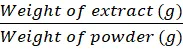
Figure 1. Muraraya Koenigii plant
Figure.2. Powder of Muraraya Koenigii Figure.3. Extraction Muraraya Koenigii leaves
Formulation
Table No.2 Formulation
|
Sr.No |
Ingredients % w/v |
Category |
|
|
1 |
Muraraya Koenigii |
Antiseptic |
|
|
2 |
Beeswax |
Emulsifier |
|
|
3 |
Liquid Paraffin |
Lubricant |
|
|
4 |
Borax |
Alkaline agent |
|
|
5 |
Mythyl Paraben |
preservative |
|
|
6 |
Rose Oil |
fragrance |
|
|
7 |
Distilled Water |
vehicle |
Optimized Formulation batch
Figure.4. Optimized Formulation batch
Evaluation parameter
Evolution of herbal toothpaste was done according to “Bureau of Indian standards” and these tests were performed for all herbal toothpaste formulation. This test includes.
1. Physical Examination
All these physical parameters of the formulation were checked visually-
2. pH
Weigh 1g of cream. Dissolve it in 10 mL of distilled water in a beaker. Stir well to form a uniform dispersion. Calibrate the digital pH meter with standard buffers (pH 4 and 7). Dip the electrode into the sample and record the pH.
Figure 5.Digital ph meter
3. Spredability Test
Weigh 1g of cream and place it between two clean glass slides. Place a 500g weight on the upper slide for 1 minute. Remove the weight and measure the diameter of the spread cream using a ruler or calliper.
Figure.6 . Spredability Test
4. Wash ability Test
Apply a small amount (0.5g) of cream on the back of the hand or a test tile. Allow it to remain for 5 minutes. Rinse under running tap water without soap. Observe whether the cream is washed off easily or leaves a greasy/sticky residue
5. Skin Irritation Test
Clean a small area (2x2 cm) on the inner forearm or behind the ear with alcohol. Apply a thin layer (0.5g) of cream. Cover with a gauze or patch. Leave for 24 hours and then inspect. Check again at 48 hours for redness, itching, swelling, or rashes.
6. Phase separation:
Prepared cream was kept in a closed container at a temperature of 25-100 ℃ away from light. Then phase separation was checked for 24 h for 30 d. Any change in the phase separation was observed/checked.
7. Stability study [18, 19]: The purpose of Stability study of herbal cream formulation was to provide the evidence of quality of product varies with time under the influence of temperature factors such as temperature, humidity, light.
The prepared herbal cream formulation were packed in air tight container at three different temperature ,humidity conditions i.e. Refrigerator condition 40 ± 20C Room temperature 25 ± 20C/ 60% ± 5%RH, and oven 40 ± 20C/ 75% ± 5%RH. The sample were withdrawn at different time interval over a period of one month & evaluate the test of Physical appearance i. e colour, odour, appearance, other was pH, Homogeneity, Spread ability, extrudability.
RESULT
Pharmacognostic characterization of plant
Table.no.3 Pharmacognostic characterization of plant
|
Sr.No. |
Part of plant |
Description |
|
1 |
Leaves |
Dark greenish –green |
|
2 |
Flower |
White |
|
3 |
Fruit |
Green. Red , Yellow |
|
4 |
Stem & Bark |
Green |
Percentage yield of extract
Table.no. 4.Percentage yield of extract
|
Sr. No |
Raw powder |
Solvent |
Extract quantity |
% Yield |
|
1 |
100 gm |
Petroleum ether |
24 g |
24% |
|
2 |
Ethanol |
20 g |
20% |
|
|
3 |
Methanol |
25 g |
25% |
Organoleptic Characteristic of extract
Table.no.5. Organoleptic Characteristic of extract
|
Sr. No |
Parameter |
Observation of Extract |
|
|
ET Sticky mass
Greenish black
Characteristic
Slightly bitter |
|||
|
1 |
Physical Appearance |
||
|
2 |
Colour |
||
|
3 |
Odour |
||
|
4 |
Taste |
Antibacterial Activity of Extract
Table.no.6. Antibacterial Activity of Extract
|
Sample |
Zone of Inhibition(mm) |
|
E.coli |
|
|
Methanolic Extract |
19 |
|
Ethanolic Extract |
17 |
Organoleptic Characterization of Antiseptic Cream
Table.no.7. Organoleptic Characterization of Antiseptic Cream
|
Sr. No. |
Formulation code |
Colour |
Appearance |
Odour |
Taste |
|
1 |
F1 |
Greenish Brown |
Smooth |
Characteristic |
Characteristic |
|
2 |
F2 |
Greenish Brown |
Smooth |
Characteristic |
Characteristic |
|
3 |
F3 |
Greenish Brown |
Smooth |
Characteristic |
Characteristic |
|
4 |
F4 |
Greenish Brown |
Smooth |
Characteristic |
Characteristic |
|
5 |
F5 |
Greenish Brown |
smooth |
Characteristic |
Characteristic |
pH of Antiseptic Cream formulation
Table.no.8 pH of Antiseptic Cream formulation
|
Sr.No |
Formulation code |
pH |
|
1 |
F1 |
5.3 |
|
2 |
F2 |
5.6 |
|
3 |
F3 |
5.1 |
|
4 |
F4 |
5.5 |
|
5 |
F5 |
5.8 |
Spredability of Antiseptic Cream Formulation
Table.no.9.Spredability of Antiseptic Cream Formulation
|
Sr. No |
Formulation code |
Spredability(cm) |
|
1 |
F1 |
8.5 |
|
2 |
F2 |
8.2 |
|
3 |
F3 |
8.8 |
|
4 |
F4 |
9.1 |
|
5 |
F5 |
8.6 |
Wash ability of Antiseptic Cream Formulation
Table.no.10. Wash ability of Antiseptic Cream Formulation
|
Sr. No |
Formulation code |
Wash ability |
|
1 |
F1 |
Easily washable |
|
2 |
F2 |
Easily washable |
|
3 |
F3 |
Easily washable |
|
4 |
F4 |
Easily washable |
|
5 |
F5 |
Easily washable |
Skin irritation test
Table.no.11. Skin irritation test
|
Sr. No |
Formulation code |
Skin Irritation |
|
1 |
F1 |
No Irritation |
|
2 |
F2 |
No Irritation |
|
3 |
F3 |
No Irritation |
|
4 |
F4 |
No Irritation |
|
5 |
F5 |
No Irritation |
phase separation
Table.no.12. phase separation
|
Sr. No |
Formulation code |
phase separation |
|
1 |
F1 |
No phase separation |
|
2 |
F2 |
No phase separation |
|
3 |
F3 |
No phase separation |
|
4 |
F4 |
No phase separation |
|
5 |
F5 |
No phase separation |
RESULT OF OPTIMIZED FORMULATION
Table No.13 Result of optimized formulation
|
Test
|
F1 |
F2 |
F3 |
F4 |
F5 |
|
Colour |
Greenish Brown |
Greenish Brown |
Greenish Brown |
Greenish Brown |
Greenish Brown |
|
Odour |
Characteristic |
Characteristic |
Characteristic |
Characteristic |
Characteristic |
|
pH |
5.3 |
5.6 |
5.1 |
5.5 |
5.8 |
|
Spredability Test |
8.5 |
8.2 |
8.8 |
9.1 |
8.6 |
|
Washability Test |
Easily washable |
Easily washable |
Easily washable |
Easily washable |
Easily washable |
|
Skin irritation Test |
No irritation |
No irritation |
No irritation |
No irritation |
No irritation |
|
Phase separation |
No Phase separation |
No Phase separation |
No Phase separation |
No Phase separation |
No Phase separation |
Stability studies
Table No1.4 Stability studies Result
|
Parameter |
Initial |
After 30 days |
|
Colour |
Greenish Brown |
No change |
|
Odour |
Pleasant |
No change |
|
Ph |
5.5 |
5.8 |
|
Texture |
Smooth |
smooth |
Antibacterial Activity
The antibacterial activity of all the extracts were recorded as zone of inhibition in mm given in Table 8.5
Table 1.5: Antibacterial Activity of Extract
|
Sample |
Zone of Inhibition(mm) |
|
|
E.coli |
S.aureus |
|
|
Methanolic Extract |
19 |
16 |
|
Ethanolic Extract |
17 |
15
|
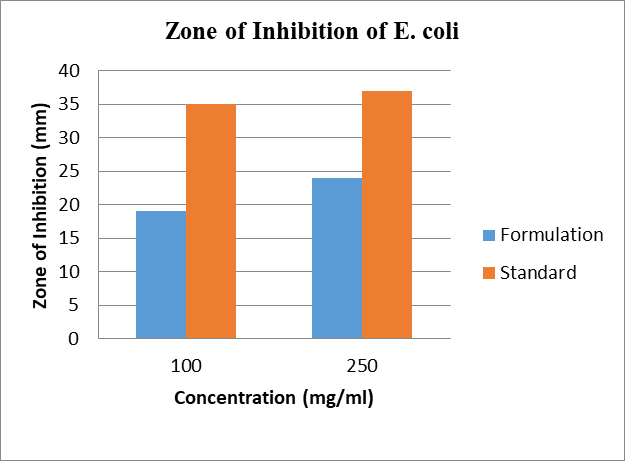
Figure 7: Graph of Antibacterial activity Of herbal mouth wash
Figure 8. Zone of Inhibition of E .Coli
CONCLUSION:
Herbal antiseptic cream is a multiuse antiseptic cream that treats all skin infection. The natural antiseptic cream was effective and potential antimicrobial agent. It is used as a preventive, curative and healing. Herbal cream useful for dry skin, cuts, scratches, minor burns, wounds, cold sores and chapped skin. The study suggests that the composition and the base of the cream are more stable and safe for use.
The evaluation results confirmed that the antiseptic cream remained physically stable; the physicochemical evaluation results confirm that the color and odor of present herbal formulation is acceptable with a pleasant odor and better after effects, acceptable pH, good spredability, wash ability and showed no skin irritation, phase separation. The findings support the use of herbal antiseptic cream as a cost effective, natural, and safer alternative to chemically formulated commercial antiseptic cream that may cause side effects such as staining, irritation, or taste alteration.
Thus, the study concludes that herbal antiseptic cream can be an effective natural skin care product, especially for individuals seeking chemical -free options.
CONCLUSION:
As per above result of herbal antiseptic cream we comes to the conclusion that the use of herbal cream of murraya koenigii is suitable for wound healing. as per the result and discussion in table no. 03 : formulation of the cream ,the F4 is comparatively good formulation then the others.
ACKNOWLEDGEMENT:
We are very thankful to the principal, Djps College of pharmacy, pohetakali dist parbhani, for providing facility for research work the special thank to Mr. Suryawanshi M.B for their guidance and support
REFERENCES




Siddheshwar Ghandge, Milind Suryawanshi, Ramesh Ingole, Rutik Kolhe, Krushna Chinchane,. Sachin Virkar, Vaishnavi Dukare, Formulation and Evolution of Herbal Antiseptic Cream Using Murraya Koenigii Leaves Extract, Int. J. of Pharm. Sci., 2026, Vol 4, Issue 6, 4436-4449. https://doi.org/10.5281/zenodo.20741930
 10.5281/zenodo.20741930