

We use cookies to ensure our website works properly and to personalise your experience. Cookies policy
RJS College of Pharmacy, Kokamthan, Kopargaon.
The current study used a 3² factorial design to formulate and optimize Orodispersible Tablets (ODTs) of Adhatoda vasica (Adulsa) for the treatment of asthma. Orodispersible tablets have a quick start of action and improve patient compliance since they dissolve quickly in the oral cavity without the need for water. Because it contains bioactive phytoconstituents such vasicine, flavonoids, tannins, saponins, and phenolic compounds that have bronchodilator, expectorant, anti-inflammatory, and antioxidant properties, Adulsa is a medicinal plant that is frequently used in respiratory illnesses. Adulsa's hydroalcoholic extract was made using the maceration method and then screened for phytochemicals. Crospovidone and sodium starch glycolate were used as superdisintegrants in the direct compression process to create orodispersible tablets. The impact of formulation factors on tablet properties such disintegration time, hardness, and cumulative drug release was investigated using a 3² factorial design. Pre-compression parameters such as angle of repose, bulk density, tapped density, and Carr's index, as well as post-compression parameters like hardness, friability, weight variation, wetting time, disintegration time, drug content, water absorption ratio, and in vitro dissolution study, were assessed for the prepared formulations. With a hardness of 5 kg/cm², friability within acceptable bounds, weight variation of 1.82%, speedy disintegration time, satisfactory wetting time, homogeneous drug content, and maximal drug release of 98.04%, the optimized F6 batch outperformed all other formulations. The efficient action of crospovidone and sodium starch glycolate, which improved tablet disintegration and dissolution, was credited with the quick drug release. According to the study's findings, Adulsa ODTs with enhanced drug release, quick disintegration, and improved patient compliance for efficient asthma therapy were created by successfully optimizing the formulation variables using a 3² factorial design.
Asthma is a chronic inflammatory disease of the airways that causes symptoms like wheezing, coughing, tightness in the chest, and shortness of breath. It is characterized by bronchoconstriction, airway hyperresponsiveness, and excessive mucus production. Even though there are many synthetic medications available, long-term use of them is frequently linked to adverse consequences, which has raised interest in herbal substitutes. Adhatoda vasica, sometimes called Adulsa or Vasaka, is a well-known medicinal herb that is frequently used to treat respiratory conditions in ancient medical systems like Ayurveda. Vasicine and vasicinone, two significant alkaloids found in the plant, have expectorant, bronchodilatory, and anti-inflammatory qualities. Due to its capacity to widen bronchial muscles, lessen airway inflammation, and aid in the removal of mucus from the respiratory system, Adulsa has been widely utilized in the treatment of asthma. These pharmacological activities aid in breathing improvement and asthma symptom relief. In order to improve the effectiveness and patient compliance of herbal medications, there has been an increasing interest in creating innovative drug delivery systems in recent years. Adulsa can have a quick beginning of action, be easily administered, and improve therapeutic outcomes when included into advanced dosage forms such orodispersible tablets, particularly for patients who have trouble swallowing. As a result, Adulsa is a promising natural therapeutic agent for the efficient treatment of asthma, and its integration into contemporary dosage forms presents substantial opportunities for pharmaceutical research.
INTRODUCTION TO ORODISPERSIBLE TABLET:
Oral administration continues to be the most popular method of drug delivery because of its ease of use, flexibility in dosage form design, high patient compliance, and simplicity. For some patient populations, however, the administration of traditional solid oral dose forms poses difficulties. Physiological or psychological problems such head and neck anomalies, advanced age, dysphagia, neurological illnesses, and unpleasant tablet-swallowing experiences throughout childhood can all contribute to these difficulties. In the 1980s, a novel oral dose form called Orally Disintegrating Tablets (ODTs) was developed to get around these restrictions. ODTs don't require water during administration because they are made to quickly dissolve in the oral cavity when they come into touch with saliva. Compared to traditional pills, these dosage forms offer better flavor and texture in addition to being easier to administer. Due to their many benefits, ODTs are especially appropriate for patients who have trouble swallowing as well as those who are young or elderly. Easy administration, better patient compliance, increased stability, precise dose, mobility, and quick beginning of action are some of these benefits. Additionally, by facilitating pre-gastric absorption and lowering first-pass hepatic metabolism, ODTs may increase bioavailability. The expanding amount of scientific
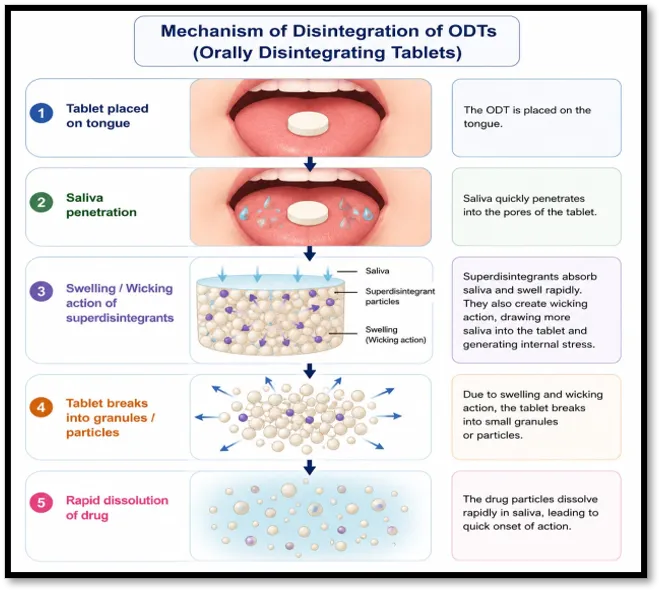
Fig. No. 01 Mechanism of Disintegration of ODTs
research and product development in this field is indicative of the growing importance of ODTs. ODTs have been the subject of numerous publications that were indexed in Scopus between January 2010 and June 2024, demonstrating their growing significance in pharmaceutical research. Furthermore, several ODT-formulated active pharmaceutical ingredients (APIs) have been approved by regulatory bodies including the U.S. Food and Drug Administration (FDA) and are sold as over-the-counter and prescription goods. The significance of ODTs in contemporary drug delivery systems is highlighted by this trend. Strict regulatory requirements and assessment procedures are in place to assist the development of ODT technology and guarantee its stability, effectiveness, and safety. Specialized knowledge in formulation design, manufacturing processes, and quality assessment procedures is necessary for the effective development of ODT formulations. While there are a number of review publications on ODTs, the majority concentrate on particular topics such flavor masking methods, disintegration and dissolution investigations, pediatric or geriatric applications, or future technologies like 3D printing and controlled-release systems. Although these studies offer insightful information, there isn't yet a thorough analysis that incorporates both conventional methods and more current developments. Therefore, by covering formulation techniques, current developments, and potential future developments, this review seeks to present an all-encompassing view of ODT technology. This effort aims to help the ongoing development of ODTs by fusing existing knowledge with new trends, ultimately promoting better patient care and pharmaceutical innovation.
Limitations of ODTs:
Advantages of ODTs:
Disadvantages of ODTs:
INTRODUCTION TO ADULSA:
In Ayurveda, Adulsa (Adhatoda vasica), commonly referred to as Vasaka, is a medicinal plant that is frequently used to treat respiratory conditions like cough, bronchitis, and asthma. Important bioactive phytoconstituents are present, primarily alkaloids such vasicine, vasicinone, vasicinol, and vasicinolone, with vasicine serving as the primary active ingredient. Adulsa's therapeutic action is attributed to flavonoids, tannins, saponins, and phenolic chemicals in addition to alkaloids. Vasicine relaxes bronchial smooth muscles and aids in the evacuation of mucus, demonstrating its bronchodilatory and mucolytic actions in asthma. Additionally, it exhibits antioxidant and anti-inflammatory qualities that aid in lowering airway irritation. Adulsa is therefore regarded as a successful herbal treatment for asthma and other respiratory conditions.
Uses:
Advantages:
Disadvantages:
METHODS OF PREPARATION:
The Orodispersible Tablets can be prepared by using the following methods,
1. Freeze drying/ Lyophilization:
Lyophilization is a method that creates very porous tablets by sublimating water at low temperatures and pressures. The medication is dissolved in a water-soluble matrix and freeze-dried to produce tablets that dissolve quickly (less than five seconds) because saliva penetrates them quickly. For medications that are thermolabile, this approach is perfect.
Steps
2. Spray drying:
This method creates a highly porous powder by spray-drying an aqueous solution containing excipients to create a particulate support matrix. After that, the powder and active medication are combined and compacted into tablets. Typically, the formulation contains superdisintegrants such sodium starch glycolate or croscarmellose sodium, mannitol as a bulking agent, and gelatin (hydrolyzed or non-hydrolyzed) as a supporting agent. To improve disintegration, alkaline (sodium bicarbonate) and/or acidic (citric acid) agents are also added. In aqueous environments, the tablets made using this process dissolve quickly (in about 20 seconds).
3. Molding:
Because they contain water-soluble carbohydrates, tablets made using the molding procedure are solid dispersions with enhanced flavor. This process creates porous pills, which dissolve and disintegrate more quickly.
Molding Types:
a) Compression Molding, or the Solvent Method: To create tablets, the powder mixture is wet with a hydroalcoholic solvent and compressed under low pressure. After that, the solvent is eliminated by air drying. These pills are very porous and less compact.
b) The Heat Method: Blister molds are filled with a medication, agar, and sugar (mannitol/lactose) suspension. After allowing it to harden at ambient temperature, it is vacuum-dried at 30°C.
4. Sublimation:
This process involves adding a volatile subliming agent to the tablet formulation and compressing it, such as ammonium bicarbonate, ammonium carbonate, urea, benzoic acid, naphthalene, or camphor. Sublimation is subsequently used to remove the subliming agent, leaving behind a highly porous structure. Increased porosity (≈30%) results from the formation of pores at the locations where the subliming material once resided. This improves saliva penetration, causing tablets to dissolve quickly—in around 15 seconds.
5. Mass extrusion:
In this method, the drug blend is softened using a solvent mixture of polyethylene glycol and methanol. After the bulk has softened, it is extruded using a syringe or extruder to create cylindrical strands, which are then cut into uniform segments with a hot blade to create tablets.
By coating bitter medication grains, this method can also be used to hide taste.
6. Direct compression:
The easiest and most economical way to make oral disintegrating tablets (ODTs) is through direct compression. To accomplish quick disintegration, sugar-based excipients and superdisintegrants are generally used.
Superdisintegrants: Superdisintegrants are essential for accelerating the rate of breakdown and disintegration. The use of effervescent agents and water-soluble excipients increases their efficacy even further.
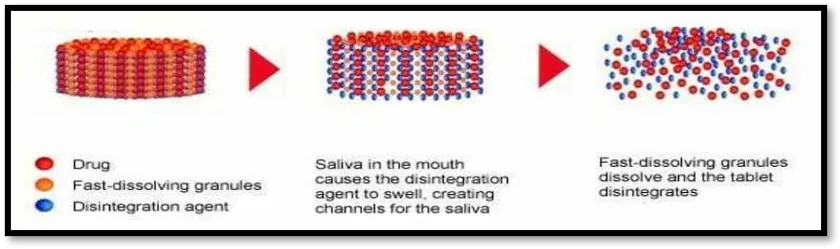
Fig. No. 02 Basic Mechanism of Superdisintegrants
Mechanism of Superdisintegrants:

Fig. No. 03 Mechanism of Superdisintegrants by Swelling
Swelling: Disintegrants swell when they absorb water, shattering the tablet.
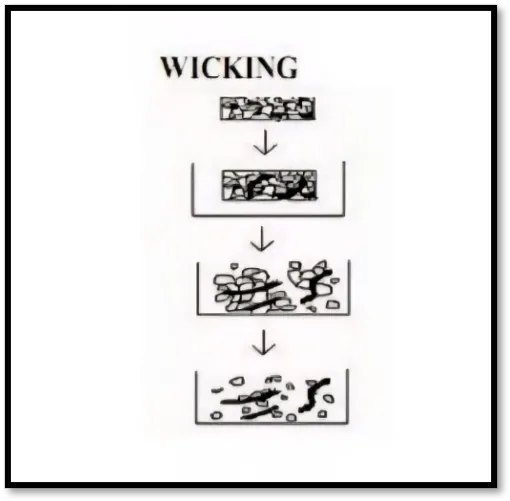
Wicking (capillary action): As water seeps into the tablet, air is replaced and intermolecular interactions are weakened.
Fig. No. 04 Mechanism of Superdisintegrants by Capillary action
Particle repulsion: Disintegration is facilitated by electrostatic repulsive forces between particles.
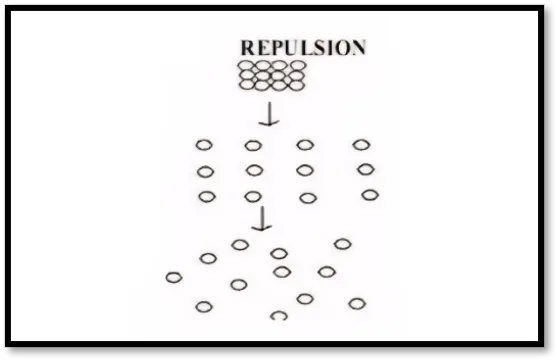
Fig. No. 05 Mechanism of Superdisintegrants due to Particle-particle Replusive force
Deformation: When particles come into contact with water, they return to their natural shape, which causes tablets to break.
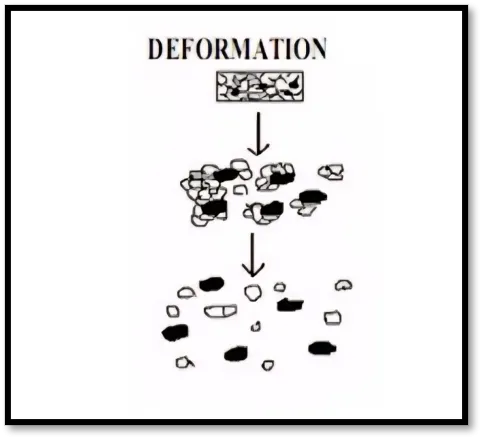
Fig. No. 06 Mechanism of Superdisintegrants due to Deformation
b) Excipients Based on Sugar:
Bulking agents include sugar-based excipients such mannitol, sorbitol, xylitol, dextrose, and maltose. They offer:
MATERIAL & METHOD
Adulsa Extract:
The active pharmaceutical ingredient (API) in orodispersible asthma tablets is Adhatoda vasica.
Therapeutic action: Has expectorant and bronchodilator properties.
Anti-asthmatic effect: Assists in reducing mucus and bronchoconstriction.
Natural origin: less harmful and safer option.
Hydroxypropyl methylcellulose (HPMC):
It is utilized as a binder while making tablets. Binding agent: Gives the powder mixture cohesiveness.
Increases mechanical integrity and tablet strength.
Film-forming property: Aids in the drug's even dispersion.
Crospovidone:
It is superdisintegrant used in ODTs.
Quick disintegration: Encourages the tablet to break up quickly.
Saliva is drawn into the tablet matrix by the wicking process.
Increases dissolution: Increases the rate of medication release.
Croscarmellose Sodium:
It is another superdisintegrant.
Swelling mechanism: Grows quickly when saliva is present.
Quick disintegration: Splits the tablet into tiny pieces.
Boosts medication solubility and bioavailability.
Sodium saccharin:
It is an artificial sweetener.
Taste masking: lessens the drug's bitterness.
Enhances palatability: Patients find the tablet more palatable.
Mannitol:
It is commonly used diluent in ODTs.
It is a bulking agent that makes tablets heavier and larger.
Cooling effect: Makes the mouth feel good.
Water-soluble: Promotes quick breakdown.
Lactose:
It is used as a diluent.
Diluent: Gives the mixture more volume.
Enhances compressibility: Aids in the production of tablets.
Magnesium stearate:
It is a lubricant.
Prevents sticking during compression and lowers friction.
Enhances flow: Guarantees efficient tablet production.
Talc:
It is used as a glidant.
Enhances flow characteristics: Facilitates powder flow.
Anti-adherent: Avoids adhering to dies and punches.
METHOD:
Adulsa leaves were extracted by using the following extraction method.
Maceration:
Maceration is a straightforward extraction method that involves soaking powdered plant material in an appropriate solvent for a certain amount of time in order to extract the active phytoconstituents. To improve the extraction efficiency, the procedure is run at room temperature with sporadic stirring. Because it doesn't require high temperatures, it is frequently employed for the extraction of thermolabile chemicals.
Procedure:
Advantages:
Disadvantages:
Method of Preparation:
Preparation of Orodispersible Tablets was carried out by Direct Compression Method.
Direct Compression:
The most straightforward and popular technique for making oral disintegrating tablets (ODTs) is direct compression. Using this approach, a mixture of medication and excipients is immediately compressed without first being granulated to create tablets. The pill will dissolve and disintegrate quickly thanks to the inclusion of water-soluble excipients and superdisintegrants.
Procedure:
Advantages:
Disadvantages:
FORMULA:
Factorial Design: A methodical technique for examining how two or more variables affect formulation responses is factorial design. It assesses the effects of individual factors as well as their interactions. Adhatoda vasica orodispersible tablets were formulated in this investigation using a 3² factorial design. The effects of two parameters on hardness, drug release, and disintegration time were examined at three different levels. This design saves time and money by optimizing formulation with fewer tests.
Table No. 01 Formulation Table of Orodispersible Tablets
|
Ingredients (mg/tablet) |
F1 |
F2 |
F3 |
F4 |
F5 |
F6 |
F7 |
F8 |
F9 |
|
Extract of DI
|
200 |
200 |
200 |
200 |
200 |
200 |
200 |
200 |
200 |
|
HPMC |
100 |
100 |
100 |
100 |
100 |
100 |
100 |
100 |
100 |
|
Crospovidone |
30 |
30 |
30 |
35 |
35 |
35 |
40 |
40 |
40 |
|
Croscarmellose sodium |
5 |
10 |
15 |
5 |
10 |
15 |
5 |
10 |
15 |
|
Sodium saccharin |
20 |
20 |
20 |
20 |
15 |
10 |
10 |
10 |
5 |
|
Mannitol |
25 |
25 |
25 |
25 |
25 |
25 |
25 |
25 |
25 |
|
Lactose |
10 |
5 |
10 |
5 |
5 |
5 |
10 |
5 |
5 |
|
Magnesium stearate |
5 |
5 |
5 |
5 |
5 |
5 |
5 |
5 |
5 |
|
Talc |
5 |
5 |
5 |
5 |
5 |
5 |
5 |
5 |
5 |
Procedure:
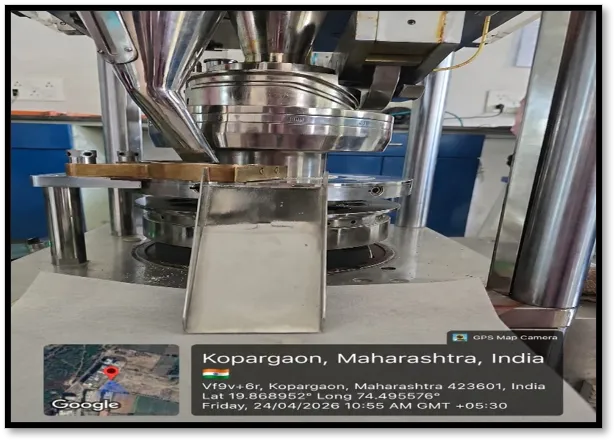
Fig. No. 07 Tablet Compression Machine used for Preparation of ODTs
EVALUATION OF EXTRACT:
Table No. 02 Organoleptic properties of Adulsa extract
|
Parameters |
Observation |
|
Color |
Greenish brown |
|
Odour |
Characteristic |
|
Taste |
Bitter |
|
Appearance |
Powder |
Table No. 03 Solubility of Adulsa extract
|
Solvent |
Solubility |
|
Water |
Slightly soluble |
|
Methanol |
soluble |
|
Ethanol |
soluble |
Table No. 04 Phytochemical screening of Adulsa extract
|
Sr. No. |
Phyto- constituents |
Test |
Procedure |
Observation |
Result |
|
1 |
Alkaloids |
Dragendorff’s Test |
Extract+ Dragendorff’s reagent |
Orange/reddish Ppt |
Present
|
|
Mayer’s Test |
Extract+ Mayer’s reagent |
Cream colored ppt |
Present |
||
|
2 |
Flavonoids |
Shinoda Test |
Extract+ Magnesium+ Conc. HCl |
Pink/ Red color |
Present |
|
3 |
Tannins |
Ferric Chloride Test |
Extact+ FeCl3 solution |
Blue-black/green color |
Present |
|
4 |
Saponins |
Foam Test |
Extract+ Water, Shaken |
Persistent Foam |
Present |
|
5 |
Phenols |
Ferric Chloride Test |
Extact+ FeCl3 solution |
Dark blue/green color |
Present |
PREFORMULATION STUDIES:
1. Angle Of Repose: The angle was computed using a conventional formula after the powder (5 g) was allowed to form a conical pile using the fixed funnel method.
Table No. 05 Angle of Repose and Corresponding Flow Properties
|
Angle of repose |
Flow Property |
|
25-30 |
Excellent |
|
31-35 |
Good |
|
36-40 |
Fair |
|
41-45 |
Passable |
|
46-55 |
Poor |
|
56-65 |
Very poor |
|
>66 |
Very very poor |
θ=tan-1 (h/r)
where, θ is the angle of repose,
h is the height of pile and r is the radius of base pile.
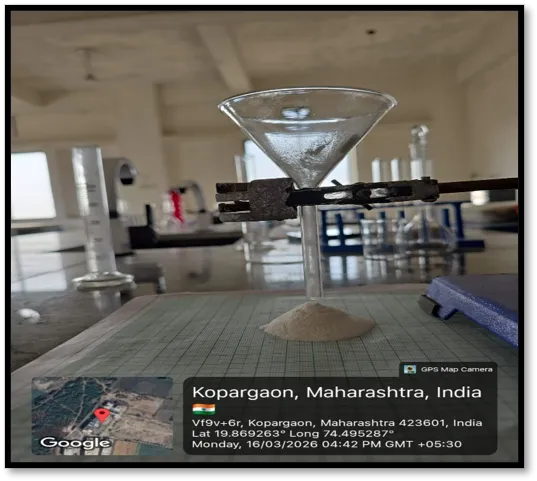
Fig. No. 08 Angle of Repose
Calculations:
θ=tan-1 (h/r)
h=2 cm
r= 2.83 cm
θ=35.240
The angle of repose was found to be 35.240, indicating good flow properties.
2. Bulk Density: Calculated by measuring the capacity of a graduated cylinder filled with a weighed amount of powder. It is the mass to bulk volume ratio.
Bulk density= Weight of powder/ Bulk volume
Calculations:
Weight of powder= 5 g
Vb= 12 ml
Bulk density= 0.4 g/ml
The powder mixture's consistent and good compactability and uniformity are demonstrated by the bulk density value of 0.4 g/ml.
3. Tapped Density: Calculated by tapping a graduated cylinder filled with a known amount of powder until a constant volume is reached. It is the mass to tapped volume ratio.
Tapped density= Weight of powder/ Tapped volume
Calculations:
Weight of powder= 5 g
Vt= 10 ml
Tapped density= 0.5 g/ml
The powder mixture's consistent and good compactability and uniformity are demonstrated by the tapping density measurement of 0.628 g/ml.
4. Hausner Ratio: Hausner's ratio, which is determined by dividing tapped density by bulk density, shows the flow characteristics of powder. The provided formula was used to calculate Hausner's ratio.
Hausner ratio= Tapped density/ Bulk density
Table No. 06 Scale of Flowability
|
Carr’s Index |
Flow property |
Hausner ratio |
|
≤10 |
Excellent |
1.00-1.11 |
|
11-15 |
Good |
1.12-1.18 |
|
16-20 |
Fair |
1.19-1.25 |
|
21-25 |
Passable |
1.26-1.34 |
|
26-31 |
Poor |
1.35-1.45 |
|
32-37 |
Very poor |
1.46-1.59 |
|
>38 |
Very very poor |
>1.6 |
Calculations:
Hausner ratio= Tapped density/ Bulk density
Hausner ratio =0.5/ 0.4
Hausner ratio =1.25
Low interparticle friction and good flowability were indicated by the Hausner's ratio of 1.25.
5. Compressibility Index: Calculated using bulk and tapped density, it is a measure of the powder's capacity to reduce in volume under pressure.
Calculations:
Carr's Index = (Tapped density - Bulk density) / Tapped density ×100
Carr's index = (0.5-0.4/0.5) x 100
Carr's index = 20 %
Excellent compressibility was indicated by the Carr's index of 20%.
EVALUATION OF ORODISPERSIBLE TABLETS
1. Weight Variation: The purpose of the weight variation test is to guarantee that the weight of tablets in a batch is consistent. Twenty tablets were chosen at random from the entire batch, and the average was computed. Additionally, the weight variation was computed and each tablet's specific weight was precisely measured.
Table No. 07 Limits of Weight Variation
|
% Variation |
IP |
USP |
|
±10 |
< 85 mg |
130 mg or less |
|
±7.5 |
85-250 mg |
130-324 mg |
|
±5 |
>250 mg |
324 mg or more |
Table No. 08 Calculation of Weight Variation
|
Sr. No. |
Initial weight (mg) |
% Weight variation |
|
1 |
384 |
3.88 |
|
2 |
412 |
3.13 |
|
3 |
395 |
1.13 |
|
4 |
406 |
1.63 |
|
5 |
389 |
2.63 |
|
6 |
408 |
2.13 |
|
7 |
392 |
1.88 |
|
8 |
414 |
3.63 |
|
9 |
397 |
0.63 |
|
10 |
401 |
0.38 |
|
11 |
405 |
1.38 |
|
12 |
390 |
2.38 |
|
13 |
409 |
2.38 |
|
14 |
396 |
0.88 |
|
15 |
402 |
0.63 |
|
16 |
398 |
0.38 |
|
17 |
407 |
1.88 |
|
18 |
393 |
1.63 |
|
19 |
404 |
1.13 |
|
20 |
388 |
2.88 |
|
Avg |
7990/20=399.5 |
36.6/20=1.83% |
Calculations: %Weight variation= (Iw- Aw/Aw) *100=1.83%
The average weight variation of the tablets was determined to be 1.83%. This indicates that the tablets meet both USP and IP standards for the weight variation test, suggesting consistency in weight and guaranteeing consistent dosing.399.5 ± 5% = 379.5 mg to 419.5 mg is the acceptable range.
Result: Every tablet was located within the ±5% deviation IP restrictions.
As a result, the sample satisfies IP requirements for weight fluctuation.
2. Hardness: A Monsanto hardness tester is used to measure a tablet's mechanical strength and resistance to breaking.
Calculation: The tablet's hardness was determined to be 5 kg/cm².
3. Friability Test: The weight loss of tablets as a result of abrasion during handling and transit is known as friability. Using a Roche friabilator, it was calculated by rotating tablets at 25 rpm for four minutes, then reweighing and computing the percentage of weight loss.
Calculations:
Iw=389 mg
Fw= 386 mg
Percentage Friability= (Iw-Fw/ Iw) *100
Percentage Friability=0.77%
(Limit is <1.0% as per IP/USP)
4. Disintegration Test:
Tablet disintegration test equipment was used to measure the disintegration time for every formulation. Each tube of the disingration test device had six separate tablets. The water was kept at 37º C, and the amount of time it took for the tablet to completely dissolve was recorded.
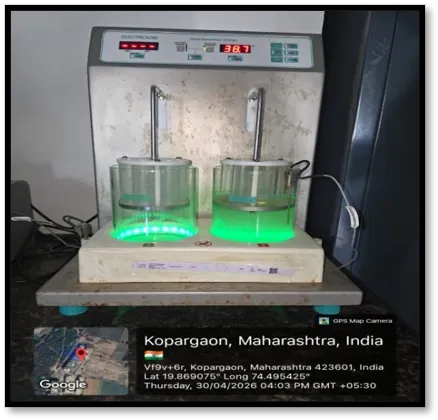
Fig. No. 09 Disintegration Test Apparatus
Calculation: It was discovered that it took 22 seconds for the entire tablet to dissolve.
5. Dissolution Test:
A USP dissolving apparatus with 0.1 N HCl (900 ml) as the dissolution medium kept at 37 ± 0.5°C was used for in vitro dissolution investigations. Using the paddle approach, the tablet was rotated at 50 rpm while submerged in the medium. At predefined intervals (2, 5, 10, 15, and 30 minutes), samples (5 ml) were removed and replaced with new media. A UV spectrophotometer was used to filter, appropriately dilute, and examine the samples. The cumulative percentage of medication release was computed and shown against time.
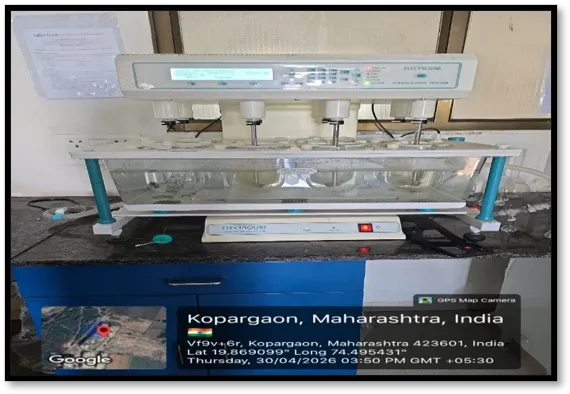
Fig. No. 10 Dissolution Test Apparatus
Table No. 09 In-vitro Drug Release Profile of Formulated ODTs
|
Time |
Abs |
Conc. Calibration curve |
dil. (*10 ml) |
Conc 5 ml |
Cumulative |
Conc 900 ml |
Cumulative 900 ml |
Cumulative 900ml/1000 |
% drug release |
|
2 |
0.122 |
0.74 |
7.4 |
37 |
3.7 |
6660 |
6660 |
6.66 |
3.126 |
|
5 |
0.185 |
1.52 |
15.2 |
76 |
113 |
13680 |
20340 |
20.34 |
9.54 |
|
10 |
0.268 |
2.45 |
24.5 |
125 |
235 |
22050 |
42390 |
42.39 |
19.9 |
|
15 |
0.340 |
3.40 |
34 |
170 |
405 |
30600 |
72990 |
72.99 |
34.26 |
|
20 |
0.436 |
4.50 |
45 |
225 |
630 |
40500 |
113490 |
113.49 |
53.228 |
|
25 |
0.495 |
5.29 |
52.9 |
264.5 |
894 |
47610 |
161100 |
166.11 |
77.87 |
|
30 |
0.502 |
5.80 |
58 |
290 |
1184 |
52200 |
213300 |
213.3 |
98.04 |
6. Wetting Time: A crucial metric for assessing a tablet's capacity to absorb water and start disintegration is wetting time. It is crucial for swiftly disintegrating tablets since it shows how soon the tablet becomes wetted when it comes into touch with a liquid medium.
Procedure:
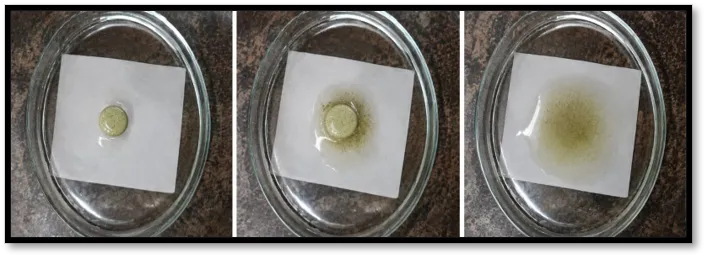
Fig. No. 11 Wetting Time
7. Drug Content:
One crucial evaluation metric for figuring out how much active medication is in a tablet is drug content. It guarantees that the medication is distributed uniformly throughout the formulation and verifies that every tablet has the necessary quantity of medication within permissible bounds.
Procedure:
Result: Adulsa extract was satisfactorily incorporated into the produced formulation, as evidenced by the formulation's percentage drug content of 85.93%.
RESULT & DISCUSSION
Table No. 10 Evaluation Parameters of Formulated ODTs (F1-F9)
|
Batch |
Hardness (kg/cm2) |
Friability (%) |
Weight variation (%) |
Disintegration Time (sec) |
Drug Release (%) |
Wetting Time (sec) |
Drug Content (%) |
|
F1 |
3.8 |
0.55 |
3.80 |
25 |
81.29 |
70 |
96.5 |
|
F2 |
4.0 |
0.33 |
3.40 |
18 |
84.15 |
39 |
97.2 |
|
F3 |
4.2 |
0.54 |
3.30 |
18 |
88.40 |
42 |
98.1 |
|
F4 |
4.3 |
0.91 |
3.40 |
18 |
86.23 |
89 |
97.8 |
|
F5 |
4.5 |
0.95 |
3.50 |
18 |
91.75 |
66 |
98.5 |
|
F6 |
5.0 |
0.77 |
1.83 |
22 |
98.04 |
34 |
85.93 |
|
F7 |
4.1 |
1.30 |
0.97 |
21 |
94.93 |
68 |
97.0 |
|
F8 |
4.4 |
0.55 |
2.40 |
19 |
92.60 |
42 |
98.3 |
|
F9 |
4.2 |
1.50 |
4.80 |
11 |
90.10 |
29 |
97.6 |
Hardness, friability, weight variation, drug content, wetting time, disintegration time, and in vitro drug release were all assessed for each of the created batches (F1–F9). Every formulation's hardness was found to be within acceptable bounds, suggesting that the tablets had good mechanical strength. Friability readings demonstrated sufficient resilience to handling and abrasion and were below the official limit. The homogeneity of pill weight was confirmed by weight variation data that fell within pharmacopoeial limitations. All formulations' drug contents fell between 96 and 99%, suggesting that the medication was evenly distributed throughout the tablets. Due to improved dissolution medium penetration and quicker tablet disintegration, formulations including superdisintegrants demonstrated rapid drug release, according to in vitro dissolution experiments. F6 had the best hardness (5.0 kg/cm2), acceptable friability (0.77%), smallest weight fluctuation (1.83%), and the maximum drug release (98.04%) of all batches. Additionally, the batch's medication content and disintegration time were satisfactory. Because of its superior drug release profile, homogeneity, and mechanical strength in comparison to other batches, F6 was deemed the optimal formulation.
SUMMARY:
The current study used a 3² factorial design to formulate and assess herbal Orodispersible Tablets (ODTs) using Adulsa (Adhatoda vasica) extract for the treatment of asthma. Because it contains alkaloids like vasicine and vasicinone, Adulsa is a medicinal plant with bronchodilator, expectorant, anti-inflammatory, and mucolytic qualities. The goal of the study was to create a fast-disintegrating dose form that would increase patient compliance, particularly in dysphagic, elderly, and pediatric patients. A hydroalcoholic solvent system was used in the maceration process to create the Adulsa extract. Using superdisintegrants such Crospovidone and Croscarmellose Sodium at different quantities in accordance with the factorial design, orodispersible tablets were made by the direct compression method. When pre-compression parameters such as angle of repose, bulk density, tapped density, Hausner's ratio, and Carr's index were assessed for the manufactured formulations, the powder blend's flow characteristics were found to be adequate. Hardness, friability, weight variation, wetting time, disintegration time, drug content, and in vitro drug release studies were all evaluated after the tablets were compressed. Every formulation demonstrated satisfactory stability, homogeneity, and mechanical strength. With optimal hardness, acceptable friability, quick disintegration, and a maximum drug release of 98.04%, batch F6 outperformed the other nine formulations overall. The results showed that the tablets' disintegration and dissolving characteristics were greatly enhanced by the addition of appropriate superdisintegrants.
CONCLUSION:
The study effectively illustrated the creation of herbal Orodispersible Tablets of Adulsa extract by employing direct compression and a 3² factorial design. The tablets' quick disintegration, adequate mechanical qualities, and improved drug release demonstrated that the chosen formulation strategy was appropriate for ODT development. Out of all the batches, the optimized formulation F6 was deemed the best due to its superior medicinal properties. Tablet disintegration and dissolving behavior were significantly improved by the use of crospovidone and croscarmellose sodium. Benefits of the created ODTs include convenience without the need for water, rapid onset of action, enhanced patient compliance, and ease of administration. As a result, Adulsa-based ODTs may offer superior therapeutic efficacy and increased patient acceptability, making them a promising herbal alternative for managing asthma.
REFERENCES

Snehal Buchkule, Tanvir Pathan, Sachin Aglawe, Kanchan Gursal, Formulation and Optimization of Orodispersible Tablets Using 32 Factorial Design for Asthma Treatment, Int. J. of Pharm. Sci., 2026, Vol 4, Issue 6, 3390-3406. https://doi.org/10.5281/zenodo.20689879
 10.5281/zenodo.20689879