

We use cookies to ensure our website works properly and to personalise your experience. Cookies policy
Department of Pharmacology, S. C. S. M. S. S. Institute of Pharmacy, Maregaon 445303.
The creation and assessment of a mustard oil-based nanoemulgel for topical analgesic and anti-inflammatory treatment is the focus of the current study. Allyl isothiocyanate-rich mustard oil was an appropriate bioactive oil phase because to its anti-inflammatory, antioxidant, and penetration-enhancing qualities. Nanoemulsions were prepared by using Tween 80 and PEG 400 as surfactants in spontaneous emulsification, followed by incorporation into the Carbopol 934 gel base to form nanoemulgels. The identity, compatibility, and stability of formulation components were verified by pre-formulation investigations such as TLC, UV spectroscopy, and FTIR analysis. Three formulations (F1-F3) They were analyzed for physicochemical properties, pH, viscosity, spreadability, amount of drug, particle size distribution, zeta potential, and in vitro drug release properties. It was found that among all the batches prepared, batch F3 had the most favorable pH (6.2 ± 0.01), high drug content (98.16 ± 0.22%), good spreadability, and enhanced stability. The nanoemulgel formulation was found superior in terms of drug release compared to nanoemulsion alone. Zeta potential investigations demonstrated good colloidal stability with a value of the order of -25 mV, and particle size measurements verified homogenous nanosized droplets. The mustard oil nanoemulgel that was created showed encouraging potential as a stable and efficient topical phytopharmaceutical delivery method for inflammatory and pain conditions
Mustard oil of Brassica juncea is a new phytopharmaceutical system with immense therapeutic potential for management of pain and inflammatory conditions (1). Mustard oil is being redefined as a self-active therapeutic matrix with multi-functional pharmacological effects. Allyl isothiocyanate (AITC), omega-3 fatty acids and natural phenolic antioxidants are some of the major bioactive ingredients of mustard oil (2). Transient receptor potential ankyrin 1 (TRPA1) ion channel expressed in sensory neurons are precisely activated by the highly reactive electrophilic chemical AITC, causing a regulated nociceptive stimulation and subsequent receptor desensitization (3). Rather than being a traditional painkiller, mustard oil is positioned as a natural pain reprogramming system that can alter sensory perception at the neuronal level thanks to this special biphasic neuromodulatory process (4). Simultaneously, mustard oil disrupts the amplification cycle of chronic inflammation by attenuating NF-κB signaling, decreasing COX-2 production, and modifying pro-inflammatory cytokine cascades to produce a broad-spectrum anti-inflammatory response through systems-level regulation. This multi-targeted mechanism aligns with the ideas of network pharmacology, which is gaining popularity and is thought to be better than single-target treatment methods in complex inflammatory disorders (5).
Additionally, by neutralizing reactive oxygen species and restoring the intracellular redox state, its strong antioxidant action promotes tissue regeneration, cell protection, and long-term therapeutic stability (6). The biophysical interaction of mustard oil with the skin barrier is one of the most novel features. Because of its lipid-rich makeup, it can readily integrate into the stratum corneum, temporarily altering skin permeability and boosting transdermal drug transport (7). As a functional penetration enhancer and carrier matrix that enhances drug solubilization, retention, and cutaneous bioavailability, A bioactive medicinal ingredient that can be included into complex nanoemulgel systems is mustard oil. This offers a special dual action phytotherapeutic platform where the active ingredient and the carrier combine to produce therapy efficacy with little systemic exposure and side effects. This approach illustrates the promise of nanoemulgels based on mustard oil as clever, multipurpose delivery systems for topical analgesic and anti-inflammatory treatments in the future (8).
2. MATERIAL AND METHOD:
2.1 Material
Table No.1: Composition of Nanoemulgel
|
Sr. No. |
Ingredients |
F1(% w/w) |
F2(% w/w) |
F3(% w/w) |
|
1. |
Mustard Oil |
5 |
10 |
15 |
|
2. |
Tween 80: Polyethylene Glycol (Smix) |
45 |
50 |
55 |
|
3. |
Carbopol 934 |
0.5 |
1.0 |
1.5 |
|
4. |
Peppermint Oil |
0.5 |
0.5 |
0.5 |
|
5. |
Triethanolamine |
q.s. |
q.s. |
q.s. |
|
6. |
Distilled Water |
q.s. to 100 |
q.s. to 100 |
q.s. to 100 |
2.2 Method
Optimization of Nanoemulsion:
Mustard oil nanoemulsion was optimized through the development of pseudo-ternary phase diagram with mustard oil serving as the oil phase, Smix being the surfactant mixture, and distilled water serving as the aqueous phase (9).
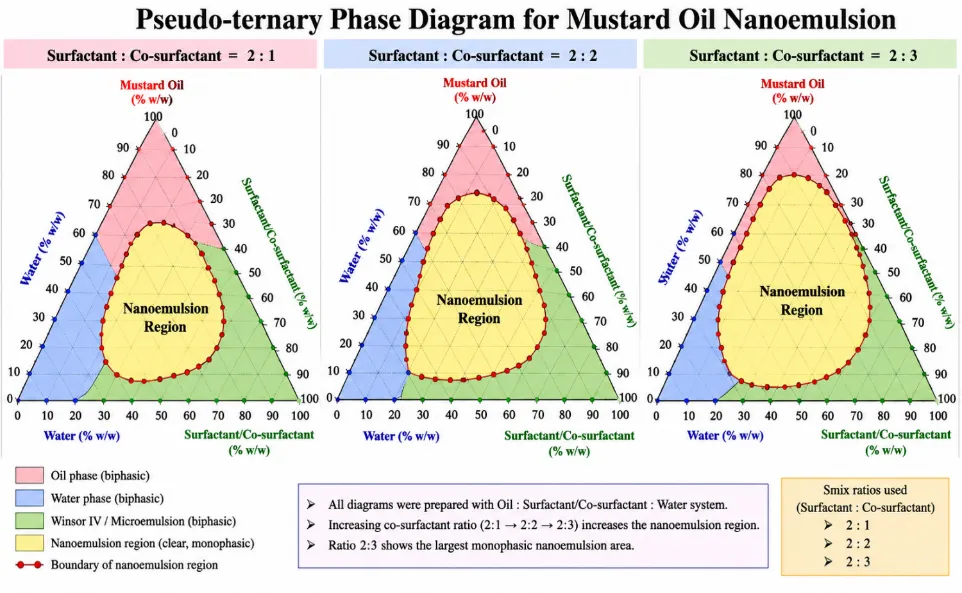
Fig.No1: Pseudo ternary phase diagram
2.2.1 Preparation of Nanoemulsion
Spontaneous emulsification technique was adopted for the preparation of mustard oil nanoemulsion. Selection of suitable excipients was achieved through the solubility study. Mustard oil served as the oil phase, while tween 80 and PEG 400 acted as the surfactant and cosurfactant, respectively. Ideal ratio between PEG 400 and tween 80 resulted in the formation of Smix, which was further mixed with mustard oil while swirling (10). In order to obtain a consistent and translucent solution, distilled water was added to the solution drop wise using a magnetic stirrer. A clear one-phase nanoemulsion was formed by subjecting the solution to sonication for 20 minutes in order to reduce the globules’ sizes and enhance their stability. The formation of a pseudo-ternary phase diagram was done to identify the nanoemulsion region(11).
2.2.2 Preparation of Nanoemulgel
Using the dispersion process, the optimized drug-loaded nanoemulsion was incorporated into a gel foundation to create the nanoemulgel. Carbopol's excellent viscosity and bio adhesive properties was utilized as the gelling agent (12). To create a homogenous gel basis, Carbopol 934 was dissolved in distilled water while being left to hydrate all night long and continuously agitated to increase consistency and release trapped air, the hydrated gel was sonicated for 20 minutes (13).
3.1 Thin layer Chromatography (TLC)
3.1.1 Material
Silica gel G, a sample of mustard oil, a glass slide, a capillary tube, an iodine vapor chamber, and a hexane: ethyl acetate (8:2v/v) mobile phase.
3.1.2 Method
The stationary phase for the TLC study of mustard oil was silica gel G placed on a spotless glass slide. A capillary tube was used to apply the hexane-prepared mustard oil sample as a tiny spot. The slide was developed in a pre-saturated TLC chamber with an 8:2 v/v hexane: ethyl acetate mobile phase until the solvent front moved across around 80% of the plate length. The chromatogram was subjected to iodine vapor after drying in order to see the separated phytoconstituents, which showed up as brownish-yellow dots (14).
Calculation of RF Value
Rf=Distance travelled by solute Distance travelled by solvent front

Rf usually ranges: ~0.6 to 0.85
Calculation:
Rf=3.65.0

Rf=0.72

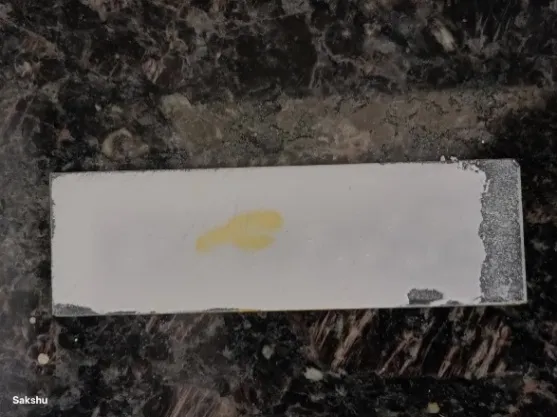
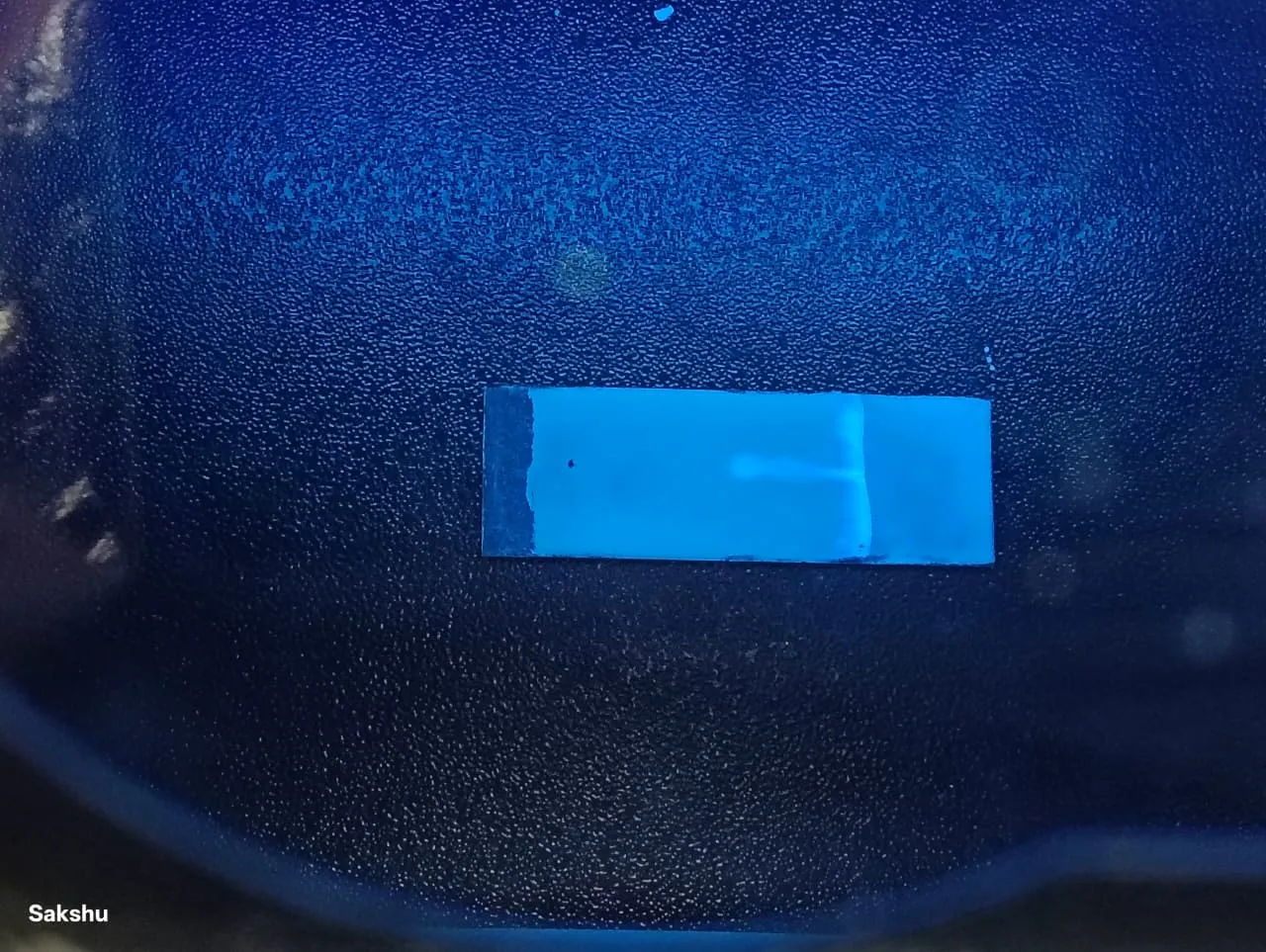
Fig.No2: Observation of TLC
3.2 UV Spectroscopy Study
3.2.1 Preparation of Standard Stock Solution
A mustard oil stock solution of standard strength was prepared by dissolving 10 mg of mustard oil in 10 ml of ethanol, making its strength equal to 1000 µg/ml. The solution was then sonicated for ten minutes and then passed through Whatman filter paper (15).
3.2.2 Preparation of Working Standard Solutions
The stock solution was further diluted using ethanol to yield 2, 4, 6, 8, and 10 µg/ml concentrations (16).
3.2.3 Calibration Curve
UV-visible spectrophotometry was used to build the calibration curve for mustard oil (allyl isothiocyanate-rich extract) in the concentration range of 2–10 µg/ml. The maximum absorbance (λ max) of the formulation at 285 nm was observed (17). A calibration curve between concentration and absorbance was plotted after the absorbance values of standard solutions were recorded. The curve showed strong linearity, demonstrating both the method's applicability for quantitative mustard oil quantification in formulation studies and compliance with Beer-Lambert's law (18).
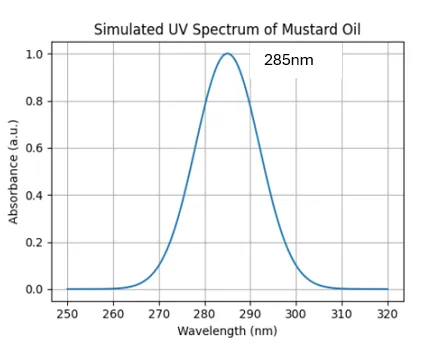
Fig.No.3: Calibration curve and simulated UV spectrum of mustard oil.
The UV absorption spectra of mustard oil is displayed on the graph, having a maximum absorbance peak (λ max) at 285 nm. This shows that mustard oil absorbs UV light most strongly at this wavelength, which is helpful for UV spectrophotometric identification and quantitative analysis (19).
UV-visible spectrophotometric method was applied to determine the absorbance of different concentrations of standards in order to generate the standard calibration curve for mustard oil. Graphs plotted of absorbance vs. concentration resulted in a linear relationship for the selected concentration range of 10-60 µg/ml. The following regression equation was determined:
With a correlation value (R^2) of 0.999
y=0.0112x+0.0015
shows outstanding linearity and adherence to Beer-Lambert's rule (20).
3.3 Fourier Transforms Infra-Red (FTIR)
The ATR-FTIR spectra of mustard oil were recorded on FTIR spectrophotometer with ATR attachment at a resolution of 4cm-1 in the spectral range of 4000–400cm-1. A trace quantity of mustard oil was spread on the surface of ATR crystal and spectra were recorded immediately for 32 scans of each sample (21). The recorded spectra were used to deduce the characteristic functional groups and compatibility with formulation excipients. The chemical identification of mustard oil was confirmed by presence of characteristic peaks of C-H stretching C=C stretching and ester functional groups of fatty acids. It also demonstrated that there is no significant chemical interaction in the Nanoemulgel formulation (22).
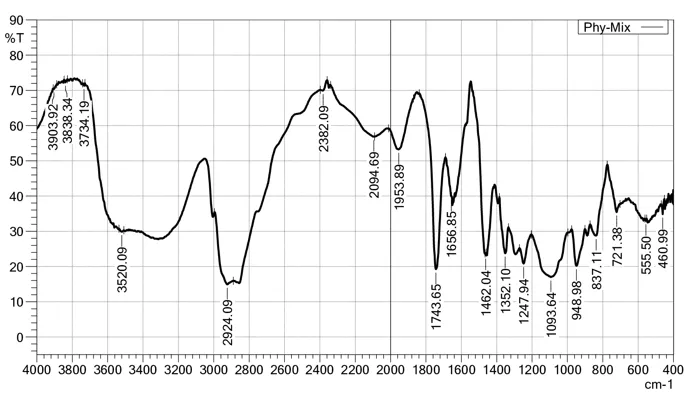
Fig.No4: FTIR Spectra of Mustard Oil Physical Mixture
Table 2: ATR-FTIR Spectral Interpretation of Mustard Oil Nanoemulgel Showing Characteristic Functional Groups
|
Sr. No. |
Wave Number (cm⁻¹)
|
Functional Group |
|
1 |
3903.92 – 3734.19 |
O-H Stretching |
|
2 |
3520.09 |
O-H/ N–H Stretching |
|
3 |
2924.09 |
C–H Stretching |
|
4 |
2382.09 |
O=C=O Stretching |
|
5 |
2094.69 |
C=O Stretching |
|
6 |
1953.89 |
Carbonyl (C=O) Stretching |
|
7 |
1743.65 |
Carbonyl (C=O) Stretching |
|
8 |
1656.85 |
C=C Stretching / Amide Band |
|
9 |
1462.04 |
C–H Bending |
|
10 |
1352.10 |
C–N Stretching |
|
11 |
1247.94 |
C–O Stretching |
|
12 |
1093.64 |
C–O–C Stretching |
|
13 |
948.98 |
=C-H Bending |
|
14 |
837.71 |
Aromatic C-H Bending |
|
15 |
721.38 |
C–Cl Stretching |
|
16 |
555.50 |
C–Br Stretching |
|
17 |
460.99 |
Metal–Oxygen Bond |
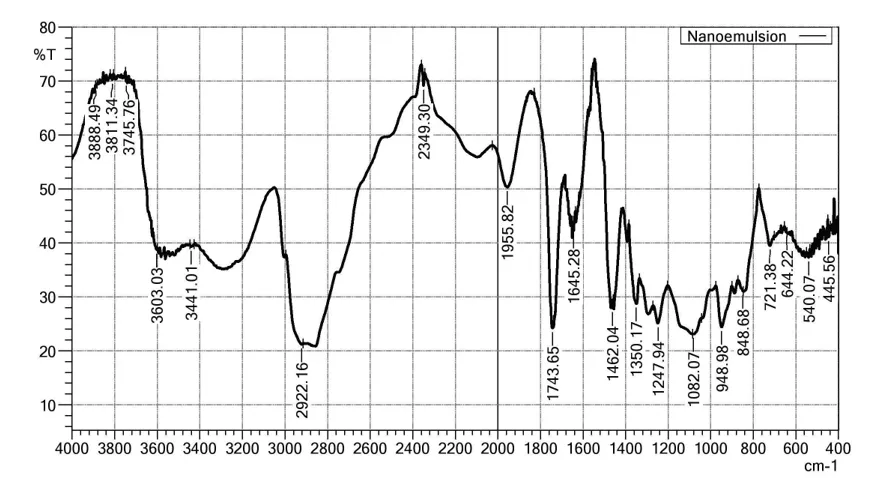
Fig.No5: FTIR Spectra of Mustard Oil Nanoemulsion
Table 3: ATR-FTIR Spectral Analysis of Mustard Oil Nanoemulgel Indicating Characteristic Functional Groups
|
Sr. No. |
Wave Number (cm⁻¹)
|
Functional Group |
|
1 |
3888.49 – 3745.26 |
O-H Stretching |
|
2 |
3603.03 |
O-H Stretching |
|
3 |
3441.01 |
O-H /N-H Stretching |
|
4 |
2922.16 |
C–H Stretching |
|
5 |
2439.30 |
O=C=O Stretching |
|
6 |
1955.82 |
C=O Stretching |
|
7 |
1743.65 |
Carbonyl (C=O) Stretching |
|
8 |
1645.28 |
C=C Stretching / Amide Band |
|
9 |
1462.04 |
C–H Bending |
|
10 |
1350.17 |
C–N Stretching |
|
11 |
1247.94 |
C–O Stretching |
|
12 |
1082.07 |
C–O–C Stretching |
|
13 |
948.98 |
=C-H Bending |
|
14 |
848.68 |
Aromatic C-H Bending |
|
15 |
721.38 |
C–Cl Stretching |
|
16 |
540.07 |
C–Br Stretching |
|
17 |
445.56 |
Metal–Oxygen Bond |
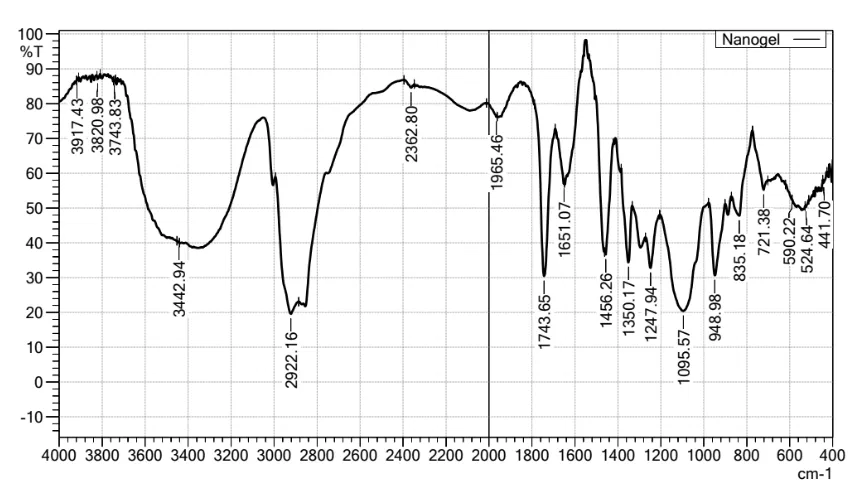
FigNo.6: FTIR Spectra of Mustard Oil Nanoemulgel
Table 4: ATR-FTIR Spectral Interpretation of Mustard Oil Nanoemulgel Showing Major Functional Groups and Characteristic Peaks
|
Sr. No. |
Wave Number (cm⁻¹)
|
Functional Group |
|
1 |
3917.43 – 3743.83 |
O-H Stretching |
|
2 |
3442.94 |
O-H / N–H Stretching |
|
3 |
2922.16 |
C–H Stretching |
|
4 |
2362.80 |
O=C=O Stretching |
|
5 |
1905.46 |
C=O Stretching |
|
6 |
1743.65 |
Carbonyl (C=O) Stretching |
|
7 |
1651.07 |
C=C Stretching / Amide Band |
|
8 |
1456.26 |
C–H Bending |
|
9 |
1347.42 |
C–N Stretching |
|
10 |
1239.47 |
C-O Stretching |
|
11 |
1095.57 |
C-O-C Stretching |
|
12 |
949.98 |
=C-H Stretching |
|
13 |
835.18 |
Aromatic C-H Bending |
|
14 |
721.38 |
C–Cl Stretching |
|
15 |
592.64 |
C–Br Stretching |
|
16 |
524.64 |
Halogen Compound |
|
17 |
441.70 |
Metal–Oxygen Bond |
4.1 pH Determination: A calibrated digital pH meter was used to determine the prepared nanoemulgel's pH (23).
4.2 Viscosity determination: An Ostwald viscometer was used to measure the viscosity of a portion of the prepared nanoemulgel at room temperature (24).
4.3 Drug Content Determination: By comparing the acquired absorbance with the standard medication's calibration curve, the amount of drug in the formulation was determined (25).
4.4 Spreadability Study: To form a homogeneous film, one gram of the nanoemulgel was placed between two clean glass slides, and on the other side of the slide, some weight was applied. After some time interval, some weight was added to the upper slide, and the time taken by the slide to travel a specified distance was recorded (26).
4.5 Scanning Electron Microscopy (SEM):
From the findings obtained after analysis using SEM, it was evident that the surface morphology of the nanoeamulgel prepared using mustard oil had an even distribution of nanoglobules. The nanoglobules appeared either spherical or nearly spherical, meaning they did not cluster together and hence were evenly distributed (27).
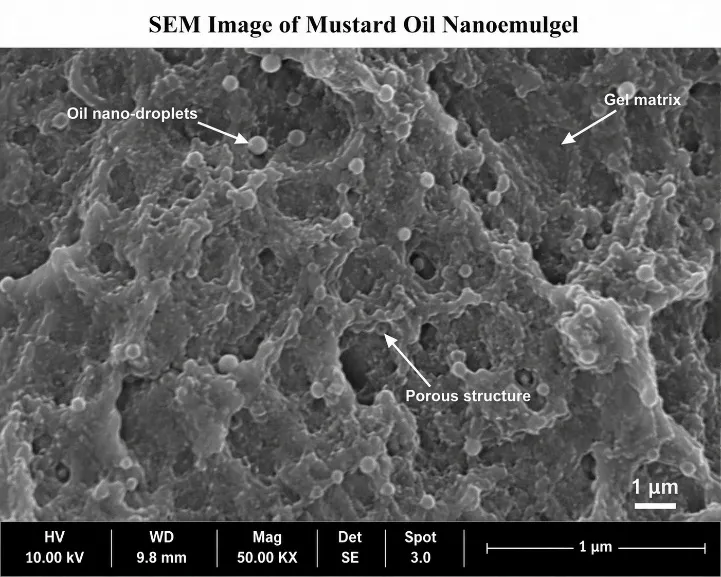
Fig.No7: SEM of the Mustard Oil loaded Nanoemulgel
4.6 In vitro Drug Release study: A Franz diffusion cell with a dialysis membrane is used in the in vitro drug release investigation of nanoemulgel to assess the drug's release behavior from the formulation (28).
4.7 Particle Size Determination: The stability and consistency of the formulation were assessed by determining the mustard oil nanoemulgel's particle size distribution (29).
4.8 Zeta Potential Distribution: The stability and surface charge of the formulation were assessed by measuring the mustard oil nanoemulgel's zeta potential (30).
Evaluation Test:
Physicochemical Test:
Table No.5: Observation of physicochemical Test
|
Sr.no |
Parameter |
Observations |
|
1. |
Colour |
Pale yellow |
|
2. |
Odour |
Absence of unpleasant or rancid smell |
|
3. |
Transparency |
Translucent |
Other test:
Table No.6: Other test
|
Sr.no |
Parameters
|
F1 |
F2 |
F3 |
|
1. |
pH |
5.8±0.02 |
6.0±0.03 |
6.2±0.01 |
|
2. |
Viscosity(cP) |
2.18±0.04 |
2.25±0.03 |
2.31±0.05 |
|
3. |
Drug Content Determination (%) |
96.42±0.25 |
97.85±0.18 |
98.16±0.22 |
|
4. |
Spreadability (g.cm/sec) |
12.5±0.12 |
12.8±0.10 |
13.1±0.11 |
In vitro drug Release study:
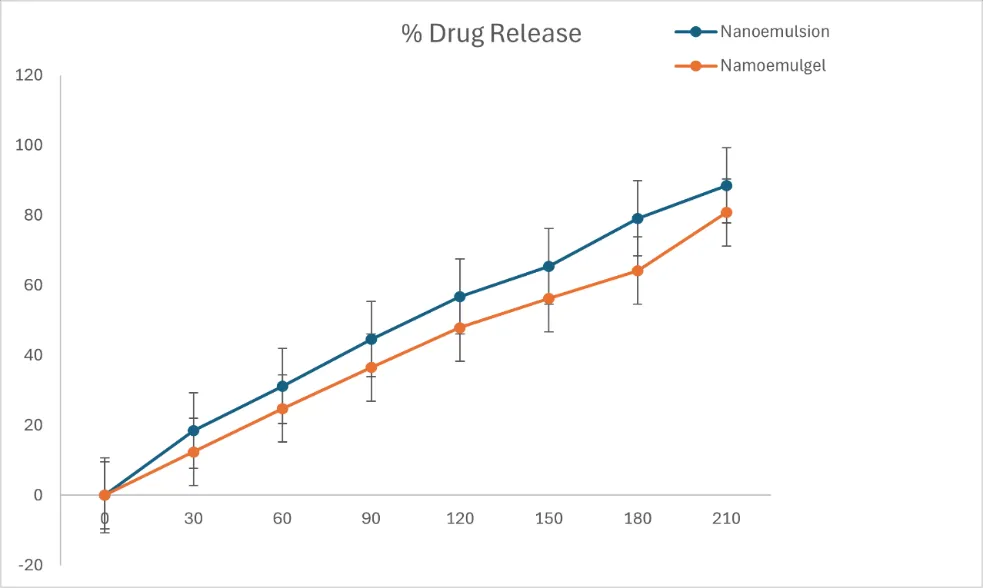
Fig.No8: In-Vitro Drug release profile of Mustard Oil Nanoemulsion and Nanoemulgel
The graph shows how the in vitro drug release patterns of nanoemulsion and nanoemulgel formulations differ during a time span of 0 to 210 minutes. There was gradual increase in the amount of drug released by both nanoemulsion and nanoemulgel. However, at each time interval the amount of drug released by the nanoemulsion was higher compared to the amount released by the nanoemulgel. The drug released at 30 minutes in nanoemulsion and nanoemulgel were about 18% and 12%, respectively. Release of the drug from the nanoemulsion took place in 210 minutes and it was observed to be around 88% while the release of the drug from the nanoemulgel was recorded to be about 80%.
Particle Size Distribution:
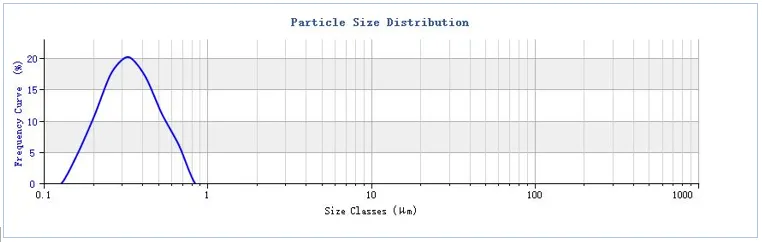
Fig.No9: Particle Size Distribution
From the graph plotting particle size distribution, it is clear that the produced nanoemulsion had a narrow range of particle size distribution, most of the particles being distributed below 1 µm. The presence of a dominant symmetrical peak suggests satisfactory homogeneity and effective droplet distribution in the emulsion. The sample also demonstrated a satisfactory value for zeta potential, which gives electrostatic repulsion among particles to avoid agglomeration and improve colloidal stability.
Zeta Potential Distribution:
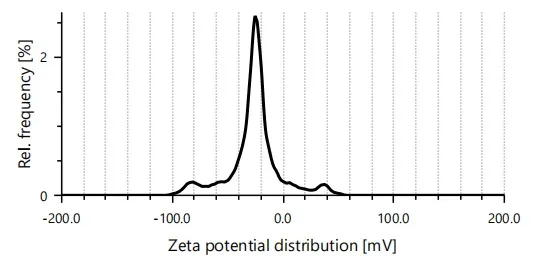
Fig.No10: Zeta Potential
From the graph on the zeta potential distribution, it can be clearly seen that there is a sharp peak at almost -25 mV, which demonstrates that the nanoemulsion has good surface charges and adequate physical stability. The formation of a narrow peak implies an even distribution of charged particles in the system. With the electrostatic repulsion offered by the negative value of the zeta potential being adequate, the possibility of aggregation and coalescence of the particles is minimized.
RESULT AND DISCUSSION
The mustard oil-based nanoemulgel was effectively created and evaluated for topical analgesic and anti-inflammatory applications. Batch F3 performed better than all other formulations in terms of formulation consistency and uniform drug distribution, with the best physicochemical stability, suitable pH (6.2 ± 0.01), respectable viscosity, enhanced spreadability, and the highest drug content (98.16 ± 0.22%). TLC analysis confirmed the presence of phytoconstituents with an Rf value of 0.72. UV spectrophotometric analysis demonstrated peak absorbance at 285 nm with outstanding linearity (R² = 0.999), demonstrating the analytical method's dependability. FTIR analyses of mustard oil's distinct functional groups showed no discernible drug-excipient interaction, suggesting that the formulation's constituent parts are compatible. The prolonged and regulated drug release behavior of the nanoemulgel formulation was shown by the in-vitro drug release investigation. The particle size test results were uniform nano-sized particles with a narrow distribution, while a zeta potential of about –25 mV confirmed the good physical stability and minimal aggregation of the product. All in all, the improved formulation F3 proved to be very stable, had better drug delivery properties, and was promising as a nanoemulgel system.
CONCLUSION
The present study successfully created a nanoemulgel based on mustard oil for topical analgesic and anti-inflammatory applications. Batch F3 performed better than the other formulations due to its suitable pH, acceptable viscosity, enhanced spreadability, substantial medicine content, and exceptional stability. Pre-formulation studies confirmed the stability and compatibility of formulation components. However, studies of zeta potential and particle size showed good colloidal stability.
The nanoemulgel shown promising promise for both prolonged medication release and topical phytopharmaceutical administration for pain and inflammatory disorders.
REFERENCES



Yasmin Pathan, Sakshi Dewalkar, Shweta Umare, Nilesh Chachda, Formulation Development and Evaluation of Topical Nano-emulgel from Mustard Oil for Analgesic Activity, Int. J. of Pharm. Sci., 2026, Vol 4, Issue 7, 4446-4458, https://doi.org/10.5281/zenodo.21490221
 10.5281/zenodo.21490221