

We use cookies to ensure our website works properly and to personalise your experience. Cookies policy
Department of Pharmaceutics, GRD (PG) IMT, Dehradun.
Bilayer tablet technology has emerged as a versatile strategy for combining immediate-release and sustained-release profiles within a single dosage form, successfully overcoming the pharmacokinetic drawbacks of conventional single-layered systems. The primary objective of this study was to formulate, optimize, and evaluate a novel gastro-retentive floating bilayer tablet featuring an immediate-release layer of Nebivolol HCl and a sustained-release floating layer of Nateglinide. Tablets were prepared via wet granulation utilizing varying ratios of matrix-forming polymers (HPMC K4M, HPMC E15, HPMC E5) and gas-generating agents (sodium bicarbonate and citric acid). Post-compression evaluations confirmed that all batches complied with USP standards for weight variation, hardness, friability, and drug content. The optimized formulation (C3) demonstrated a rapid floating lag time of 65 seconds, prolonged buoyancy exceeding 12 hours, and a biphasic drug release pattern. In vitro dissolution data followed zero-order and Korsmeyer-Peppas kinetics, indicating non-Fickian diffusion mechanisms. Accelerated stability studies in accordance with ICH guidelines confirmed that batch C3 retained its physical integrity and release characteristics.
Drugs can enter the body via various routes, including oral, submucosal (buccal and sublingual), parenteral, transdermal, and pulmonary administration. For systemic delivery, tablets—frequently referred to as "pharmaceutical powder compacts"are the most widely used, practical, and preferred dosage form. They offer distinct advantages, including formulation versatility, simplicity of administration, and high patient compliance. However, the effectiveness of oral drug delivery is heavily influenced by physiological factors such as gastric emptying, gastrointestinal transit time, drug release rates, and the primary site of absorption.(1,2,3)
Conventional dosage forms often cause wide fluctuations in plasma drug concentrations, resulting in poor clinical efficacy or undesirable toxicity. To address these challenges, sustained- or controlled-release systems were developed to decrease dosing frequency, maintain consistent therapeutic levels, and enhance safety by localizing medication at the site of action. (4,5)
Over the past decade, combining two or more active pharmaceutical ingredients (APIs) into a single bilayer tablet has gained significant attention. Combination therapy aims to reduce dose-dependent side effects and improve patient outcomes through lower total drug dosages. Bilayer tablets successfully overcome the drawbacks of single-layer combination tablets by physically separating incompatible APIs and facilitating distinct, biphasic release profiles—such as combining an immediate-release layer with a sustained-release layer.(6,7)
MATERIALS AND METHOD
Materials and Purpose
|
Sr. No. |
Materials |
Purpose |
|
1 |
Nateglinide |
Sustained release drug |
|
2 |
Nebivolol HCl |
Immediate release drug |
|
3 |
HPMC K4M |
Release retardant polymer |
|
4 |
HPMC E5 |
Film-forming / hydrophilic polymer |
|
5 |
HPMC E15 |
Sustained release polymer |
|
6 |
Carbopol |
Swelling and mucoadhesive polymer |
|
7 |
Sodium bicarbonate |
Gas generating agent |
|
8 |
Citric acid |
Floating enhancer |
|
9 |
Povidone (PVP K30) |
Binder |
|
10 |
Dicalcium phosphate |
Diluent / Filler |
|
11 |
Magnesium stearate |
Lubricant |
|
12 |
Talc |
Glidant |
|
13 |
Crospovidone |
Superdisintegrant |
|
14 |
Purified water / IPA |
Granulating fluid |
IMMNEEDIATE RELEASE LAYER (NEBIVOLOL HCL)
Materials:
Purpose:
SUSTAINED FLOATING LAYER (NATEGLINIDE)
Materials:
Purpose:
FORMULATION:
IMMNEEDIATE RELEASE LAYER (NEBIVOLOL HCL)
Weigh the All Raw Materials (API + Excipients)
Sifting of Raw Materials through suitable sieve (#40/#60)
Mix:
Dissolve povidone in:
Add Binder solution slowly to powder mix.
Mix until:
Pass wet mass through sieve#16 or #22
Wet granules formed.
Dry granules:
Temperature:
Until proper moisture removal.
Pass dried granules through sieve #20.
Uniform granules obtained
Final Blending for uniform distribution Add:
Mix gently
SUSTAINED FLOATING LAYER (NATEGLINIDE)
Weigh the All Raw Materials (API + Excipients)
Sifting of Raw Materials through suitable sieve (#40/#60)
Mix:
Preparation of Binder Solution (Povidone in IPA / Purified Water)
Add Binder solution slowly to powder mix.
Mix until:
Pass wet mass through sieve (#16/#20)
Dry granules:
Temperature:
Until proper moisture removal.
Pass dried granules through sieve #20.
Uniform granules obtained
Final Blending for uniform distribution Add:
Mix gently.
COMPRESSION STAGE OF BILAYER GASTRO-RETENTIVE FLOATING TABLET
The floating Bilayer tablet was prepared by sequential compression technique.
COMPRESSION PRINCILE
FIRST LAYER:
Immediate release layer is lightly compressed.
SECOND LAYER:
Sustained floating layer is added and final compression is applied to obtain bilayer tablet.
Floating Mechanism After Compression
NaHCO3+H+→CO2↑+H2O
List of Materials Used in the Formulation of Gastro-Retentive Floating Bilayer Tablets of Nebivolol HCl and Nateglinide
|
Sr. No |
Ingredients |
Function |
C1 |
C2 |
C3 |
C4 |
C5 |
C6 |
C7 |
C8 |
C9 |
|
Sustained Release Floating Layer |
|||||||||||
|
1 |
Nateglinide |
Active drug |
60 |
60 |
60 |
60 |
60 |
60 |
60 |
60 |
60 |
|
2 |
HPMC K4M |
Release retardant / matrix forming polymer |
50 |
100 |
150 |
– |
– |
– |
150 |
100 |
50 |
|
3 |
HPMC E15 |
Release modifier / matrix forming polymer |
150 |
100 |
50 |
50 |
100 |
150 |
– |
– |
– |
|
4 |
HPMC E5 |
Low viscosity release modifier |
– |
– |
– |
150 |
100 |
50 |
50 |
100 |
150 |
|
5 |
Sodium Bicarbonate |
Gas generating agent |
100 |
100 |
100 |
100 |
100 |
100 |
100 |
100 |
100 |
|
6 |
Citric Acid |
Floating enhancer / acidifying agent |
50 |
50 |
50 |
50 |
50 |
50 |
50 |
50 |
50 |
|
7 |
Dicalcium Phosphate |
Diluent |
40 |
40 |
40 |
40 |
40 |
40 |
40 |
40 |
40 |
|
Total Weight of SR Layer (mg) |
450 |
450 |
450 |
450 |
450 |
450 |
450 |
450 |
450 |
||
|
Immediate Release Layer |
|||||||||||
|
8 |
Nebivolol HCl |
Active drug |
5 |
5 |
5 |
5 |
5 |
5 |
5 |
5 |
5 |
|
9 |
Crospovidone |
Superdisintegrant |
10 |
10 |
10 |
10 |
10 |
10 |
10 |
10 |
10 |
|
10 |
Dicalcium Phosphate |
Diluent |
30 |
30 |
30 |
30 |
30 |
30 |
30 |
30 |
30 |
|
11 |
Magnesium Stearate |
Lubricant |
3 |
3 |
3 |
3 |
3 |
3 |
3 |
3 |
3 |
|
12 |
Talc |
Glidant |
2 |
2 |
2 |
2 |
2 |
2 |
2 |
2 |
2 |
|
Total Weight of IR Layer (mg) |
50 |
50 |
50 |
50 |
50 |
50 |
50 |
50 |
50 |
||
|
Total Tablet Weight (mg) |
500 |
500 |
500 |
500 |
500 |
500 |
500 |
500 |
500 |
||
POST-COMPRESSION ELAVUATION OF BILAYER TABLETS
For a tablet to be accepted by customers, its overall "elegance," visual identity, and general look are crucial. includes the tablet's dimensions, shape, colour, taste, odour, surface texture, physical defects, and the consistency and readability of any identifying markings...(08,09)
The compressed tablets' dimensions and form were assessed using a magnifying lens. (08,09)
Tablet thickness is a crucial feature for both counting with filling equipment and duplicating look. Certain filling machines use the tablets' consistent thickness as a counting mechanism. A micrometer was used to measure the thickness of ten pills. (10)
The Roche friabilator was used to assess the tablets' friability. The percentage (%) is used to express it. Twenty pills were put into a friabilator after being first weighed (w0 initial). The friabilator was run up to 100 revolutions or at 25 rpm for four minutes. Once more, the pills were weighed (w).(11)
Percentage of Friability:
Initial weight = Final Weight (After Friability)/ Initial WeightX100
Limit: Percentage friability of tablets less than 1% is considered acceptable.
The average weight of twenty randomly chosen pills was calculated. None of the individual weights differ from the average weight by more than twice the percentage, and no more than two deviate by more than the percentage shown in the table. The table displays the approved USP limits for tablet percentage variation. (12,13)
The tablet's swelling property was assessed by submerging it in 900 ml of 0.1 N HCl at 37 ± 2 0C in the dissolving test device. By regularly removing the tablets from the dissolving media, the weight and volume that the matrix tablets attained over time were ascertained. After the pills were lightly blotted with tissue paper to eliminate any remaining test liquid, they were weighed on an analytical scale. Taking into account a right circular cylinder shape, the thickness and diameter of the tablets were measured to determine their volume. The tablet density during the dissolving research was computed using the determined weight and volume. The equation was used to express swelling properties as a percentage of water absorption (WU%). (14,15)
WU % = Wt. of swollen tablet – Initial wt. of tablet / Initial wt. of tablet × 100.
The hardness of a tablet determines how resistant it is to capping, abrasion, or breaking during handling, storage, and transit. When a coil spring's force is applied diametrically to a tablet, the Monsanto hardness tester calculates the force needed to shatter the tablet. The diametrically applied force needed to shatter the pill is measured using the Strong-Cobb Pfizer and Schleuniger device. Determinations of hardness, which is now more accurately referred to as crushing strength, are made during tablet manufacture and are used to assess if the tablet machine's pressure has to be adjusted.
If the tablet is too soft, it might not be able to resist handling during further processing, such as coating or packaging and shipping operations; if it is too hard, it might not dissolve in the time needed to fulfill the dissolving standards. A crushing strength of 4 kg is typically regarded as the minimum for acceptable tablets, and the force needed to shatter the tablet is measured in kilograms. While hypodermic and chewable tablets are typically significantly softer (3 kg) and certain extended release tablets are substantially harder (10–20 kg), oral pills typically have a hardness of 4–10 kg. Hardness often rises with regular tablet storage and is influenced by the form, chemical makeup, and binding agent. (16)
Tablet disintegration time is typically measured using a disintegration test device. One pill is put in each tube for the disintegration time, and the basket arch is placed in a 1-liter beaker with water at 37°C ± 2°C. The basket assembly is moved up and down using a typical motor-driven mechanism. All tablets must dissolve and all particles must pass through the 10 mesh in the allotted period in order to meet USP standards. (17,18)
Since the usual stomach emptying duration is around two hours, drug release investigations are conducted using USP dissolution test equipment I at 100 rpm, 37±0.5°C, and pH 1.2 buffer (900 ml) (i.e., 0.1 N HCl) for two hours. The experiment was carried out for an additional ten hours when pH 6.8 phosphate buffer (900 ml) was substituted for the dissolving medium. A UV spectrophotometer with a multi-component mode of analysis is used to examine the samples removed during the dissolution test.(19,20)
According to ICH criteria for expedited research, the bilayer tablets are packaged appropriately and kept under the following circumstances for a certain amount of time. After 15 days, the tablets were taken out and examined for drug content and physical characteristics such hardness, friability, dissolution, and visual flaws. The kinetics of deterioration are ascertained by fitting the collected data into first-order equations. The Arrhenius equation is used to visualize accelerated stability data in order to calculate the shelf life at 25°C.(21,22)
|
Study |
Storage Condition |
Minimum time period covered by at submission |
|
Long term study |
25°C ± 2°C/60% RH ± 5% RH or 30°C ± 2°C/65% RH ± 5% RH |
12 months |
|
Intermediate study |
30°C ± 2°C/65% RH ± 5% RH |
6 months |
|
Accelerated study |
40°C ± 2°C/75% RH ± 5% RH |
6months |
RESULT AND DISCUSSION
PREFORMULATION STUDIES:
Preformulation studies are an essential initial step in the development of pharmaceutical dosage forms. These studies involve the systematic investigation of the physical, chemical, and physicochemical properties of drug substances before formulation development. The primary objective of preformulation is to generate relevant information regarding the drug's characteristics, stability, solubility, compatibility, and processing behaviour to facilitate the development of a safe, effective, and stable pharmaceutical formulation. Various parameters, including organoleptic properties, particle size, melting point, solubility, pH, flow properties, bulk density, tapped density, compressibility index, and Hausner’s ratio, may be evaluated depending on the nature of the drug and the intended dosage form. Furthermore, drug–excipient compatibility studies are performed to identify potential interactions that could affect the stability, performance, or quality of the final product. The findings obtained from preformulation studies help in selecting suitable excipients, establishing appropriate manufacturing procedures, and optimizing formulation composition. Therefore, preformulation studies provide a scientific foundation for subsequent formulation development and evaluation.
Table : Preformulation Characteristics of Nebivolol HCl and Nateglinide
|
Sr.no. |
Parameter |
Nebivolol HCl |
Nateglinide |
|
|
Colour |
White to off-white |
White to pale white |
|
|
Odour |
Odourless |
Odourless |
|
|
Appearance |
Crystalline powder |
Crystalline powder |
|
|
Taste |
Slightly bitter |
Slightly bitter |
|
|
Particle Size (µm) |
85.4 ± 2.1 |
112.7 ± 3.4 |
|
|
Angle of Repose (°) |
27.4 |
29.8 |
|
|
Bulk Density (g/mL) |
0.42 |
0.39 |
|
|
Tapped Density (g/mL) |
0.49 |
0.47 |
|
|
Compressibility Index (Carr’s Index) (%) |
14.28 |
17.02 |
|
|
Hausner’s Ratio |
1.16 |
1.2 |
|
|
Flow Property |
Good |
Fair to good |
|
|
Moisture Sorption Capacity (%) |
2.1 ± 0.1 |
2.1 ± 0.1 |
CALIBRATION CURVE:
Nebivolol HCl Calibration Curve
Solvent: 0.1 N HCl λmax: 281 nm
Concentration (µg/ml) – Absorbance
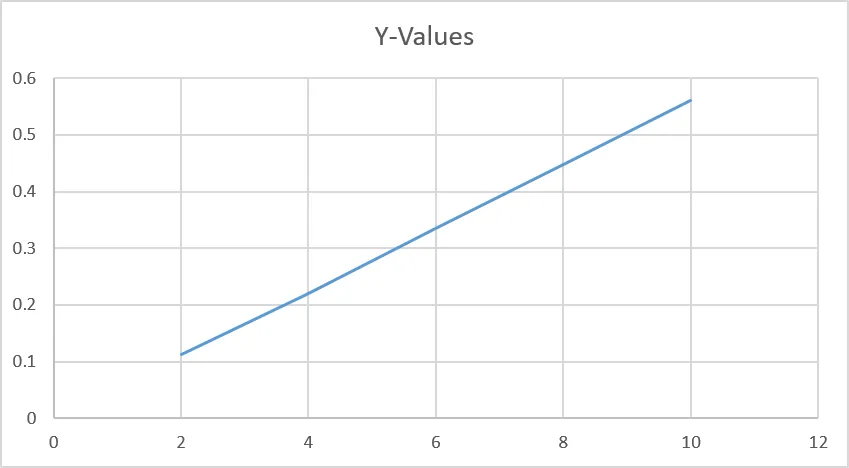
Regression equation: y = 0.056x + 0.001
R² = 0.999
Nateglinide Calibration Curve
Solvent: Phosphate Buffer pH 6.8 λmax: 210 nm
Concentration (µg/ml) – Absorbance
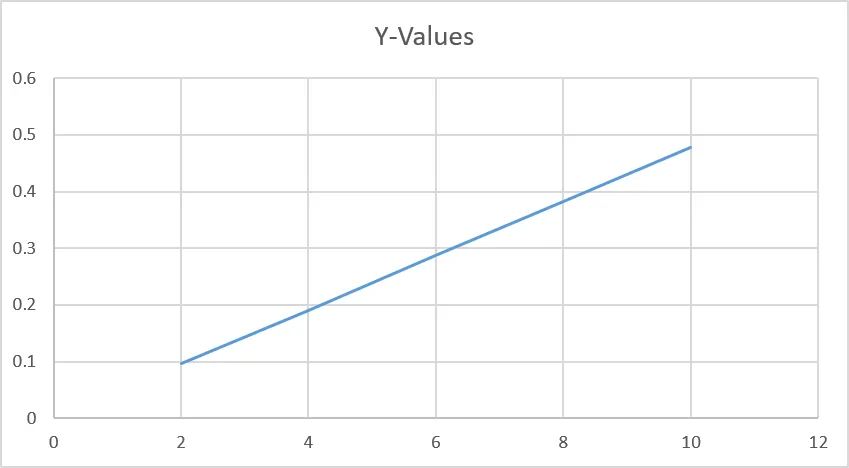
Regression equation: y = 0.0478x + 0.0003
R² = 0.999
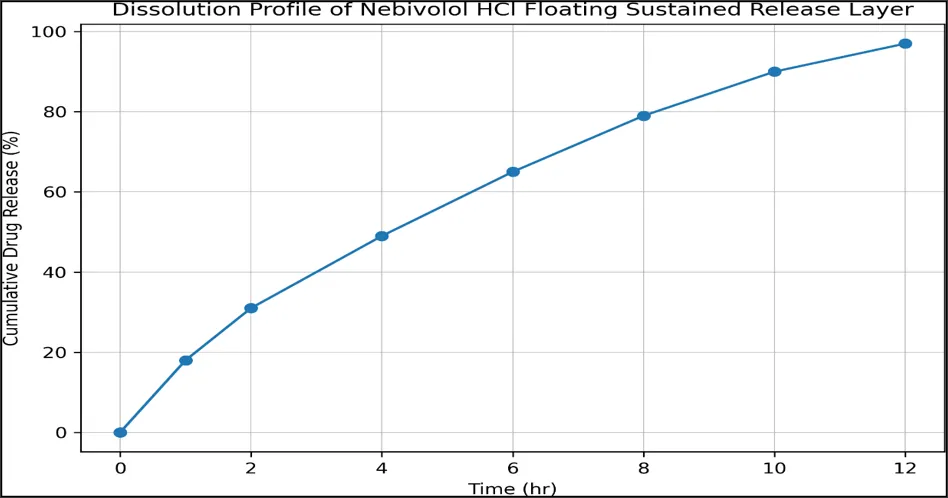
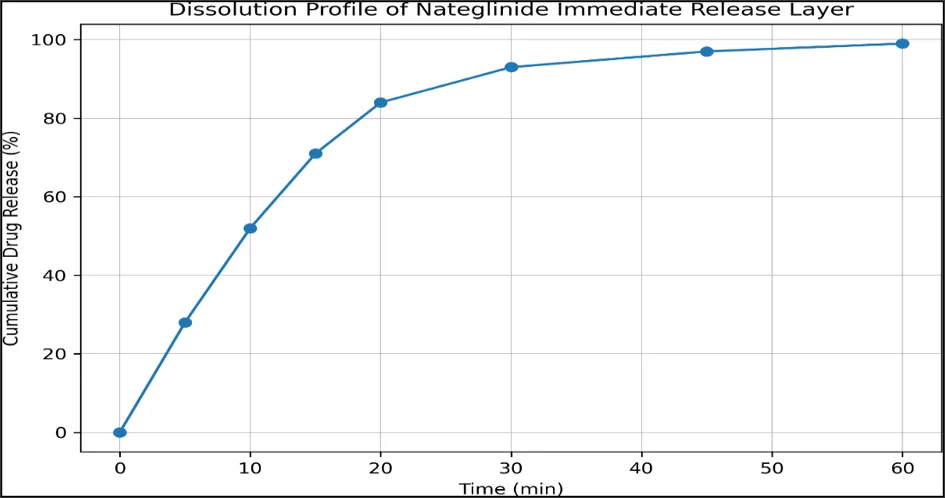
Dissolution Profile Study
The purpose of the dissolving research was to assess the bilayer gastro-retentive floating tablet formulation's drug release behaviour.
Floating Behavior Study
The floating lag time and total floating time in 0.1 N HCl were used to assess the floating behavior of gastro-retentive bilayer tablets. Better gastro-retentive function is indicated by a longer floating duration and a lower floating lag time.
|
Batch |
Floating Lag Time (sec) |
Total Floating Time (hr) |
|
F1 |
92 |
7.5 |
|
F2 |
78 |
8.0 |
|
F3 |
65 |
8.8 |
|
F4 |
58 |
9.5 |
|
F5 |
46 |
10.2 |
|
F6 |
39 |
11.0 |
|
F7 |
32 |
11.5 |
|
F8 |
28 |
12.0 |
|
F9 |
24 |
12.0 |
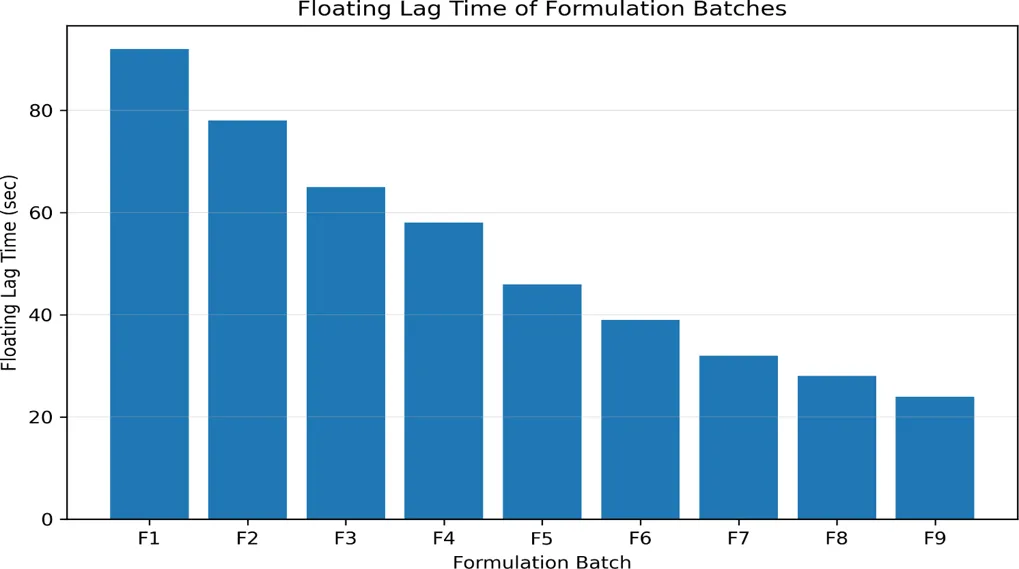
Figure. Floating Lag Time
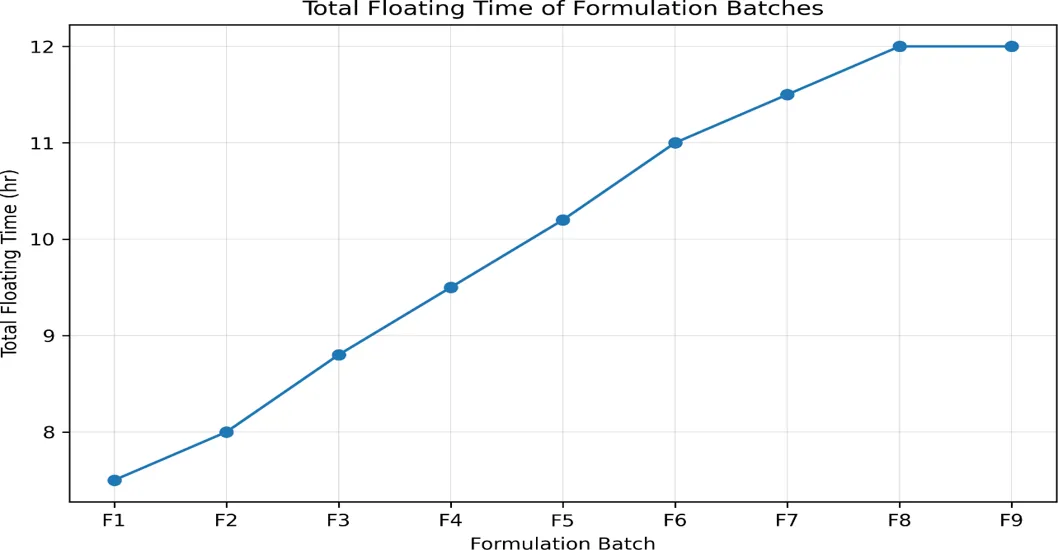
Figure. Total Floating Time
Interpretation
Over the course of the formulation batches, the overall floating time grew while the floating lag time gradually reduced. This might be because to increased polymer concentration and effective gas production from citric acid and sodium bicarbonate. The batch that was optimized demonstrated quick buoyancy and continued to float for up to 12 hours.
CONCLUSION
Bilayer tablets including both an immediate release layer and a sustained release layer were successfully produced for nateglinide and Nebivolol. It was discovered that release adhered to zero, Krossmayer-Peppas models. Every formulation batch that was examined for physical characteristics such as drug content, hardness, friability, and weight fluctuation was determined to be within the USP standards. The enhanced formulations were found to be stable across all stability parameters. No discernible change in drug release was seen during stability tests, suggesting that formulation batch C3 was stable under the selected conditions for three months. The medication release profile was improved by the optimized formulation C3. An intriguing polymer mixture for making SR matrix tablets is a combination of HPMC K4M and HPMC E5.
REFERENCES


Piyush Bhatt, Manika Panday, Dr. Vinod Rana, Formulation Optimization and Evaluation of Floating Bilayer Tablets of Nebivolol HCL and Nateglinide for Enhanced Gastro-Retention, Int. J. of Pharm. Sci., 2026, Vol 4, Issue 10, 2731-2743. https://doi.org/10.5281/zenodo.23425046
 10.5281/zenodo.23425046