

We use cookies to ensure our website works properly and to personalise your experience. Cookies policy
1Post Graduate Trainee, Department of Homoeopathic Materia Medica, Mahesh Bhattacharyya Homoeopathic Medical College & Hospital. Sailen Manna Sarani, Doomurjala Howrah - 711104, Howrah, West Bengal, India.
2Post Graduate Trainee, Department of Homoeopathic Materia Medica, Mahesh Bhattacharyya Homoeopathic Medical College & Hospital. Sailen Manna Sarani, Doomurjala Howrah - 711104, Howrah, West Bengal, India.
3Post Graduate Trainee, Department of Practice of Medicine, Mahesh Bhattacharyya Homoeopathic Medical College & Hospital. Sailen Manna Sarani, Doomurjala, Howrah - 711104, Howrah, West Bengal, India.
Introduction: Herpes zoster (HZ) is a painful vesicular eruption that typically follows a unilateral dermatome. This case describes the clinical course of HZ in a 28-year-old man who received individualized homoeopathic care Case summary: The patient presented on 21 February 2024 with a one-day history of burning and itchy vesicles over the chest and back, accompanied by sharp, stitching neuralgic pain aggravated by touch and motion. HZ was diagnosed clinically. Repertorisation of four symptoms ranked Ranunculus bulbosus first, with a total score of 11 and coverage of all four rubrics. Two doses at 200 potency were administered on consecutive mornings, followed by placebo. Results: At the follow-up on 28 February, pain had reduced. By 6 March, it had resolved and the vesicles were drying. By 13 March, the rash had healed without scarring. No post-herpetic neuralgia or adverse effects were reported during the documented follow-up. The MONARCH assessment provided a structured appraisal of possible treatment attribution, while also recognizing the expected natural course of HZ as an alternative explanation for improvement. Conclusion: This case documents resolution of pain and rash over three weeks following individualized homoeopathic care. The clinical course and MONARCH assessment are presented as a case observation; the outcome alone cannot establish that the intervention caused the recovery.
Herpes zoster (HZ), commonly known as shingles, is caused by reactivation of the varicella-zoster virus (VZV), the virus that causes chickenpox. After the initial infection resolves, VZV remains latent in sensory nerve ganglia. When it reactivates, the virus travels along the affected sensory nerve and produces symptoms in the corresponding area of skin. The illness may begin with pain, burning, tingling or itching before a rash appears. The rash typically develops as grouped vesicles on one side of the body, follows one or more adjacent dermatomes, and usually does not cross the midline [1,2,3,4]. The trunk is a common site of involvement, particularly the thoracic region. The lesions usually pass through stages, from early spots to grouped blisters and then crusts, with the skin generally healing over two to four weeks. Pain can occur throughout this period and may be sharp, burning or triggered by light touch. For many patients, the acute illness settles as the rash heals. In some, however, nerve pain continues after the skin has recovered. This is known as post-herpetic neuralgia (PHN), the most common complication of HZ. Other complications include eye involvement, neurological problems and secondary infection of the lesions [1,3,4]. HZ is more frequent in older adults and people with impaired immunity, but it can occur at any age. A clinical review notes that HZ is less common in children and younger people than in older adults, while also describing cases in younger age groups [3]. In India, a review of 27 studies covering 3,124 reported cases found that thoracic dermatomes were the most frequently affected sites. Across the included studies, PHN and secondary bacterial infection were also reported as important complications. The authors observed that the available Indian evidence was based on clinical reports and that population-level information remained limited [2]. These findings make clear why clinicians need to recognize the characteristic presentation and remain alert to complications, while also showing that individual reports should be interpreted within the limits of the evidence available. Early recognition is clinically relevant because standard management may include antiviral medicines and treatment for acute pain. Reviews describe antiviral therapy as most beneficial when started early, with the aim of reducing the severity and duration of the acute illness and lowering the risk of complications [1,3]. A case report that describes a different or individualized approach should therefore give a clear account of the clinical assessment, the treatment actually given and the patient’s progress. Such detail helps readers understand the observation and judge its limitations. A single case cannot determine whether improvement was caused by a treatment, and the natural course of HZ must also be considered when interpreting recovery. This report describes a 28-year-old man with a one-day history of painful, burning and itchy vesicular eruptions over the chest and back. The rash was described as unilateral and dermatomal, and the associated neuralgic pain was aggravated by motion and touch. The case was diagnosed clinically as HZ and treated with an individualized homoeopathic prescription of Ranunculus bulbosus. The documented follow-up describes improvement in pain and drying and healing of the lesions over three weeks. The case is of interest because it records the presentation and short-term course of HZ in a younger adult in an Indian clinical setting, together with the symptoms used to select the remedy. Its value is as a clinical observation that can be assessed alongside the known natural course of HZ; the reported recovery alone does not establish the effectivity of medicine in cases of HZ.
CASE REPORT
Patient information
A 28-year-old man presented on 21 February 2024 with a one-day history of painful, burning and itchy vesicular eruptions over the chest and back. The rash was described as unilateral and dermatomal, with sharp, stitching neuralgic pain aggravated by touch and motion. He reported having had chickenpox approximately 10 years earlier. Based on the clinical presentation, a diagnosis of herpes zoster was made. Following homoeopathic case analysis and repertorisation, Ranunculus bulbosus at 200 potency was prescribed for two doses, administered in the morning on two consecutive days on an empty stomach. Placebo was then prescribed during follow-up.
History of Presenting Complaint
The patient presented on 21 February 2024 with a one-day history of burning and itching vesicular eruptions over the chest and back. The onset was sudden, with burning and neuralgic pain preceding the appearance of the rash. The lesions developed into grouped vesicles and were described as unilateral and confined to a dermatome. The associated pain was sharp, burning and stitching in character, continuous since onset, and aggravated by touch and motion. No clear precipitating cause was identified. The patient had not received treatment for the current complaint before this consultation.
Past History
The patient reported having chickenpox approximately 10 years before the current illness. The case notes record no history of chronic disease, major surgery or previous complications related to vaccination. No other significant past medical history was documented.
Physical Generals
The patient had a normal appetite, desired potatoes, and had no significant food aversions. Thirst was moderate, and he was described as chilly. His tongue was moist, with increased perspiration over the face and neck. He passed stool once daily after breakfast, and his urine was clear. Sleep was sound. Energy level, sleep position, dreams and other general symptoms were not documented.
Mental Generals
The patient was mainly focused on the pain. No other mental or emotional symptoms were documented.
Systemic and Local Examination
On general examination, the patient was described as well nourished, with no systemic abnormalities noted. Vital signs were reported to be within normal limits, although individual measurements were not recorded. The case notes do not provide specific findings from the cardiovascular, respiratory, abdominal or neurological examinations.
On local skin examination, grouped vesicular eruptions were present over the chest and back on an erythematous base. The rash was described as unilateral and confined to one dermatome. The affected area was very painful to touch, and neuralgic pain was noted. The precise side and dermatome, lesion extent, and presence or absence of crusting, discharge or secondary infection were not documented.
Analysis of the Case
The unilateral, dermatomal vesicular eruption over the chest and back, together with the history of chickenpox, supported the clinical diagnosis of herpes zoster. For homoeopathic analysis, the case notes identify burning and itching vesicles and sharp, stitching neuralgic pain aggravated by motion and touch as the main characteristic symptoms. The patient’s chilly thermal state and craving for potatoes were also recorded as general symptoms.
Repertorial Totality
The repertorial totality was based on four symptoms documented in the case: vesicular eruptions, burning of the eruptions, aggravation from touch, and aggravation from motion. These correspond to the rubrics Skin—Eruptions—Vesicular, Skin—Eruptions—Vesicular—Burning, Generalities—Touch—Aggravation, and Generalities—Motion—Aggravation. In the repertorization sheet, Ranunculus bulbosus obtained the highest total score (11) and covered all four selected symptoms.
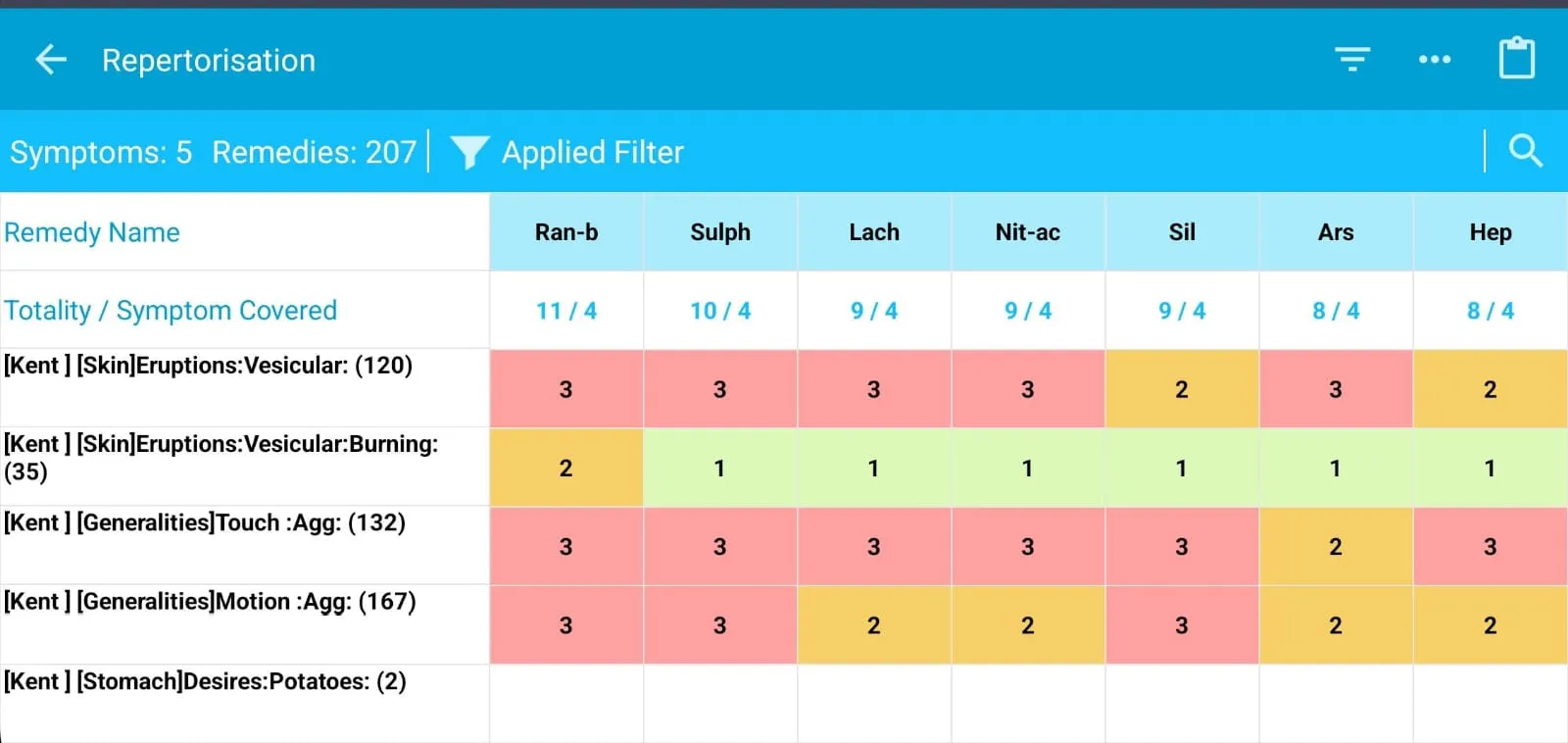
Figure 1: Repertorisation Sheet of Case
Therapeutic Intervention
Repertorisation was performed using Kent’s Repertory [add the software name and version, if applicable]. Four rubrics were used in the remedy comparison: vesicular eruptions, burning of the vesicles, aggravation from touch, and aggravation from motion. Ranunculus bulbosus received the highest total score (11), covering all four scored rubrics. It was followed by Sulphur (10), while Lachesis, Nitric acid and Silicea each scored 9. On the basis of this repertorial result and the recorded characteristic symptoms and consulting with materia medica, Ranunculus bulbosus was selected. 200th potency with two doses given in the morning on two consecutive day followed by placebo for 7 days, to be taken in empty stomach through oral route.
Follow-up and Outcome
At the first follow-up, one week after the initial consultation, the patient reported reduced pain intensity. Placebo was prescribed at this visit. At the second follow-up, in week two, the pain had resolved and the vesicles had begun to dry; placebo was again prescribed . By the third week, the rash had healed completely without scarring. No post-herpetic neuralgia or recurrence was reported during the documented follow-up, and no adverse effects were noted. The follow-up table summarizes the observations and prescriptions at each visit, with clinical photographs provided to illustrate the progression of the skin lesions.
Table 1: Follow up and Outcomes
| Date of Visits | Observation | Prescription | Pictures |
|---|---|---|---|
| 21st February 2024 | Painful vesicular rash on chest and back region with sharp, stitching neuralgic pain aggravated by motion and touch for 1day. | Ranunculus Bulbosus 200, 2 Doses, to be taken in morning in consecutive two days, in empty stomach, followed by placebo 200 for 5 days | Fig2a & fig 2b: Initial vesicular rash on chest and back |
| 28th February 2024 | Pain intensity reduced. | Placebo 200, 7 doses, to be taken empty stomach in morning for 7 days. | Fig3a & fig3b: vesicular rash on chest and back on second visit |
| 6th march 2024 | Pain resolved completely; vesicles began to dry. | Placebo 200, 7 doses, to be taken empty stomach in morning for 7 days. | Fig4a & fig4b: vesicular rash on chest and back on third visit |
| 13th march 2024 | Rash healed completely. No post-herpetic neuralgia. | Placebo 200, 7 doses, to be taken empty stomach in morning for 7 days. | Fig5a & fig5b: vesicular rash on chest and back on final visit |
DISCUSSION
Herpes zoster (HZ) usually presents as a painful, unilateral vesicular eruption in a dermatomal distribution. In this patient, grouped vesicles on an erythematous base, burning and itching, and sharp neuralgic pain were consistent with the clinical diagnosis. The reported history of chickenpox also supports prior varicella-zoster virus infection. No laboratory confirmation was performed; the diagnosis was based on the clinical presentation, as is common in typical cases [1,3,4]. HZ occurs more often in older adults and people with impaired immunity, but it can also occur in younger adults [3]. Although no chronic illness was reported, the case notes do not describe a specific assessment of immune status or other risk factors. Indian reports identify thoracic involvement as common and describe post-herpetic neuralgia and secondary infection among potential complications [2] . In this patient, no post-herpetic neuralgia was reported during the documented follow-up, which extended to three weeks. The prescription was selected after repertorisation of four symptoms: vesicular eruptions, burning of the eruptions, and aggravation from touch and motion. Ranunculus bulbosus ranked first, with a score of 11 and coverage of all four rubrics. These scores describe the remedy-selection process used in this case maintaining a individualistic approach so, do not establish that this specific medicine is effective for all cases of HZ. Pain had reduced by the first follow-up on 28 February 2024, resolved by 6 March, and the rash was reported healed by 13 March. Uncomplicated HZ lesions commonly heal within two to four weeks, so this three-week course is consistent with the expected natural history [1,3,4]. The improvement followed the initial prescription, but this single case cannot establish that Ranunculus bulbosus caused the recovery. The case has limitations. The precise dermatome and side, lesion extent, individual vital-sign measurements, and quantified pain severity were not recorded. Follow-up was limited to three weeks, and the duration of monitoring for recurrence, adverse effects, and post-herpetic neuralgia was not specified. Clinical photographs may illustrate changes in the lesions, but they cannot independently confirm the diagnosis or establish the cause of improvement. The MONARCH assessment provides a structured framework for considering possible causal attribution, but its score should be interpreted in light of the information documented and should not be treated as proof that the intervention caused the outcome [5,6,7]. Transparent reporting of the clinical timeline, intervention, follow-up, and consent is consistent with CARE and HOM-CASE guidance [5,6]. This report documents the presentation and three-week clinical course of HZ in a 28-year-old man, together with the repertorial reasoning and treatment sequence. The outcome should be interpreted as a clinical observation within the expected healing period for uncomplicated HZ, rather than evidence of treatment efficacy.
Table 2: Assessment of the Case According to Monarch (Modified Naranjo Criteria for Homeopathy)
| Domains | Yes | No | Not sure |
|---|---|---|---|
| 1. Was there an improvement in the main symptom or condition for which the homeopathic medicine was prescribed? | +2 | ||
| 2. Did the clinical improvement occur within a plausible timeframe relative to the drug intake? | +1 | ||
| 3. Was there an initial aggravation of symptoms? | 0 | ||
| 4. Did the effect encompass more than the main symptom or condition (i.e., were other symptoms ultimately improved or changed)? | +1 | ||
| 5. Did overall well-being improve? (Suggest using validated scale) | +1 | ||
| 6A. Direction of cure: did some symptoms improve in the opposite order of the development of symptoms of the disease? | 0 | ||
| 6B. Direction of cure: did at least two of the following aspects apply to the order of improvement of symptoms: • from organs of more importance to those of less importance? • from deeper to more superficial aspects of the individual? • from the top downwards? |
+1 | ||
| 7. Did “old symptoms” (defined as non-seasonal and non-cyclical symptoms that were previously thought to have resolved) reappear temporarily during the course of improvement? | 0 | ||
| 8. Are there alternate causes (other than the medicine) that—with a high probability—could have caused the improvement? (Consider known course of disease, other forms of treatment, and other clinically relevant interventions) | +1 | ||
| 9. Was the health improvement confirmed by any objective evidence? (e.g., laboratory test, clinical observation, etc.) | +2 | ||
| 10. Did repeat dosing, if conducted, create similar clinical improvement? | +1 | ||
| Total Score = +10 |
CONCLUSION
This case documents the clinical course of herpes zoster in a 28-year-old man who received Ranunculus bulbosus at 200 potency for two doses, followed by placebo during weekly follow-up. Pain resolved and the rash healed within three weeks, with no post-herpetic neuralgia reported during the documented period. As this recovery occurred within the usual healing period for uncomplicated herpes zoster, the case cannot establish that the homoeopathic intervention caused the outcome.
DECLARATION OF PATIENT’S INFORMED CONSENT
Written informed consent was obtained from the patient for publication of the clinical details and accompanying photographs. The patient was informed that identifying information would be withheld; however, complete anonymity cannot be guaranteed.
ACKNOWLEDGEMENT:
The authors thank the patient for her cooperation and consent.
CONFLICT OF INTEREST:
The authors declare no conflict of interest.
REFERENCES



Apurba Pratihar, Parveen Middya, Kausthab Dey, From Neuralgic Pain to Rash Resolution: Clinical Course of Acute Herpes Zoster Case Treated with Individualized Homoeopathic Medicine - a Case Report, Int. J. of Pharm. Sci., 2026, Vol 4, Issue 10, 2441-2449. https://doi.org/10.5281/zenodo.23410287
 10.5281/zenodo.23410287