

We use cookies to ensure our website works properly and to personalise your experience. Cookies policy
Dept. of pharmacology, Dr. Rajendra Gode Institute of Pharmacy, Mardi Road, Amravati, Maharashtra- 444602.
Major challenges in preclinical pharmacology, such as low predictivity, high rates of attrition, prolonged development cycles, and high costs remain significant issues as they largely relate to how translational relevance of past experimental models. This work aims to assess the potential of artificial intelligence-based models, especially graph neural networks in enhancing the predictivity, opportunity, discovery and challenges solving in preclinical pharmacology. This is a synthesis review on machine learning, deep learning and graph-based architectures being used to predict molecular properties, toxicity, drug-target and drug-drug interaction, drug repurposing and de-novo molecule design and their methodological basis and application in preclinical workflows. The reviewed literature reveals that AI models, particularly graph neural networks, may be useful in learning complex chemical and biological relationships, leading to improved prediction of ADMET properties, toxicity endpoints, pharmacokinetics, and therapeutic efficacy, while reducing reliance on animal models and accelerating candidate prioritization. Despite these advances, significant limitations persist, including data scarcity and heterogeneity, limited interpretability, bias, scalability constraints, and challenges in generalization across biological systems and regulatory acceptance. In conclusion, artificial intelligence and graph neural network–based approaches represent a transformative paradigm for preclinical pharmacology by enhancing predictivity, efficiency, and translational relevance; however, their successful integration into drug development will depend on advances in high-quality data generation, explainable and hybrid modeling strategies, standardized validation practices, and ethical and regulatory alignment
The failure to discover and preclinical pharmacology has continued to experience high attrition rates, lengthy development cycles, and high-cost development liabilities. A large percentage of drug candidates exhibiting encouraging in vitro or in animal preclinical activity end up failing in the clinical phase, in large part because of the limited predictivity of conventional preclinical models and the inability to completely model human-relevant biological complexity (Vora LK et al, 2023; Petkovic et al, 2024). To overcome these shortcomings, Artificial intelligence and machine learning are now being applied in the initial phases of drug development to allow data-driven modeling of efficacy, toxicity, and pharmacokinetic behaviours in exceptionally large and accurate scale (Gaudelet et al, 2021). Graph neural networks have become the most transformative type of AI architecture that is exceptionally suitable to chemical and biological data among other modern architectures. Unlike traditional machine-learning methods that depend on manually designed molecular descriptors, Graph Neural Networks (GNNs) learn directly from the natural structure of molecules. In GNNs, a molecule is treated as a graph in which atoms act as nodes and chemical bonds serve as edges, allowing the model to automatically capture structural relationships and chemical interactions without the need for manual feature engineering. It enables Graph Neural Network to acquire rich, structure sensitive molecular representations of features involving electronic, topological, and spatial properties of drugs that drive drug behaviour (Duvenaud D et al, 2015; Gilmer J et al, 2017; Kearnes S et al, 2016). These capabilities have enabled major advancements in drug discovery and development by improving the prediction of important pharmacological properties. Graph-based models can accurately estimate ADME characteristics, identify potetial toxicity risks, predict drug-target interactions and even discover synergistic drug combinations, thereby supporting safer and more effective therapeutic design (Wang J et al, 2022). Moreover, it has been reported the combination of GNNs and knowledge graphs, multi-omics data, and deep-learning architectures will benefit enormously in terms of mechanistic interpretability and translational relevance (Yao R et al, 2024; Nisar U et al, 2025; Zhang O et al, 2024). The issue with this is that the results obtained with conventional preclinical models are not easily translatable to human outcomes therefore, they have low predictive potential (Kola et al, 2004; Visk et al, 2015).
GRAPH NEURAL NETWORK
With the help of a GNN, a molecule is fed in and the Message Passing algorithm is used to compute it by letting atoms (nodes) exchange messages and update their feature vectors over several rounds. Messages about their neighbours are sent to the atoms and this provides them with information about their immediate environments and they in its turn update their feature vectors with a neural network to reflect that bigger picture. There are multiple steps until the information carrying feature vectors of all atoms are provided to a Readout layer which in turn integrates them in a single large and comprehensive feature vector which is used to predict the entire molecule (Yin et al, 2021; Durap et al, 2023; Sarkar et al, 2021). Although, non-linear interactions, which pharmacokinetics would impose, are challenging to model using such standard computational models such as linear regression, decision trees and even more advanced machine learning models such as Random Forest and XGBoost, and as a result, companies can potentially cut down the time to assess the absorption, distribution, and elimination properties of a compound by orders of magnitude by resorting to AI models such as Graph Neural Networks (GNNs) and Transformers ( Nadkarni et al, 2023; Patel et al, 2021; Gangwal et al, 2024). The GNN models particularly the GraphSAGE models were more superior to the traditional models in terms of high accuracy (a maximum of 93.67) in terms of ADE to detect and classifying during the process of facilitating improved pharmacovigilance. The health claim data on patients (ICD-10 codes) offered by this paper allowed to utilize the Graph Neural Networks to predict the progression of diseases and Adverse Drug Events (ADS) with a sufficient level of accuracy (Zhou et al, 2024).
Table 1- GNN Performance in Adverse Drug Event (ADE) Prediction (Zhou et al, 2024).
|
Prediction Task |
Best-Performing GNN Model |
Primary Performance Metric (Accuracy) |
Key Finding & Significance |
|
1. ADE Detection (Predicting the presence of an ADE) |
GraphSAGE |
88.63% |
Confirms GNNs can effectively distinguish patients who will experience an ADE from those who will not, demonstrating high utility for early risk stratification. |
|
2. ADE Timing (Predicting the time of ADE occurrence) |
GAT (Graph Attention Network) |
87.69% |
Validates GNNs' ability to capture the temporal progression of patient diagnosis history to forecast future events. |
|
3. Specific ADE Classification (Predicting the type of ADE) |
GraphSAGE |
93.67% |
Achieved the highest accuracy, indicating GNNs can learn complex subgraphs related to specific ADE types, with high recall (e.g., 98.12%) which is crucial for safety systems. |
The integration of multimodal and highly nonlinear biological relationships becomes easier to be adopted when GNNs are incorporated in biomedical networks. During the recent years, GNNs have demonstrated a high potential to predict different types of interaction including protein–protein interactions (PPIs), drug-drug adverse interactions, and drug-target interactions and to support the identification of new chemical entities. Deep learning along with an effective evaluation plan demonstrated azithromycin and atorvastatin as potential adaptable drugs against COVID-19. In this work, the researcher built a SARS-CoV-2 graph based on selected COVID-19 literature, applied transferable knowledge representations from drug repurposing knowledge graph (DRKG) and learnt the embeddings of potential repurposable drugs using deep GNN models that were then strictly validated using in vitro efficacy data (Mohamed et al, 2020; Zitnik et al, 2018; Hsieh et al, 2024; Nisar et al, 2025).
Types of GNN models
Graph neural network (GNN) models represents a class of neural networks designed to process graph structured data. They have received significant interest in most areas resulting in their remarkable ability to determine the sophisticated relationship and concealed patterns in graph-structured data. (Velickovic et al, 2018; Hamilton et al, 2017; Nguyen et al, 2021).
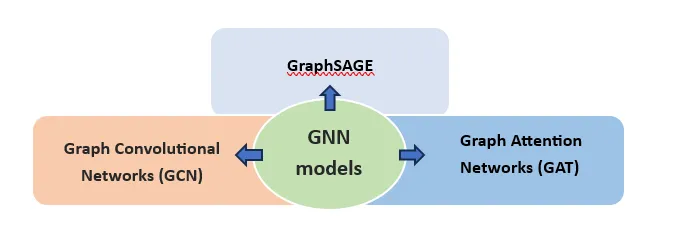
Figure 1. Types of Graph Neural Network Models
Graph convolutional networks (GCN):
In a Graph Convolutional Networks each layers collect and integrates information from neighbours by taking a mean (or normalized sum) of their features. The crucial component is the use of the renormalized adjacency matrix (Ā = A + I) and the degree matrix (D

Graph attention networks (GAT):
Instead of using a fixed normalization (like GCN), GAT computes a set of learnable attention coefficients ( αij


GraphSAGE:
GraphSAGE focuses on inductive learning by training a set of aggregator functions that can generate embeddings for new, unseen nodes and graphs. Scalability is achieved by sampling a fixed-size neighbourhood for each node at every layer instead of considering all neighbouring nodes.
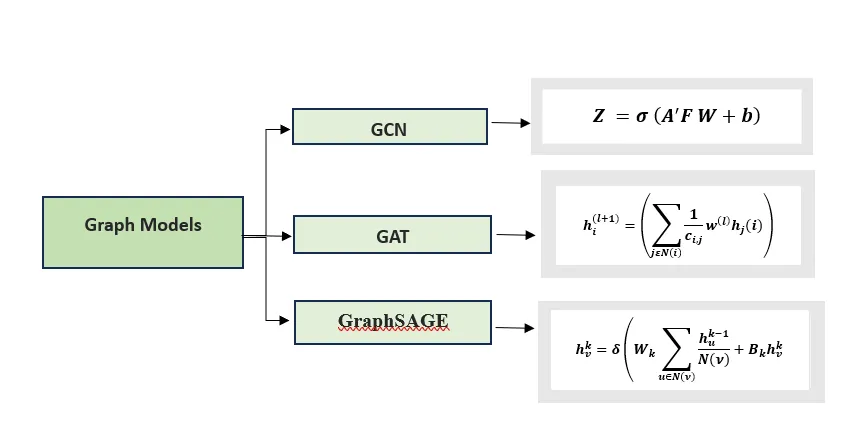
Figure 2. Equations of GNN Models
Application of GNN
Promising antitussive therapy:
This multi-centre real-world study demonstrates that Gefapixant is effective and rapid in the management of chronic cough in the refractory phase. The response to treatment and side effects of taste are some of the aspects of therapy and taste, respectively, that can be predicted using certain sensations in the larynx and cough triggers. Although novel treatments (e.g., NK-1 or sodium-channel-targeting drug) remain necessary, mild taste abnormality can be tolerated in case the antitussive effect is adequate (Matsumoto et al, 2023).
Drug-Target and Drug-Drug Interaction (DDI) Prediction:
GNNs are particularly effective at modeling the multifaceted interactions of biological networks as well as can be applied to predict the affinity of a drug with its target protein or predict possible adverse drug-drug interactions (Liu et al, 2024)).
Drug repurposing:
GNNs can facilitate drug repurposing by modelling drug-disease associations as a link prediction problem within a knowledge graph.
Retrosynthesis & synthesis planning:
predicting the chemical reactions that can be used to stepwise synthesize a desired molecule out of commercially available starting reactants (Han et al, 2022).
Graph neural network challenges
In this part, the authors have outlined the key challenges that occur when researchers apply GNNs to different healthcare uses. It also discusses the prospects of the study and the future outlook of the GNN-based methods development in the healthcare field (Van der et al, 2010).
Heterogeneous data integration:
situations where one has different types and sources of data, data of different types, data sparsity and semantic meaning does not allow the easy integration of data into a single GNN. These discrepancies make it difficult to develop a full graph representation, which often results in poor model performance. Interpreting GNN prediction:
The rationale of GNN prediction is difficult to comprehend since it is concealed in complex graphs. The problems include significance feature identification, node identification or edge identification, which decrease transparency and uptake in high stakes medical settings. Scalability Healthcare Graphs Healthcare data including EHRs and networks of healthcare patients can be complex and numerous graphs. They are computationally expensive to run in large scale and require a slow real time processing, which is memory intensive.
Little labelled data:
GNNs can be highly problematic in case of low labelled data availability which leads to overfitting and poor generalization.
Generalization of GNNs:
GNNs can be trained using one healthcare dataset and it is not always applicable to new data with a different distribution and cross-domain generalization is one of the most important issues.
Ethical GNN use:
GNNs are able to acquire and uphold biases in healthcare information leading to unjust forecasts or prejudiced forecasts. The issue of low interpretability also casts doubt in the issue of transparency and accountability.
Missing data:
Missing values are typical in healthcare graphs, and model relationships may be distorted and model performance degraded by imputing them improperly. Good techniques should be able to maintain the structure of the graph and fill in the holes.
Bias in GNN prediction:
When training data are skewed or imbalanced, GNNs can be skewed and amplify these. biases, which lead to systematically prejudiced or discriminatory predictions.
AI BASED MODELS IN PRECLINICAL PHARMACOLOGY - PREDICTIVITY, OPPORTUNITIES AND CHALLENGES
the process of transforming a lead candidate from early discovery into clinical practice can be described as complex, resource-intensive, and associated with a high degree of risk. The application of preclinical research and in particular preclinical animal research has been a key component of the drug development and translation research continuum (Leenars et al, 2019). Animal models are able to provide significant hints concerning disease pathophysiology, drug behaviour, and clinical efficacy, and provide some degree of biological context that may not be well realized in a cell culture environment. However, it is quite restricted that such systems can do the correct predictions on human outcomes and cause profound ethical concerns. Artificial intelligence (AI) has been a common concept of being a disruptive technology in the area of experimental pharmacology where it has enabled innovation and efficiency throughout various stages of drug discovery and development (Mak et al, 2019). AI could be applied in the target validation that includes identification of off-target effects and probability of adverse toxicity of new drugs and subsequently minimizing the risk of expensive failures in the next steps of drug development. In the case of animal model systems, AI and machine learning have the capability to provide a contribution to the predictive power and productivity of the preclinical research (Tanoli et al, 2021; Gangwal et al, 2025). An example is an AI-based model could predict which small molecules have affinity with the target proteins and will not require experimental measurements of pharmacological target interaction (Dhakal et al, 2022). Algorithms such as machine learning (ML) and deep learning (DL) are the examples of AI, and they can be efficiently used on big datasets that can be processed and interpreted more accurately. In rare diseases or even in certain categories of patients, often it is a challenge to find and keep volunteers in the clinical trials. The ability of AI to handle considerable volumes of data, identify valuable trends and forecast outcomes is altering the conventional approach according to which the drug development process will become quicker, more effective and cheaper (Gupta et al, 2021; Abdul et al, 2021). The initial stage of drug development can be reduced in terms of time and cost by selecting the most probable therapeutic candidates by using AI algorithms to sift through a large number of chemical compounds within a relatively limited time span. The machine learning models take into consideration the physicochemical characteristics and biological responses in order to predict the possibility of the success of the compound. The AI-based predictive modelling also maximizes the development of drugs by improving the pharmacodynamics and the pharmacokinetics effect. By modeling the behaviour of a biological system of a drug, these models are able to identify the therapeutic effectiveness and the potential adverse side effects and therefore aid in the selection of more effective and safer drugs treatment (Fleming et al, 2018; Vamathevan et al, 2019; Ekins et al, 2019). The ethical and regulatory issues also become significant when the pharmacology is being incorporated in AI. The AI algorithms are supposed to be transparent, comprehensible, and fair to gain the good will of the regulators and the citizens (Hasan et al, 2024).
Artificial intelligence in preclinical pharmacology:
Artificial Intelligence represents the broadest field, focusing on the design and development of systems capable of performing tasks that typically require human intelligence such as reasoning, learning and decision making. Machine Learning is one of the most basic aspects of AI, and it enables the systems to learn using the information and enhance their ability to accomplish some tasks without the need to be programmed with the set of rules. Deep learning (DL) in its turn is a field of the latter employs the multilayer neural network models to automatically learn intricate, hierarchical representations of high-dimensional unstructured data sources, including images and natural language text. Most of the innovative AI-based applications oday are based on the ability.
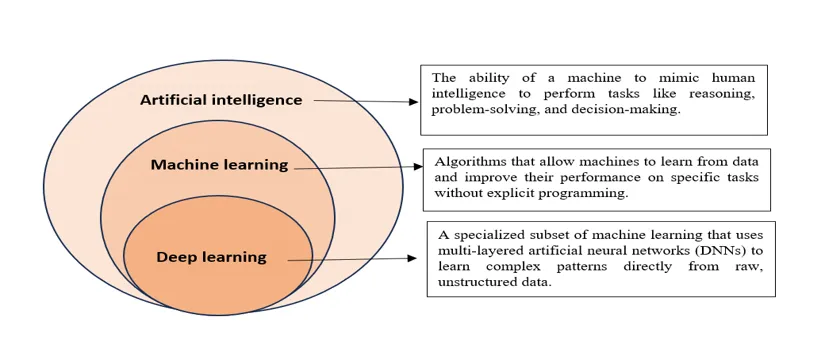
Figure 3. Relationship between Artificial Intelligence, Machine Learning, and Deep
MACHINE LEARNING
The Machine Learning has gained a lot of relevance in pharmacological studies. It assists in drug discovery, drug prediction, and optimization of treatment programs. Machine Learning algorithms process extensive biological and chemical databases, extract relevant patterns and reliable predictions. Consequently, machine learning approaches of various forms are applied extensively in the field of pharmacology. Quality data are desired to enable successful ML models. Both chemical and biological data in publicly accessible databases like PubChem and ChEMBL, among other screening resources, have grown rapidly within the last ten years. These databases now store the information on millions of molecules, including their biological activities against various disease targets as well as data related to absorption, distribution, metabolism, Excretion and toxicity (ADMET) properties (Kim et al, 2023; Gaulton et al, 2017). These are highly valuable datasets that can be used in machine learning in drug discovery. It is becoming common practice to have large quantities of high-quality data on many disease targets, captured by the popularity of databases, like ChEMBLE and the high predictive performance of the models created on these platforms (Gaulton et al, 2012). A major limitation of most databases is that the data not readily model-ready or machine readable (Chen et al, 2018).
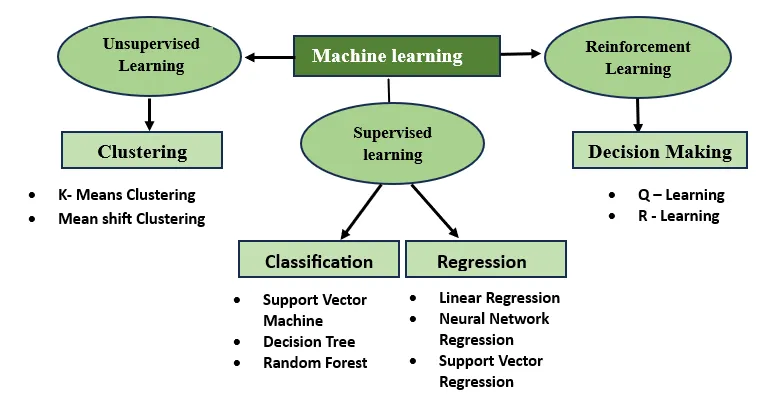
Figure 4. Types of Machine learning
Support vector machine:
The Support Vector Machines (SVMs) are widely adopted in pharmacological studies in both classification and regression. They operate by discovering explicit decision domains in high-dimensional data and are quite appropriate to derive non-linear, complex relationships (Cortes et al, 1995). It works by identifying the best boundary, or hyperplane, between data within two different classes maximizing the distance between them. SVM is utilized in classifying the compounds as either active (potential hits) or non-active (non-hits) against a particular drug target, so that researchers can focus on the potentially active compounds selected from extensive chemical libraries for experimental validation (Melville et al, 2009). SVM models were applied to determine possible thrombin and HDAC1 inhibitors as compounds were categorized according to their molecular properties. In conjunction with a structure-based pharmacophore model emphasizing zinc-binding features and molecular docking, this methodology identified 23 compounds of which three were found to have HDAC1 inhibitory properties and moderate antiproliferative activities (Krishna et al, 2020).
Random Forest:
Random forest is a widely used supervised learning algorithm in pharmacological studies. It can effectively predict and is also able to handle high-dimensional data by combining several decision trees together. Common applications of virtual screening, feature selection, drug candidate classification, and toxicity prediction use the Random Forest models (Svetnik et al, 2003). The resulting Random Forest model is a useful computational resource to the chemical biology and drug discovery fields, as it is able to make predictions of AUC (0 – 5h) as well as facilitate the early identification of compounds likely to show inadequate oral exposure (Mughal et al, 2021).
Decision Tree:
Decision Trees (DTs) are among the oldest and most widely used machine learning algorithms. A decision tree is a way of describing decision logic using a sequence of tests and results, which are follow-ups of each other, and the classification process is structured as a tree. In a decision tree, the topmost node is the root node, represent the starting point of the decision-making process, while internal nodes correspond to tests performed on input features. Depending on the result of a given test, the model will lead to the relevant child node then the process is repeated until the leaf node is attained. These leaf or terminal nodes are the result or outcome of decision or classification. Decision trees are interpretable, fast to train and hence are mostly applied in medical and pharmacological decision-making and diagnostic applications (Quinlan et al,1986; Cruz et al, 2006).
Reinforcement Learning:
In Reinforcement learning (RL), a group of decision-making algorithms, a computer is trained to learn the best course of action in a given situation by assessing the outcomes of the actions. Based on ideas of psychology, RL emulates animal learning, where the behaviour is influenced by the trial and error and the gain of rewards as the consequences of the actions (Sutton et al, 2015). traditional methods may be insufficient to represent patient-to-patient variation in drug response. The article shows how reinforcement learning (RL) with pharmacodynamics/pharmacokinetics and Quantitative systems pharmacology (QSP) models would facilitate real-time optimization of individual dosing schedules. Having developed drug administration as a sequence decision-making process, RL agents acquire the best dose changes to reach therapeutic goals in critically ill patients, and clinical pharmacology emerged as a data-driven basis of personalized healthcare (Thomas et al, 2020).
Unsupervised machine learning (UML)
Unsupervised machine learning (UML) is widely applied in preclinical pharmacology to make sense of large, complex, and unlabelled datasets generated during early drug discovery. By applying unsupervised learning techniques such as K-means clustering, hierarchical clustering and principal component analysis, UML helps researchers uncover hidden patterns in pharmacokinetic data, biological responses, and multi-omics profiles. These techniques allow compounds with similar behaviours to be grouped together, even when prior knowledge is limited, and can highlight potential mechanisms of action or early toxicity signals. By providing an unbiased, exploratory view of complex data, UML supports hypothesis generation and helps prioritize experiments, ultimately guiding more informed decision-making during the preclinical drug discovery (Lavecchia et al, 2015; Jolliffe et al, 2016).
Support vector regression:
Support vector machine is considered an effective method for capturing complex nonlinear relationship between predictor and response variables. The models of SVR allow the inference of functions directly on the data that is observed, and hence they are especially useful in practice in the scenarios, in which the data heterogeneity contributes to the handcrafted design of functions infeasible. Therefore, SVM methods have been widely applied across various fields, including system identification and control patterns recognition and data visualization (Smola et al,2004). SVR is a supervised machine learning approach based on support vector machines that performs regression tasks by estimating continuous output values. By using kernel function like radial basis function, SVR can capture complex, input-output non-linear relationships enables it suitable for cases where traditional linear regression falls short. In preclinical pharmacology, SVR is particularly useful for modeling and predicting quantitative drug properties and responses. For instance, it has been applied to construct dose–effect models in drug interaction studies, enabling the prediction of additive, synergistic, or antagonistic effects more efficiently than classical methods. This capability not only improves the accuracy of drug response simulations but also has the potential to minimize the dependence on large scale animal testing (Salata et al, 2015; Rodriguez et al, 2022).
DEEP LEARNING
AlphaGo used a sophisticated and novel architecture, which is based on Convolutional neural networks (CNNs), which is the most successful and popular Deep learning (DL) frameworks in neural network studies (ssilver et al, 2016). The implementation of deep learning (DL) structures has become one of the first steps towards tackling major issues in the field of artificial intelligence (LeCan et al, 2015). Different Dl architecture produces semantic features in different ways, depending on training data structure, each of them recognise patterns. In this primarily presented some of this DL architecture such as CNN, RNN, Generative network (Mienye et al, 2024).
Convolutional neural network (CNN):
Convolutional neural network (CNNs) considered to be the most representative ones in deep learning and have found wide applications across various domains, including image and speech recognition as well as natural language processing (NLP). Contemporary CNNs can be said to have their roots in the work of Fukushima of the 1980s that was inspired by the receptive field studies of the cat visual cortex (Hubel et al, 1959). Computational toxicology heavily depends on CNNs to predict an ADMET profile of drug candidate (Shi et al, 2019). They forecast such endpoints as hepatotoxicity, genotoxicity and blood brain barrier (BBB) penetration (Alsenan et al, 2021; Lee et al, 2025). Convolutional Neural Networks (CNNs) are very effective when it comes to virtual screening and drug target interaction (DTI) prediction. They represent molecular representations, e.g. SMILES strings or 3D structures to 1D or 2D formats and use convolutional filters to learn informative features automatically. This facilitates the creation of high scoring capabilities to select potential drug candidates. Also, CNNs are highly applicable to study images of experiments on high-content screening (HCS), which can differentiate cellular phenotypes and detect toxic or therapeutic effects with a minimum of manual intervention (Rifaioglu et al, 2020; Vaz et al, 2021).
Recurrent neural network (RNN):
Recurrent neural networks (RNNs) are widely used deep learning models in preclinical pharmacology, especially for sequence-based data in which temporal or structural order is crucial, such as molecular sequence or pharmacokinetic profiles. The most frequent use of RNNs (and their more sophisticated versions such as LSTM and GRU models) is in De Novo Drug Design. Information about a molecule is encoded in the form of the simplified molecular-input line-entry system (SMILES) of a molecule, which is then treated as a sentence, and RNNs are then trained to identify the syntax and structural rules of chemical space and can generate novel, chemically valid molecular structures character by character, overcoming the constraints of scaffold-based design approaches (Grisoni et al, 2020; Ahmad et al, 2023). In one instance, an LSTM-based generative model, NovoMol was used to generate new drug-like molecules where there was a particular emphasis on enhancing oral bioavailability. The model could perform the optimization of molecular structures repeatedly in such a way that the produced compounds met the quantitative drug-likeness and pharmacokinetics requirements (Rao et al). Beyond generation, RNNs also have an important role in the prediction of the behaviour of a drug over time including the application of Elman RNNs to predict and model more complicated profiles of drug dissolution and release of controlled-release formulations where the output at moment t predicts the output at moment t+1 and the profile is a time series (Mao et al, 2023).
Generative adversarial network (GAN):
Generative adversarial network are the most influential types of models in preclinical pharmacology that have fundamentally changed the work of novel drug design, enabling the creation of novel molecules possessing particular, pre-defined characteristics. GAN works by playing an adversarial two-player game: a Generator network, which learns the distribution of the chemical data and tries to create realistic new molecular structures, and a Discriminator network which is a critic which attempts to differentiate between real molecules and fake (generated) molecules. The generative AI company In-silico Medicine used a GAN-based framework called Generative tensorial reinforcement learning (GENTRL) for the identification of new inhibitors against the DDR1 kinase target, they successfully generated and synthesized promising preclinical candidates in the ever-present competition compels the generator to imorove the realism and chemical validity of the compounds it produces. A key advantage of GANs is their capacity to navigate large, unexplored regions of chemical space and optimize molecules for properties f interest, including drug-likeness, target binding affinity and synthetic feasibility. One of such applications is the analysis of the model such as MedGAN which uses a combination of a Wasserstein GAN (WGAN) and Graph convolutional networks (GCNs) to create new molecules with a certain scaffold such as quinolines (Macedo et al, 2024). The GAN- based drug-target ligand generator (GANDALF) is another variant that has been applied to produce new peptides that interact with certain cancer targets using protein targets, and has been shown to be able to design small molecules and fructifier peptides (Lin et al, 2022).
Autoencoder:
Autoencoder models and especially the Variational Autoencoder (VAE) architecture have taken their place as the backbone of preclinical pharmacology in tackling complex problems, mainly in de novo drug design and representation learning. Researchers can create a completely new molecule by sampling a random vector which is transformed by the decoder. Since it is a continuous space, simple mechanisms, such as interpolation can create new structures whose properties lie in between those of the two starting molecules. One of the earliest works utilized a VAE to encode molecules into continuous vectors. They effectively used Bayesian Optimization (BO) to search this latent space to generate novel chemical structures that is expected to be active at dopamine receptor type 2 (DRD2), and effectively solved the reverse Quantitative structure activity relationship concern by designing molecules and satisfying an activity constraint in the first place (Blaschke et al, 2018; Gomez et al, 2018; Griffiths et al, 2020).
Table 2 - AI and Machine Learning Models in Preclinical Pharmacology for Disease and Toxicity Prediction
|
Disease/Condition/Toxicity Endpoint |
AI-based Model/Technique |
Preclinical Application |
|
Neurotoxicity/Epilepsy |
Support vector regression (SVR) |
Predicting the proconvulsant activity of novel compounds to determine their therapeutic dose range and toxicity threshold in animal models. (Salat et al, 2012). |
|
Renal Disease/Nephrotoxicity |
Convolutional Neural Network (CNN) / Support Vector Machine (SVM) |
Automated analysis of whole slide images (WSIs) from animal models for the accurate detection and segmentation of renal structures (e.g., glomeruli) to assess drug-induced injury (Simon et al, 2018). |
|
Cardiotoxicity |
Multimodal AI (e.g., Madrigal) |
Predicting adverse cardiac outcomes and drug-drug interactions (DDIs) by integrating molecular, pathway, and cellular data (Feng et al, 2025). |
|
Inflammatory bowel disease (IBD) |
Explainable Machine Learning (Pharmacology-AI) |
Identifying genetic and clinical features that drive drug response and patient stratification in human living tissue assays (Gardiner et al, 2022). |
|
Type 2 diabetes & obesity |
Multi-omics AI / Machine Learning |
Predicting compound efficacy, optimizing dose-response relationships, and guiding the design of precision combination therapies (Ayomide et al, 2024). |
|
Alzheimer’s disease |
Generative AI / Multi-omics ML (e.g., PandaOmics) |
Identifying novel therapeutic targets by predicting proteins prone to phase separation (Lima et al, 2023). |
|
Non-Alcoholic Steatohepatitis (NASH) / MASH |
Deep Learning |
Automated and precise quantification of steatosis, lobular inflammation, and ballooning from preclinical tissue slide (Pulaski et al, 2024). |
AI BASED MODELS PREDICTIVITY IN PRECLINICAL PHARMACOLOGY
High quality of chemical, biological, pharmacokinetic, toxicity, and efficacy data is a key condition of predictivity of AI-based models in preclinical pharmacology. Multimodal datasets can support model translational relevance by providing complex drug - target interactions.
ADMET prediction:
Molecular structures and physicochemical properties are used to evaluate several ADMET endpoints by AI and Machine learning (ML) algorithms are the faster and more scalable than several traditional statistical models. Such models are support vector machine, random forest and deep learning networks developed using large-scale experimental data sets on such endpoints as permeability, metabolic stability, and toxicity profiles. Within the area of toxicity prediction, AI predictors have been used to predict organ-specific toxicity (e.g., hepatotoxicity, nephrotoxicity), and systemic endpoints of toxicity. These models combine a variety of molecular descriptors, and, more often, multi-modal information (e.g. toxicogenomic data) in order to enhance prediction accuracy and interpretability (Zhang et al, 2025). As an example, the use of graph neural networks (GNNs) via platforms such as ADMET-AI has shown a better predictive capability and speed compared to the previous approach and allows large-scale screening of compound libraries to evaluate their favourable ADMET properties (Swanson et al, 2024).
Toxicity prediction:
The objective of predictive toxicity is to estimate the potential toxic effects of compounds at an early stage of drug development, thereby minimizing the reliance on animal testing and improving compound safety. Machine learning algorithms can predict toxicity based on chemical and biological feature representations, facilitating the early identification of safety risks such preliminary screening enables the removal of unsuitable compounds at an early stage, thereby reducing animal usage and significantly saving time and cost in the drug development process (Tran et al, 2023).
Prediction of drug-target interactions:
With the help of deep learning, drug repurposing aims to identify alternative therapeutic uses for already approved drugs. It has gained significant attention due to its shorter development time, reduce investment and higher success rate compared to conventional de novo drug development. Drug-target interaction prediction represents a fundamental step in drug discovery and serves as a critical component of drug screening and target-guided synthesis (wang et al, 2020).
Drug sensitivity and response prediction using DL:
This article provides an overview of drug sensitivity and response prediction using deep learning approaches. The DL framework utilizes a drug-protein heterogenous interaction network for drug response prediction. Even though the deep neural network (DNN) methods have been widely used in numerous disciplines such as computational chemistry, their application to the multi-pathway biological interactions networks is still developing. DNNs have not been used in drug response prediction until recently. Some of the early attempts encountered difficulties because of limited data including overparameterization, overfitting and poor generalization. Nonetheless, the increased access to public data and new DNN models have been quite promising. This part thus examines the existing issues of deep learning and the recent developments in drug-response prediction (Yu G et al, 2025).
Drug-drug similarity prediction based on DL:
The theory behind drug similarity studies is that similar drugs in terms of their pharmacological effect reflecting their effects on a living being, share common mechanisms of action and will usually have common side effects. It is through this correlation that we discover new methods of curing medical conditions. Drug-pharmacological similarity is widely used in diverse applications such as identifying drug targets, predicting adverse drug effects, modelling drug-drug interactions and facilitating drug repurposing. Chemically based properties give a basic and explainable depiction of drugs that allow the description of their pharmacological property and biological activity (O’Boyle et al 2016).
OPPORTUNITIES
Artificial intelligence and machine learning integration have driven a paradigm shift in preclinical pharmacology which has radically altered the long, expensive and high-risk drug discovery and development process. Possessing the capability to anlyze large and complicated biomedical data, AI systems can provide time-saving and minimized clinical trial failure rate solutions, as well as enhance profitability on the whole. The main opportunities are seen in the speeding up and streamlining of major preclinical phases, the initial target selection process to the lead compound optimization (Dhudum et al, 2024; Lu M et al, 2023). Among the major uses of AI in preclinical pharmacology, it can be noted that it accelerates drug-target identification and validation. Artificial intelligence (AI) can be used to systematically analyse extensive multi0omics data encompassing genomics, transcriptomic, proteomic and metabolomics together with information that is mined out of the scientific literature. This integrative method allows identifying new disease-related targets and signalling pathways that might be challenging to find with the help of the traditional means available to a human researcher and with references to scientific literature to identify new, disease-related targets and pathways, which may go unnoticed by a human researcher.
Upon recognition of a target, AI is used to perform virtual screening, in which algorithms are used to simulate chemical reactions, which predict affinity of millions of compounds to the target protein to prioritize candidate compound with high potential for experimental testing. AI and ML models, including QSAR models are trained to learn structure-activity relationship from available data of drugs to make precise predictions of these molecular properties in silico (Shukla et al, 2025; Aoyama et al, 1990; Han R et al, 2023). Through the early evaluation of toxicity and physicochemical properties during the preclinical development phase, an investigator may promptly adopt a strategy of a quick kill of undesirable molecules, that is, the molecules which do not exhibit favourable properties early in the preclinical development process are not subjected to further development stages at a later cost (Barrett et al, 2023).
CHALLENGES
AI is revolutionizing the biopharmaceutical industry. In spite of the fact that proponent of AI technology thinks that, it will take new era of AI-driven drug discovery (Schneider et al, 2020). There are various issues in implementing AI in drug discovery and data availability is one of the most critical issues. The creation of proper models needs high quality datasets which are expensive and time-intensive to create, and the creation of this kind of data is incomplete and unbalanced in particular with ADMET properties. The sparse modelling and deep imputation methods have demonstrated potential in overcoming these limitations in data. In silico drug toxicity prediction AI-based has experienced a lot of advancement over the years; there are still a number of hurdles. The absence of adequate high-quality toxicity data is one of the biggest limitations and limits the model accuracy and generality (Vo Ah et al, 2020). The quality of AI is as good as its training data. Preclinical data are frequently small, dirty, unstandardized and biased (assay-specific studies, species variations, biased reporting). Significant endpoints (e.g. ADME/Tox measurements, in-vivo pharmacokinetics) are interspersed in proprietary databases or reported incomplete, which reduces the ability of models to generalize, leading to overfitting issues. Standardizing formats and increasing the amount of high-quality, well- annotated publicly available data are both still necessary (Paul et al, 2021). molecular binding does not necessarily predict cellular effect, and cellular signals are not simply the predictors of organismal toxicity. Deep models have the ability to capture patterns but are usually black boxes their decisions cannot be held in a mechanistic manner and trusted to preclinical scientists and regulators with making model-based decisions. Explainable AI and hybrid models that move mechanistic (physiologically-based) models with ML are also an active area of research (Van ser Lee et al,, 2023). Models that have been trained using a single cell line or a single type of assay or a single series of chemicals often fail when applied in other experimental conditions or animal models. Unreliable predictions in the wild are being caused by covariate shift, batch effects, and unrepresented chemical/biological space. External validation and prospective testing with strong validation and testing in multifaceted datasets is have yet to be seen (Serrano et al, 2024). Safety decisions are supposed to be made by regulators on clear evidence that is proven. The opaqueness of most ML pipelines, paired with patchy reporting and standardized validation protocols, makes the acceptance of regulatory processes slow. Ethical issues (who owns the data, privacy of the human-generated datasets, and bias in the algorithms) should be governed as well. Replicability is lost when the models are based on proprietary data or secret preprocessing (Oualikene et al, 2024). Safety decisions are supposed to be made by regulators on clear evidence that is proven. The opaqueness of most ML pipelines, paired with patchy reporting and standardized validation protocols, makes the acceptance of regulatory processes slow. Ethical issues (who owns the data, privacy of the human-generated datasets, and bias in the algorithms) should be governed as well. This is because reproducibility is compromised when models are based on proprietary data or unknown preprocessing.
CONCLUSION
The application of Artificial intelligence and graph neural networks in preclinical pharmacology has come out as a promising approach to overcome long-standing problems in the drug discovery field, such as low predictivity, high attrition rate, or high cost of development. GNNs have the advantage of being able to directly model molecular structures, biological networks as graphs, and model all of the complicated chemical and biological relationships that can usually be overlooked by more traditional methods of describing them and the animal dependent on them. They have been particularly useful at predicting ADMET properties, toxicity, drug-target interactions, drug repurposing opportunities and de novo molecular design with integrations with machine learning and deep learning frameworks. The model of artificial intelligence-based systems increases the translational relevance through the combination of heterogenous data sources (chemical structures, omics datasets, biological pathways, and real-world evidence) and decreases the difference between preclinical and human outcomes. The capabilities help to assist previous decision-making, minimize inefficient animal testing, and shorten the process of the safe and effective drug candidates. Nevertheless, such issues as the shortage of quality labelled data, the interpretation of the model, bias, extrapolation to other biological systems, and regulatory approval continue to be a major obstacle. To solve these concerns, further developments in explainable AI, standardized data, hybrid mechanistic/AI systems, and transparent validation processes will be needed based on regulatory expectations. Therefore, AI and GNNs have massive potential to significantly change preclinical pharmacology to become more predictive, efficient and ethically accountable.
REFERENCES

Akanksha Binzade, Rutuja Deshpande, Prashant Ajmire, Graph Neural Network and Artificial Based Models in Preclinical Pharmacology: Predictivity, Opportunities and Challenges, Int. J. of Pharm. Sci., 2026, Vol 4, Issue 8, 32-52, https://doi.org/10.5281/zenodo.22230913
 10.5281/zenodo.22230913