

We use cookies to ensure our website works properly and to personalise your experience. Cookies policy
Vijaya College of Pharmaceutical Sciences for Women, Vijayawada, Andhra Pradesh, India.
High-performance liquid chromatography (HPLC) is the most widely used separation technique in pharmaceutical quality control, yet its dependence on large volumes of organic solvents, particularly acetonitrile and methanol, generates substantial hazardous waste and poses risks to analysts. Green analytical chemistry (GAC) offers a framework for reducing this burden without compromising analytical performance. This review examines the integration of GAC principles into HPLC practice, with a focus on pharmaceutical analysis. It outlines the twelve principles of GAC and critically discusses the main strategies for greening liquid chromatographic methods, namely alternative solvents, miniaturisation and ultra-high-performance liquid chromatography (UHPLC), and systematic method optimisation through quality-by-design. The review then compares established and recent assessment tools, including the Analytical Eco-Scale, HPLC-EAT, the Green Analytical Procedure Index (GAPI), the Analytical GREEnness metric (AGREE), and the white analytical chemistry framework with its complementary blue and red indices. It also considers how greenness can be balanced with validation requirements under ICH Q2 (R2) and Q14. Representative applications to pharmaceutical analytes are summarised and evaluated. Finally, persisting challenges are identified, including solvent compatibility, instrument cost, and inconsistent reporting of greenness scores, and directions for future research are proposed. This synthesis is intended to support analysts and students in designing HPLC methods that are both scientifically robust and environmentally responsible.
Analytical chemistry underpins the quality, safety, and efficacy of medicines, but analytical procedures also consume solvents and energy and generate waste. This dual role was recognised in the early years of green chemistry, when the need to align analytical methodology with environmental goals was first articulated as an emerging field of study [1]. The concept was later formalised as twelve principles of green analytical chemistry (GAC), summarised by the mnemonic SIGNIFICANCE, which emphasise reducing reagent and energy use, minimising waste, and protecting operators [2].
Among analytical techniques, HPLC occupies a central position in the pharmaceutical sector. Reversed-phase HPLC (RP-HPLC) is the principal tool for the quality control of bulk drugs and formulations, for impurity and degradation product profiling, and for the analysis of drugs in biological samples [3]. This widespread use carries an environmental cost. A single instrument running continuously with a conventional column (15-25 cm length, 4.6 mm internal diameter, 5 µm particles) at 1 mL/min produces roughly 1.5 L of waste per day, and large pharmaceutical organisations operate hundreds of such systems across their research and quality control laboratories [3]. Because the mobile phases are typically built on acetonitrile and methanol, the waste stream is both voluminous and hazardous [3].
The chromatographic community has responded with a range of strategies for greener separations [4,5]. These include replacing conventional organic solvents with safer alternatives, reducing mobile phase consumption, and optimising method conditions to shorten analysis time. Each approach involves trade-offs. Solvent substitution can alter selectivity, backpressure, and detector compatibility, while reducing solvent volume through UHPLC often requires costly instrumentation [3]. A method is therefore not green simply because its authors describe it as such.
This is where greenness assessment tools become essential. Early and widely cited approaches, such as the National Environmental Methods Index (NEMI) and the Analytical Eco-Scale, offer simple, semi-quantitative evaluation [6], while HPLC-EAT was developed specifically to profile the safety, health, and environmental impacts of liquid chromatography methods [7]. More recent tools provide broader and more visual assessments. The Green Analytical Procedure Index (GAPI) evaluates every stage of a method, from sample collection to final determination [8], and the Analytical Greenness metric (AGREE) converts each of the twelve GAC principles into a score on a unified 0-1 scale [9]. Complex GAPI extends GAPI to cover processes that precede the analytical procedure itself [10]. The authors of that work note that many published protocols are described as green or eco-friendly with little tangible evidence in the form of a metric score [10]. Furthermore, the white analytical chemistry (WAC) model addresses a limitation of purely environmental metrics by weighing compliance with green chemistry principles against analytical performance and practical effectiveness [10,11].
The latter point matters most in the pharmaceutical context, where any method must still meet stringent validation requirements. The revised ICH Q2 (R2) guideline on validation of analytical procedures, together with ICH Q14 on analytical procedure development, reflects a lifecycle approach to method design [12,13]. Greener methods must therefore be demonstrably fit for purpose, not merely environmentally attractive.
Earlier reviews have covered specific aspects of this field, such as alternative solvents for RP-HPLC in pharmaceutical analysis [3] and eco-friendly liquid chromatography for pharmaceutical compounds [5]. This review aims to bring these threads together. It combines the principles of GAC, solvent and instrumental strategies, a comparison of assessment metrics, and regulatory considerations in a single, structured account written for pharmacy students and early-career analysts. After describing the literature search strategy (Section 2), the review discusses the principles of GAC (Section 3), strategies for greening HPLC (Section 4), greenness assessment tools (Section 5), applications in pharmaceutical analysis (Section 6), regulatory and validation aspects (Section 7), and a critical discussion with challenges and future perspectives (Section 8).
2. Search Strategy and Methodology
This narrative review was prepared by searching PubMed/MEDLINE, Scopus, Web of Science Core Collection, ScienceDirect, and Google Scholar for literature published between January 2013 (the year the twelve GAC principles were published [2]). Earlier landmark papers that define the field were included regardless of date. Regulatory documents were obtained directly from the websites of the International Council for Harmonisation and the US Food and Drug Administration.
The following search string was adapted to each database: ("green analytical chemistry" OR "green chromatography" OR "sustainable chromatography" OR "eco-friendly HPLC" OR "green HPLC") AND (HPLC OR "high-performance liquid chromatography" OR UHPLC) AND (pharmaceutical OR drug) AND (greenness OR AGREE OR GAPI OR "eco-scale" OR "alternative solvent*" OR ethanol).
Articles were included if they were peer-reviewed, published in English, focused on HPLC or UHPLC, and either described a strategy for greening liquid chromatography or reported a greenness assessment. Articles were excluded if liquid chromatography was not a central focus, if the full text was unavailable, or if they were conference abstracts or non-peer-reviewed material. Titles and abstracts were screened first, followed by full-text assessment. Reference lists of key reviews were also checked for additional relevant studies.
3. Principles of Green Analytical Chemistry
3.1 From green chemistry to green analytical chemistry
The twelve principles of green chemistry proposed by Anastas and Warner [14] provided a design framework for reducing hazard and waste in chemical processes. Analytical chemistry emerged as a distinct concern within this movement during the 2000s, as the field recognised that measurement itself consumes reagents and energy [1,15]. The existing principles of green chemistry did not fully fit analytical practice, which led to a dedicated set of twelve GAC principles with the SIGNIFICANCE mnemonic [2]. The rationale for a separate GAC framework has also been debated in the literature [16], and the field has since broadened into related concepts that address sample preparation [17] and green chromatography in particular [18].
3.2 The twelve principles and their meaning for HPLC
The GAC principles combine familiar ideas, such as reducing reagents and energy and eliminating waste and hazard, with newer ideas such as using natural reagents [2]. Table 1 summarises each principle in paraphrased form and gives the author's interpretation of what it means for routine HPLC work.
Table 1: The Twelve Principles of GAC [2] and Their Practical Interpretation for HPLC (Interpretation by the Author)
| No. | Principle (paraphrased) | Practical meaning for HPLC |
|---|---|---|
| 1 | Use direct techniques that avoid sample treatment | Simple dilution or direct injection instead of multi-step extraction where possible |
| 2 | Use minimal sample size and few samples | Smaller injection volumes; efficient sampling plans |
| 3 | Measure in situ where possible | Limited relevance to laboratory HPLC; online or at-line formats where feasible |
| 4 | Integrate analytical steps to save energy and reagents | Combine extraction, separation and detection in fewer steps |
| 5 | Prefer automated and miniaturised methods | Autosamplers; narrow-bore columns; UHPLC |
| 6 | Avoid derivatisation | Choose detectors that need no pre- or post-column reaction |
| 7 | Avoid large volumes of analytical waste and manage waste properly | Lower flow rates; shorter run times; solvent recovery |
| 8 | Prefer multi-analyte methods | One run for several drugs or impurities |
| 9 | Minimise energy use | Shorter runs; efficient column ovens and detectors |
| 10 | Prefer reagents from renewable sources | Bio-based solvents such as ethanol |
| 11 | Eliminate or replace toxic reagents | Replace acetonitrile and methanol where performance allows |
| 12 | Increase operator safety | Less hazardous solvents; reduced exposure |
Three principles carry the greatest weight in routine HPLC. These are the reduction of waste (principle 7), the replacement of toxic reagents (principle 11), and automation and miniaturisation (principle 5). The remaining principles are relevant but are often constrained by the requirements of pharmaceutical quality control, where sample type and regulatory expectations limit flexibility.
3.3 From green to white and beyond
GAC alone does not guarantee that a method is useful. White analytical chemistry (WAC) extends GAC by adding two further perspectives: analytical performance (red) and practical effectiveness (blue). A method that balances all three is described as white [11]. This framework is especially relevant for pharmaceutical analysis, where validation parameters such as accuracy and precision cannot be compromised. In parallel, the ten principles of green sample preparation address the step that often dominates the environmental profile of an analytical procedure [17]. Together, these frameworks form the conceptual basis for the strategies discussed in the next section.
4. Strategies for Greening HPLC
Greening an HPLC method generally follows one or more of four routes: replacing hazardous solvents, reducing solvent consumption through miniaturisation, modifying operating conditions, and optimising methods systematically. Figure 1 summarises these routes.
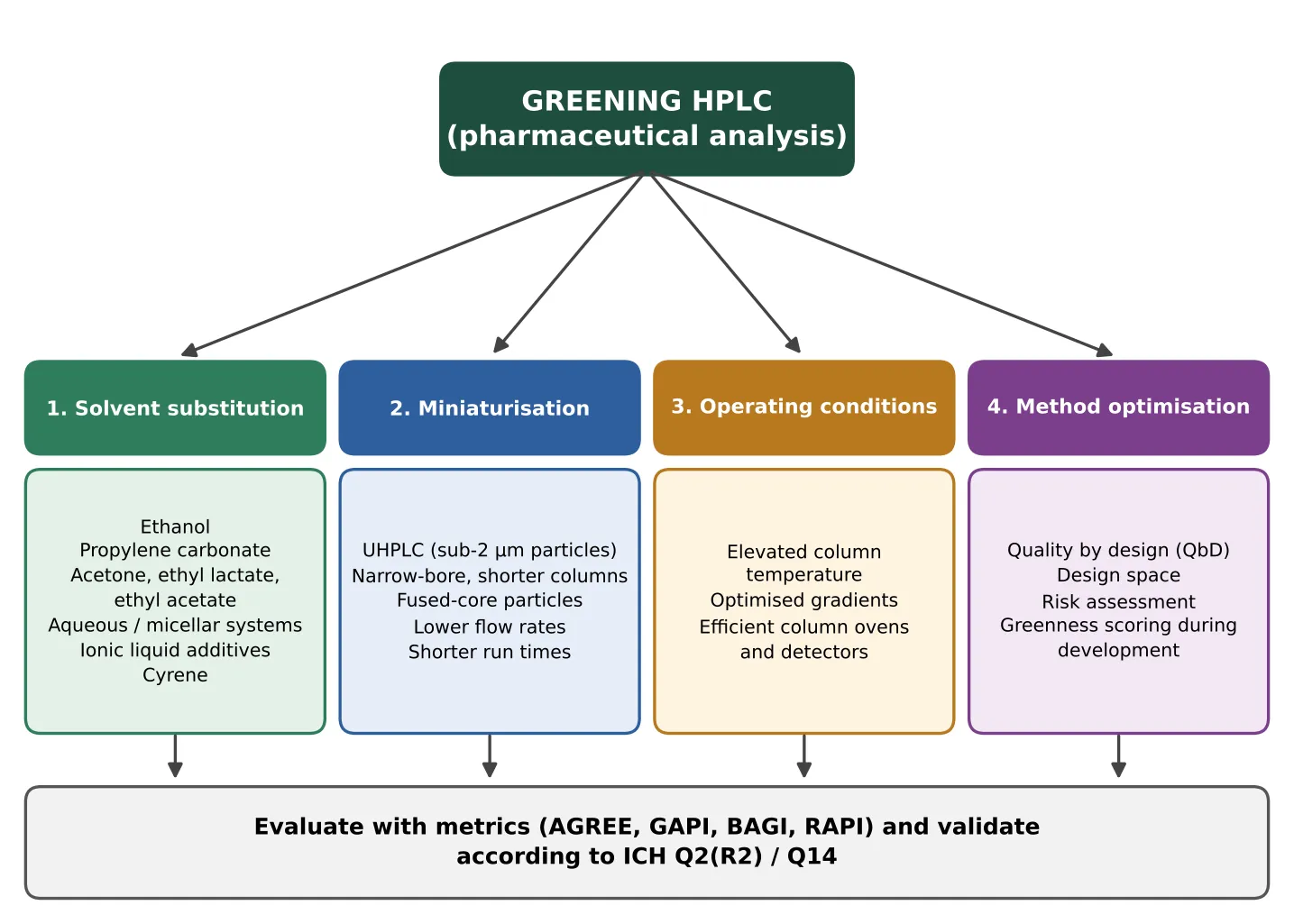
Figure 1: Main Strategies for Greening HPLC Methods in Pharmaceutical Analysis.
4.1 Solvent substitution
Reversed-phase methods commonly use acetonitrile and methanol, and replacing these with less hazardous alternatives is the most direct way to reduce environmental and health impact [3,19]. Guidance on how to select substitutes has been published, including solvent selection guidelines, hazard-based scoring systems, and an assessment of chromatographic suitability that can be used to decide whether a candidate solvent is practical [19].
Ethanol is the most frequently used alternative organic solvent in the pharmaceutical literature [3]. Its attraction lies in its lower hazard profile and its bio-based origin. Its main limitations are its higher viscosity in mixtures with water, which raises column backpressure, and its poorer transparency at low wavelengths compared with acetonitrile, which can restrict UV detection [3]. Propylene carbonate, acetone, ethyl lactate, and ethyl acetate have also been explored, each with its own balance of advantages and drawbacks [3]. Alternative solvents have also been investigated for preparative liquid chromatography, where solvent volumes are much larger [20]. A recent bio-derived option is Cyrene, which has been proposed as a more sustainable mobile phase constituent aligned with greener and whiter analytical chemistry [21]. Propylene carbonate has been applied in a stability study of ripretinib by RP-HPLC, with the method evaluated using advanced sustainability tools [22].
Beyond single-solvent replacement, three other approaches have been developed: totally aqueous mobile phases, micellar liquid chromatography, and the use of ionic liquids as mobile phase additives [3]. These approaches have been well developed, in part because they require no new equipment and are comparatively economical [3].
Table 2: Qualitative Comparison of Selected Mobile Phase Solvents and Approaches
| Solvent / approach | Main advantages | Main limitations |
|---|---|---|
| Acetonitrile, methanol (conventional) | Excellent chromatographic performance; widely established | Hazardous; contribute strongly to waste burden [3] |
| Ethanol | Lower hazard; bio-based; compatible with RP-HPLC | Higher viscosity (higher backpressure); limited low-UV transparency [3] |
| Propylene carbonate | Explored as a greener organic modifier [3,22] | Less widely adopted; limited method precedent |
| Acetone, ethyl lactate, ethyl acetate | Alternative organic solvents with different selectivity [3] | Detection and miscibility constraints |
| Aqueous / micellar systems | Little or no organic solvent; no new hardware [3] | Efficiency and selectivity trade-offs |
| Ionic liquids (additives) | Can improve peak shape and selectivity [3] | Cost and toxicity of some ionic liquids |
| Cyrene | Bio-derived alternative [21] | Limited application data so far |
4.2 Miniaturisation and UHPLC
Reducing the volume of mobile phase consumed attacks the problem from the opposite direction. Moving to columns with smaller particles and operating at higher pressures is the basis of UHPLC, which shortens analysis times and reduces solvent use [23]. A simple illustration shows the scale of the saving. A conventional method at 1 mL/min consumes about 1.4 L of mobile phase per day of continuous operation (1 mL/min × 1,440 min), consistent with the figure reported in the literature [3]. A narrow-bore UHPLC method at 0.3 mL/min consumes about 0.43 L per day under the same assumption, a reduction of roughly 70%, before even accounting for shorter run times. This calculation is illustrative only, and actual savings depend on the method.
The main barrier is cost, since an overall reduction in solvent use often implies buying UHPLC instruments or adopting new technology [3]. Alternatives that work on existing equipment include fused-core particles, which have been investigated as a substitute for fully porous sub-2 µm particles in pharmaceutical analysis [24], and broader trends in green liquid chromatography have been reviewed for pharmaceutically active compounds [25] and for pharmaceutical analysis more generally [5].
4.3 Operating conditions
Elevated column temperature changes mobile phase viscosity and retention behaviour, and has been combined with fused-core particles and coupled columns in pharmaceutical applications [24]. Shorter gradients, lower flow rates, and efficient use of column ovens reduce both solvent and energy consumption. These adjustments are typically low-cost, but they must be re-validated, since temperature and gradient changes can affect selectivity and robustness.
4.4 Systematic optimisation with quality by design
Quality-by-design (QbD) approaches can be integrated with GAC to improve method understanding while assuring quality and minimising environmental impact and analyst exposure [26]. In a published example, a UHPLC method for the main degradation products of dextromethorphan hydrobromide was developed using this combination, validated using the total error concept, and applied to a drug product [26]. The enhanced approach described in ICH Q14, built on knowledge and risk management and an analytical target profile, provides a regulatory framework in which such systematic development fits naturally [13]. Green method development has also been demonstrated for statin analysis [27]. For students, the lesson is that greenness is best built in during development rather than retrofitted afterwards.
4.5 Sample preparation
Because sample preparation often dominates the overall environmental footprint, it should be considered alongside the chromatographic step. The ten principles of green sample preparation offer a roadmap for choosing greener extraction and clean-up strategies [17]. In many pharmaceutical quality control methods, simple dissolution and dilution already satisfy the spirit of GAC principle 1 [2].
5. Greenness Assessment Tools
Claims of greenness need evidence. A range of metrics has been developed, each looking at the method from a different angle. Comparative reviews of green chemistry metrics and green analytical metrics describe their advantages and limitations [6,29].
5.1 Established tools
The National Environmental Methods Index (NEMI) is an early pictogram-based tool, and the Analytical Eco-Scale assigns penalty points to a procedure, with higher final scores indicating a more sustainable method [6,28]. The Eco-Scale is valued for simplicity and its semi-quantitative treatment of reagents and waste [10]. HPLC-EAT was designed specifically to profile the safety, health, and environmental impacts of liquid chromatography methods, making it directly relevant to this review [7].
5.2 GAPI, ComplexGAPI, and AGREE
GAPI uses a pictogram of five pentagrams coloured from green through yellow to red to show the impact of each stage of a method, from sample collection to final determination, and it clearly indicates the weakest points of a procedure [8]. ComplexGAPI adds fields for processes performed before the analytical procedure itself [10]. AGREE transforms each of the twelve GAC principles into a score on a 0-1 scale, allows weights to be assigned to the principles, and provides free software that produces a clock-like pictogram with an overall score [9]. For most students, AGREE is the easiest tool to apply and report.
5.3 White analytical chemistry and its companion indices
Because greenness alone cannot show whether a method is analytically sound or practical, WAC introduced the red-green-blue (RGB) model, in which a white method balances analytical performance, ecological aspects, and practicality [11]. Two companion tools have since been published. The Blue Applicability Grade Index (BAGI) evaluates practicality using ten attributes, including the type of analysis, number of analytes, sample throughput, reagents, instrumentation, and degree of automation, and it produces an asteroid pictogram with a score [30]. The Red Analytical Performance Index (RAPI) evaluates analytical performance against ten pre-defined criteria and gives a score between 0 and 100 [31].
Table 3: Comparison of Selected Assessment Tools
| Tool | Main focus | Output | Notes |
|---|---|---|---|
| NEMI | Hazard of chemicals and waste | Simple pictogram | Early, basic tool [6] |
| Analytical Eco-Scale | Penalty points for reagents, energy, waste | Score (higher = greener) | Simple, semi-quantitative [6,10,28] |
| HPLC-EAT | Safety, health and environmental impacts of LC methods | Profile / score | Designed for liquid chromatography [7] |
| GAPI | All stages, sample collection to determination | Five-pentagram colour pictogram | Shows weak points at a glance [8] |
| ComplexGAPI | GAPI plus pre-analytical processes | Extended pictogram | Covers upstream steps [10] |
| AGREE | The 12 GAC principles | 0-1 score with clock-style diagram; free software | Flexible weighting [9] |
| WAC (RGB model) | Green + analytical + practical balance | Colour-based "whiteness" | Combines three perspectives [11] |
| BAGI | Practicality | Asteroid pictogram and score | Blue criteria of WAC [30] |
| RAPI | Analytical performance | Score 0-100 | Red criteria of WAC [31] |
5.4 Using metrics responsibly
No single tool captures everything. Different tools weigh criteria differently, and the result depends on the inputs chosen by the evaluator [29]. Good practice is to report at least one green metric alongside the validation data, to state clearly the assumptions behind each score, and, where possible, to pair a green tool with BAGI and RAPI so that greenness is never presented without evidence of performance and practicality [11,30,31].
6. Green HPLC in Pharmaceutical Analysis
6.1 Published applications
The applications below illustrate how the strategies in Section 4 have been combined in practice. Table 4 summarises examples whose details were confirmed from the original records.
Table 4: Examples of Green Liquid Chromatographic Methods for Pharmaceutical Analytes
| Analyte / context | Greening strategy | Evaluation / validation | Ref. |
|---|---|---|---|
| Degradation products of dextromethorphan hydrobromide (drug product) | UHPLC combined with QbD and GAC | Total-error validation; applied to a drug product | [26] |
| Ripretinib (stability studies) | Propylene carbonate as RP-HPLC solvent | Evaluated with advanced sustainability tools | [22] |
| Pharmaceutical analytes (mobile phase study) | Cyrene as a bio-derived mobile phase constituent | Assessed within a greener and whiter framework | [21] |
| Statins | Green analytical method development | See original paper for details | [27] |
6.2 Cross-field relevance
Reviews in other application areas, such as food analysis, report the same hazards of acetonitrile and methanol and the same toolbox of eco-friendly solvents, miniaturised instrumentation, and greener sample preparation [32]. This suggests that lessons from pharmaceutical applications transfer readily, and it supports the case for treating green HPLC as a general laboratory practice rather than a niche topic.
6.3 Pharmacopoeial perspective
Pharmacopoeial methods are the backbone of quality control, and calls have been made for pharmacopoeias to implement newer, greener methods and modernise traditional liquid chromatographic procedures [19]. Until this happens at scale, individual laboratories can still apply greener conditions to in-house and non-compendial methods, subject to validation.
7. Regulatory and Validation Considerations
A greener method has value in a pharmaceutical setting only if it remains fit for its intended purpose. The revised ICH Q2 (R2) guideline on validation of analytical procedures and the new ICH Q14 guideline on analytical procedure development were adopted at Step 4 of the ICH process on 1 November 2023 [12,13]. Q2 (R2) is a complete revision aligned with Q14, and it broadens the scope to include modern techniques such as spectroscopic and multivariate procedures [12]. Q14 describes minimal and enhanced approaches to development, the analytical procedure lifecycle, the analytical target profile, and knowledge and risk management, and it aims to facilitate science- and risk-based post-approval change management [13]. The US FDA published final guidance on both documents in March 2024 [33].
For green HPLC, three practical consequences follow. First, validation is non-negotiable: switching to ethanol or to a UHPLC format means demonstrating accuracy, precision, specificity, linearity, and robustness for the new conditions, in line with Q2 (R2) [12]. Second, lifecycle thinking helps: the enhanced approach of Q14, with its emphasis on understanding and risk management, offers a natural structure for developing greener methods and for justifying later changes [13,26]. Third, greenness is currently voluntary: to the best of the author's knowledge, neither guideline sets environmental criteria for analytical procedures, so greenness evidence supports a method but does not replace regulatory requirements.
The red and blue criteria of the WAC model map conveniently onto this situation: validation parameters correspond to analytical performance, and practicality covers cost, time, and ease of use, so reporting RAPI and BAGI alongside a green score gives reviewers a fuller picture [11,30,31].
8. Critical Discussion, Challenges, and Future Perspectives
8.1 Critical discussion
Taken together, the literature shows that solvent substitution is the most accessible route to greener HPLC because it can be done on existing instruments [3], while miniaturisation delivers larger waste reductions but often requires capital investment [3]. Systematic development through QbD allows both to be pursued without sacrificing robustness [26]. The field's main weakness is not a lack of strategies but a lack of consistent evidence. Many protocols are described as green with little tangible support in the form of metric scores [10], and different metrics can weigh the same method differently [29]. A second weakness is the slow uptake of greener approaches in official methods [19].
8.2 Challenges
Chromatographic compatibility. Greener solvents can bring higher backpressure, limited UV transparency, or altered selectivity, so re-development and re-validation are usually needed [3]. Cost. UHPLC and other new technology involve capital investment that smaller laboratories may not afford [3]. Regulatory inertia. Pharmacopoeial and registered methods change slowly, which delays the adoption of greener alternatives [13,19]. Inconsistent reporting. Greenness scores are reported unevenly, and many claims lack quantitative support [10]. Missing dimensions. Energy consumption and carbon footprint are not always captured, and scientists have suggested including them among validation criteria for new methods [19].
8.3 Future perspectives
Several developments look promising. First, wider adoption of the full WAC toolkit, combining a green metric with BAGI and RAPI, would stop greenness from being reported in isolation [30,31]. Second, extending the field towards circular analytical chemistry, which has been framed as a set of twelve goals, would add resource recovery and reuse to the current focus on waste reduction [34]. Third, other separation techniques such as capillary electrophoresis and supercritical fluid chromatography are considered greener than liquid chromatography and may suit some applications [19]. Fourth, bio-derived solvents such as Cyrene deserve systematic evaluation across a wider range of pharmaceutical analytes [21]. Finally, education matters. Teaching students to build greenness into method development from the start, rather than retrofit it, is likely to be the most durable lever for change.
CONCLUSION
HPLC will remain indispensable in pharmaceutical analysis, so reducing its environmental footprint is both necessary and achievable. The most practical strategies are solvent substitution, miniaturisation, and systematic optimisation through quality-by-design, and the choice among them depends on available instruments and the requirements of the method. Greenness must be demonstrated, not merely claimed. Combining a green metric such as AGREE or GAPI with BAGI and RAPI, and validating methods according to ICH Q2 (R2) and Q14, gives the most credible evidence that a method is green, effective, and practical [11,12,13,30,31]. Continued work on solvent compatibility, cost, pharmacopoeial adoption, and consistent reporting will determine how quickly green HPLC becomes routine practice.
Declarations
Conflict of interest:
The author declare no conflict of interest associated with this manuscript Acknowledgements: The authors gratefully acknowledge Vijaya College of Pharmaceutical Science for Women, Vijayawada, Andhra Pradesh for providing the academic environment and resources that supported the preparation of this review article.
Data availability: No new data were generated. All data discussed are available in the cited publications.
REFERENCES

M. Neeharika, Green and Sustainable High-Performance Liquid Chromatography in Pharmaceutical Analysis: Principles, Greenness Assessment Tools, and Future Directions, Int. J. of Pharm. Sci., 2026, Vol 4, Issue 11, 5996-6006. https://doi.org/10.5281/zenodo.24645738
 10.5281/zenodo.24645738