

We use cookies to ensure our website works properly and to personalise your experience. Cookies policy
Womens College of Pharmacy, Peth Vadgaon, Maharashtra, India
Green synthesis of nanoparticles has become a sustainable, economical, and environmentally beneficial method in nanotechnology. Because plants contain a variety of phytochemicals, including flavonoids, alkaloids, terpenoids, phenolics, tannins, and proteins that function as stabilising and reducing agents, plant-mediated nanoparticle manufacturing has attracted a lot of attention. Green synthesis minimises toxicity, lowers environmental risks, and improves biocompatibility as compared to traditional physical and chemical techniques. Antimicrobial, antioxidant, anticancer, anti-inflammatory, wound healing, drug delivery, antiviral, and diagnostic applications are just a few of the amazing medicinal uses for nanoparticles made from plant extracts. The principles, methodologies, mechanisms, characterisation techniques, factors influencing synthesis, benefits, drawbacks, and medicinal uses of green synthesised nanoparticles utilising plant extracts are all covered in this review article. The essay also discusses new developments and prospects for green nanotechnology.
One of the scientific disciplines that is expanding the fastest is nanotechnology, which deals with the manipulation of materials at the nanoscale level, which is between 1 and 100 nm.(31) Because of their small size and high surface area to volume ratio, nanoparticles have special physical, chemical, optical, electrical, and biological capabilities. Nanoparticles are very helpful in pharmaceutical, biological, agricultural, cosmetic, dietary, and environmental applications because of these special qualities.
Conventional techniques for creating nanoparticles include chemical and physical processes. Chemical procedures use dangerous solvents and toxic reducing agents that may be harmful to the environment and biological systems, whereas physical methods sometimes call for high temperatures, pressures, and energy usage. As a result, scientists have concentrated on creating sustainable, affordable, and ecologically acceptable green synthesis techniques. Green synthesis is the process of creating nanoparticles using biological resources like fungi, algae, bacteria, and plant extracts. Because plant extracts contain naturally occurring phytochemicals that can reduce metal ions into nanoparticles, plant-mediated synthesis is thought to be quite beneficial among these.
Plant extracts are rich in bioactive compounds such as:
During the creation of nanoparticles, these phytochemicals serve as capping, stabilising, and reducing agents.
Safer nanoparticles with improved biocompatibility and decreased toxicity are produced by the green synthesis method, making them appropriate for use in pharmaceutical applications
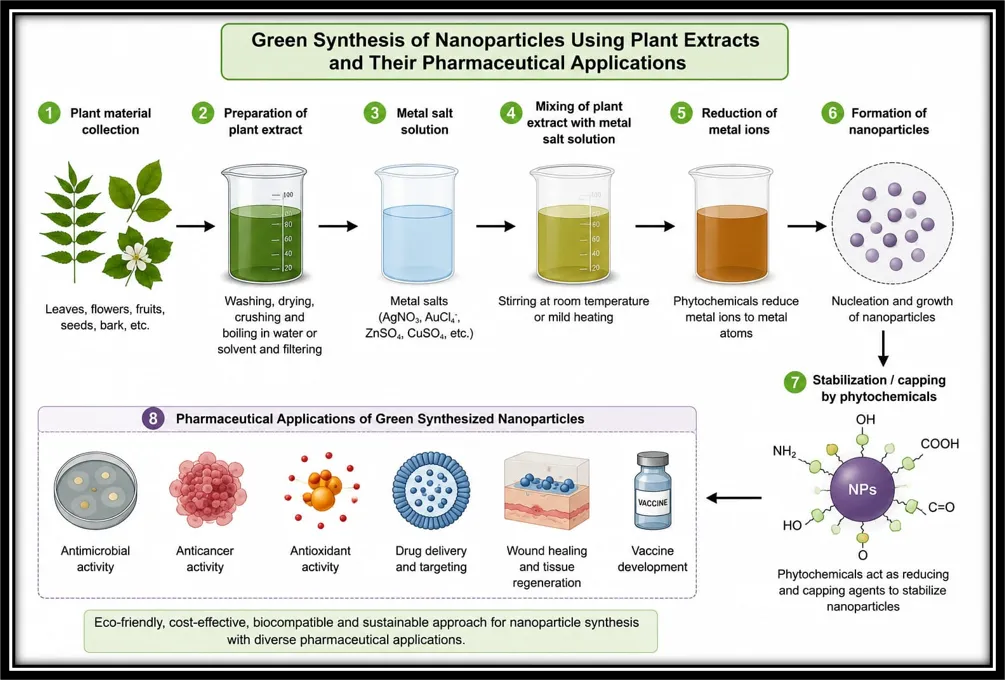
Figure 1: Overview of Green Synthesis of Nanoparticles
2. History and Development of Nanotechnology:-
In his 1959 speech "There's Plenty of Room at the Bottom," physicist Richard Feynman initially presented the idea of nanotechnology. Later, Norio Taniguchi came up with the name "nanotechnology" in 1974.
Table no 1 :- Important milestones in nanotechnology
|
Year |
Development |
|
1959 |
Richard Feynman introduced nanotechnology concepts |
|
1974 |
Norio Taniguchi coined the term nanotechnology |
|
1981 |
Development of scanning tunneling microscope |
|
1985 |
Discovery of fullerenes |
|
1991 |
Discovery of carbon nanotubes |
|
2000 onwards |
Rapid growth in nanoparticle synthesis and applications |
The development of nanotechnology has greatly benefited medicine, particularly in the areas of therapeutic systems, diagnostics, and targeted medication delivery.
NANOPARTICLES :-
Ultrafine particles with sizes ranging from 1 to 100 nm are called nanoparticles. Nanoparticles have better physicochemical characteristics and increased reactivity because of their nanoscale size.
Classification of Nanoparticles
A. Based on Composition
1. Metallic nanoparticles
2. Metal oxide nanoparticles
3. Polymeric nanoparticles
4. Lipid nanoparticles
5. Carbon-based nanoparticles
B. Based on Origin
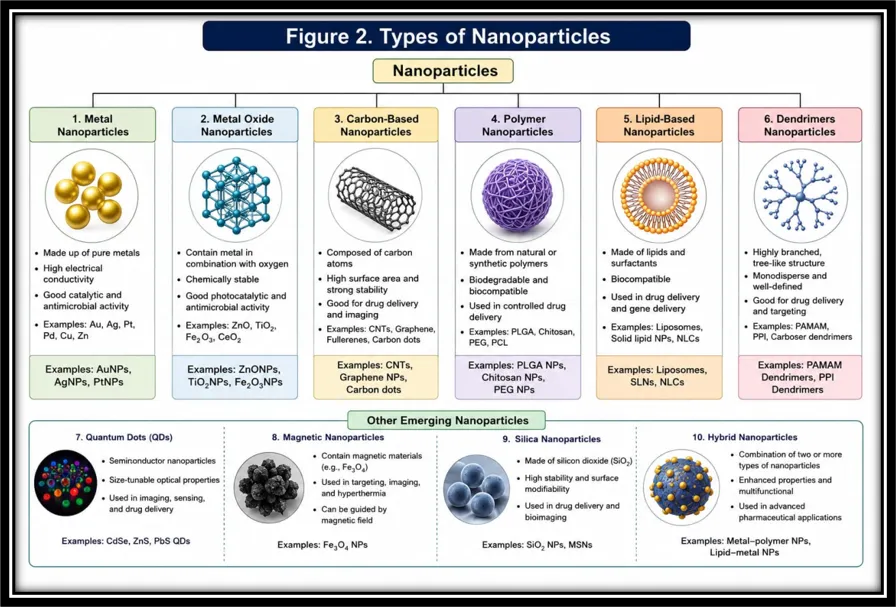
Fig 2 :-Types of Nanoparticles
4. Green Synthesis of Nanoparticles :-
Green synthesis is the use of biological systems to produce nanoparticles in an environmentally sustainable manner. It stays away from hazardous reagents and toxic compounds.
4.1 Principles of Green Synthesis :-
The principles of green synthesis include:
Biological Sources for Green Synthesis :-
Various biological systems are used for nanoparticle synthesis:
|
Biological Source |
Examples |
|
1.Plant |
Neem, Tulsi, Aloe vera |
|
2.Bacteria |
Bacillus species |
|
3.Fungi |
Aspergillus species |
|
4.Algae |
Marine algae |
|
5.Yeast |
Saccharomyces cerevisiae |
Plant-mediated synthesis is favoured among them due to its ease of usage, speed, and scalability.
5. Plant-Mediated Synthesis of Nanoparticles :-
Plant extracts are used in plant-mediated synthesis to reduce metal ions into nanoparticles.
5.1 Steps in Plant-Mediated Synthesis:-
1. Collection of plant material
2. Washing and drying
3. Preparation of plant extract
4. Filtration
5. Mixing with metal salt solution
6. Formation of nanoparticles
7. Purification and characterization
Flavonoids and phenolics are examples of phytochemicals that give electrons to metal ions, resulting in the production of nanoparticles.
6. Phytochemicals Involved in Nanoparticle Synthesis :-
Plant extracts contain a variety of phytochemicals that contribute to the creation of nanoparticles.
Phytochemical Role in Synthesis :-
|
Phytochemical |
Role in synthesis |
|
Reducing agents |
|
Stabilizing agents |
|
Capping agents |
|
Stabilization |
|
Reduction of metal ions |
|
Prevention of aggregation |
These substances aid in the creation of stable, biocompatible nanoparticles.
7. Common Plants Used for Green Synthesis :-
A number of therapeutic plants are frequently utilised in the production of nanoparticles.
|
Plant Name |
Nanoparticle synthesized |
Application |
|
1. Azadirachta indica (Neem) |
Silver nanoparticles |
Antimicrobial |
|
2. Aloe vera |
Gold nanoparticles |
Wound healing |
|
3. Ocimum sanctum (Tulsi) |
Silver nanoparticles |
Antioxidant |
|
4. Moringa oleifera |
Zinc oxide nanoparticles |
Anticancer |
|
5. Curcuma longa (Turmeric) |
Gold nanoparticles |
Anti-inflammatory
|
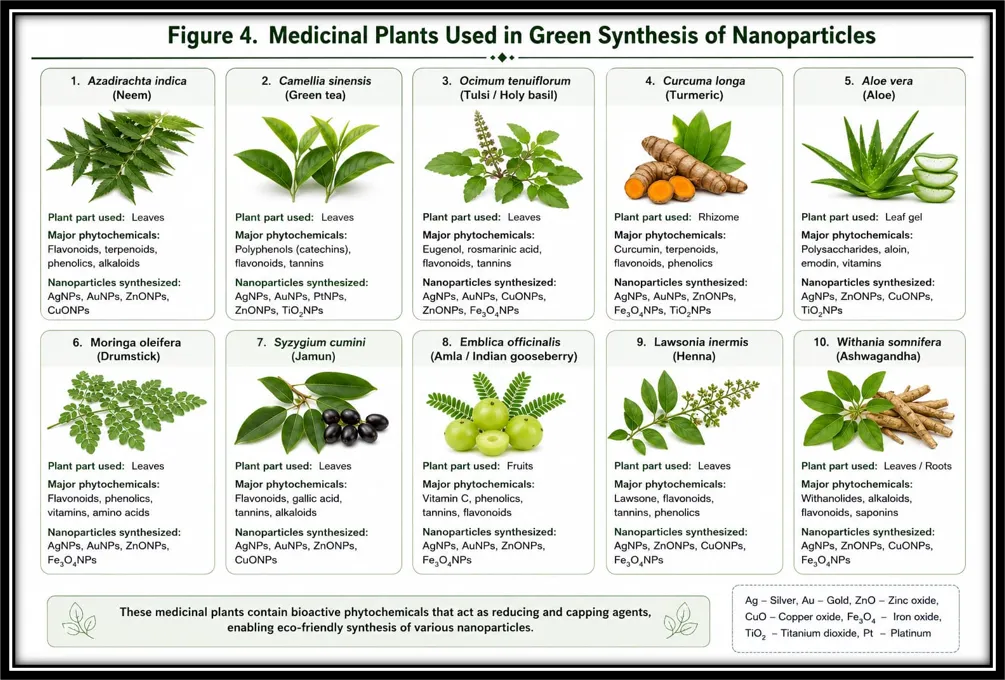
Fig no 4 Medicinal Plant used in green synthesis
8.Types of Green Synthesized Nanoparticles :-
8.1 Silver Nanoparticles (AgNPs) :- Due to their potent antibacterial qualities, silver nanoparticles are used extensively.
Properties
Applications
8.2 Gold Nanoparticles (AuNPs) :-
Gold nanoparticles have outstanding optical and biocompatibility qualities.
Applications
8.3 Zinc Oxide Nanoparticles (ZnO NPs)
ZnO nanoparticles have UV protection and antibacterial qualities.
Applications
8.4 Iron Oxide Nanoparticles
Iron oxide nanoparticles are mostly utilised in MRI imaging and targeted medication administration.
9. Characterization Techniques of Nanoparticles :-
Determining the size, shape, structure, and stability of particles requires characterization.
|
Technique |
Purpose |
|
1. UV-Visible Spectroscopy |
Confirmation of nanoparticle formation |
|
2. FTIR |
Identification of functional groups |
|
3. XRD |
Crystalline structure analysis |
|
4. SEM |
Surface morphology |
|
5. TEM |
Particle size and shape |
|
6. DLS |
Particle size distribution |
|
7. Zeta potential |
Stability analysis |
10. Advantages of Green Synthesis :-
Green synthesis offers several benefits compared to conventional methods.
Green Synthesis Advantages
11. Limitations of Green Synthesis (31) :-
12. Pharmaceutical Applications of Green Synthesized Nanoparticles
There are many uses for green synthesized nanoparticles in medicine.
Strong antibacterial action is demonstrated by nanoparticles against both Gram-positive and Gram-negative bacteria.
Mechanism :-
Commonly Used Nanoparticles
Applications
Green synthesized nanoparticles are being researched extensively for the treatment of cancer.
Mechanism
Advantages
3. Drug Delivery Systems
Nanoparticles improve drug delivery by enhancing solubility, bioavailability, and targeting efficiency.
Benefits
Examples
4. Antioxidant Activity
Plant-based nanoparticles exhibit excellent antioxidant activity due to phytochemical coating.
Mechanism
5. Anti-inflammatory Activity
Green synthesized nanoparticles reduce inflammation by inhibiting inflammatory mediators.
Applications
6. Antiviral Activity
Nanoparticles exhibit antiviral properties against various viruses.
Mechanism
7. Wound Healing Applications
Nanoparticles enhance wound healing by:
Silver nanoparticles are commonly incorporated into wound dressings.
13.Recent advancements include:
Artificial intelligence and machine learning are also being integrated into nanoparticle design and optimization.
14. Future Perspectives :-
Future research in green synthesis should focus on:
REFERENCES

Purva Miraje, Rajlaxmi Shinde, Priyanka Mohite, Green Synthesis of Nanoparticles Using Plant Extracts and Their Pharmaceutical Applications, Int. J. of Pharm. Sci., 2026, Vol 4, Issue 6, 71-80. https://doi.org/10.5281/zenodo.20483244
 10.5281/zenodo.20483244