

We use cookies to ensure our website works properly and to personalise your experience. Cookies policy
College of Pharmaceutical Sciences, Govt. Medical College Kannur, Pariyaram 670503
Vulvovaginal candidiasis (VVC) is one of the most common fungal infections affecting women globally, with Candida albicans serving as the primary causal organism. Azole antifungal medications are widely used, however they still present serious therapeutic problems due to rising drug resistance, side effects, and high recurrence rates, especially in recurrent vulvovaginal candidiasis (RVVC). Essential oils have attracted considerable attention as alternative antifungal agents due to their broad-spectrum activity, natural origin, and lower likelihood of inducing microbial resistance. However, their low bioavailability, volatility, instability, and poor water solubility frequently restrict their clinical use. By improving the solubility, stability, permeability, and controlled release of essential oils, nanoemulsion-based delivery methods have emerged as viable platforms to get beyond these constraints. The pathophysiology of VVC and RVVC, the antifungal potential of several essential oils against Candida species, and the basic elements and preparation methodologies of nanoemulsions—including high-energy and low-energy emulsification techniques—are all included in this review. Additionally, a summary of important physicochemical characterization techniques is provided, including particle size analysis, zeta potential measurement, transmission electron microscopy, conductance measurement, viscosity determination, and stability investigations. A comprehensive evaluation of recent developments in essential oil-loaded nanoemulsions for the treatment of vaginal candidiasis is presented, emphasizing their enhanced physicochemical performance and antifungal efficacy. Future ways to treating recurring infections are also investigated, such as individualized vaginal medicine and probiotic-integrated nanotherapeutics. All things considered, essential oil nanoemulsions offer a promising next-generation therapeutic strategy for vulvovaginal candidiasis, with the potential to enhance treatment results, lower recurrence, and address the growing challenge of antifungal resistance.
Up to 75% of women have at least one episode of VVC, which is mostly caused by Candida albicans, and many of them have repeated occurrences. Every year, almost 138 million women worldwide suffer from VVC.(1) Candida albicans is the primary cause of vulvovaginal candidiasis (VVC), a chronic and common multifactor an infectious condition. After bacterial vaginosis, it is one of the most common mucosal infections, accounting for 50–72% of cases. C. albicans develops in the vaginal mucosa under ideal circumstances, causing symptomatic VVC.The synthetic antifungal drugs that are now on the market have a number of drawbacks, including rapid development, a significant degree of resistance, systemic and local adverse effects, and high cost. According to recent research, C. albicans has acquired azole resistance as a result of a genetic alteration, increasing the likelihood of VVC recurrence. Antifungal drugs now on the market have limited the spectrum of Candida and are unsuccessful at reducing future recurrence rates.(2)
Natural products stand out in the quest for alternative therapies, particularly essential oils, which are thought to be promising antifungal agents. Essential oils, which come from the secondary metabolism of plants, have a number of medicinal uses.(3)In addition to being extremely volatile and having limited water solubility, essential oils are typically unstable in the presence of light, heat, oxygen, and humidity. In this instance, the nano essential oil formulations are seen to be an effective means to get over these stability-related restrictions, with the goals of higher therapeutic efficacy, safeguards against instability and decomposition, controlled release, increased bioavailability, and decreased toxicity.(3)
Essential oils can suppress or eradicate Candida albicans due to their antifungal characteristics. As a natural product, essential oil is one of the most promising antibiotic substitutes due to its safety, effectiveness, lack of residue, lack of resistance, good tolerance within the animal body, and fewer negative side effects. The antibacterial properties of essential oils, in contrast to some chemical treatments, are the product of several interrelated components. This intricate mix of components lowers the risk by making it more difficult for microorganisms to become resistant to essential oils.(4)Since essential oil faces limitations of solubility and stability , novel approaches are being investigated.
In recent years, there has been a notable surge in the discovery and application of alternative medicines, such as nano emulsions, which have gained popularity in the treatment of fungal infections, including VVC. Because of a number of benefits, including making lipophilic compounds more soluble, protecting against degradation and instability mechanisms, boosting the bioavailability of bioactive substances, promoting controlled delivery, lowering side effects, and improving therapeutic efficacy, nanoemulsions have been used extensively in therapy. Nano emulsions, which give superior drug solubilization for poorly water-soluble azoles, are thermodynamically or kinetically stable emulsions with droplet sizes in the 20–500 nm range. Increased cell wall penetration and better drug-membrane interaction are responsible for the improved antifungal activity. Because surfactant components have antibacterial capabilities, nano emulsions also have self-preserving qualities.(5)
Vulvovaginal candidiasis (VVC)
Candida albicans, an opportunistic fungal pathogen, is the primary cause of vulvovaginal candidiasis (VVC), a mucosal infection of the vulva and vaginal tissue of the lower female reproductive tract. Candida albicans accounts for more than 90% of VVC cases, with non-albicans Candida (NAC) species such Candida glabrata, Candida krusei, Candida tropicalis, and Candida parapsilosis accounting for the remaining 10%. VVC is a global health concern because to rising genital tract infections and their correlation with both direct and indirect economic implications. According to reports, this vaginal yeast infection affects 75% of women at least once in their lifetime .(6) The second most common underlying cause of vaginal inflammation, after anaerobic bacterial vaginosis, is candidiasis. It can cause symptoms like itching, irritation, dysuria, dyspareunia, cottage cheese-like vaginal discharges, or vulvar soreness that can last for days or even weeks and be made worse by sexual activity. Furthermore, compared to other mammals (pH of 5.4–7.8), the normal human vaginal microenvironment is more acidic (pH of 3.8–4.5), and Lactobacilli are the predominant organisms in the human vaginal microbiota—more than 70% of it in certain women. Direct microscopy from vaginal swabs or smears, which show yeast cells, pseudo hyphae, and hyphae, is used to diagnose VVC. Common symptoms of VVC include vulval oedema, erythema of the vaginal mucosa, an elevation in vaginal pH of roughly 4.5, and a thick white discharge. (7)
Recurrent VVC (RVVC)
If a woman has more than three episodes in a 12-month period, it is known as recurrent VVC (RVVC). C. albicans is the primary source of infections in women with RVVC. It has been determined that predisposing genetic variables or hypersensitivity to Candida make women with RVVC more vulnerable to this infection.(8)
Pathophysiology
C. albicans is a frequent vaginal colonizer that is found in the lumen and typically produces no symptoms as part of the normal human microbiota. When Candida spp. pierce the vaginal mucosal linings, an inflammatory reaction is triggered by its pseudo hyphae and hyphae, which activate the NLRP3 (NOD-like receptor protein 3) inflammasome in epithelial cells, resulting in vulvovaginal candidiasis. The inflammatory reaction results in a dense discharge, irritation, itching, burning, excoriations, dysuria, dyspareunia, and even edema. The main inflammatory cells are often polymorphonuclear cells and macrophages. Neutrophil infiltration caused by Candida albicans is known, however the underlying mechanism is yet unknown.(9)
Stages of Candida albicans Infection: From Mycobiome Dysbiosis to Symptomatic Disease
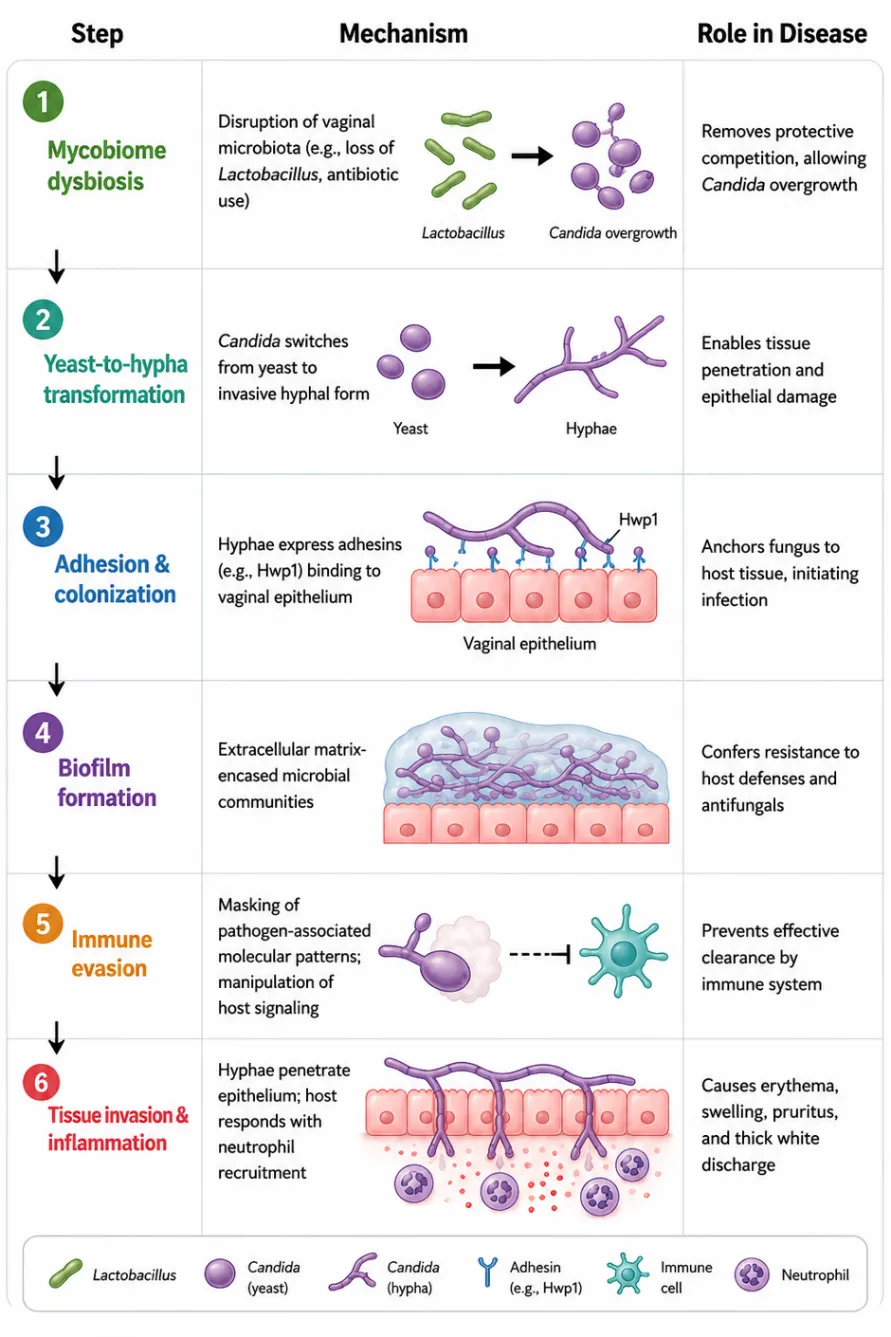
Figure 1. Schematic illustration of the stepwise pathogenesis of vulvovaginal candidiasis, highlighting mycobiome dysbiosis, yeast-to-hypha transition, adhesion, biofilm formation, immune evasion, and tissue invasion leading to inflammation and clinical symptoms.
Essential oils proven to be effective in vaginal candidiasis treatment
Essential oil is a secondary metabolite that is typically extracted by solvent extraction, distillation, or cold pressing from plant flowers, leaves, roots, fruits, or bark.(10) It has antibacterial qualities that can suppress or eliminate a variety of pathogens, including bacteria, fungus, and viruses .Different essential oils have varying levels of antibacterial effectiveness due to their distinct chemical compositions. Many volatile substances found in essential oils, including phenols, alcohols, esters, aldehydes, and ketones, have the ability to either suppress or completely eradicate microbes. Additionally, essential oil is one of the most promising antibiotic substitutes because it is a natural substance that is safe, effective, leaves no residue, has no resistance, is well tolerated by animals, and has few harmful side effects. The antibacterial properties of essential oils, in contrast to many chemical drugs, are the product of several interrelated components. This intricate mix of components lowers this risk by making it more difficult for microorganisms to become resistant to essential oils. C. albicans can be inhibited or killed by essential oils because to their antifungal qualities.(11)
Table 1. Essential oils proven effective against vaginal candidiasis, listing their active antifungal ingredients, targeted Candida species
|
Essential Oil |
Active Ingredients |
Candida Species Tested |
Reference |
|
Tea Tree Oil (Melaleuca alternifolia) |
terpinen-4-ol (42%), γ-terpinene (21%), α-terpinene (10%) |
C. albicans (including azole-resistant strains) |
(12) |
|
Clove Oil (Syzygium aromaticum) |
eugenol (major), β-caryophyllene |
C. albicans, C. neoformans, A. fumigatus |
(13,14) |
|
Oregano Oil (Origanum vulgare) |
carvacrol (9.44%), thymol (8.42%), γ-terpinene, limonene |
C. albicans (including non-albicans) |
(15) |
|
Thyme Oil (Thymus vulgaris, red thyme) |
thymol, carvacrol |
C. albicans (vaginal strains) |
(16) |
|
White Thyme Oil (Thymus blanizii) |
borneol (32%), α-terpineol (16%), carvacrol (9%) |
Drug-resistant vaginal Candida isolates |
(17) |
|
Cinnamon Oil (Cinnamomum verum) |
trans-cinnamaldehyde |
C. albicans |
(18) |
|
Lavender Oil (Lavandula angustifolia) |
linalool, linalyl acetate |
C. albicans |
(19,20) |
|
Coconut Oil |
caprylic acid, capric acid, fatty acids |
C. albicans |
(21) |
|
Garlic (Allium sativum) |
allicin, allyl sulfide compounds |
C. albicans |
(22) |
|
Peppermint Oil (Mentha piperita) |
monoterpenes |
C. albicans |
(23) |
|
Machilus cicatricosa S.K. Lee |
α-pinene, bicyclogermacrene, linalool and β-pinene |
Candida albicans |
(24) |
|
Zingiber densissimum rhizome essential oil |
β-pinene, β-phellandrene and α-pinene |
Candida albicans |
(25) |
|
Ocimum Basilicum L. Essential Oil |
linalool, eugenol, trans-a-bergamotene, a-guaiene |
Candida albicans |
(26) |
|
Origanum majorana L. Essential Oil |
carvacrol |
C. albicans, C. tropicalis, C. krusei, C. dubliniensis |
(27) |
Nano emulsion as a novel therapeutic approach
Unlike the milky-white colour associated with coarse dispersion, nanoemulsions, often referred to as nanometric size emulsions, are fine water-in-oil (w/o) and oil-in-water (o/w) dispersions of two immiscible fluids. By adding the proper amphiphilic emulsifiers or emulsifiers, these 20–200 nm droplets are stabilized. Thus, mini-emulsions are another name for nanoemulsions. Unlike microemulsions (ME), nanoemulsions (NE) are stable on heterogeneous systems because of kinetic stability. Nanoemulsions, also referred to as "potential thermodynamically stable" and distinguished by their prolonged physical constancy, do not seem to agglomerate or flocculate.(28)
Components of nano emulsion
a. Oil/Lipid
Nanoemulsions in oil-in-water (o/w) emulsions usually contain 5–20% oil/lipid globules, sometimes up to 70%. The formulation uses a variety of oils as sources of triglycerides, such as coconut, sesame, rice bran, safflower, soybean, and cottonseed oils. D-tocopherol, or vitamin E, frequently acts as a lipid carrier. Drug solubilization by the oil phase is essential for oral delivery, and medium and long-chain triglycerides are employed for emulsification. Furthermore, synthetic lipids such as triacetin and Caproyl 90 are frequently used in the creation of nanoemulsions.(29)
b. Surfactants
The choice of surfactant is critical for nanoemulsion formulation. Surfactants should have a strong ability to solubilize drugs and encourage oily phase nanoemulsion. It should be noted that the surfactants are not harmless.
Tween 20, for instance, exhibits strong virucidal action. A number of factors need to be considered when selecting a surfactant type and concentration. For example, phospholipids are better than synthetic surfactants whenever possible. Regardless of the kind, origin, or form of surfactant, the MiA minimum concentration of surfactant in nanoemulsion should be utilized. The choice of surfactant for the formulation would also depend on the type of nanoemulsion. For w/o nanoemulsion, sorbitan monoester, a low HLB surfactant, is preferred; for o/w nanoemulsion, polysorbate 20, a high HLB surfactant, is selected.
Sometimes lipophilic (low HLB) and hydrophilic (high HLB) surfactants must be combined to form a nanoemulsion. The most popular surfactants among those available are lecithin, poloxamer, and polysorbate 20.(30)
c. Co-surfactants
Since cosurfactants fit well between structurally weaker areas, they are added to surfactants to enhance the interfacial film. When a surfactant is unable to lower the interfacial tension between water and oil to create a stable NE, co-surfactants are used. By penetrating the surfactant monolayer, co-surfactant provides fluidity and disturbs the liquid crystalline phase. Some of co-surfactants used commonly , include Transcutol P ,Ethylene glycol ,Propylene glycol etc.(31)
d. Aqueous phase
The stability profile of a nanoemulsion formulation is determined by the oil phase's aqueous solubility, and choosing the right base would help prevent Ostwald ripening. Ostwald ripening is a typical drawback. For the formulation, the aqueous phase is also important. In the instance of topical Nanoemulsion, distilled water is used as
an aqueous phase-in case of parenteral. Additives like electrolytes (sodium chloride), glycerol, dextrose, and sorbitol can assist make the aqueous phase of a nanoemulsion iso-osmotic to the blood. The nanoemulsions' area of existence may be impacted by these additions. The non-ionic surfactant's phase inversion temperature (PIT) is lowered by electrolytes like sodium chloride. The behaviour of the nanoemulsion phase and its area of existence may also be impacted by additional aqueous phase additives, such as preservatives. It is known that surfactants like polysorbate can form complexes with preservatives like methyl and propyl paraben; these interactions could affect the characteristics of nanoemulsion.(30)
Pseudo ternary phase diagram
By creating pseudo ternary phase diagrams in the nanoemulsion system, the initial concentration of the elements is ascertained at room temperature using the water titration method. Phase diagrams are created using different emulsifier and coemulsifier weight ratios. To fully analyse the phase diagrams, these ratios are chosen with increasing concentrations of emulsifier relative to coemulsifier and coemulsifier relative to emulsifier. The ratios of oil to the mixture of emulsifier and coemulsifier are changed for every phase diagram for a particular weight ratio of emulsifier to coemulsifier. The oil, emulsifier, and coemulsifier mixes are moderately magnetically stirred as water is added drop by drop. Transparent nanoemulsions that flow easily are observed visually. The aqueous phase is represented by the first axis of an artificial ternary phase diagram, the oil phase by the second, and Smix (emulsifier: coemulsifier) at a preset weightiness ratio by the third,(29) as illustrated in Figure 2.
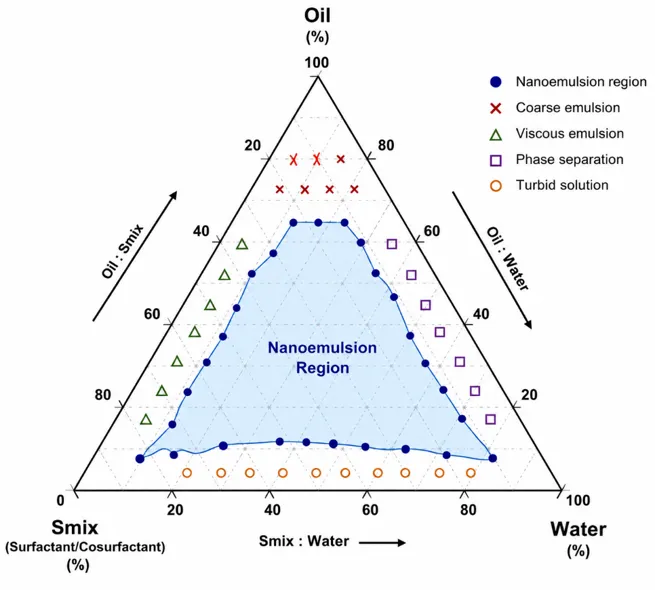
Figure 2. Constructed pseudo ternary phase diagram showing the nanoemulsion region and the influence of oil, Smix, and aqueous phase concentrations on nanoemulsion formation and stability.
Different approaches for Nanoemulsion preparation
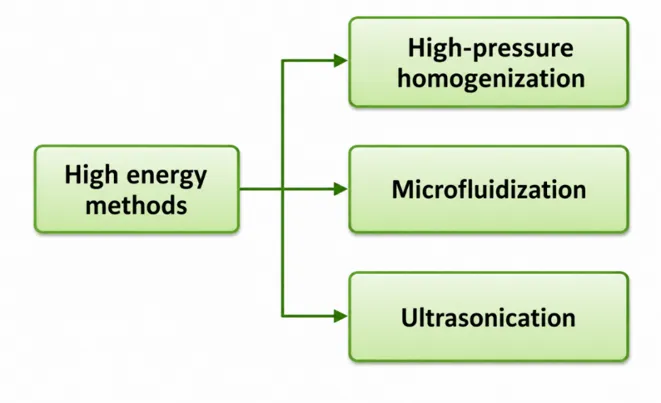
High Pressure Homogenization
This technique creates nanoemulsions with extremely small particle sizes (up to 1 nm) by using a high-pressure homogenizer or piston homogenizer. The product is subjected to severe pressure by forcing two liquids—the viscous phase and the aqueous phase—through a tiny input aperture at 500 to 5000 psi. Extremely tiny emulsion fragments result by hydraulic shear and turbulence. The liquid, lipophilic core of the generated particles is surrounded by a monomolecular layer of phospholipids, which separates them from the nearby aqueous phase. The only disadvantages of this approach, despite its high effectiveness, are the considerable energy consumption and temperature rise. (32)
Micro fluidization
The blending procedure known as micro-fluidization uses a device known as a micro-fluidizer. The instrument uses a positively distributed pump (500 to 20,000 pressure) to force the object into the interaction chamber. The microscopic channels that make up this are called "microchannels." The material passes through small openings and strikes a surface, creating submicron-sized particles. A coarse emulsion is produced by combining the aqueous and viscous phases and treating them in an internal homogenizer. A coarse emulsion is either treated to produce a permanent nanoemulsion in a micro-fluidizer. Until the required particle size is achieved, the coarse emulsion is repeatedly passed through the microfluidizer with interaction chamber.(32) Because micro fluidization operates at a constant shear rate, it is less likely to clog than high-pressure homogenization . Additionally, because of the predefined geometry, this method offers improved reproducibility.(33)
Ultrasonication
A special homogenization method used in many various fields is ultrasonication. Large particles are broken up into smaller fragments or, better yet, uniformly sized particles in the base fluid. By using sound energy to agitate the nanoparticles in the suspension, sonication of nanofluid is accomplished. Ultrasonication is a homogenization procedure that uses ultrasonic rates and frequencies higher than 20 kHz. Bath-type and probe-type sonicators are two types that are frequently used. High-intensity probe-type sonicators are shown to be more efficient than bath-type ones. Concentrations, viscosity (low viscous liquids), and the use of surfactants can all affect a nanofluid's stability; nevertheless, surfactants typically increase the viscosity of the nanofluid. Heat transmission in nanofluids will be enhanced by the ultrasonic effect. The increased efficiency of heat transfer will result in a decrease in the heat flow. The ultrasonic velocity steadily drops as the viscosity of the nanofluid grows with volume concentration.(34)
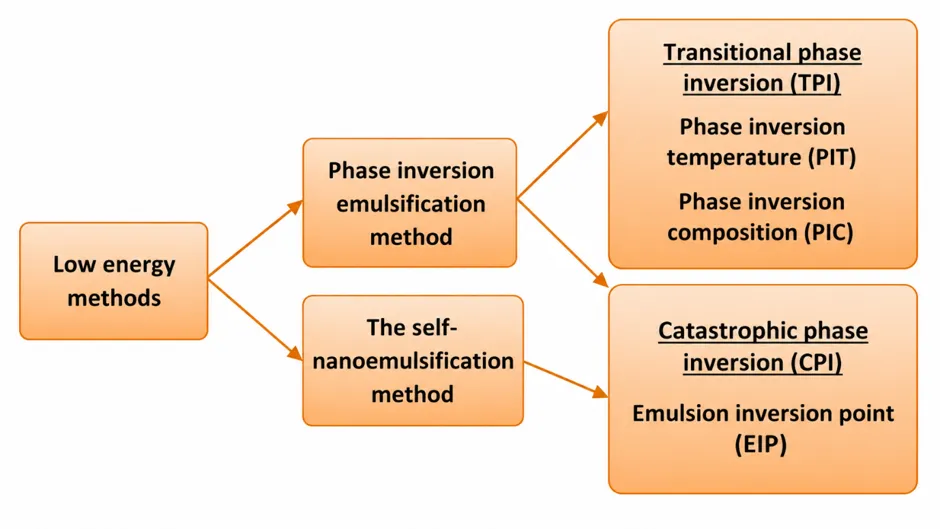
Phase Inversion Temperature (PIT)
The Phase Inversion Temperature (PIT) approach uses the temperature-dependent characteristics of non-ionic surfactants, particularly ethoxylated surfactants, to create nanoemulsions in a low-energy manner. The procedure entails heating and combining the aqueous and oil phases with a surfactant. The surfactant's hydration decreases with temperature, changing its attraction from water to oil. Equal affinity for both phases is attained at the PIT, reducing interfacial tension and allowing bicontinuous microemulsion structures to develop. At this stage, quick cooling enables the surfactant to become hydrophilic again, stabilizing tiny oil droplets in water and producing oil-in-water nanoemulsions. Because of its low energy requirements and capacity to create finely dispersed emulsions, this technology is preferred in the food, cosmetic, and pharmaceutical industries.(35,36)
Phase inversion composition (PIC)
Instead of using a lot of mechanical energy, the Phase Inversion Composition (PIC) approach is a low-energy way to create nanoemulsions by progressively altering the system's composition. Using this procedure, the aqueous phase is gradually added while being continuously stirred at a steady temperature after the oil phase containing the surfactant (and co-surfactant, if needed) has been produced. The surfactant molecules gradually hydrate as the water content rises, changing the interfacial curvature and guiding the system through a variety of intermediate forms such reverse micelles, lamellar liquid crystals, and bicontinuous microemulsions.(37) Phase inversion occurs when more water is added, causing the system to change from a water-in-oil (W/O) structure to an oil-in-water (O/W) structure. A nanoemulsion with droplet sizes usually in the nanometer range is produced during this transition because the interfacial tension becomes incredibly low, which permits the spontaneous creation of very small droplets. Because it is straightforward, energy-efficient, scalable, and able to create stable nanoemulsions with narrow droplet size distributions, the PIC method is widely utilized and especially well-suited for food, cosmetic, and pharmaceutical applications.(38)
Emulsion inversion point (EIP)
A catastrophic phase transition that happens when water (or an aqueous medium) is titrated into a mixture of oil and hydrophilic surfactant is the basis for the low energy EIP (emulsion inversion point) approach. The system's high oil phase: water phase ratio causes an unstable w/o emulsion to form at the onset of the titration procedure. The process known as catastrophic phase inversion (CPI) occurs when water is added to the oil and hydrophilic surfactant mixture, causing the system to go through various structures such bicontinuous phases, lamellar phases, and multiple emulsions. Usually, atypical emulsions—emulsions in which the surfactant has a greater affinity for the dispersed phase—are the starting point of such an emulsification process.(39) Strong mixing is necessary to keep these atypical emulsions stable due to their high instability, which intensifies until the emulsion inverts to the opposite type (e.g., w/o to o/w). The catastrophic phase inversion is caused by an increase in the droplet coalescence rate, which can be brought about by continuously stirring the emulsion or by increasing the volume of the dispersed phase (using the previously mentioned titration procedure). The flow rate of the aqueous phase over the oil phase, the type and concentration of surfactant, and the type and speed of stirring are therefore crucial factors in the EIP process. The hydrophilic surfactant's rate of diffusion from the oil to the aqueous phase is altered by the presence of cosolvents like glycerol.(40)
Self-nano emulsification method
The self-emulsification approach creates nanoemulsions without altering the surfactant's spontaneous curvature. Turbulence and nanoscale emulsion droplets are produced when surfactant and/or co-solvent molecules quickly migrate from the dispersed phase to the continuous phase. The spontaneous emulsification method is another name for the self-emulsification process. (13) Based on the self-emulsification phenomena, SNEDDS have a reduced lipid content and more hydrophilic surfactants or co-surfactants (co-solvents).
After being diluted in the gastrointestinal (GIT) aqueous fluid and slightly agitated by peristaltic movement, SNEDDS are defined as an isotropic or homogenous mixture of medication, solid or liquid surfactant, and cosurfactant that tends to form fine oil in water (o/w) emulsion formulation.(41) Diffusion of the hydrophilic co-solvent or co-surfactant from the organic phase into the aqueous phase and the formation of nanoemulsion negative free energy at transient negative or ultra-low interfacial tensions are the two most frequently reported mechanisms of nanoemulsion formation from SNEDDS. The most widely used and promising method for delivering hydrophobic medications with limited bioavailability is SNEDDS.(42)
NANOEMULSION FOR VAGINAL CANDIDIASIS TREATMENT
Nanoemulsions are some of the most effective method for improving the limitations of essential oil delivery and has been proven effective method as per literature. Some of them are given here.
Table 2: The table representing the different method of preparation of emulsion, formulation ingredients, particle size, polydispersity index (PDI), zeta potential, target Candida species of vaginal candidiasis.
|
Method of Preparation |
Ingredient |
Particle Size (Nm) |
Pdi |
Zeta Potential (Mv) |
Candida Species |
Reference |
|
Homogenisation method under high agitation |
5% essential oil (eucalyptus or lemongrass) |
60 - 90 nm |
< 0.3 |
- 9.09 ± 0.65 |
C. albicans |
(3) |
|
Magnetic stirring followed by high-pressure homogenization |
Pelargonium graveolens essential oil |
297 nm |
0.1-0.3 |
53.43 ± 3.85 |
C. albicans, C. glabrata, C. krusei, and C. parapsilosis |
(43) |
|
High-speed homogenization + sonication |
Clove oil, tea tree oil |
62.11 |
0.359 |
−40.35 |
Candida albicans |
(44) |
|
Spontaneous emulsification |
Geraniol |
232.3±122.5 |
0.155 |
−4.60 |
Candida albicans |
(45) |
|
Low-energy emulsification |
Gomortega keule, Essential Oil |
22.00 ± 7.3 |
0.484±0.19 |
−4.27 ± 0.3 |
Candida albicans, Candida tropicalis, Candida parapsilosis |
(46) |
|
Ultrasonication |
Tea Tree Oil |
161.8 ± 3.97 |
0.21 ± 0.01 |
−12.33±0.72 |
Candida albicans |
(47) |
|
Spontaneous emulsification |
Tea Tree Oil + Propolis |
10.90–20.64 |
0.17–0.24 |
−7.91 to −25.1 |
Candida albicans |
(48) |
Physical Characterization Techniques of nanoemulsions
The physical aspects of the nanoemulsion characterisation procedures involves the nanoemulsions' size, size distribution, zeta potential, refractive index, viscosity, conductance, stability, etc.
Transmission Electron Microscopy (TEM)
For the morphological analysis of nanoemulsions, Transmission Electron Microscopy (TEM) is frequently used because it allows for the direct imaging of droplet size, shape, and dispersion at the nanoscale. To achieve an appropriate concentration and avoid droplet aggregation, the nanoemulsion is usually diluted with distilled water for TEM investigation. A copper grid coated with carbon is covered with a little amount of the diluted sample, which is then left to adsorb for a brief amount of time. After carefully removing any excess liquid with filter paper, the sample is negatively stained with an electron-dense contrast agent, such as uranyl acetate or phosphotungstic acid, to make the droplets more visible.(49)
After staining, the grid is allowed to air dry at room temperature before being viewed using a transmission electron microscope running at the proper accelerating voltage, which is typically between 80 and 200 kV. Droplet shape, size distribution, structural integrity, and aggregation behaviour can all be evaluated using TEM images taken at different magnifications. For a thorough grasp of nanoemulsion properties, dynamic light scattering (DLS) data is frequently contrasted with the particle size determined from TEM micrographs. TEM is still one of the most dependable methods for verifying the nanoscale dimensions and homogeneity of nanoemulsion formulations because of its excellent resolution and imaging capability.(50)
Dynamic Light Scattering (DLS)
The size distribution profile of tiny particles in suspension or polymers in solution is frequently determined using DLS. DLS is also known as photon correlation spectroscopy or quasi-elastic light scattering since this method often uses the intensity or photon auto-correlation function to study the temporal variations. DLS analysis is now the fundamental but required method for determining the hydrodynamic size of nanoemulsion droplets. This is made possible by the one-step DLS size measurement procedure and accurate hydrodynamic size range estimation of nanoemulsion droplets.(51)
Zeta potential
Under particular experimental circumstances, the zeta potential of nanoemulsions can be calculated to assess changes in surface charge. In short, a suitable buffer solution is used to dilute the nanoemulsion formulation, which is then incubated under regulated circumstances, including physiological temperature and constant stirring. The formulation may be subjected to biological fluids, enzymes, or other pertinent agents, depending on the goal of the investigation, while a control sample is kept untreated. Aliquots are taken out and examined using a zeta potential analyser based on electrophoretic light scattering at prearranged intervals. According to the manufacturer's specifications, measurements are usually carried out using a laser source at a set wavelength and suitable scattering angles. In order to track changes in surface charge over time and gather data on nanoemulsion stability, surface modification, and interactions with the environment, the resulting zeta potential values are recorded.(52)
Refractive Index:
The reflectivity of a nanoemulsion is determined using an Abbes refractometer. The refraction describes both the transparency of a nanoemulsion and the way light travels through a substance. The ability to calculate the medium's refractive index is based on the speed of the wave in the reference media (c) in relation to the wave's phase speed in the medium (vp) (n), i.e., n=c/vp. The nanoemulsion is considered transparent if its refractive index is equal to that of water.(53)
Viscosity
A viscometer is a tool used to determine a fluid's viscosity. The rotating viscometer is the primary tool used to characterize nanoemulsions. The concept behind rotational viscometers is that the torque needed to rotate an object in a fluid depends on the fluid's viscosity. They calculate the torque needed to turn a bob or disk in a fluid at a predetermined speed.(51) Evaluation of viscosity is a crucial factor in the physicochemical description of nanoemulsion. The Ostwald viscometer, Hoeppler falling ball viscometer, Stormer viscometer, Brookfield viscometer, and Ferranti-Shirley viscometer are some of the tools used to measure viscosity. The Brookfield viscometer is the best option for determining the viscosity of a nanoemulsion. Viscosity measurements confirm whether the system is an O/W or W/O emulsion. Systems with low viscosity are O/W type, while those with high viscosity are water-in-oil type.(54)
Conductance Measurement
A common technique for describing nanoemulsions and identifying the type of continuous phase they include is conductance measurement. A conductivity meter is used to measure a nanoemulsion's electrical conductivity by submerging an appropriate conductivity probe in the formulation at a regulated temperature. Because water is a good electrical conductor, the presence of water as the exterior continuous phase in oil-in-water (o/w) nanoemulsions typically results in high conductivity values. Water-in-oil (w/o) nanoemulsions, on the other hand, exhibit extremely poor conductivity due to the oil phase surrounding the scattered water droplets, which restricts ion mobility. Therefore, conductance measurements are helpful in determining the type of emulsion, tracking phase inversion occurrences, and evaluating formulation stability. Furthermore, conductivity and dielectric investigations can offer important insights into the dynamic characteristics, droplet interactions, and structural organization of nanoemulsion systems.(55)
Stability studies
One crucial factor to take into account while evaluating nanoemulsions is the stability study. The exceptional stability of nanoemulsions sets them apart from other dispersed systems. Thermodynamic stability studies and accelerated stability studies are two of the many stability investigations carried out for nanoemulsions.
To evaluate the physical stability of the chosen formulation, various thermodynamic stability studies were conducted.(56) The procedure comprised three cycles: heating and cooling were done six times at first, then alternatively heated and cooled at 40°C and 4°C, respectively. Centrifugation was then done for 30 minutes at 3500 rpm. Phase separation-related changes in the formulation were monitored for each cycle.
Studies of accelerated stability were conducted on the optimized formulation. Three batches of the nanoemulsions were placed in glass vials and stored under ambient humidity conditions at temperatures of 30°C, 40°C, and 60°C.(57) In accordance with the usual process outlined in the International Conference on Harmonization (ICH) Q1 recommendations, the samples were taken out for drug content analysis. It was determined how much of the medication was broken down at each interval. The graphical method was used to determine the order of the reaction. For every temperature, the degradation rate constant (K) was calculated.(58)
Potential Paths for Future Treatment
New treatment options are critically required due to the increasing resistance to antifungal medications. As a result, many new research projects and preclinical trials have been carried out. The market has recently seen the launch of new antifungal medications.(9)
Probiotics
Probiotics are live, helpful bacteria that support the maintenance and restoration of a healthy vaginal microbiota. They are mostly Lactobacillus species. Probiotics are used in conjunction with antifungal medication to restore the Lactobacillus-dominant vaginal environment and lower recurrence rates in vulvovaginal candidiasis (VVC), especially recurrent vulvovaginal candidiasis (RVVC).(59)
Since certain probiotics contain Lactobacillus species that have an antagonistic effect on Candida-induced vulvovaginitis, probiotics are regarded as a natural way to prevent and cure vaginal infections. It is hardly surprising, that they have achieved tremendous achievements in their fight against VVC. Probiotics such Lactobacillus rhamnosus GR-1, Lactobacillus reuteri RC-14, or their combination have been demonstrated to significantly reduce fungal colonization in in-vitro settings. There were no adverse effects, a return to normal microflora from asymptomatic bacterial vaginosis, and a decrease in yeast in a trial comparing the effects of Lactobacillus fermentum RC-14 and Lactobacillus rhamnosus GR-1 versus a placebo. Azoles seem to be controversially replaced by probiotics.(9)
Probiotic-integrated nanotherapeutics
Combining probiotics with cutting-edge nanotechnology-based delivery methods is a promising future strategy for the treatment of vulvovaginal candidiasis. Wei et al. created a probiotic nanozyme hydrogel that combines catalytic nanozymes that can alter the vaginal microenvironment with the helpful bacterium Lactobacillus. This multipurpose platform was created to concurrently restore vaginal microbial equilibrium, control local pH, lower oxidative stress, and inhibit fungal development, in contrast to traditional antifungal treatments that mainly concentrate on getting rid of Candida species. The hydrogel improved therapeutic efficacy by offering a protective matrix for probiotic survival and extended retention in the vaginal cavity.
The study showed that in experimental models, the probiotic nanozyme hydrogel successfully prevented Candida albicans colonization, decreased inflammation, and encouraged the restoration of a healthy vaginal microbiota. Instead of just treating acute fungal overgrowth, this approach addressed the underlying reasons of recurrent infection by combining microbiome restoration with nanotechnology-enabled local delivery. The findings highlight the potential of probiotic-based nano formulations as next-generation therapeutics for recurrent vulvovaginal candidiasis, offering a personalized and microbiome-centered treatment approach with reduced risk of drug resistance and recurrence.(60)
Personalized medicine
The goal of personalized medicine is to tailor therapies to each patient's particular traits, including genetics and lifestyle. This entails tailoring medicine formulations and delivery methods for vaginal drug delivery based on variables such as vaginal pH and flora. Research indicates that hormonal treatments should be customized to maximize patient success and reduce side effects. Implants that are tailored to each patient's anatomy and hormone requirements can be made thanks to 3D printing technology. Regulations are changing to guarantee the effectiveness and safety of these customized devices, especially those made at the point of care. Personalized techniques could greatly improve the management of a variety of gynaecological disorders in women's healthcare, possibly leading to better results and lower costs.(61)
CONCLUSION
Due to its high prevalence, rising antifungal resistance, and frequent recurrence after conventional therapy, vulvovaginal candidiasis (VVC), especially recurrent vulvovaginal candidiasis (RVVC), continues to be a major global health concern. Due to their broad-spectrum efficacy against Candida species and reduced tendency to induce resistance, essential oils have become attractive natural antifungal agents. However, their direct medicinal application is limited by issues such chemical instability, volatility, and low water solubility. By boosting essential oils' solubility, stability, bioavailability, and controlled release while also strengthening their interaction with fungal cells and vaginal mucosa, nanoemulsion-based delivery methods provide a practical solution to these problems.
According to the reviewed studies, essential oil-loaded nanoemulsions had better therapeutic efficiency than traditional formulations, excellent physicochemical properties, and strong antifungal activity against a variety of Candida species. Stable and effective delivery platforms for vaginal administration have been made possible by developments in nanoemulsion preparation and characterization techniques. Additionally, new methods like personalized vaginal medicine and probiotic-integrated nanotherapeutics demonstrate a move toward microbiome-centered and patient-specific therapy techniques. When taken as a whole, these developments present nanoemulsion-based essential oil formulations as prospective next-generation therapeutic approaches for the efficient treatment of VVC and RVVC, necessitating more preclinical and clinical research to enable their transfer into clinical practice.
REFERENCES


Arsha P, Ann Rose Augusthy, Vipin K V, Adithya K P, Harnessing Nanotechnology and Natural Antifungals: Essential Oil Nanoemulsions for Improved Vaginal Candidiasis Therapy, Int. J. of Pharm. Sci., 2026, Vol 4, Issue 6, 7922-7940. https://doi.org/10.5281/zenodo.21101129
 10.5281/zenodo.21101129