

We use cookies to ensure our website works properly and to personalise your experience. Cookies policy
Department of Agadatantra, SNVVS’S SGV AMC Research Centre and Hospital Bailhongal..
Background: Food-borne illnesses remain a major global health problem. Ayurveda correlates many such conditions with Garavisha. Dhamargava 1,2(Luffa cylindrica) possesses Vishagna1,2and Krimighna1,2properties. Aim: To evaluate the in vitro antimicrobial activity of 1,2extracts against selected food-borne pathogens.Materials and Methods: Fruit and flower extracts were prepared using maceration and percolation. Powder microscopy, phytochemical screening and TLC were performed. Agar well diffusion was used against Escherichia coli, Clostridium botulinum and Clostridium perfringens. Results: Dharmargava flower maceration extract showed moderate inhibition against C. botulinum (9–11 mm). No significant inhibition was observed against E. coli or C. perfringens. Conclusion: Dhamargava exhibits selective antimicrobial activity and warrants further phytochemical and clinical evaluation
Food poisoning is an important public health issue caused by ingestion of food contaminated with pathogenic microorganisms, toxins or harmful chemicals. Common bacterial pathogens include Escherichia coli, Clostridium botulinum and Clostridium perfringens, which produce gastrointestinal illness and systemic complications. Increasing antimicrobial resistance has encouraged the search for plant-derived
antimicrobial agents.
Ayurveda correlates conditions resembling food poisoning with Garavisha, a slowly acting artificial poison formed by incompatible combinations or contaminated substances. Classical Ayurvedic texts recommended Vishagna1,2and Krimighna1,2 drugs for such conditions. Dhamargava (Luffa cylindrica), belonging to the family Cucurbitaceae, is described with Tikta rasa2, Laghu-Ruksha guna 2 Ushna virya2 and Katu vipaka2. It is indicated in Garavisha1,2 Gulma1,2, Udara1,2and other gastrointestinal disorders.
Previous phytochemical investigations have demonstrated alkaloids, saponins, flavonoids, phenolics, triterpenoids and phytosterols in Dhamargava4, suggesting antimicrobial potential. However, scientific evidence against food-borne pathogens remains limited. Therefore, this study evaluated the in vitro antimicrobial activity of Dhamargava extracts against selected organisms.
AIM AND OBJECTIVES
To evaluate the in vitro antimicrobial activity of Dhamargava 1,2(Luffa cylindrica)
against food poisoning-causing microorganisms; to prepare extracts; to perform phytochemical evaluation; and to statistically analyze antimicrobial activity.
MATERIALS AND METHODS
Study design: Experimental in vitro study.
Plant material: Fresh Dhamargava fruits and flowers were collected, authenticated, sliced, dried and powdered.
Extraction: Methanolic maceration and aqueous percolation techniques were employed. Extracts were concentrated on a hot water bath.
Pharmacognostical evaluation: Powder microscopy using iodine and safranin staining.
Phytochemical screening: Qualitative tests for alkaloids, carbohydrates, proteins, saponins, phenolics, tannins, phytosterols and triterpenoids. TLC fingerprinting was performed.
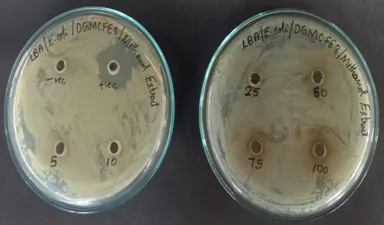
Antimicrobial assay: Agar well diffusion method against E. coli (MTCC 1586), C. botulinum (ATCC 19397) and C. perfringens (ATCC 13124). DMSO served as solvent and standard antibiotics as positive controls. Zones of inhibition were measured after incubation.
Statistical analysis: Descriptive statistics, Kruskal–Wallis ANOVA and Mann–Whitney U test; p<0.05 considered significant.
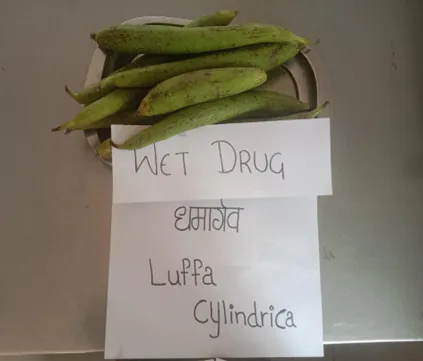
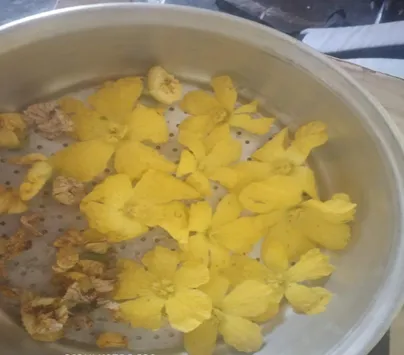
Dhamargava fruit Dhamargava flower
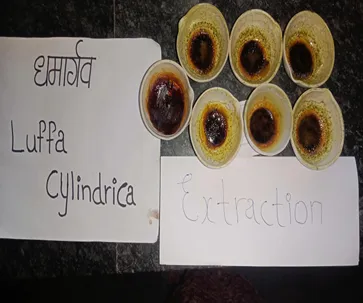
Extraction of Dhamargava
Microbial activity of Dhamargava
RESULTS
Dhamargava flower maceration extract demonstrated consistent inhibition (9–11 mm) against C. botulinum at higher concentrations. Dhamargava fruit oven dried percolation extract showed inhibition only at the highest concentration, while Dhamargava fruit sundried maceration extract showed no activity. None of the extracts inhibited E. coli or C. perfringens significantly. Statistical analysis revealed no significant differences among groups (p>0.05).
DISCUSSION
The observed selective inhibition against C. botulinum may be attributed to bioactive phytochemicals identified during preliminary screening. Lack of activity against E. coli may reflect the protective outer membrane of Gram-negative bacteria. Although statistical significance was not achieved, the biological activity supports the classical Ayurvedic indication of Dhamargava in Garavisha3. Larger studies using purified fractions, MIC determination and in vivo models are warranted.
CONCLUSION
Dhamargava (Luffa cylindrica) possesses selective in vitro antimicrobial activity against Clostridium botulinum and represents a promising herbal antimicrobial candidate. Future studies should isolate active constituents and validate efficacy through animal and clinical studies.
REFERENCES
https://share.google/JG5oXvvGcmXBrsXLx

Dr. Manjula Turamari, Pratibha Hunachikatti, In Vitro Antimicrobial Activity of Dhamargava1(Luffa cylindrica) Against Food Poison- causing microbes, Int. J. of Pharm. Sci., 2026, Vol 4, Issue 7, 1666-1668, https://doi.org/10.5281/zenodo.21264497
 10.5281/zenodo.21264497