View Article

Abstract

Metformin is a widely used in the oral antidiabetic drug belonging to the biguanide class and is primarily used in the management of type 2 diabetes mellitus. This review summarizes the chemistry and physicochemical properties of metformin, its mechanism of action, pharmacokinetic characteristics, and the importance of impurity profiling. Metformin has the molecular formula C?H??N? and a molecular weight of 129.16 g/mol. It is hydrophilic and freely soluble in water. Its glucose-lowering action is mainly associated with reduced hepatic glucose production and improved insulin sensitivity. Pharmacokinetically, metformin has limited plasma-protein binding, undergoes minimal hepatic metabolism, and is eliminated predominantly by the kidneys in unchanged form. Therefore, renal function is an important consideration during treatment. Impurity profiling is an essential part of pharmaceutical quality assessment because it supports the detection, identification, structural characterization, and quantification of impurities in an active pharmaceutical ingredient. Impurities may be classified as organic impurities, inorganic impurities, and residual solvents. Understanding these categories and applying appropriate analytical evaluation and relevant ICH guidance are important for assessing the quality and safety of metformin. Overall, this review brings together key information on metformin’s chemistry, pharmacological action, pharmacokinetics, and impurity profiling.

Keywords

Biguanides, Impurity Profiling, Mechanism of Action, Metformin, Pharmacokinetics, Physiochemical Properties, Residual Solvents, Type 2 Diabetes Mellitus

Introduction

× Popup Image

Diabetes mellitus (DM) is a metabolic disease characterized by high glucose levels in the bloodstream, a phenomenon known as hyperglycemia. It results from insufficient insulin secretion by the pancreas or from a reduced response of the body's cells to insulin; when blood sugar levels are elevated, polydipsia, polyphagia, and polyuria occur. [1]

Metformin is an antidiabetic medication used to lower blood sugar levels, primarily in patients with type type 2 diabetes. [2]

The drug lowers blood sugar levels by reducing hepatic glucose production and enhancing the body's responsiveness to insulin;[3] several studies indicate that it also exerts anti-inflammatory, anti-apoptotic, and antioxidant effects [6,7] .

The drug metformin came to the market in the United Kingdom in 1958 and in the United States in 1995. (3) Metformin is highly valued by the American Diabetes Association and the European Association for the Study of Diabetes and is recommended for use in T2DM patients. [4]

This paper endeavors to analyze the uses of metformin, its analysis techniques, and its impurities. In addition, the pharmaceutical significance of the drug and certain other issues will be examined.

1. Diabetes Mellitus Type 1

One thing that may sound surprising to the current generation of HCPs is that, until the publication of DCCT study in 1993 [8], there was no general opinion on the potential benefits of the intensive management of type 1 DM. In many countries, including Europe and the USA, endocrinologists did not see any benefit from intensive therapy and therefore did not try to do their best in managing their type I diabetic patients. It is worth noting that it is the Russian (Soviet) school of endocrinology that introduced the concept of diabetes control in type 1 diabetes patients.

2.Diabetes Mellitus Type 2

Diabetes type 2 mellitus is referred to as adult-onset diabetes. Insulin secretory defect in the presence of insulin resistance is a hallmark of this condition. Individuals with type 2 diabetes are usually resistant to insulin[9]. It is prevalent in about 5-7% of the world's population. Management of this disorder is normally done using dietary methods, exercises, and antidiabetic drugs[10]. It is the commonest form of diabetes mellitus and is highly correlated with a diabetic family history, aging, obesity, and sedentary lifestyle[11]

3. Gestational Diabetes Mellitus

Glucose intolerance which is newly developed or is developed in pregnancy is called as gestational diabetes mellitus (GDM) [12]. Women developing Type 1 diabetes mellitus during pregnancy and women having undiagnosed asymptomatic Type 2 diabetes mellitus during pregnancy are categorized under Gestational Diabetes Mellitus (GDM) [13]. Gestational Diabetes Mellitus (GDM) (diabetes detected in pregnancy but cannot be definitely classified over diabetes) [14]. Gestational diabetes mellitus (GDM) may develop during pregnancy and may disappear after childbirth; in long run, children born to mothers having GDM are more likely to become obese and type 2 diabetic patients due to intrauterine exposure to hyperglycemia.

Metformin

Metformin which belongs to biguanide family is considered to be the choice for treating DM2 in most cases due to its higher efficacy in managing this condition. [15] Metformin decreases blood glucose levels and increases insulin sensitivity. [16] As it is described in, intensification of therapy with metformin decreased the incidence of microvascular complications by 29% and combined diabetes complications by 32% in comparison with the intensification with insulin and by 25% with sulphonylureas, respectively. Intensive blood pressure management along with metformin in treating diabetes was associated with significant decrease in cardiovascular events and death rate in comparison with conventional therapy. [17] Furthermore, metformin does not lead to hypoglycemia and weight gain. According to Salpeter [18] et al, metformin is a safe drug for the long-term treatment in terms of the doses and clinical situations which were contraindicated before because of the danger of lactic acidosis.
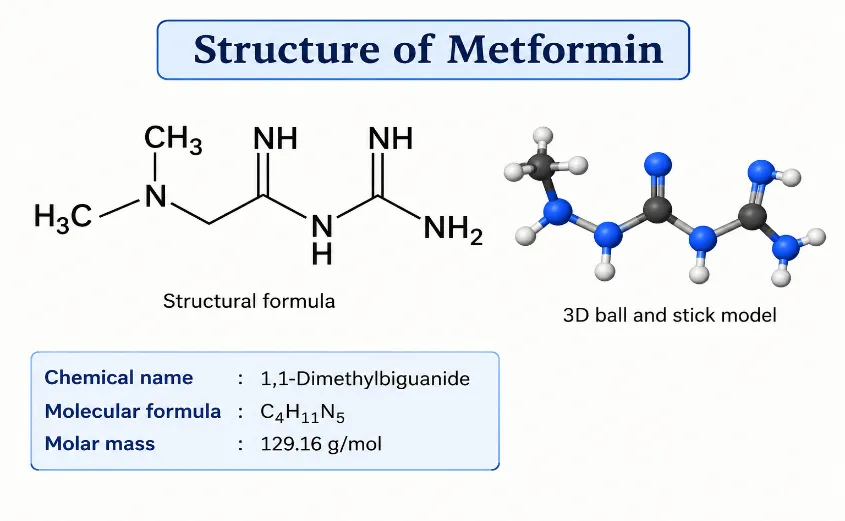
figure

Figure 1: Chemical Stracture of Metformin

[19]

Chemical Information of Metformin :

  • Chemical Name : 1,1-Dimethylbiguanide
  • Molecular Formula : C₄H₁₁N₅
  • Molecular Weight : 129.16 g/mol
  • Drug Class : Biguanide
  • IUPAC Name : 1- carbamimidamido- N, N- dimethylmethanimidamide

Physiochemical Properties :

Solubility 1. Freely soluble in water
2. Slightly soluble in alcohol
3. Practically insoluble in acetone and in dichloromethane.
Stability Protect from light and moisture
Hydrophilicity Hydrophilic
LogP -o.5
pKa 12.4
Physical state Solid
Melting point 223 – 226 ̊C
UV max 233 nm in water
Storage Store between 15 – 30 ̊C ( 59 – 86 ̊ F ).
Dispense in light resistant container .
Other information Hygroscopic nature

[20]

Mechanism of Action

Metformin, as a biguanide derivative, metformin lowers the liver's glucose production, decreases glucose uptake from the intestine, and enhances cellular sensitivity to insulin. It lowers blood glucose levels in both the fasting and postprandial states. Metformin works by decreasing the levels of insulin, luteinizing hormone, and androgens, which helps to regulate ovarian function and menstrual cycles in patients suffering from polycystic ovary syndrome (PCOS). When metformin is prescribed for PCOS, physicians should inform women of childbearing age about the possibility of pregnancy . [21]

For gestational diabetes, metformin is considered an acceptable alternative to insulin. Gestational diabetes demands careful management, since maternal hyperglycemia can impact fetal development and contribute to birth defects. In addition, under the old Food and Drug Administration (FDA) system, metformin was previously classified as a category B drug during pregnancy. This medication is able to cross the placenta and pass into breast milk . Importantly, metformin is considered neutral with respect to body weight, and it may even help a woman to lose weight. Metformin is usually associated with a small chance of hypoglycemia, and it may reduce the chances of developing cardiovascular diseases and improve the quality of life of a patient [22]. The action of the drug usually begins 3 hours after taking the medication, and its action may last up to 20 hours. Metformin undergoes only minimal liver metabolism, and its protein binding rate is also very low. The drug is eliminated mainly through the kidneys without any changes in structure.[23]

Pharmacokinetics

  • Absorption: For healthy volunteers administered the 500 mg metformin hydrochloride tablet under fasting conditions, absolute absorption was found to be 50 to 60 %.
  • Food effect: Compared with fasting administration, taking the drug with food lowers Cmax by 40% and AUC by 25%, and lengthens Tmax by 35 minutes.
  • The volume of distribution of the metformin hydrochloride tablet of 850 mg is 654 ± 358 L.
  • Plasma protein binding: Metformin hydrochloride is less than 2% in protein-bound.
  • Steady-state plasma concentration: This is achieved within 24 – 48 hours.
  • Elimination: Metformin is excreted by the kidney and mainly remains unaltered. There is no significant hepatic or biliary metabolism of metformin.
  • Elimination half-life: it is around 6.2 hours.

Classification of Impurities

The impurities found in a new drug substance can be grouped into two aspects: chemistry and safety. Under the chemistry aspect, impurities are identified and classified, and analytical methods are developed to establish their specifications. The safety aspect addresses the qualification of impurities that were not assessed during clinical trials, and their threshold limits are established. Under the ICH guidelines, the impurities are classified as Organic, Inorganic, and Solvent. This ICH guidance categorizes impurities into three classes: Organic, Inorganic and Solvent. For each impurity in a new drug, every class and aspect should be clearly reported [24].

  • In accordance with ICH Q3A (R2) guidelines,impurities are classified as [25]

1.Organic impurities could be either identified or unidentified as well as volatile or nonvolatile. Organic impurities could have been formed during the manufacturing process or in the storing process of new drug substances.

Starting materials

Byproducts

Intermediates

Degradation products

Reagents, ligands and catalysts

2. Inorganic impurities could be formed during the manufacturing process. Inorganic impurities could be either identified and known,

Reagents, ligands and catalysts

Heavy metals and other residual solvents

Inorganic salts

Other substances such as filter aid and charcoal

3.The Residual Solvents are the volatile organic compound which are either used in the manufacturing process of formed during synthesis . These are classified into three groups whose levels in pharmaceutical products are defined by ICH guidelines Q3C . The first group of solvents such as benzene, carbon tetrachloride , 1,1- dichloroethane , 1,2- dichloroethylene and 1,1,1 trichloroethane should be avoided. The second group of solvents such as methanol, toluene , pyridine, N,N- dimethylformamide and acetonitrile have Permitted Daily Exposure (PDEs) . The third group of solvents such as acetone, isopropyl alcohol , butanol , ethanol and ethyl acetate should be controlled through Good Manufacturing Practices (GMP) [26].

Impurity Profiling

Impurity profiling is the general term for analytical activities aimed at detecting, identifying, elucidating the structure of, and quantitatively determining organic and inorganic impurities, as well as residual solvents, in bulk drugs and pharmaceutical formulations. Across all phases of development, production, and stability testing of a drug product, the impurity profiling of an API is a critical quality control variable. It should include the details of impurities in both qualitative and quantitative form. It describes the approach to investigating impurities associated with an API. Impurity profiling is the general term for analytical activities aimed at detecting, identifying, elucidating the structure of, and quantitatively determining organic and inorganic impurities, as well as residual solvents, in bulk drugs and pharmaceutical formulations. Across all phases of development, production, and stability testing of a drug product, the impurity profiling of an API is a critical quality control variable. It should include the details of impurities in both qualitative and quantitative form. It describes the approach to investigating impurities associated with an API. [27,28]

CONCLUSION

Metformin is an important biguanide antidiabetic drug. They used mainly in the management of type 2 diabetes mellitus. Its glucose-lowering effect is primarily related to suppression of hepatic glucose production and improvement of insulin sensitivity. The physicochemical and pharmacokinetic characteristics discussed in this review—including its hydrophilic nature, low plasma-protein binding, minimal hepatic metabolism, and renal elimination—help explain important aspects of its pharmaceutical use and the need to monitor kidney function in appropriate patients.

Impurity profiling is also a critical element of the quality evaluation of metformin as an active pharmaceutical ingredient. This review will provide a classification of impurities in terms of three main groups: organic, inorganic, and residual solvents. Identifying and assessing these impurities using suitable analytical approaches and applicable ICH guidance can support consistent pharmaceutical quality and patient safety.

In conclusion, knowledge of metformin’s chemistry, pharmacology, pharmacokinetics, and impurity profile provides a useful foundation for understanding the drug and its quality requirements. Further work should include validated, stability-indicating analytical methods and appropriate experimental data to identify and quantify specific metformin-related impurities. Such results should be reported only when supported by experimental evidence or reliable published sources.

REFERENCES

  1. Scheen A.I, Paquot N. Metformin revisited : A critical review of the benefit – risk balance in at – risk patients with type 2 diabetes Metab. 2013 ; 39 ; 179 – 90. Doi : 10. 1016 / j . diabet . 2013 . 02 . 006.
  2. Kirpichnikov D. Mcfarlane S I, Sowors IR . Metformin : An update . Ann Intern Med. 2002 ; 137 : 25 – 33. Doi : 10. 7326 / 0003 – 4819 – 1347 – 200207020 – 00009 .
  3. Scarpello JHHowlettHCMetformin therapy and clinical uses Diab Vasc Dis Re6200853157 16718777488 .
  4. Inzucchi SEBergenstalRMBuseJBManagement of hyperglycaemia in type 2 diabetes : a patient- centered approach . Position statement of the American Diabetes Association (ADA) and the European Association for the study of Diabetes (EASD) Diabetologia 20125561577 159622526604 .
  5. GrzybowskaMBober JOIszewskammetfor min – mechanism of action and use for the treatment of type 2 diabetes mellitusPostepy Hig Med Dosw (online) 201165 277 285 216 .
  6. Nath N, Khan M, Paintlia Mk, Hoda MN, Giri S. Metformin attenuated the autoimmune diseases of the Central nervous System in animal models of multiple Selerosis. J Jmmunol . 2009 ; 15 ; 182 : 8005 . 14 . doi : 10 . 4049 / jimmunol . 0803563 .
  7. Alzoubi H, Khabour F . I Al. azzams , H Tashtoush M , M Mhaidat N. Metformin eased Cognitive impairment induced by chronic L – methionine administration : potential role of oxidative stress . (arr Neuropharmacol . 2014 ; 12 : 186 – 92 . doi : 10 . 21741 1570 159 X 11 – 666131120223201 .
  8. The effect of intensive treatment of diabetes on the development and progression of long – term complications in insulin – development diabetes mellitus. The Diabetes Control and Complications Trial Research Group. NEngl J Med. 1993;329 (14):977-86. Dol: 10. 1056/ NEJM 199309303291401.
  9. Singh N, Kesherwani R, Kumar A. and Dilip D.K., ̏ A review on diabetes mellitus ˝ , The Pharma Innovation journal 2016;5 (7): 36-40.
  10. Bastaki S., ̏ Diabetes mellitus and its treatment ˝ , International journal of Diabetes and Metabolism 2005; 13: 111-134.
  11. Baynest H.W., ̏ Classification, pathophysiology, diagnosis and management of diabetes mellitus ˝. Journal of Diabetes and Metabolism 2015; 6:5.
  12. Ross and Wilson. Anatomy and Pathophysiology in Health and I llness, Churchill Livingstone Elsevier, 11th edition,2010,227-229.
  13. Harris MI. Undiagnosed NIDDM, clinical and public health issues, Diabetes Care. 1993; 16:642-52.
  14. Jun SK Yoon YW. A new look at viruses inType 1 diabetes , Diabetes/Metabolism Research and Reviews. 2002; 19:8-31.
  15. Municipal Health Secretariat Belo Horizonte. Scientific Committee on Drug Use Studies : Therapeutic Information Bulletin . Treatment of type 2 diabetes mellitus at outpatient level. Belo horizonte, 2001, 920, 1-17 .
  16. Pernicova, I.; Korbonits M. Metformin-Mode of Action and Clinical Implications for Diabetes and Cancer . Nature Rev. Endocrinology 2014, 10, 143 – 156 .
  17. U.K. Prospective Diabetes Study (UKPDS) Group. Effect of Intensive Blood Glucose Control with Metformin on Complications in Over weight Patients with Type 2 diabetes (UKPDS 34) . The Lancet 1998 , 352, 854 – 865.
  18. Salpeter, S. R.; Greyber, E.; Pasternak, G. A.; Salpeter, E. E. Risk of Fatal and Nonfatal Lactic Acidosis with Metformin use in Type 2 Diabetes Mellitus. The Cochrane Database Systematic Rev. 2010, 4, 1-34.
  19. National Center for Biotechnology Information. PubChem Compound Summary for CID 4091, Metformin [Internet]. Bethesda (MD): National Library of Medicine . 20 http://www.drugs.com/international/metformin.html
  20. 12. Wang YW, He SJ, Feng X, Cheng J, Luo YT, Tian L, Huang Q. Metformin: a review of its potential indications. Drug Des Devel Ther. 2017;11:2421-2429. [PMC free article] [PubMed]
  21. Foretz M, Guigas B, Bertrand L, Pollak M, Viollet B. Metformin: from mechanisms of action to therapies. Cell Metab. 2014 Dec 02;20 (6):953-66. [PubMed]
  22. Mahesh Mukund Deshpande (September 14th 2020). Analytical, bioanalytical, stability indicating methods: Key part of regulatory submissions [Online First], IntechOpen, DOI: 10.5772/intechopen.93566. 24 Available:https://www.intechopen.com/online-first/analytical-bioanalytical-stability-indicating-methods-key-part-of-regulatory-submissions
  23. ICH, Impurities in new drug substances Q3A (R2). In: International Conference on Harmonization. IFPMA. Geneva (Switzerland); 2006
  24. ICH, Impurities: Guideline for Residual Solvents Q3C (R6), in: International Conference on Harmonization, IFPMA, Geneva (Switzerland); 2016.
  25. Salunkhe MN, Gite SD, Kachave RN. Recent trends in impurity profiling and forced degradation of antihypertensive drugs . J Liq Chromatoger Relat Technol . 2017 ; 40 (16) : 813 – 31 .
  26. Ramachandar B. Development of impurity profiling method using modern analytical techniques. Critical Reviews in Analytical Chemistry . 2017 ; 47 : 24 – 36 .

Reference

  1. Scheen A.I, Paquot N. Metformin revisited : A critical review of the benefit – risk balance in at – risk patients with type 2 diabetes Metab. 2013 ; 39 ; 179 – 90. Doi : 10. 1016 / j . diabet . 2013 . 02 . 006.
  2. Kirpichnikov D. Mcfarlane S I, Sowors IR . Metformin : An update . Ann Intern Med. 2002 ; 137 : 25 – 33. Doi : 10. 7326 / 0003 – 4819 – 1347 – 200207020 – 00009 .
  3. Scarpello JHHowlettHCMetformin therapy and clinical uses Diab Vasc Dis Re6200853157 16718777488 .
  4. Inzucchi SEBergenstalRMBuseJBManagement of hyperglycaemia in type 2 diabetes : a patient- centered approach . Position statement of the American Diabetes Association (ADA) and the European Association for the study of Diabetes (EASD) Diabetologia 20125561577 159622526604 .
  5. GrzybowskaMBober JOIszewskammetfor min – mechanism of action and use for the treatment of type 2 diabetes mellitusPostepy Hig Med Dosw (online) 201165 277 285 216 .
  6. Nath N, Khan M, Paintlia Mk, Hoda MN, Giri S. Metformin attenuated the autoimmune diseases of the Central nervous System in animal models of multiple Selerosis. J Jmmunol . 2009 ; 15 ; 182 : 8005 . 14 . doi : 10 . 4049 / jimmunol . 0803563 .
  7. Alzoubi H, Khabour F . I Al. azzams , H Tashtoush M , M Mhaidat N. Metformin eased Cognitive impairment induced by chronic L – methionine administration : potential role of oxidative stress . (arr Neuropharmacol . 2014 ; 12 : 186 – 92 . doi : 10 . 21741 1570 159 X 11 – 666131120223201 .
  8. The effect of intensive treatment of diabetes on the development and progression of long – term complications in insulin – development diabetes mellitus. The Diabetes Control and Complications Trial Research Group. NEngl J Med. 1993;329 (14):977-86. Dol: 10. 1056/ NEJM 199309303291401.
  9. Singh N, Kesherwani R, Kumar A. and Dilip D.K., ? A review on diabetes mellitus ? , The Pharma Innovation journal 2016;5 (7): 36-40.
  10. Bastaki S., ? Diabetes mellitus and its treatment ? , International journal of Diabetes and Metabolism 2005; 13: 111-134.
  11. Baynest H.W., ? Classification, pathophysiology, diagnosis and management of diabetes mellitus ?. Journal of Diabetes and Metabolism 2015; 6:5.
  12. Ross and Wilson. Anatomy and Pathophysiology in Health and I llness, Churchill Livingstone Elsevier, 11th edition,2010,227-229.
  13. Harris MI. Undiagnosed NIDDM, clinical and public health issues, Diabetes Care. 1993; 16:642-52.
  14. Jun SK Yoon YW. A new look at viruses inType 1 diabetes , Diabetes/Metabolism Research and Reviews. 2002; 19:8-31.
  15. Municipal Health Secretariat Belo Horizonte. Scientific Committee on Drug Use Studies : Therapeutic Information Bulletin . Treatment of type 2 diabetes mellitus at outpatient level. Belo horizonte, 2001, 920, 1-17 .
  16. Pernicova, I.; Korbonits M. Metformin-Mode of Action and Clinical Implications for Diabetes and Cancer . Nature Rev. Endocrinology 2014, 10, 143 – 156 .
  17. U.K. Prospective Diabetes Study (UKPDS) Group. Effect of Intensive Blood Glucose Control with Metformin on Complications in Over weight Patients with Type 2 diabetes (UKPDS 34) . The Lancet 1998 , 352, 854 – 865.
  18. Salpeter, S. R.; Greyber, E.; Pasternak, G. A.; Salpeter, E. E. Risk of Fatal and Nonfatal Lactic Acidosis with Metformin use in Type 2 Diabetes Mellitus. The Cochrane Database Systematic Rev. 2010, 4, 1-34.
  19. National Center for Biotechnology Information. PubChem Compound Summary for CID 4091, Metformin [Internet]. Bethesda (MD): National Library of Medicine . 20 http://www.drugs.com/international/metformin.html
  20. 12. Wang YW, He SJ, Feng X, Cheng J, Luo YT, Tian L, Huang Q. Metformin: a review of its potential indications. Drug Des Devel Ther. 2017;11:2421-2429. [PMC free article] [PubMed]
  21. Foretz M, Guigas B, Bertrand L, Pollak M, Viollet B. Metformin: from mechanisms of action to therapies. Cell Metab. 2014 Dec 02;20 (6):953-66. [PubMed]
  22. Mahesh Mukund Deshpande (September 14th 2020). Analytical, bioanalytical, stability indicating methods: Key part of regulatory submissions [Online First], IntechOpen, DOI: 10.5772/intechopen.93566. 24 Available:https://www.intechopen.com/online-first/analytical-bioanalytical-stability-indicating-methods-key-part-of-regulatory-submissions
  23. ICH, Impurities in new drug substances Q3A (R2). In: International Conference on Harmonization. IFPMA. Geneva (Switzerland); 2006
  24. ICH, Impurities: Guideline for Residual Solvents Q3C (R6), in: International Conference on Harmonization, IFPMA, Geneva (Switzerland); 2016.
  25. Salunkhe MN, Gite SD, Kachave RN. Recent trends in impurity profiling and forced degradation of antihypertensive drugs . J Liq Chromatoger Relat Technol . 2017 ; 40 (16) : 813 – 31 .
  26. Ramachandar B. Development of impurity profiling method using modern analytical techniques. Critical Reviews in Analytical Chemistry . 2017 ; 47 : 24 – 36 .

Photo
Gauravi Dandkar
Corresponding author

Siddhi ?s Institute of Pharmacy, Nandgaon, Murbad, Thane, Maharashtra, India.

Photo
Harshala Golhe
Co-author

Siddhi ?s Institute of Pharmacy, Nandgaon, Murbad, Thane, Maharashtra, India.

Photo
Shital Nimase
Co-author

Siddhi ?s Institute of Pharmacy, Nandgaon, Murbad, Thane, Maharashtra, India.

Photo
Tejal Shinde
Co-author

Siddhi ?s Institute of Pharmacy, Nandgaon, Murbad, Thane, Maharashtra, India.

Gauravi Dandkar, Harshala Golhe, Shital Nimase, Tejal Shinde, Metformin : A Review of It ?S Chemistry , Pharmacology , Impurity Profiling, Int. J. of Pharm. Sci., 2026, Vol 4, Issue 11, 551-556. https://doi.org/10.5281/zenodo.23938171

More related articles
A Comprehensive Review of Diabetic Wound Healing: ...
Akshada Wagh, Rutuja Sanap, shrilekha Bodke, Roshan Sanap...
Lipid Nanoparticles for Oral Delivery of Poorly Wa...
Archana Rautela, Kriti Dabral, Gulfsha Parveen, Anisha Arya...
Microspicule-Assisted Skin Delivery: Mechanisms, F...
Sonal Bangar, Tripthi Hinger, Soni Suryavanshi, Shrutika Patil, S...
Design and Characterization of Gastro-Retentive Floating Tablets of Alendronic A...
Muskan Sharma, Rajesh Kumar, Amar Pal Singh, Ajeet Pal Singh...
Film-Forming Drug Delivery Systems: Formulation Strategies, Characterization, Th...
Anju K. R., Tanu Hinger, Shrutika Patil, Shivanshu Singh, Priyanka Gupta, Hariom Ojha...
Advances in Topical Drug Delivery for Dermatophytosis Formulation: Strategies, E...
Christina Viju, Shrutika Patil, Pruthviraj Jangam, Manas Pandere, Asmita Sawant, Adrija Pramanick...
Related Articles
Pharmacognostical and Antimicrobial Activity of Methanolic Extract of Neolamarck...
Rituraj Singh Songar, Saurabh Sharma, S. C. Mahajan, Mughisa Nagori...
Semaglutide in Cardiovascular Disease: Integrating Mechanisms with Evidence from...
Akif Ahamad Baig, Kothapalli Akanksha, Muhammed Sumayya Qatun, Yenduri Harikrishna Vignesh...
Novel Topical Formulations for Hyperpigmentation: Recent Advances and Therapeuti...
Christina Viju, Shrutika Patil, Shreeya Shelar, Saniya Nadhavale, Nadim Khan, Anushka More...
A Comprehensive Review of Diabetic Wound Healing: Mechanism, Medicinal Plant and...
Akshada Wagh, Rutuja Sanap, shrilekha Bodke, Roshan Sanap...
More related articles
A Comprehensive Review of Diabetic Wound Healing: Mechanism, Medicinal Plant and...
Akshada Wagh, Rutuja Sanap, shrilekha Bodke, Roshan Sanap...
Lipid Nanoparticles for Oral Delivery of Poorly Water-Soluble Drug...
Archana Rautela, Kriti Dabral, Gulfsha Parveen, Anisha Arya...
Microspicule-Assisted Skin Delivery: Mechanisms, Formulation Strategies and Ther...
Sonal Bangar, Tripthi Hinger, Soni Suryavanshi, Shrutika Patil, Shravani Shingate, Khan Zoya Almas...
A Comprehensive Review of Diabetic Wound Healing: Mechanism, Medicinal Plant and...
Akshada Wagh, Rutuja Sanap, shrilekha Bodke, Roshan Sanap...
Lipid Nanoparticles for Oral Delivery of Poorly Water-Soluble Drug...
Archana Rautela, Kriti Dabral, Gulfsha Parveen, Anisha Arya...
Microspicule-Assisted Skin Delivery: Mechanisms, Formulation Strategies and Ther...
Sonal Bangar, Tripthi Hinger, Soni Suryavanshi, Shrutika Patil, Shravani Shingate, Khan Zoya Almas...